The temples in Odisha rank among the finest stone monuments India has ever raised, yet many first-time visitors reach Bhubaneswar with only Jagannath Puri on their list. That is a mistake, because this eastern state holds a thousand-year unbroken tradition of Kalinga architecture, from a UNESCO-listed sun chariot at Konark to a roofless tantric shrine hidden in a paddy field. This guide maps the shrines worth your time, the practical rules that trip up pilgrims, and one warning that can save you money and heartache.
TemplesMap.com is an independent temple-information guide. We are not affiliated with, endorsed by, or the official website of any temple trust, the Shree Jagannatha Temple Administration, or any government body. We do not take bookings, donations, or payments. Always use the official portals linked below for reservations and current information.
Odisha Temples at a Glance
- Where: The three headline sites sit inside the “Golden Triangle” of Bhubaneswar, Puri, and Konark, all within 65 km of each other.
- Star attraction: The Konark Sun Temple, a UNESCO World Heritage Site since 1984.
- Living faith: Jagannath Puri, one of the four Char Dham pilgrimage seats.
- Entry note: Jagannath Puri and Lingaraja do not admit non-Hindus, though both offer outside viewpoints.
- Best season: October to March, when the coast stays cool and dry.
Why the Temples in Odisha Stand Apart
Most travellers know Tamil Nadu’s towering gopurams or the marble of Rajasthan. The temples in Odisha follow a different grammar altogether, so the first look can feel unfamiliar. Here the towers curve upward like a beehive, and the stone tells stories in dense, layered relief. This regional tradition is called Kalinga architecture, and Bhubaneswar alone once held around 700 shrines.
Because the old capital grew as a sacred city, texts call it Ekamra Kshetra. Pilgrims have circled these tanks and towers since at least the seventh century. That long continuity is exactly why the temples in Odisha reward a slow, thoughtful visit rather than a rushed checklist.
How to Read Kalinga Architecture
Once you learn three words, every shrine suddenly makes sense. Kalinga temples are a branch of the wider Nagara style of northern India, and they use a form called the deula. There are three deula shapes, so knowing them turns a confusing wall into a clear plan.
The Rekha Deula is the tall, curved tower over the sanctum. The Pidha Deula is the stepped, pyramid-like roof over the hall in front. The Khakhara Deula is a barrel-vaulted roof, usually reserved for goddess shrines. A big temple such as Lingaraja simply lines these forms up in a row.
The Most Famous Temples in Odisha to Visit
Some shrines are living centres of daily worship, while others are protected monuments where the deity long ago departed. Both kinds matter, so this list mixes them and flags which is which. Together they form the essential circuit of the temples in Odisha.
1. Shree Jagannath Temple, Puri
Built in the twelfth century by King Anantavarman Chodaganga Deva, the Jagannath Temple is the spiritual heart of the state. It honours Lord Jagannath with his brother Balabhadra and sister Subhadra. Unusually, the three deities are carved from sacred neem wood, not stone. This is one of the four Char Dham seats, so it draws pilgrims from every corner of the country.
The grand Rath Yatra chariot festival falls on 16 July 2026, when the deities roll down the Grand Road before millions. Regular darshan is completely free, and there is no official online booking for ordinary entry. It opens around 5:30 AM and closes late at night, and our Jagannath timings guide details each ritual slot. Confirm current timings at the official portal, shreejagannatha.in, before you travel.
2. Konark Sun Temple
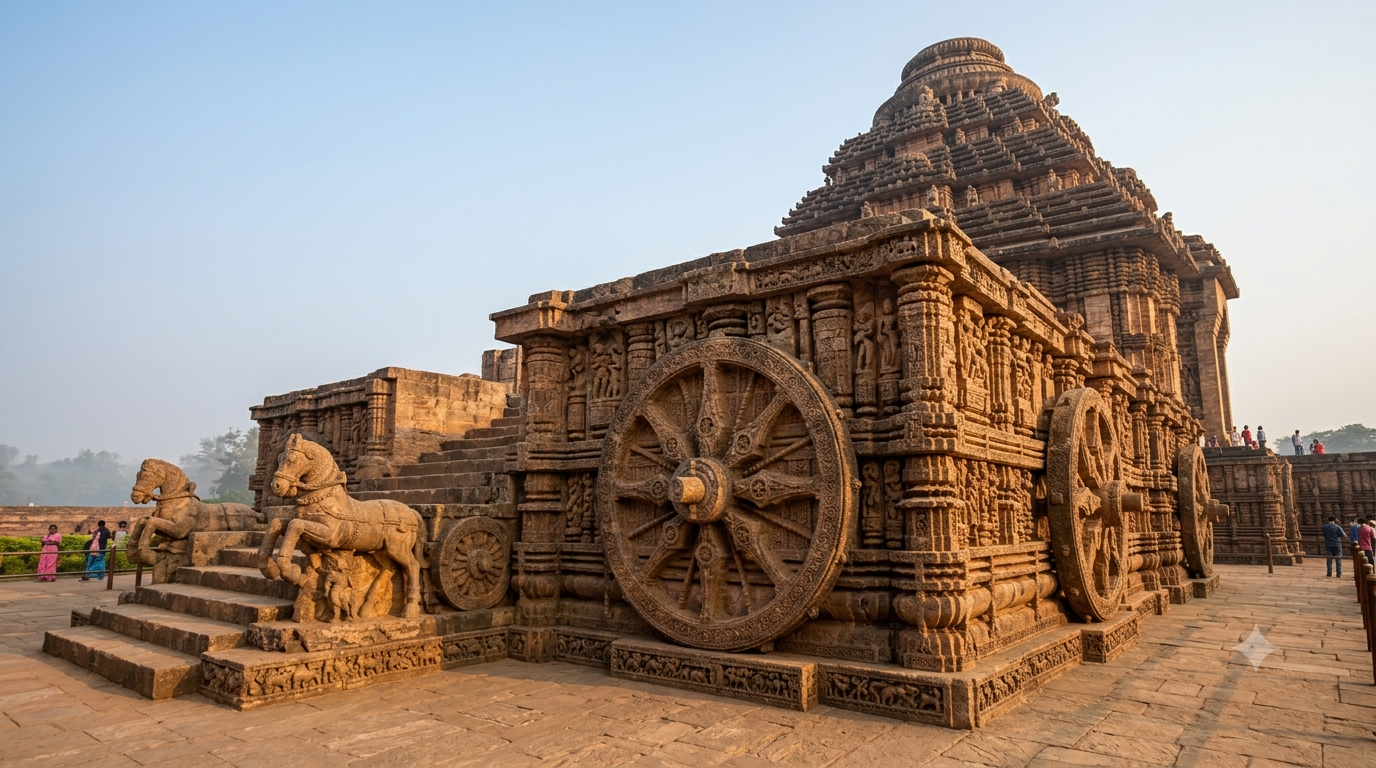
If you see one monument in the state, make it Konark. King Narasimhadeva I of the Eastern Ganga dynasty raised it around 1250 CE as a colossal stone chariot for Surya, the sun god. Seven straining horses and 24 carved wheels pull the temple across imagined skies, and each wheel doubles as a working sundial. UNESCO granted it World Heritage status in 1984.
One fact catches many visitors off guard. The main tower collapsed centuries ago, so Konark is now a ticketed heritage monument under the Archaeological Survey of India, not a place of daily worship. You come here to marvel, not to seek darshan of a living idol. It sits about 35 km northeast of Puri, and entry fees are modest but revised from time to time, so check the ASI counter on arrival.
3. Lingaraja Temple, Bhubaneswar
The Lingaraja Temple is the largest and holiest shrine in the old capital. Somavamsi kings built it in the eleventh century, and its curved tower rises about 55 metres over the skyline. The deity is worshipped as Harihara, a rare fusion of Shiva and Vishnu, which mirrors Odisha’s blend of two great traditions. More than 150 smaller shrines crowd the walled courtyard.
Note one important rule before you plan. The inner complex is closed to non-Hindus, although a raised viewing platform beside the wall gives a clear look at the towers. That platform was first built for a visit by Lord Curzon, so it has served curious outsiders for over a century.
4. Mukteswara Temple, Bhubaneswar
Small in size but perfect in finish, the tenth-century Mukteswara Temple is often called the “gem of Odisha architecture”. Its glory is the carved torana, an arched stone gateway that stands like a doorway between worlds. Dedicated to Shiva, it repays a slow walk around its richly worked walls. Architecture lovers rate it among the most refined of all the temples in Odisha.
5. Rajarani Temple, Bhubaneswar
The Rajarani Temple breaks the usual pattern, because its sanctum holds no presiding deity today. Somavamsi builders raised it in the eleventh century using a warm yellow-red sandstone known locally as rajarani stone, which gave the shrine its name. What survives is a masterclass in sculpture, with graceful figures wrapped around the tower. The Archaeological Survey of India maintains it as a ticketed monument, and it hosts an annual classical music festival.
6. Chausathi Yogini Temple, Hirapur
About 20 km from Bhubaneswar, this ninth-century shrine feels like nowhere else. A Bhauma-Kara queen, Hiradevi, built it around 864 CE to honour 64 yoginis, powerful goddess figures of the tantric tradition. It is circular and roofless by design, since the open sky forms part of the ritual. Archaeologists only rediscovered and reassembled it in the 1950s, so its survival is a small miracle.
7. The Shakti Peethas: Biraja and Tara Tarini
Odisha also guards ancient seats of goddess worship. The Biraja Temple at Jajpur, on the Baitarani river, marks a Shakti Peetha where part of Sati fell. Far to the south in Ganjam, the Maa Tara Tarini shrine crowns the Kumari Hills above the Rushikulya river. Devotees climb 999 steps or take a ropeway, and the Chaitra Parba festival packs the hill each spring.
Odisha Temples: Quick Comparison
| Temple | Location | Deity / Focus | Highlight |
|---|---|---|---|
| Jagannath | Puri | Jagannath, Balabhadra, Subhadra | Char Dham, Rath Yatra |
| Konark Sun | Konark | Surya (heritage site) | UNESCO chariot temple |
| Lingaraja | Bhubaneswar | Harihara (Shiva-Vishnu) | Largest city shrine |
| Mukteswara | Bhubaneswar | Shiva | Carved torana gateway |
| Chausathi Yogini | Hirapur | 64 Yoginis | Roofless circular shrine |
| Tara Tarini | Ganjam | Twin goddesses | Hilltop Shakti Peetha |
Which Temples in Odisha Are Open to Non-Hindus?
This single question causes more disappointment than any other. Two of the most famous shrines, Jagannath Puri and Lingaraja, do not permit non-Hindus inside the main complex. Foreign visitors and people of other faiths are turned away at the gates, however respectful their intent.
The good news is that workarounds exist. At Puri, the rooftop of the Raghunandan Library, opposite the Lion’s Gate, gives a fine view of the temple tower. At Lingaraja, the Curzon viewing platform serves the same purpose. Heritage sites like Konark, Mukteswara, and Rajarani welcome everyone, so no one need miss the artistry.
Planning the Odisha Golden Triangle
The smartest way to see the headline temples in Odisha is the compact Golden Triangle loop. Bhubaneswar, Puri, and Konark sit close together, and a comfortable trip covers all three in three days. Base yourself in Bhubaneswar for the city shrines, then move to Puri for the coast.
How to Reach
Biju Patnaik International Airport in Bhubaneswar is the main gateway, and Puri lies about 60 km away by road. Trains run directly to Puri from Kolkata, Delhi, Chennai, and Mumbai, while the railway station sits close to the Jagannath Temple. Konark has no airport or major station, so most travellers reach it by taxi or bus from Puri, roughly 35 km up the coast. A hired car for a day makes the Puri-Konark stretch easy.
Best Time to Visit the Temples in Odisha
Plan your trip between October and March, since the coastal heat and humidity ease during these months. Summer, from April to June, turns the stone floors painfully hot underfoot. The monsoon brings heavy rain that can disrupt travel along the coast.
Festival timing rewards a little planning. Rath Yatra transforms Puri in the summer, though crowds swell into the millions, so book rooms months ahead. The Konark Dance Festival and the February Chandrabhaga Mela light up the Konark area beautifully. If you prefer calm over spectacle, aim for ordinary weekdays instead.
A Warning: Avoiding Fake Booking Portals
Here is the caution that matters most. The Shree Jagannatha Temple Administration has publicly warned devotees about fraudulent websites that pose as official booking channels. These fake portals charge for “VIP darshan” or “online tickets” that do not officially exist for regular entry.
Protect yourself with a simple habit. Regular darshan at Jagannath Puri is free, so treat any site demanding an entry fee with suspicion. Book special sevas and donations only through the genuine official portal, and never hand card details to a random page. When a domain looks official but asks for upfront money, stop and verify first.
What Most Guides Skip
A few practical truths make a real difference on the ground. Mobile phones, cameras, and leather items are barred inside Jagannath Puri, so leave them at your hotel or a designated stand. Reach popular shrines by 6 AM, because queues and heat both build fast after sunrise. Carry water and wear thin socks, since bare feet on sun-baked stone can genuinely hurt.
One more piece of advice concerns the hill shrines. The climb to Tara Tarini runs to nearly a thousand steps, so pace yourself and use the ropeway if you have knee trouble, heart conditions, or are travelling with elderly relatives. A short rest and steady hydration matter more than speed. These temples have waited centuries, so there is no need to rush.
Before You Go
The temples in Odisha offer something rare: a complete arc from living devotion to frozen artistry, all within a small stretch of the eastern coast. Start with the Golden Triangle if your time is short, then reach out toward the Shakti Peethas and the hidden yogini shrine if you can. Respect the entry rules, guard against fake booking sites, and travel in the cool season. Do that, and you will carry home far more than photographs.
Frequently Asked Questions
Which is the most famous temple in Odisha?
The Jagannath Temple in Puri is the most famous and revered, as one of the four Char Dham pilgrimage seats. The Konark Sun Temple is the most celebrated for architecture and holds UNESCO World Heritage status. Together they anchor almost every Odisha itinerary.
Can non-Hindus enter the temples in Odisha?
It depends on the shrine. Jagannath Puri and Lingaraja restrict entry to Hindus, though both provide outside viewing points. Heritage monuments such as Konark, Mukteswara, and Rajarani are open to all visitors regardless of faith.
Is there an entry fee for Odisha temples?
Living temples like Jagannath and Lingaraja charge no fee for regular darshan. Protected monuments under the Archaeological Survey of India, including Konark and Rajarani, charge a modest ticket. Fees change over time, so confirm the current amount at the ticket counter.
When is Rath Yatra in Puri in 2026?
Rath Yatra falls on 16 July 2026. On this day the three deities travel by chariot to the Gundicha Temple, and it is the one occasion when non-Hindus can also view them on the Grand Road. Expect enormous crowds and book accommodation early.
How many days do I need to see the main temples in Odisha?
Three days comfortably cover the Golden Triangle of Bhubaneswar, Puri, and Konark. Add two or three more days if you want to reach the Shakti Peethas at Jajpur and Ganjam. A relaxed pace suits the heritage sites best.
Is online darshan booking available for Jagannath Puri?
No official online booking exists for regular darshan, which is free and open to all Hindu devotees. Special sevas and donations may be arranged through the official temple administration website. Be wary of unofficial sites claiming to sell VIP or fast-track tickets.
What is the best time to visit Konark Sun Temple?
Early morning between October and March is ideal, when the light rakes across the carvings and the crowds are thin. The stone heats up sharply by midday in warmer months. Sunrise flatters the giant wheels, while the evening light-and-sound show offers a different mood.