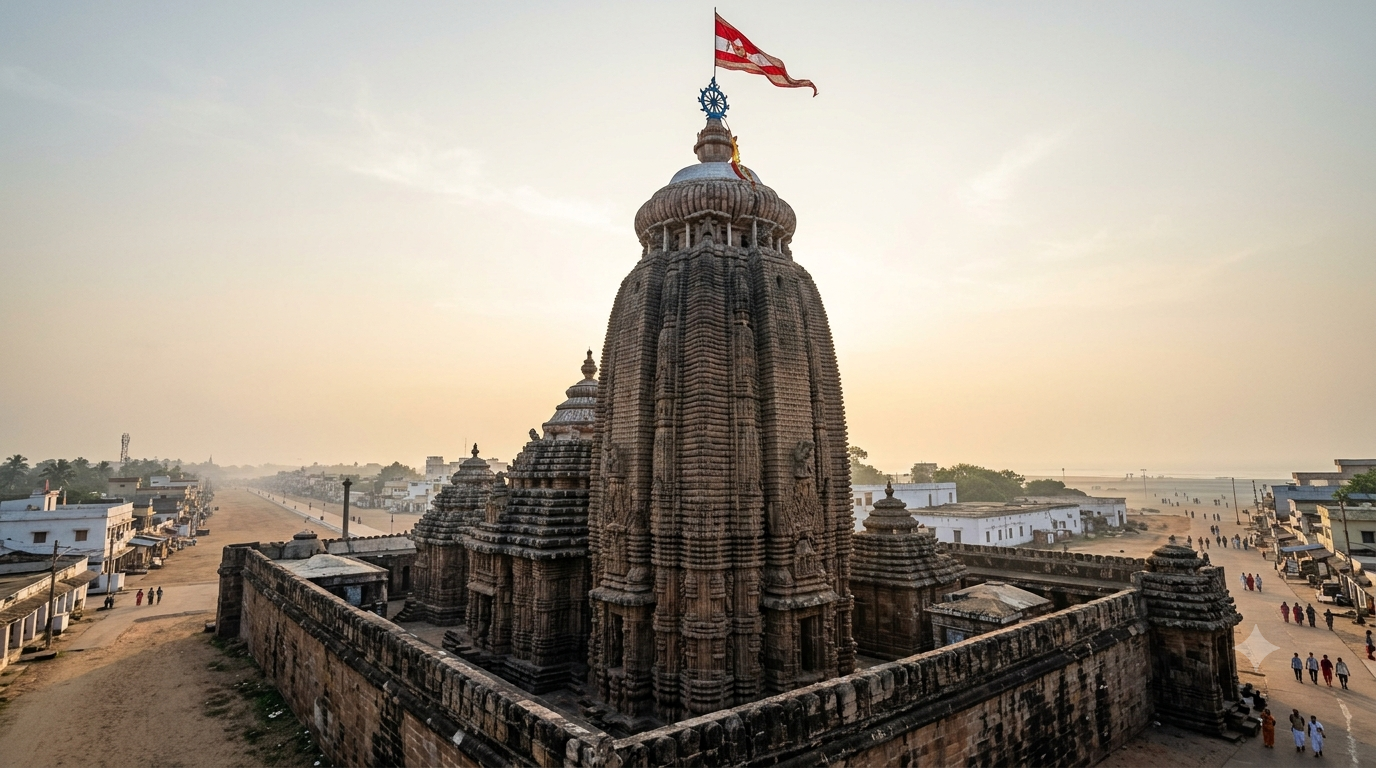
Puri Jagannath Temple timings run from roughly 5 in the morning to close to midnight. Yet the shrine never stays open in one unbroken stretch. Darshan opens and pauses around a fixed chain of daily rituals called nitis.
Most pages print a tidy three-line schedule and stop there. So pilgrims turn up at the wrong hour and queue far longer than they need to. This guide lays out the real ritual clock, the entry rules, and the costly myth that still circulates online.
Temples Map is an independent pilgrim guide. We are not affiliated with, endorsed by, or the official website of the Shree Jagannatha Temple Administration (SJTA). We take no bookings, donations, or payments of any kind. For official notices, always use the SJTA portal at shreejagannatha.in.
Puri Jagannath Temple Timings at a Glance
Here is the short version of Puri Jagannath Temple timings, because most visitors only need a handful of facts.
- Doors open: around 5:00 AM, after the Dwaraphita ritual.
- Doors close: around 11:30 PM, after Khata Seja Lagi and Pahuda.
- Entry fee: none. Darshan is completely free.
- Paid VIP darshan: does not exist. SJTA has said so repeatedly.
- Who may enter: Hindus only, by long-standing temple tradition.
- Banned inside: phones, cameras, leather goods, footwear, umbrellas.
The temple sits in Puri, on the Odisha coast, and it is one of the four Char Dham shrines. Three deities share the jewelled platform inside: Lord Jagannath, his elder brother Balabhadra, and their sister Devi Subhadra. Sudarshana, the divine wheel, stands with them.
Puri Jagannath Temple Timings: The Full Daily Ritual Clock
The temple runs on nitis rather than on shift hours. Since each niti has its own slot, darshan availability shifts through the day. The schedule below follows the daily-ritual sequence published by the Shree Jagannatha Temple Administration.
| Approximate time | Ritual (niti) |
|---|---|
| Around 5:00 AM | Dwaraphita, the ceremonial opening of the doors |
| 5:30 AM | Mangala Alati, the first lamp offering |
| Around 6:00 AM | Mailam and Tadapalagi, changing the night garments |
| 6:00 to 6:30 AM | Abakasha, the morning ablutions |
| Roughly 7:00 to 8:00 AM | Sahana Mela, free close darshan for the public |
| 7:00 to 8:00 AM | Rosa Homa, Surya Puja and Dwarapala Puja |
| Around 8:00 AM | Gopala Ballava Bhoga, the breakfast offering |
| 9:00 to 10:00 AM | Sakala Dhupa, also called Raj Bhoga |
| Around 11:30 AM | Bhoga Mandap offering |
| 11:00 AM to 1:00 PM | Madhyahna Dhupa, the midday offering |
| 1:30 to 2:00 PM | Madhyanha Pahuda, a short rest |
| 6:00 PM | Sandhya Alati, the evening lamps |
| 6:30 to 8:00 PM | Sandhya Dhupa |
| 9:00 to 10:00 PM | Chandan Lagi, sandalwood anointing |
| 10:30 to 11:00 PM | Badasinghara Dhupa, the last offering |
| Around 11:30 PM | Khata Seja Lagi and Pahuda, doors close |
Treat every figure above as approximate. Ritual clocks drift by thirty minutes or more on a busy day. So confirm the current sequence at the temple office when you arrive.
Why Puri Jagannath Temple Timings Look Different on Every Website
Search this topic and you will find flat blocks like “morning 4 AM to 10 AM, afternoon 1 PM to 7 PM”. That framing is misleading, because it suggests the shrine shuts for three hours in the middle of the day. It does not.
What actually happens is narrower. Darshan is briefly restricted while servitors perform certain nitis, and the deities rest for roughly half an hour at Madhyanha Pahuda. Otherwise the queue keeps moving.
Published Puri Jagannath Temple timings vary between sites because writers copy each other rather than the ritual list. So treat the SJTA sequence as your anchor.
Darshan Is Free, and There Is No VIP Darshan
This is the single most important correction on this page. Entry to the Puri Jagannath Temple costs nothing, and no paid priority queue exists. SJTA has cautioned the public against fraudulent advertisements offering paid VIP darshan, stating that no such facility exists at the shrine.
Hemanta Kumar Padhi, Officer on Special Duty for Security, set out the position in a police complaint. The temple has no provision for paid VIP darshan, and SJTA has authorised nobody to arrange it. The administration lodged that complaint at Singhadwar police station against a portal marketing privileged access for money.
The pattern is not new either. Investigators found one website advertising ₹100 for quick darshan, ₹500 for VIP darshan and ₹50 for night darshan. The pages carried temple history and ritual detail to look credible. Some portals targeted overseas devotees by quoting puja and darshan prices in US dollars.
How to Spot a Fake Puri Darshan Portal
Use these checks before you pay anyone anything.
- If a site sells darshan tickets, slots or VIP entry, it is fake. No such product exists.
- Accommodation bookings run only through shreejagannatha.in and stayatpurijagannatha.in.
- Be wary when a “temple” site asks you to transfer money to a personal bank account.
- Ignore WhatsApp numbers offering queue-free entry, since agents cannot arrange it.
Odisha Police have already acted on these rackets. The Crime Branch arrested two men from Uttar Pradesh over a counterfeit booking website. They ran it in the name of a temple guest house and collected money from devotees.
Sahana Mela: The Free Close Darshan Most Guides Skip
Sahana Mela is the part of the day nobody writes about, though it matters more than any paid shortcut ever could. During Sahana Mela the public may proceed near the Ratnavedi, the jewelled throne, view the deities closely and circumambulate.
It usually falls in the morning window after the deities are dressed. Because it is unticketed and crowded, arrive well before it starts. Ask a servitor or the information counter for the day’s exact slot, since Puri Jagannath Temple timings for Sahana Mela move with the ritual clock.
Who Can Enter the Temple
Entry to the main shrine is restricted to Hindus. That rule is old, the staff enforce it, and visiting dignitaries get no exception. A stone board at the Singhadwara states it plainly in several languages.
Non-Hindu visitors are not left with nothing, though. From the rooftop of the Raghunandan Library, opposite the Lion Gate, you get a clear view of the 65-metre tower and the Nilachakra. During Rath Yatra the restriction lifts in practice, because the deities travel on chariots along a public road where everyone may join.
Dress Code and Banned Items
SJTA has not published a rigid list of permitted garments. From 1 January 2024 the administration decided to discourage shorts, transparent or revealing clothing and torn jeans. It suggested trousers, shirts, kurta-pyjama or dhoti for men, and sarees or salwar kameez for women.
The banned-item list is stricter, and guards check it at the gate. Leave phones, cameras, smartwatches, leather belts, leather wallets, handbags and umbrellas at your hotel or in the cloakroom. Footwear comes off outside. Paid shoe-keeping stalls sit near every gate, though queues there get long at peak hours.
Planning Around Puri Jagannath Temple Timings: Best Hours to Arrive
Crowd load matters more than the published Puri Jagannath Temple timings. Use this rough decision guide.
| If you want | Aim for |
|---|---|
| Shortest queue | Weekday, soon after doors open |
| Close darshan | Sahana Mela in the morning |
| Quiet atmosphere | Mid-afternoon on a weekday |
| Lamp ritual | Sandhya Alati around 6:00 PM |
| Heaviest crowds | Weekends, Ekadashi, festival days |
October to February is the comfortable season. Summer is punishing here, and queues run partly in the open, so the heat is a genuine risk rather than a nuisance.
A note on physical demand: darshan often means standing for one to two hours in humid coastal heat, with no water allowed inside. Carry fluids for before and after, and keep essential medicines accessible outside the temple. If you are elderly, pregnant, or managing a heart or blood-pressure condition, speak to your doctor first. Then consider the quieter afternoon slot.
When Puri Jagannath Temple Timings Change During Festivals
Festival days rewrite Puri Jagannath Temple timings completely. Rath Yatra begins on Ashadha Shukla Dwitiya and runs to Ashadha Shukla Dashami; in 2026 the chariot festival fell on 16 July. During the nine-day period the deities leave the shrine for the Gundicha Temple, roughly three kilometres along the Bada Danda.
Anasara is the other window worth knowing. After Snana Yatra the deities go into seclusion for about a fortnight. Darshan inside the main shrine therefore stops. Many pilgrims travel instead to Alarnath during those days.
If your dates fall near either period, check the ritual calendar first, since festival dates move each year. Our note on the Puri to Alarnath route and timings covers that detour.
Mahaprasad and Ananda Bazar
Temple cooks prepare Mahaprasad in earthen pots in the great kitchen. Servitors then offer it to the deities, and again at the shrine of Goddess Bimala. Only after that second offering does the food carry the name Mahaprasad.
You buy it at Ananda Bazar inside the complex, where vendors sell it by weight in clay pots. Prices are modest and change with the season, so confirm the rate at the counter. Eat it there or carry it out, though the kitchen preparations do not keep well for long journeys in warm weather.
How to Reach Puri
Puri railway station is the practical entry point, and it sits roughly two kilometres from the temple. Trains connect it directly to Kolkata, Delhi, Chennai and several other cities.
The nearest airport is Biju Patnaik International Airport at Bhubaneswar, about 60 kilometres away. From there, taxis and buses take around ninety minutes depending on traffic. Long-distance road travellers reach Puri on the coastal highway network; our Hyderabad to Puri route guide maps one common approach in detail.
Where to Stay Safely
SJTA runs several pilgrim guesthouses. These include Neelachal Bhakta Niwas, Neelachal Yatri Niwas, Neeladri Bhakta Niwas, Shree Purushottama Bhakta Niwas and Shree Gundicha Bhakta Niwas. SJTA has asked visitors to use only its official websites for any such booking, after miscreants created a fake site to cheat devotees.
Private hotels cluster along the beach road and near the Grand Road. Rates swing widely with the festival calendar, so book early for Rath Yatra season. We list no agent numbers here and take no bookings, because that is precisely where the fraud happens.
History and Architecture, Corrected
A stubborn error travels across pilgrimage pages: that the temple was “built in 1198 AD” in “Orissa architecture”. Both halves need fixing.
Anantavarman Chodaganga Deva of the Eastern Ganga dynasty began the present temple in the twelfth century. He had taken the Utkala region in 1112 CE.
Temple chronicles give the construction year variously as 1196, 1197, 1205, 1216 or 1226. That spread suggests completion or renovation under his son Anangabhima. So no single date is settled, and stating one flatly is simply wrong.
The style is Kalinga, not a vague regional label. It combines a curvilinear Rekha Deula over the sanctum with tiered Pidha Deula roofs over the halls. Our overview of Indian temple architectural styles sets that pattern in context. The complex holds at least 120 temples and shrines across more than 37,000 square metres, ringed by the 6.1-metre Meghanada Pacheri wall.
What Has Changed at the Temple Recently
Two developments reshaped the visitor experience, and older guides miss both.
Odisha inaugurated the Srimandir Parikrama Prakalpa, the heritage corridor around the shrine, on 17 January 2024. It cost about ₹800 crore. It added a 75-metre corridor, multi-level parking and a welcome space holding 6,000 people. Approach routes and parking therefore differ from what older blog posts describe.
The temple treasury, known as the Ratna Bhandar, reopened on 14 July 2024 after 46 years. An inventory of its ornaments followed. The treasury is not a public gallery, so do not plan a visit around it.
What Experienced Pilgrims Do Differently
These are the habits that separate a smooth darshan from a frustrating one.
- Leave your phone at the hotel rather than the cloakroom, because the return queue costs time.
- Enter through Singhadwara if you want the traditional first sight of the Nilachakra.
- Carry small cash, since Ananda Bazar and shoe stalls rarely take cards.
- Skip anyone offering to “arrange” faster entry inside the complex.
- Plan Gundicha Temple and the beach for the afternoon, after darshan.
Before You Go
Two things decide your visit. First, arrive early on a weekday. Build your day around the ritual clock rather than a generic opening block. Second, pay nobody for darshan, because it is free and always has been.
Confirm the day’s schedule on the SJTA portal or at the temple office. Puri Jagannath Temple timings shift with festivals and ritual delays. So dress modestly, travel light, and leave the electronics behind.
Frequently Asked Questions
What are the Puri Jagannath Temple timings today?
The doors usually open around 5:00 AM after Dwaraphita and close around 11:30 PM after Pahuda. Darshan pauses briefly during certain rituals and a short midday rest. Festival days follow a separate schedule, so check the SJTA portal before you travel.
Is there any entry fee or ticket for darshan?
No. Darshan is completely free and there is no ticket system for regular entry. SJTA has stated there is no paid VIP darshan either. Any website selling darshan tickets or priority slots is fraudulent.
Can non-Hindus enter the Puri Jagannath Temple?
No, entry to the main shrine is restricted to Hindus by long-standing tradition. Non-Hindu visitors can view the temple tower and Nilachakra from the Raghunandan Library rooftop opposite the Lion Gate. During Rath Yatra, everyone can see the deities on the chariots.
Are mobile phones allowed inside?
No. Phones, cameras, smartwatches and other electronics are prohibited inside the temple. Leather items, footwear and umbrellas are also barred. Cloakrooms operate outside the gates, though they get busy at peak hours.
Do Puri Jagannath Temple timings change on Sundays?
The published schedule stays the same on Sundays. Crowds, however, are noticeably heavier, so queues move slower. Arrive soon after the doors open if you visit on a weekend or a public holiday.
How long does darshan usually take?
On an ordinary weekday, expect roughly thirty to sixty minutes including the queue. On weekends and festival days it can stretch to two hours or more. Sahana Mela draws its own crowd, so factor extra time in.
What is the best time of year to visit Puri?
October to February offers the most comfortable weather for queuing. Summer brings heavy heat and humidity along this coast. Rath Yatra season is spectacular but extremely crowded, so plan accommodation months ahead.
Can I book a room at the temple guesthouse online?
Yes, but only through the official SJTA websites. Bookings for the Bhakta Niwas guesthouses run through shreejagannatha.in and stayatpurijagannatha.in. Police have already prosecuted fake booking sites, so verify the address carefully before paying.