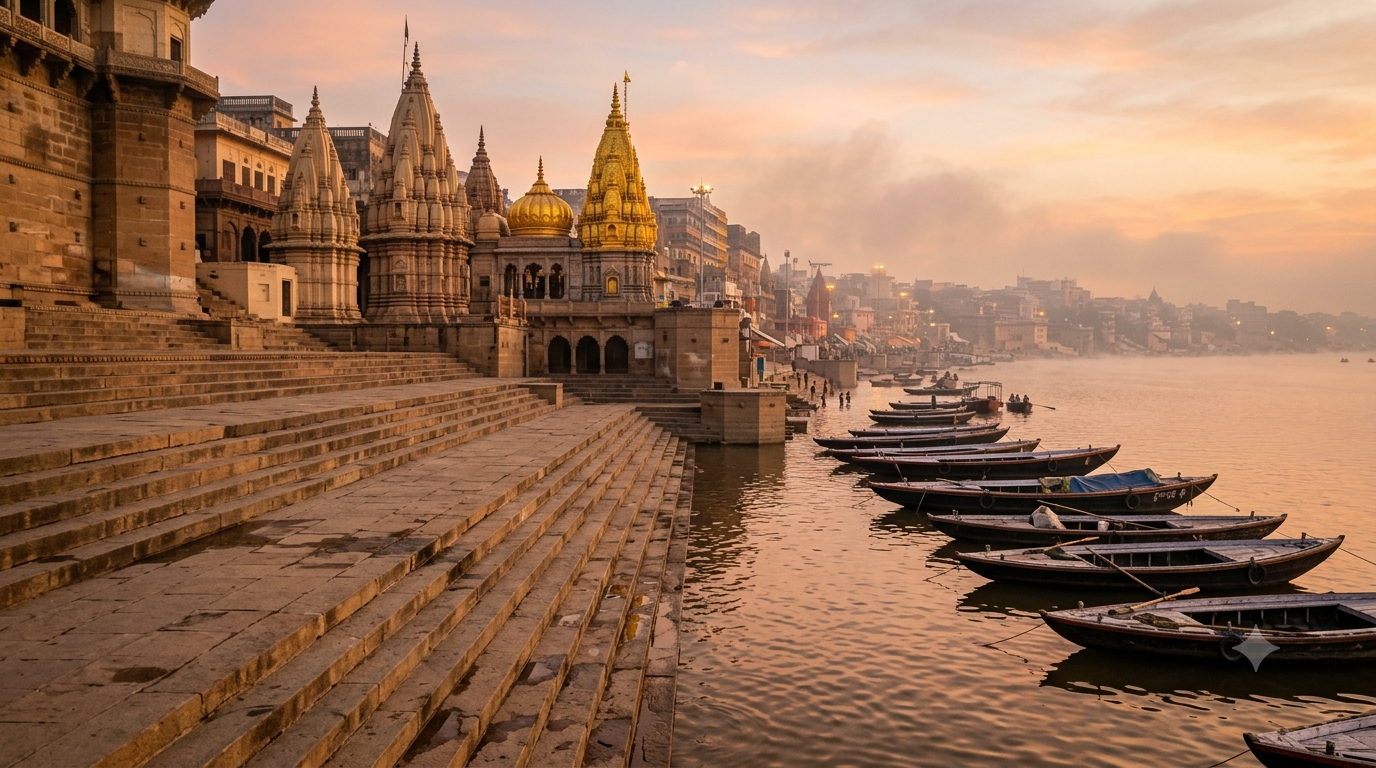
The temples in Uttar Pradesh range from ancient Jyotirlinga shrines on the Ganga to the newly built Ram Mandir in Ayodhya. Together they form the busiest pilgrimage circuit in northern India. If you are planning a yatra, you probably want three things. You need honest darshan timings, a safe way to book, and a route that links the big sites without wasted travel days.
This guide gives you all three. Most pages online still repeat outdated fees, wrong aarti timings, and fake booking links that mislead first-time pilgrims. Read on, because you will not need to click back to Google for anything.
Temples Map is an independent temple guide. We are not affiliated with, endorsed by, or the official website of any temple, trust, or government body. We do not take bookings, donations, or payments — always use the official portals linked below.
Temples in Uttar Pradesh at a Glance
Uttar Pradesh holds four of Hinduism’s most sacred destinations in one state. Before the detailed sections, here is the quick picture so you can plan fast.
- Kashi Vishwanath, Varanasi — one of the twelve Jyotirlingas, dedicated to Lord Shiva.
- Ram Mandir, Ayodhya — the birthplace shrine of Lord Ram, consecrated in January 2024.
- Krishna temples of Mathura–Vrindavan — Banke Bihari, Prem Mandir, ISKCON, and Krishna Janmabhoomi.
- Vindhyavasini, Mirzapur — a revered Shakti Peeth of the Goddess.
- Gorakhnath, Gorakhpur — the seat of the Nath yogi tradition.
Each of these draws huge crowds, so timing and booking matter as much as devotion. The sections below then cover every major shrine with verified details.
Kashi Vishwanath Temple, Varanasi
Kashi Vishwanath is one of the twelve Jyotirlinga shrines of Lord Shiva. It sits at the spiritual heart of Varanasi beside the Ganga. Pilgrims believe a darshan here, when combined with a dip in the river, carries deep significance. The Shri Kashi Vishwanath Temple Trust manages the shrine.
The temple now opens onto the Kashi Vishwanath Dham corridor. This walkway opened in December 2021, and it connects the shrine directly to the riverfront ghats. Because the complex opens very early for Mangala Aarti and stays active until late night, you can plan darshan around a pre-dawn or a late-evening slot. That way you also avoid the heaviest rush.
Aarti timings shift, so confirm the current schedule on the official portal before you travel.
Booking and Darshan at Kashi Vishwanath
General darshan is open to all and needs no ticket. Sugam Darshan, a faster assisted queue, carries an indicative fee in the ₹250–₹300 range per person. You also book any paid aarti participation separately. Since these charges change from time to time, treat them as indicative and verify on the official site.
Book only through shrikashivishwanath.org, because fake portals routinely charge inflated “VIP” fees for a low-cost or free service. Our detailed walkthrough of the Kashi Vishwanath pooja and darshan booking process breaks down each step for first-time visitors.
Ram Mandir, Ayodhya
The Ram Mandir in Ayodhya is the most talked-about of all the temples in Uttar Pradesh. It marks the birthplace of Lord Ram on the Ram Janmabhoomi site. Priests consecrated the main idol, Ram Lalla, on 22 January 2024 in the Pran Pratishtha ceremony. Construction then continued in phases across the sprawling complex.
A major milestone followed on 25 November 2025. On that day, the trust hoisted the temple’s flag atop the completed main spire in the Dhwajarohan ceremony. This marked the structural completion of the grand shikhar. As a result, Ayodhya has quickly become one of India’s most visited pilgrimage destinations.
How to Get Free Darshan Passes in Ayodhya
Here is the single most important fact for your safety. The Sugam Darshan and Aarti passes at Ram Mandir are completely free. The Shri Ram Janmabhoomi Teerth Kshetra Trust issues them at no cost.
So any website or agent charging money for a “pass” is running a scam. Book only on the official portal. General darshan usually runs in a morning window and an afternoon–evening window, though the exact hours shift with the season. Free e-passes typically release about 15 days in advance, and they fill within minutes, so plan ahead.
Confirm the live schedule and reserve your slot at srjbtkshetra.org before you set out.
Hanuman Garhi, Ayodhya
A short walk from the Ram Mandir sits Hanuman Garhi. This hilltop shrine takes a climb of around 76 steps. Many pilgrims visit Hanuman Garhi first, since local tradition holds that Hanuman guards the town. The climb is short but steep, so elderly visitors should pace themselves and carry water.
Krishna Temples of Mathura and Vrindavan
Mathura is the birthplace of Lord Krishna, while neighbouring Vrindavan is where he spent his childhood. Together the twin towns hold some of the most loved Krishna temples in the country. You can cover the main four in a single busy day, though two days feels more relaxed.
Banke Bihari Temple, Vrindavan
Banke Bihari is Vrindavan’s most famous shrine, and it follows a unique darshan style. A curtain, the “pat”, opens and closes every few minutes. So the deity is never seen for too long at once. Entry is also completely free.
Two myths trip up many pilgrims here, so clear them before you go. First, Banke Bihari does not perform a morning Mangala Aarti. Instead, devotees worship the deity as a child who wakes late.
Second, there is no official online VIP pass or paid priority entry, so anyone selling one is misleading you. Timings also run on separate summer and winter schedules with a long afternoon closure, so check the current window before travelling.
Prem Mandir, Vrindavan
Kripalu Maharaj built Prem Mandir, a gleaming white marble temple that opened in February 2012. It stands across a large landscaped campus and honours Radha Krishna and Sita Ram. The evening light show is the highlight most visitors remember, when the marble glows through changing colours. Entry here is also free.
ISKCON Krishna Balaram Mandir, Vrindavan
The ISKCON temple in Vrindavan’s Raman Reti area, also called Sri Krishna Balaram Mandir, opened in 1977. It also draws devotees from around the world. Daily kirtan and Bhagavad Gita sessions give it a lively, welcoming feel. For its history and architecture, see our guide to the ISKCON Vrindavan temple.
Krishna Janmabhoomi, Mathura
The Krishna Janmabhoomi complex in Mathura marks the spot that tradition honours as Krishna’s birthplace. Because it is a high-security site, you cannot carry mobile phones or bags inside, so travel light. The nearby Dwarkadhish Temple is also worth pairing on the same visit.
Vindhyavasini Temple, Mirzapur
The Vindhyavasini Temple at Vindhyachal near Mirzapur honours the Goddess as an important Shakti Peeth of northern India. Pilgrims often complete the Trikon Parikrama, a triangular circuit linking three hill shrines around the town. The recently built Vindhya Corridor has widened the approach and eased crowd movement. Since festival days like Navratri still see enormous footfall, plan around them.
Gorakhnath Temple, Gorakhpur
Gorakhnath Temple in Gorakhpur is the principal seat of the Nath sampradaya, a yogic tradition. The sage Guru Gorakhnath inspired this lineage. The sprawling complex stays calm on ordinary days.
Yet it transforms during the Khichdi Mela on Makar Sankranti in January, when lakhs of devotees offer khichdi to the deity. It is an easy stop if your route runs through eastern Uttar Pradesh.
Best Time to Visit the Temples in Uttar Pradesh
The winter months from October to March offer the most comfortable weather for temple travel. Summers between April and June turn very hot, especially in Varanasi and Mathura. Early-morning darshan therefore works best then. If you can, avoid the biggest festival peaks unless the festival itself is your reason to go.
Major crowd magnets include Maha Shivaratri at Kashi Vishwanath and Ram Navami at Ayodhya. Janmashtami and Holi fill Mathura–Vrindavan, while Navratri packs Vindhyachal. These dates draw millions, so book stays and passes weeks in advance. Alternatively, shift your visit by a few days for a calmer darshan.
How to Reach the Temples in Uttar Pradesh
Uttar Pradesh is well connected by air and rail, which makes reaching the temples in Uttar Pradesh straightforward. Three airports anchor the pilgrim routes.
- Varanasi — Lal Bahadur Shastri International Airport, plus a major railway junction.
- Ayodhya — Maharishi Valmiki International Airport, opened in December 2023.
- Mathura–Vrindavan — nearest airports are Agra and Delhi; Mathura Junction is the closest railway station.
Lucknow, the state capital, also works as a useful hub. Since it links by fast road and rail to both Ayodhya and Varanasi, many pilgrims start there. Trains remain the most economical option, while cabs and app-based taxis handle the shorter town hops.
Booking Safety at the Temples in Uttar Pradesh
Fake booking portals are the biggest risk pilgrims face today, so this section is worth reading twice. Scammers copy official-looking designs and then charge for passes that are free or cheap at the source. A few simple rules keep you safe.
- Ram Mandir Sugam Darshan and Aarti passes are always free — book only on the official trust portal.
- Banke Bihari has no official online VIP pass — ignore any site selling one.
- Book Kashi Vishwanath services only on shrikashivishwanath.org, never through a third-party agent.
- Check that the web address is the genuine official government or trust domain before you pay.
When in doubt, walk up to the temple’s own helpdesk counter, since same-day general darshan usually needs no booking. For broader planning, you can also explore our guide to the famous temples in Maharashtra if your yatra extends beyond the north.
Temples in Uttar Pradesh: Comparison Table
This quick table sums up the key temples in Uttar Pradesh covered in this guide.
| Temple | City | Main Deity | Entry / Booking |
|---|---|---|---|
| Kashi Vishwanath | Varanasi | Shiva (Jyotirlinga) | Free general; paid Sugam via official site |
| Ram Mandir | Ayodhya | Ram Lalla | Free passes via official portal only |
| Banke Bihari | Vrindavan | Krishna | Free; no VIP pass exists |
| Vindhyavasini | Mirzapur | Goddess (Shakti Peeth) | Free general darshan |
| Gorakhnath | Gorakhpur | Guru Gorakhnath | Free general darshan |
Health and Safety at the Temples in Uttar Pradesh
Several of these shrines involve long queues, steep steps, or intense heat, so plan for your own comfort. Also carry water and any regular medication. Pace the climb at Hanuman Garhi if you are elderly or unwell.
Ritual and astrological practices at these temples are matters of faith and tradition. They are not a substitute for medical care when you need it.
Before You Explore the Temples in Uttar Pradesh
The temples in Uttar Pradesh reward a little planning far more than a rushed dash between cities. Group the shrines by region so travel stays simple. Keep Varanasi in the east, Ayodhya in the centre, and Mathura–Vrindavan in the west, and then give each cluster its own day.
Above all, book only through official portals, and treat every “paid VIP pass” claim for a free service as a warning sign. Do that, and your pilgrimage across the temples in Uttar Pradesh will be smooth, safe, and genuinely memorable.
Temples in Uttar Pradesh: Frequently Asked Questions
Which are the most famous temples in Uttar Pradesh?
The most famous temples in Uttar Pradesh are Kashi Vishwanath in Varanasi and Ram Mandir in Ayodhya. The Krishna temples of Mathura–Vrindavan, such as Banke Bihari, Prem Mandir, and ISKCON, follow close behind. Vindhyavasini in Mirzapur and Gorakhnath in Gorakhpur are also major draws.
Is the Ram Mandir darshan pass really free?
Yes, the Ram Mandir Sugam Darshan and Aarti passes are completely free. The Shri Ram Janmabhoomi Teerth Kshetra Trust issues them at no cost through its official portal. So any website or person charging money for these passes is not official.
Does Banke Bihari Temple have a Mangala Aarti or a VIP pass?
No, Banke Bihari Temple does not perform a morning Mangala Aarti, since devotees worship the deity as a child who wakes late. It also has no official online VIP or priority pass, so avoid any site selling one.
What is the best time to visit temples in Uttar Pradesh?
The winter months from October to March offer the most pleasant weather. Early morning is ideal for a calmer darshan. Because major festival days like Ram Navami, Janmashtami, and Maha Shivaratri bring the heaviest crowds, plan around them.
How many Jyotirlingas are in Uttar Pradesh?
Uttar Pradesh has one of the twelve Jyotirlingas, which is Kashi Vishwanath in Varanasi. It ranks among the holiest Shiva shrines in India, and it anchors any temple trip to the state.
How do I travel between Varanasi, Ayodhya, and Mathura?
All three cities connect well by train, while Varanasi and Ayodhya both have international airports. You reach Mathura–Vrindavan most easily via Agra or Delhi, with Mathura Junction as the nearest railway station.
Do I need to book darshan in advance for these temples?
General darshan at most temples needs no booking. Ayodhya’s free time-slot e-passes and Kashi Vishwanath’s paid Sugam Darshan help you skip queues. Slots go fast, so reserve both only on the respective official portals.