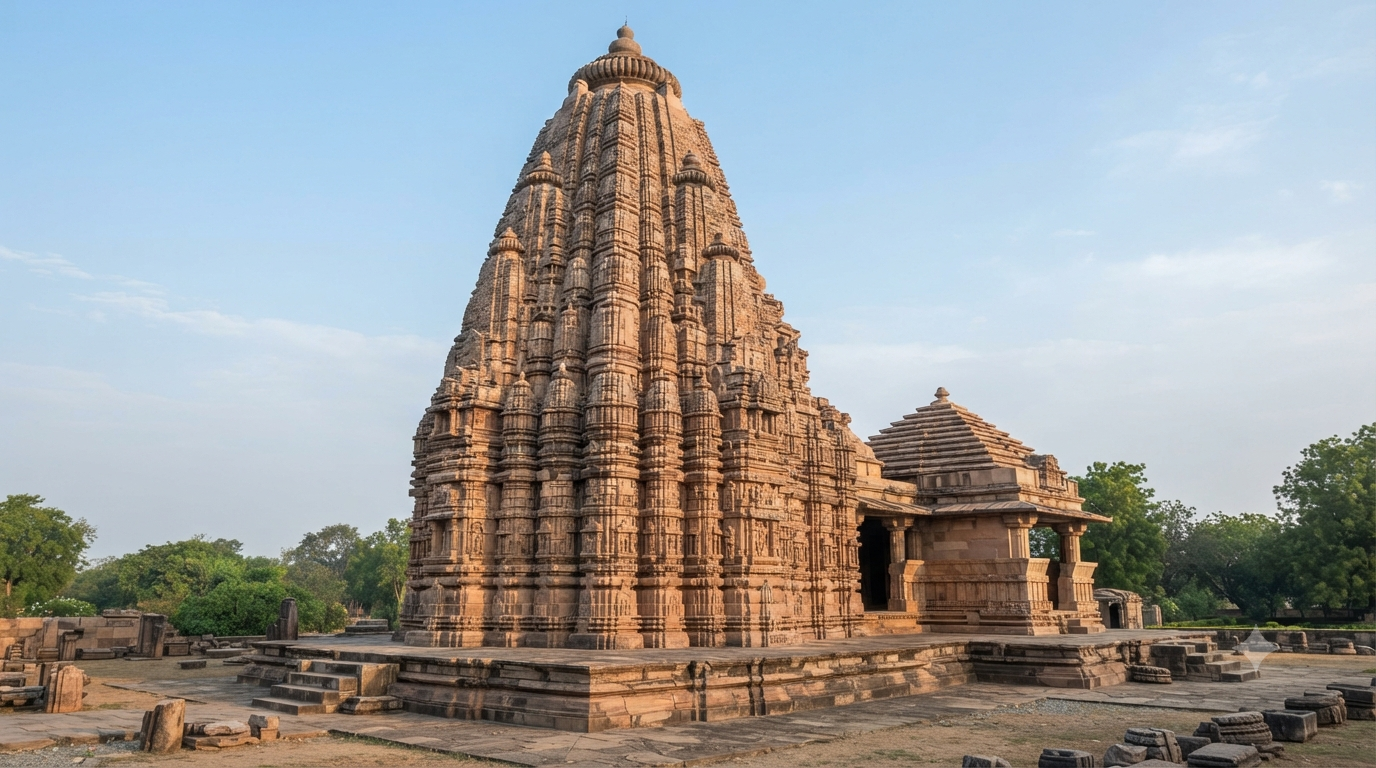
Bhumija temple towers stand out because long vertical bands divide the shikhara into orderly fields of miniature shrine forms. From a distance, the stonework resembles a woven grid rising towards one crown. Up close, each unit reveals a planned pattern, not a row of separate worship rooms.
That distinction matters when comparing Bhumija with Shekhari towers. Both belong to the wider Nagara tradition, yet they arrange their smaller forms in markedly different ways. Here is how to recognise that pattern and where to see it.
Editorial note: TemplesMap.com is an independent heritage guide, not an official temple or monument authority. We are not affiliated with temple trusts or heritage agencies, and we accept no bookings, donations or payments.
What are Bhumija temple towers?
Bhumija temple towers are a type of Nagara shrine superstructure recognised by prominent vertical spines and repeated miniature architectural forms. Small tower-like units rise in organised rows between the spines, giving the main shikhara a gridded appearance. The rows follow the tower upwards rather than forming a loose cluster around it.
The term shikhara commonly names the rising tower above the garbhagriha, or inner sanctum, in northern temple architecture. Bhumija thus describes one mode of organising that tower. It does not name a deity, a separate faith, or a standard plan for every temple.
Architectural historian Krishna Deva describes four prominent latas, or spines, with groups of miniature forms in the spaces between them. His study, “Bhumija Temples,” hosted by the Indira Gandhi National Centre for the Arts, is a detailed reference for the vocabulary and surviving monuments.
Bhumija temple towers at a glance
- Architectural family: a mode within the wider Nagara tradition.
- Main visual clue: rows of small shrine-like forms repeat between clear vertical spines.
- Key terms: shikhara, lata, ratha, kuta and kutastambha.
- Overall effect: an ordered, rising network rather than a cluster of separate-looking peaks.
- Useful example: Udayeshvara Temple at Udayapur in Madhya Pradesh.
- Important caution: miniature shrine motifs are architectural forms, not proof of miniature sanctums.
For wider context, see our overview of Indian temple architecture. The phrase bhumi can also refer to a level or storey in architectural discussion. That helps explain why some descriptions call the design “storied”.
However, do not assume every visible row is a usable floor inside the tower. These are divisions in the external composition.
How the vertical bands organise the tower
Start with the main shikhara and look for its strong upright lines. The lata is a continuous central spine along a projecting face of the tower. It draws the eye upwards while dividing the smaller repeating forms on either side.
A ratha is a projection or offset in a temple’s plan and elevation. The principal projection may be called a bhadra in some descriptions. Our guide to identifying a temple bhadra projection explains how to find that central outward step.
In a Bhumija elevation, the major spine is more than a narrow decorative strip. It also anchors the design and gives the surrounding miniature forms a clear frame. Therefore, the tower looks structured even when carvings cover nearly every surface.
Photographs can hide these divisions. Strong sunlight brings the central ribs forward, while deep shadow can merge adjacent units. Compare two views before deciding where one band ends and another begins.
Why miniature shrines form repeated rows
The miniature forms of Bhumija temple towers are architectural representations, not tiny independent buildings. Scholars describe them as kutas or miniature shikharas. When one rests on a small pilaster-like support, the combined feature is called a kutastambha.
These units then repeat in sequences across the spaces between the main spines. A photograph can also suggest both horizontal tiers and vertical chains. The resulting grid is therefore one of the most useful ways to recognise the mode.
Yet a miniature shrine form is not necessarily a room. It can depict the outline of a complete little building while forming part of the outer surface of a larger one. You cannot infer an accessible chamber from the carving alone, since it depicts an architectural motif.
The exact shape of each small crowning element also varies. Some examples show forms that recall different architectural traditions. Consequently, the repeated arrangement matters more than assuming every miniature element is a perfect copy of a single Nagara spire.
How are Bhumija temple towers different from Shekhari?
Bhumija temple towers use rows of repeated miniature forms between pronounced upright divisions. Shekhari towers instead emphasise subsidiary spires clustered around a dominant central shikhara. Both may look richly layered, but the organising idea differs: Bhumija reads as an ordered surface, while Shekhari reads as gathered peaks.
| Tower mode | First visual clue | What to examine |
|---|---|---|
| Latina | A unified curving tower | Follow the main continuous outline. |
| Shekhari | Attached subsidiary spires | Find the central peak and its clustered companions. |
| Bhumija | Organised rows of miniature forms | Trace vertical spines and repeating units between them. |
For a close account of the other mode, read our Shekhari temple towers guide. It explains the main shikhara, attached urushringas and their mountain-like silhouette.
The comparison is not a contest between simple and complex temples, since both modes can be elaborate. Shekhari buildings can carry dense sculptural detail, while Bhumija buildings may have prominent projecting features. Classification therefore depends on the complete composition, not the mere presence of small spires.
Architectural historian Adam Hardy illustrates the modes separately in his study of Indian temple typologies.
The pattern is not a literal stack of little temples
A common captioning error also turns every tiny shikhara into a separate shrine. In Bhumija architecture, the miniature units generally belong to the stone envelope of the same principal tower. Yet these forms do not imply a matching room behind each one.
Another mistake is calling every row a full storey. The exterior may suggest stacked levels even when no matching floors exist inside. The distinction is especially important when describing a monument from photographs rather than architectural plans.
Look also at what the surface does not tell you. Ornament cannot confirm a temple’s patron, exact date or ritual use. Inscriptions, excavation records and conservation studies provide stronger evidence for those questions.
Udayeshvara Temple: a clear Bhumija example
The Udayeshvara Temple at Udayapur in Vidisha district, Madhya Pradesh, offers a strong example of the Bhumija arrangement. Be careful with the place name: this Udayapur is not the city of Udaipur in Rajasthan. The name also appears in different spellings in architectural publications.
Krishna Deva associates the temple with the Paramara ruler Udayaditya and discusses its shikhara in detail. Adam Hardy’s published typology likewise identifies the Udayeshvara shrine as Bhumija. Their accounts support using the monument as a documented example rather than a merely similar-looking building.
Study its upper tower in a clear three-quarter view. First, pick out the strong projecting spine. Then follow the repeated, small capped forms alongside it. The lines seem to rise together towards the summit, although the individual carvings diminish with height.
This building demonstrates an important point: the central spine and the rows of miniature forms work as one design. Neither element alone gives the full reading, so study both together. A close-up may show exquisite carving yet conceal the pattern across the whole face.
Where the Bhumija mode appeared
Scholarly studies strongly associate Bhumija temple towers with the Malwa region of central India and Paramara-era patronage. The form also appears outside that core area, including sites in present-day Maharashtra and Rajasthan. It is therefore misleading to confine every Bhumija monument to one modern state.
Krishna Deva discusses the medieval Shiva temple at Ambarnath in Maharashtra as another early example. Its details differ from the Malwa temples, which is precisely why it deserves a separate reading. Regional craft traditions could shape the miniature features without erasing the broader Bhumija arrangement.
The central point is geographical as well as visual. A shared architectural mode can therefore travel and change. Do not infer identical materials, proportions or decorative treatment from the Bhumija name alone.
Reading Bhumija temple towers in photographs
When you first inspect Bhumija temple towers, a straight-on photograph may look like a dense wall of stone carving. A three-quarter angle usually reveals more depth because projections cast different shadows. It also lets you compare the spine with the recesses around it.
- Find the main sanctum tower. Separate the tall shikhara from a lower hall or mandapa roof.
- Trace the central projection. Follow its continuous vertical band towards the crown.
- Scan the adjacent fields. Look for small capped forms repeating in organised chains.
- Check the rhythm. Notice how those chains rise and diminish across the curved face.
- Compare another angle. A corner view can reveal features that the frontal photograph hides.
- Confirm with a monument study. Use a plan, elevation or scholarly description when the identification remains uncertain.
This is a visual guide, not a rigid checklist that every surviving monument must pass. Weathering, repairs or missing upper stonework can also interrupt the pattern. If a photograph shows only the base, the tower mode may simply remain unknown.
What beginners get wrong about the design
The biggest error is deciding from one detail, because many modes share small motifs. Small shrine motifs occur in several Indian temple traditions, so their presence alone cannot settle the classification. Their arrangement across the main shikhara therefore gives much better evidence.
Also, a miniature shikhara is not the same object as an amalaka, the ribbed crowning stone on many Nagara towers. A surviving summit may include a crowning disc and finial. Those elements do not, by themselves, identify Bhumija rather than Shekhari.
Beware of treating architectural styles as rigid chronological stages. Latina, Shekhari and Bhumija are useful categories for reading forms, but actual monuments also reflect local choices and later alterations. A mixed or damaged building may still resist a quick label.
Finally, visual resemblance is not a measured survey. When a caption claims an exact count of tiers or miniature towers, look for a specialist study of that particular building. Counts can differ from one example to another.
Why the pattern matters to temple architecture
The strength of Bhumija temple towers lies in how much form a mason could organise on one rising surface. The tower retains a clear overall outline, yet it carries many repeated images of smaller architectural units. Together, they also create a controlled rhythm of light, depth and scale.
This also helps explain why different views produce different impressions. From far away, the rows merge into a textured shikhara. From nearby, each small unit becomes legible, while the larger pattern becomes harder to see.
The contrast with Shekhari sharpens the lesson. One mode draws attention to an orderly network across the tower. The other instead foregrounds the gathering of subsidiary peaks around a leading spire. Both demonstrate how Nagara architects used repetition without making every monument look alike.
Bhumija temple towers: the essential distinction
To identify Bhumija temple towers, look for strong vertical spines with repeated miniature shrine forms arranged between them. That organised rhythm is therefore more useful than counting peaks or guessing from a single ornament. Udayeshvara at Udayapur provides a documented example for comparison.
Start with a wide photograph, then examine the carvings and consult a reliable plan when needed. If the tower instead reads as a central peak surrounded by attached secondary peaks, compare it with the Shekhari mode before deciding.
Frequently asked questions
What is a Bhumija shikhara?
A Bhumija shikhara is a Nagara-style temple tower with pronounced vertical divisions and organised rows of miniature architectural forms. These units fill the fields between the major spines. As a result, the tower appears gridded or storied rather than simply clustered.
How can you recognise Bhumija temple towers?
Look for a strong central spine and lines of small capped forms rising on either side. Then check whether the same arrangement repeats around the tower. A three-quarter photograph and a scholarly description make the identification more reliable.
What is a kutastambha in temple architecture?
A kutastambha combines a miniature tower-like element, or kuta, with a pillar-like support. Repeated kutastambhas are central to many Bhumija elevations. Their small scale does not mean each contains a separate sanctum or usable room.
What is the difference between Bhumija and Shekhari?
Bhumija emphasises ordered rows of small architectural units between upright spines. Shekhari emphasises smaller spires attached around a dominant central shikhara. Both belong to the Nagara family, and both can show elaborate carvings.
Is Bhumija part of Nagara temple architecture?
Yes. Architectural histories describe Bhumija as a mode of Nagara temple design, alongside other tower forms. The classification concerns the shape and organisation of the shrine’s superstructure, not a different religious community.
Which temple is a good Bhumija example?
Udayeshvara Temple at Udayapur in Madhya Pradesh is a well-documented example. Krishna Deva and Adam Hardy both discuss its distinctive tower. Use photographs of the complete shikhara rather than a close crop of one ornament.
Does every miniature spire contain a shrine?
No. A miniature spire can be a sculpted architectural form on the outside of a larger tower. It does not necessarily cover an independent worship space. Check the monument’s plan before calling the repeated forms separate shrines.
Does every Bhumija tower have the same number of rows?
No. The number and detailing of repeated units also vary between buildings. Weathering and lost stonework can also change what is visible today. Therefore, avoid universal row counts unless a specialist source documents a particular example.