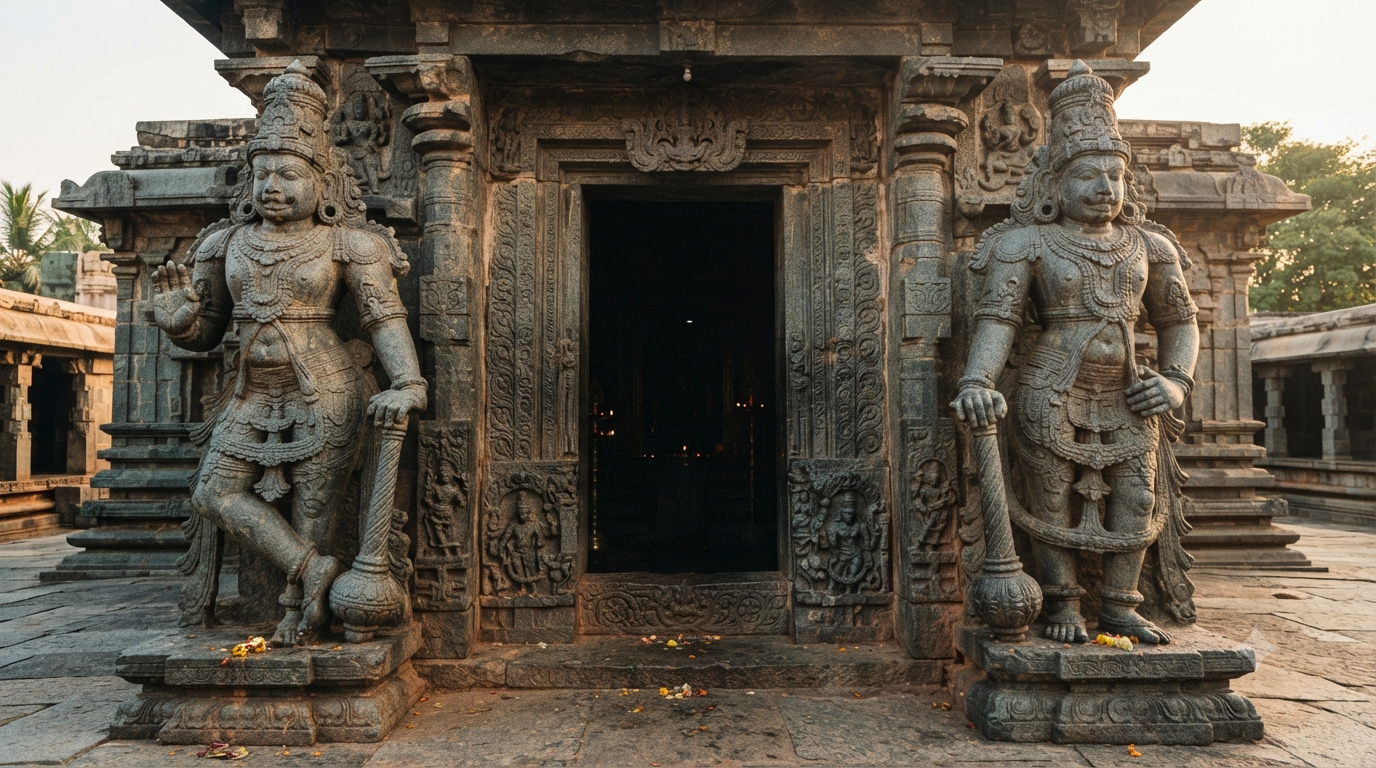
Temple dvarapala meaning begins at the doorway, where carved guardians mark the passage from everyday space into a sacred shrine. Their clubs, gestures and sometimes fearsome faces are not random decoration. Yet a Shaiva guardian does not always look like a Vaishnava one, and no single emblem identifies every figure across India.
Temples Map is an independent heritage guide, not an official temple or government website. We are not affiliated with temple authorities and do not accept bookings, donations or payments.
Temple dvarapala meaning at a glance
A dvarapala is a guardian of a doorway, commonly carved beside a temple entrance or the approach to a sanctum. Guardian figures mark the sacred threshold and express protection. Their objects, posture and facial features often reflect the shrine’s religious tradition, but regional styles and local practice affect their appearance.
- Literal sense: Dvara means door or gateway; pala means protector.
- Typical location: Beside a gateway, hall entrance or the doorway leading to a shrine.
- Common visual clues: Clubs or staffs, striking stances, rich ornaments and protective hand gestures.
- Shaiva clues: A trident, matted hair or a serpent-linked club can suggest Shiva’s circle in some settings.
- Vaishnava clues: Some guardian imagery borrows symbols associated with Vishnu, but each identification needs supporting context.
- Essential caution: A guardian’s personal name usually needs more evidence than its pose or weapon.
The broader temple iconography and symbolism guide explains related carvings. Here the focus stays on the doorway figures themselves.
What makes a temple doorway guardian different from a warrior?
A dvarapala has a job within the building’s sacred layout. A warrior in a battle scene belongs to a story, while a doorway guardian stands in relation to an entrance. The paired placement matters because the two figures frame a passage.
Even a damaged statue may retain that clue. Thus, temple dvarapala meaning often survives when an object has lost its hands or weapons.
The Impart Encyclopedia of Art’s dvarapala entry describes guardians flanking main entrances, halls and sanctum doorways. These positions help distinguish a guardian from a figure in a narrative relief. Northern examples also survive: the Los Angeles County Museum of Art documents a guardian on a Madhya Pradesh doorjamb.
Do not confuse a dvarapala with a dikpala, a guardian of a direction. The words describe different roles, although one temple’s visual programme may contain both. Nor is every imposing figure beside a doorway necessarily a named gatekeeper. Its setting must support the identification.
Temple dvarapala meaning in Shaiva temples
In a Shiva temple, the guardian often borrows aspects of Shaiva imagery. A trident, hand drum, coiling serpent or matted hairstyle can help place the figure in Shiva’s religious world. Yet none of these items is mandatory, and some Shaiva guardians display only a large club and a powerful stance.
The Impart Encyclopedia of Art’s account of Badami Cave 1 identifies a trident-holding guardian on the cave’s eastern flank. The same account places a relief of Shiva and Parvati above the sentry. That architectural setting supports a Shaiva reading without requiring a list of unverified hand-held objects.
The Badami example establishes a trident and a Shaiva context, not a universal costume or weapon list. Elsewhere, a jata-makuta, or piled matted hairstyle, may help identify Shaiva imagery. Here, temple dvarapala meaning emerges from the temple setting as well as the figure’s attributes.
A separate museum example shows how different the same role can look. The University of Michigan Museum of Art holds a pair of wooden guardians from Kerala. The museum relates their fierce expressions to a Shaiva setting.
One lifts a leg around its club, while serpent forms appear near the base. Here movement and mood matter as much as any hand-held emblem.
Vaishnava guardians serve entrances connected with Vishnu worship. Some use objects that recall Vishnu, especially the shankha or conch and chakra or discus. A mace may support the figure, while raised hands offer reassurance or signal caution. However, these details vary from one image to another.
The Los Angeles County Museum of Art’s doorjamb with a divine guardian provides a documented comparison. Carved in Madhya Pradesh, the figure holds a thick staff and forms part of a decorated doorway. The museum discusses the Vaishnava tradition of Jaya and Vijaya in its notes, but the object itself does not display a conch and discus.
The Metropolitan Museum of Art’s Standing Vishnu confirms the conch, discus and mace as attributes of Vishnu himself. That sculpture is not a dvarapala, so its objects cannot be transferred automatically to an unidentified guardian. Thus, temple dvarapala meaning depends on evidence specific to the doorway figure.
Impart explains that guardian figures may borrow symbols from the deity they protect. However, a staff-bearing guardian is not automatically Shaiva or Vaishnava, and a Vishnu statue is not automatically a gatekeeper. If an image has lost its hands or original setting, reliable documentation becomes especially important.
The table compares recurring clues, not rigid religious rules. A feature should support an identification alongside the figure’s position and the shrine’s dedication. In particular, the club occurs in both Shaiva and Vaishnava art, so it cannot settle the question alone.
| Feature | Shaiva examples | Vaishnava examples |
|---|---|---|
| Hand-held objects | Club or trident in documented examples | Staff or club; possible Vishnu-linked motifs |
| Head and ornaments | Matted hair or decorated crown | Often an ornate crown |
| Animal motifs | Serpents appear in some examples | Read motifs with the full shrine programme |
| Hand gestures | Raised or warning gesture may occur | Protective or granting gestures may occur |
| Face and stance | Calm to fierce; static to animated | Calm to fierce; static to animated |
| Best evidence | Original Shaiva setting and object record | Original Vaishnava setting and object record |
A quick memory aid helps: identify the doorway first, the emblem second and the named individual last. That order protects against confident but unsupported labels. It also makes temple dvarapala meaning easier to explain without reducing sacred art to a symbol checklist.
Temple dvarapala meaning in poses and gestures
Dvarapala poses give a doorway both energy and order, so a guardian can define a threshold without many symbols. A guardian may lean on a club, turn towards the entrance or shift weight onto one leg. Other figures twist sharply or lift a foot. The resulting mood can feel welcoming, watchful or intimidating, depending on the sculptural setting.
Tribhanga means a body stance with bends through the hips and upper torso. A mudra is a meaningful hand gesture. An open palm may resemble abhaya mudra, a sign of reassurance, while another hand points or warns. Yet damage and unusual local conventions can make a gesture difficult to read.
The Asian Art Museum’s early Chola guardian offers a concrete example. Its label describes a figure twisting toward a doorway, with a club and fierce facial features. The club is both a weapon and part of the pose.
Consequently, the body tells the story of guardianship before a viewer studies the ornaments. This is another layer of temple dvarapala meaning that photographs can miss.
Temple dvarapala meaning across Indian regions
Regional comparison reveals why a single textbook picture is not enough, since the artistic settings changed over time. Carvers worked with different materials, proportions and doorway schemes. Temple patronage and changing artistic taste also shaped the figures. The examples below show specific contrasts, not a claim that every temple in each region looks alike.
Central and northern India: guardians within a door frame
Door guardians can form part of the carved doorjamb itself. The Los Angeles County Museum of Art catalogues a late fifth-century doorjamb from Madhya Pradesh with a guardian holding a thick staff. Its stance is relatively restrained, while the frame carries floral carving. The sculpture therefore reads as one element within an ornate entrance, not a separate giant sentry.
This surviving example also challenges the idea that a dvarapala must have fangs or a dramatic weapon. Its placement and staff also help explain its protective role. However, the object’s particular Vaishnava interpretation should not become a blanket identification for every ancient northern doorjamb.
Temple dvarapala meaning in Pallava and Chola sculpture
The Impart survey of Pallava rock-cut sculpture describes early doorway guardians leaning on serpent-entwined clubs. Later Chola works can give the same role greater scale and motion. These are broad art-historical tendencies, though individual monuments and phases deserve separate study.
The Great Living Chola Temples provide a strong setting for the later comparison. The United Nations Educational, Scientific and Cultural Organization (UNESCO) describes the architecture and sculpture at Thanjavur, Gangaikondacholapuram and Darasuram. The Chola programme also treats large shrine entrances as major visual moments. Still, a date for the temple does not automatically date every guardian or later repair.
Karnataka: Chalukya and Hoysala differences
The trident-holding guardian at Badami Cave 1 provides a documented Shaiva example from the Deccan. However, one carving cannot establish the attributes of all Chalukya guardians. UNESCO describes Pattadakal as a place where northern and southern architectural forms met, but that architectural mix does not prescribe a single dvarapala type.
Later Hoysala temples surround their entrances with especially rich surface carving. UNESCO’s Sacred Ensembles of the Hoysalas includes Belur, Halebidu and Somanathapura. To explore that carved setting, see our Belur Chennakeshava architecture guide. When looking at a single guardian, record the actual attributes instead of inferring them from the word “Hoysala” alone.
Kerala: wooden guardians and regional variety
Kerala’s surviving wooden guardians show how material alters the effect. Curving limbs, deep carving and former painted surfaces can create a lively figure quite unlike a granite doorway image. The Michigan museum pair gives a documented example, though it cannot stand for every Kerala temple.
The wood of the Kerala pair creates a different effect from the sandstone doorway fragment at the Los Angeles County Museum of Art. Yet the materials alone do not decide Shaiva or Vaishnava identity. For figures from Andhra Pradesh, Odisha or elsewhere, compare only those attributes that an accessible, reliable object record actually documents.
No. Jaya and Vijaya are celebrated as Vishnu’s gatekeepers in Vaishnava religious narratives, and temples may associate a guardian pair with them. Yet a generic pair beside a Vishnu shrine cannot always receive those personal names from appearance alone. Other named guardians also occur in Vaishnava textual traditions.
The Los Angeles County Museum of Art discusses Jaya and Vijaya in its description of a historic Vaishnava doorjamb. That establishes a meaningful traditional connection. It does not identify every unnamed statue as one of the two. If a temple’s inscription, reliable catalogue or established local tradition names the figures, report that attribution clearly.
Shaiva pairs deserve the same caution. Calling every fierce figure Nandi or a particular attendant may overlook different local names and roles. Temple dvarapala meaning starts with function; a specific personal identity requires stronger proof.
Temple dvarapala meaning: How to identify an unfamiliar guardian
Begin with what you can see and verify. The most reliable reading combines the structure, the full pair, the objects and the site’s documented history. A single close-up often hides the most useful evidence: where the figure originally stood.
- Locate the threshold. Note whether the carving stands at an outer gate, hall or sanctum door.
- Check the shrine’s dedication. Look for a documented Shaiva or Vaishnava setting, not just a nearby motif.
- Study both guardians. Compare their inward turn, height, gestures and matching or contrasting objects.
- Record visible attributes. Name the mace, conch, discus, trident or drum only when the form is clear.
- Describe the posture. Note a raised leg, bent hip, club support or raised hand before assigning a meaning.
- Read a dependable label. An inscription, museum record or heritage guide may give date, region or identity.
- Keep uncertainty visible. Use “possible Vaishnava guardian” rather than inventing a missing weapon or personal name.
At large South Indian complexes, visitors may pass several thresholds. Our gopuram meaning guide explains the gateway structure. A guardian at a gopuram should not automatically be treated as the guardian of the innermost sanctum.
Three mistakes that distort guardian iconography
First, treating the club as a sectarian badge. Both Shaiva and Vaishnava examples may hold or lean on a mace. Without further clues, the weapon proves little about shrine dedication. A missing conch is also not proof that a figure cannot be Vaishnava, especially if part of the carving has broken away.
Second, treating fierceness as a fixed religious label. The bulging eyes and exposed teeth of some guardians suit a protective role. Yet calm figures also guard doors, as the central Indian doorjamb shows. Expression changes with artistic choices, so it is not a universal identity test.
Third, giving every pair a famous name. Jaya and Vijaya belong to Vaishnava tradition, but temple images require local evidence. Likewise, don’t call a guardian Shiva himself just because it has a trident.
The Metropolitan Museum of Art even catalogues one Cham sculpture as “Standing Shiva or Temple Guardian”. That cautious title shows how scholars preserve uncertainty when evidence allows more than one reading.
Temple dvarapala meaning at the sacred threshold
A dvarapala changes the way a visitor experiences a building. The pair marks a moment of passage before the worshipper reaches a more restricted or sacred chamber. The guardian’s scale and stance draw attention to the door, while the framing architecture gives the figure its place.
In some temples, the figures act almost like brackets around an opening. Elsewhere, their bodies dominate the approach. A fierce face can convey protective force, but it need not suggest hostility towards worshippers. That distinction matters because ritual meaning and artistic effect are related without being identical.
Look at the doorway as a whole: lintel, jamb, threshold, guardian pair and nearby images. Impart’s account of guardian placement at temple entrances, halls and sanctums is useful here.
The same club could appear in a different story elsewhere, but a paired guardian beside a shrine entrance has a specific architectural job. So temple dvarapala meaning cannot be read from weapons alone. That is the deeper point behind the visual drama.
The most useful way to remember the guardians
Temple dvarapala meaning rests on a simple principle: role first, visual detail second, personal name last. Shaiva and Vaishnava examples share a protective function, while their religious symbols may differ. Compare real museum records before treating a crown, club or pose as a universal rule. At a temple, examine the full entrance rather than one isolated carving.
Frequently asked questions about dvarapalas
What does dvarapala mean in a Hindu temple?
Dvarapala means a guardian or protector of a doorway. The figure commonly stands at a temple gateway or shrine entrance, often with a companion, so its position offers a key clue. The entrance marks a sacred threshold, while objects and gestures may reflect the religious setting. There is no single required appearance.
What is the difference between dvarapala and dwarapalaka?
The terms refer to the same broad guardian role. Dvarapala and dvarapalaka represent Sanskrit-based forms, while “dwarapala” reflects a common English spelling. Regional languages use further variants. The spelling alone therefore does not indicate a different deity or sculptural style.
Do Shiva temple dvarapalas always carry tridents?
No. Some Shaiva examples include a trident, but others emphasise a club or different attributes. Impart identifies a trident-holding guardian at Badami Cave 1, yet that individual example does not set a rule for every Shiva temple. Instead, identify each figure through its setting and several clues.
Why do some dvarapalas have fangs or fierce eyes?
Fierce features can communicate protective power and a warning to hostile forces. The Asian Art Museum describes an early Chola example with fangs and wild hair. However, a calm face can serve the same doorway function. Expression reflects artistic tradition as well as the guardian’s role.
Are Jaya and Vijaya the guardians of every Vishnu temple?
No universal identification is safe. Jaya and Vijaya are well-known Vaishnava gatekeepers, and individual temples may associate their images with that pair. Other guardian names appear in religious traditions.
A secure attribution depends on local practice, inscriptions or trustworthy documentation. In short, temple dvarapala meaning should not be confused with a guaranteed personal name.
Where are dvarapala statues usually placed?
They commonly flank entrances to temples, halls and sanctum approaches. Large complexes may also have several sets at different doorways. However, a sculpture in a museum may have lost its original architectural setting. The collection record then becomes crucial to understanding its former role.
Are dvarapalas and dikpalas the same?
No. A dvarapala guards a door or threshold, whereas a dikpala guards a direction in sacred cosmology. Temples can include both kinds of protective imagery. Their subjects may overlap in broad ideas of guardianship, but their positions and iconographic roles are not interchangeable.
Can a dvarapala be identified from a photograph?
Sometimes the doorway position and clear attributes support a broad identification. Yet a cropped or weathered image may hide the shrine dedication, original location or damaged objects. In those cases, describe the visible evidence and leave the personal name uncertain until reliable documentation confirms it.