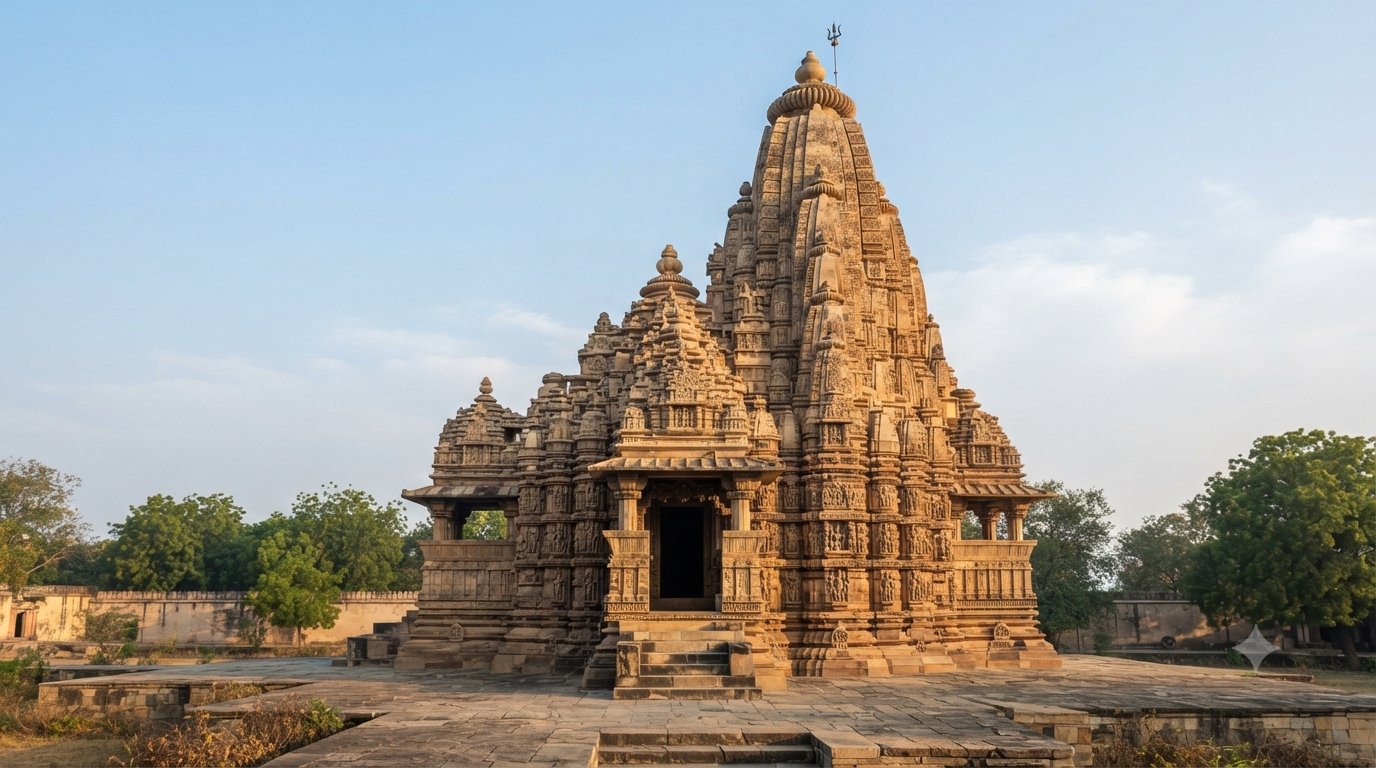
Shekhari temple towers turn one rising shrine tower into a cluster of smaller peaks. Their main feature is a tall central shikhara, while attached subsidiary spires repeat its curving outline at different heights. The result looks like several towers growing together, yet they belong to one coordinated architectural composition.

TemplesMap.com is an independent heritage guide, not an official temple or monument authority. We are not affiliated with any temple trust or heritage agency, and we do not accept bookings, donations or payments.
What are shekhari temple towers?
Shekhari temple towers are a clustered form of the Nagara shikhara in northern Indian temple architecture. A dominant, usually curving central tower rises above the sanctum. Smaller attached spires, often called urushringas, also gather around it. Their repetition builds a layered silhouette without turning every visible peak into a separate shrine.
For readers new to the vocabulary, shikhara means the tower over a shrine in common northern usage. The garbhagriha is the inner sanctum below. NCERT’s account of temple architecture also describes the move from a simpler latina tower to grouped towers that rise like adjacent peaks.
Start with our broader overview of Indian temple architecture if you need the Nagara and Dravida distinction first. Here, the focus is narrower: how the principal tower and its smaller companions work together.
Shekhari temple towers at a glance
- Principal feature: one dominant shikhara above the main sanctum.
- Subsidiary feature: attached half-spires or smaller spirelets, not a standard number of free-standing towers.
- Visual effect: repeated curved outlines build a layered, upward-moving profile.
- Architectural context: a clustered expression within the wider Nagara tradition.
- Useful comparison: latina emphasises a more unified tower; bhumija often shows a more regular network of miniature forms.
With shekhari temple towers, the defining clue is the relationship between parts, not a count of visible peaks. Since buildings vary in height, shape and arrangement, their clusters rarely look identical. Even one temple can look more crowded from the corner than from the front.
Visual feature guide: reading a clustered shikhara
To identify the parts of a Shekhari tower, begin at the crown and follow the tall central shikhara downward. Then look for the shorter spires that gather around its sides. The features below offer a practical way to read the architecture, not a fixed arrangement that every temple must follow.
| Where to look | Architectural label | What to notice |
|---|---|---|
| Highest point | Kalasha and amalaka | A finial above a ribbed crowning element in familiar Nagara examples. |
| Tall central mass | Principal shikhara (latina core) | The leading curving profile above the main shrine. |
| Attached side peaks | Urushringas | Subsidiary half-spires that echo the central outline. |
| Lower and outer peaks | Smaller spirelets | Further repetitions that enrich the clustered surface. |
| Space beneath the tower | Garbhagriha | The central sanctum, not another peak on the roof. |
First, look at the amalaka separately from the tall body below it. The crown helps you find the summit, whereas the urushringas explain why the tower appears to branch into many peaks. For the space underneath, our garbhagriha guide explains the sanctum and its place in a temple plan.
How the principal tower holds the design together
In shekhari temple towers, the main shikhara remains the clear centre of the composition. It rises above the garbhagriha and sets the tallest visible line. The subsidiary spires follow that lead, so the eye can still find a single dominant summit.
The central form often relates to the latina or rekha-prasada profile. These terms describe a tower whose sides curve inward while rising. The central shikhara is therefore more than a background for ornamental pieces. It also gives the smaller forms a common shape to repeat.
That also explains a frequent viewing mistake. A photograph may compress all the attached elements into a forest of separate points. Look for the tallest continuous curve first. Then trace where the shorter peaks meet the main mass, rather than assuming each one begins over its own room.
Why urushringas matter in shekhari temple towers
Urushringa refers to a subsidiary spire associated with the main shikhara. In clustered compositions, these attached or engaged forms echo its vertical shape. Their size and placement can vary, so an urushringa need not be a miniature copy with identical detail.
Next, notice the join between the lesser spire and the taller tower. Unlike a free-standing shrine, an attached spire reads as part of the same superstructure. In a photograph, its lower portion may disappear when projecting walls obscure the join. This is why counting every visible tip seldom explains the design.
Some Shekhari examples also use several visible scales of attached peaks. Larger forms establish a secondary rhythm; smaller ones fill the spaces around them. Together, they make the tower appear increasingly dense toward its lower portions while keeping the main summit distinct.
Shekhari temple towers compared with latina and bhumija
The three terms describe ways of organising a Nagara tower, so they do not name separate religious traditions. The easiest comparison asks what happens to the main rising mass. Does it stay visually unified, gain attached clusters, or support a more ordered field of miniature forms?
| Tower mode | Visual clue | Careful reading |
|---|---|---|
| Latina or rekha-prasada | One dominant curving tower. | Look at the main continuous outline. |
| Shekhari | Central tower with attached, clustered subsidiary spires. | Follow the hierarchy from principal peak to smaller peaks. |
| Bhumija | More regular rows or a network of miniature spire forms. | Study the repeated pattern, not just the total spire count. |
This comparison helps, but it cannot replace examining the whole building. Since local traditions and building phases vary, neat categories may need careful qualification. For example, a decorative band of small shrine-like motifs does not, by itself, prove that a tower belongs to the Shekhari mode.
Khajuraho: a useful place to see the clustered effect
The temples at Khajuraho in Madhya Pradesh show how a principal shikhara can rise above lesser peaks. UNESCO’s Khajuraho Group of Monuments description highlights the central spire and the miniature spires flanking it. This is a helpful visual reference for the layered Nagara profile.
The Archaeological Survey of India identifies Kandariya Mahadeva as the largest and grandest temple in the group. Its tower offers a strong case study because the shorter peaks gather around a much taller central form. The comparison works best when you view both its overall outline and a closer side angle.
UNESCO also records a mountain-related interpretation for Khajuraho’s tower composition. That is evidence about this heritage setting, not proof that each urushringa everywhere has a fixed, independent meaning. Architectural identification should come first; symbolic readings need an attributed source and a specific monument or tradition.
Are subsidiary spires the same as subsidiary shrines?
No. A subsidiary spire is an architectural element attached to, or grouped around, the larger tower. A subsidiary shrine is a distinct worship space, with its own plan and often a separate roof or tower. The two may occur in one complex, but their names do not describe the same thing.
This distinction matters at Khajuraho, where some temples also have corner shrines on a raised platform. The Archaeological Survey of India discusses that panchayatana arrangement in its account of the site. Those corner shrines are a planning feature, while urushringas belong to the tower’s visible composition.
If a caption calls every small spire a shrine, check what lies underneath it. A roof form alone cannot prove a separate inner chamber, so check the plan when possible. Conversely, a small shrine standing away from the main sanctum should not automatically be labelled an urushringa.
How to read a Shekhari silhouette in photographs
A photograph gives you a silhouette, not a floor plan. When a low viewpoint pushes roofs together, several unrelated elements may appear to share one base. Start by finding the tallest peak and the wall mass directly beneath it. Then compare a view from the side.
Look for overlap because an attached urushringa can hide part of the central shikhara. A separate mandapa roof, by contrast, may sit forward along the temple axis. Its visible height can step down as you move away from the sanctum. Yet that roof does not become an urushringa merely because it looks pointed in a cropped photograph.
Light can also flatten the surface. If carvings merge into shadow, check images taken from another direction before assigning a name. A measured plan or conservation drawing is better evidence when the photograph remains unclear.
Even then, describe only what the record supports. Architectural classification becomes stronger when profile, attachment and plan agree.
What beginners often miss when studying shekhari temple towers
Begin with a three-quarter view. A straight front photograph can hide the depth of attached forms, while a low-angle close-up can obscure the whole outline. Together, the two views also tell you more than a single dramatic shot.
- Find the sanctum axis: locate the main tower above the garbhagriha before naming any outer feature.
- Trace the longest curve: it usually reveals the principal shikhara despite the clustered ornament.
- Compare scales: distinguish large attached urushringas from smaller decorative spirelets.
- Check the junctions: attached architectural forms differ from independent corner shrines.
- Use more than one view: corners, side faces and later repairs may change what a photograph seems to show.
There is no universal Shekhari spire count to memorise. Nor is there a safe shortcut that assigns one spiritual meaning to every tiny tower. What matters first is the visible relationship between the larger shikhara and its smaller companions.
Shekhari temple towers: the essential distinction
Shekhari temple towers make a central curving shikhara appear richer through groups of smaller attached spires. Their architecture depends on hierarchy, repetition and the way profiles overlap. The same principles help you read Khajuraho without confusing spirelets with separate sanctums.
Use the visual feature guide above to recognise the main tower, its attached spires and the sanctum beneath. When studying a particular building, check a reliable site description and photographs from more than one angle. That approach also avoids forcing the temple into a standard count or borrowed symbolic explanation.
Frequently asked questions
What is a Shekhari shikhara?
A Shekhari shikhara is a clustered Nagara tower form. It has a dominant central spire with smaller attached spires around it. The smaller parts repeat the upward shape and create a layered profile. The name describes an architectural arrangement, so it does not set a standard number of towers.
What does urushringa mean in temple architecture?
An urushringa is a subsidiary spire associated with a larger shikhara. It often appears as an attached half-spire that echoes the main tower. Several sizes may also appear in one composition. When reading a building, distinguish these attached forms from separate shrines nearby.
Is Shekhari a type of Nagara temple architecture?
Yes. Shekhari describes one way of organising a shikhara within the broad Nagara architectural tradition. It also helps to compare it with latina and bhumija tower forms. However, the name alone does not tell you a temple’s full plan, date or regional history.
How is Shekhari different from latina?
Latina commonly describes a visually unified curving shikhara. Shekhari retains a dominant tower but surrounds it with attached secondary spires. Because the smaller forms echo the principal curve, the whole structure appears to rise in clustered peaks. So study the whole profile rather than one ornament.
How is Shekhari different from bhumija?
Shekhari is most readily recognised by subsidiary spires grouped around a dominant central tower. Bhumija often displays a more regular arrangement of miniature forms across the tower surface. Both terms belong to Nagara discussions, so the difference is in the organisation of the rising architectural mass.
Do all Shekhari temples have the same number of smaller spires?
No fixed count defines every Shekhari temple. The number and scale of visible subsidiary forms change with the building and the viewing angle. A photo may also hide some of them. Describe the actual monument rather than repeating a universal spire number from an unverified caption.
Which temple is a useful example of the clustered tower?
Kandariya Mahadeva at Khajuraho is a strong example to study. The Archaeological Survey of India identifies it among the leading monuments of the site, while UNESCO describes Khajuraho’s main shikhara flanked by miniature spires. Compare wide and close views, since each reveals different parts of the tower cluster.