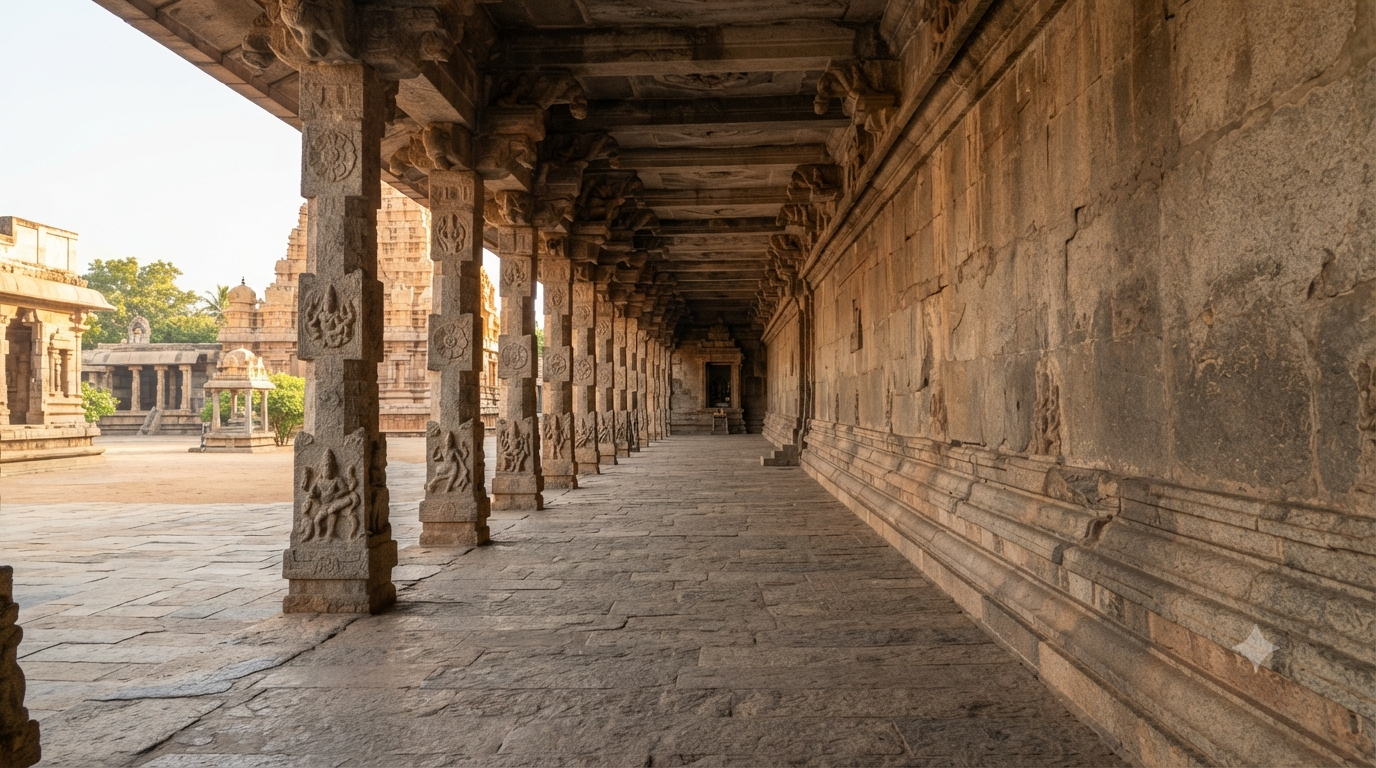
The temple prakaram meaning is easier to grasp when you picture a shrine within an enclosing wall, with space to move around it. In South Indian temple architecture, the word can describe a wall, while some guides use it for the surrounding passage. That is why a prakaram may look like a stone corridor in one temple and a broad street in another.
Independent guide: TemplesMap is not affiliated with any temple administration, the Tamil Nadu Hindu Religious and Charitable Endowments Department, or UNESCO. We also do not arrange access, accept bookings, donations, or payments. Check authorised temple sources for current visitor instructions.
What is the temple prakaram meaning in architecture?
A prakaram, also written prakara or prākāra, is an enclosure around a temple’s sacred core. Architects use the term chiefly for an enclosing wall, although broader descriptions may include its precinct. In everyday temple descriptions, it can also mean a surrounding corridor or walking space. So the temple prakaram meaning depends on the building and the writer.
This distinction matters because a wall and a walkway do different jobs. The wall, meanwhile, marks a boundary. The space beside or between walls can also support movement, worship and other temple activities. A roof or line of pillars may cover that space, yet neither is necessary for every prakaram.
Temple prakaram meaning at a glance
- Core idea: an enclosure wall or enclosed circuit surrounding a temple shrine or precinct.
- Common visual form: an open court, walled passage, roofed corridor or broader ring of streets.
- Ritual connection: devotees may perform pradakshina, a clockwise circumambulation, along a designated route.
- Important caution: the enclosure, the path and the act of walking around the shrine are related but not identical.
- Number of rings: the arrangement varies by temple. No single enclosure count applies to Hindu temples generally.
Prakaram, pradakshina and mandapam: what is different?
First, separate structures from actions when reading a temple plan. A prakaram defines an enclosed part of the complex, while a walking path serves a different purpose. A pradakshinapatha is the path for moving around a sacred space. Pradakshina names the devotional act itself, while a mandapam is a hall or pavilion.
A Karnataka government heritage nomination dossier, available through UNESCO, lists prakara as an enclosure wall. It separately defines pradakshinapatha as a circumambulatory passage and mandapa as a pillared hall. As a result, this formal glossary makes the differences clear.
| Term | Basic meaning | What to look for |
|---|---|---|
| Prakaram or prakara | Enclosure or enclosed precinct | Boundary walls and surrounding space |
| Pradakshinapatha | Path around a sacred space | Walkable route near a shrine |
| Pradakshina | Act of ritual circumambulation | Devotees following an allowed circuit |
| Mandapam | Hall or pavilion | Pillars, roof and gathering space |
| Gopuram | Monumental gateway tower | Tower marking an entrance |
For the formal usage, see the Sacred Ensembles of the Hoysalas nomination glossary. For a wider introduction to temple building types, read our Indian temple architecture guide.
How enclosure walls and corridors work together
Think of a temple plan as a series of thresholds, because not every enclosure has the same form. One wall can set the limit of an inner court, while another may extend farther out. The next may form the edge of a larger precinct. Gateways connect these spaces, while passageways allow people to move between shrines or around them.
Some prakarams also include a covered, pillared corridor beside the wall. In contrast, other routes remain open to the sky. Larger complexes may contain gardens, smaller shrines, tanks, halls and processional spaces within the enclosing rings. Their function, therefore, depends on the particular site.
Because the outer rings may blend into public streets, a temple boundary is not always obvious in a photograph. A street beside a gopuram might belong to a broader temple-town pattern rather than an inner worship corridor. This is one reason to consult a plan before assigning an enclosure number.
Are all prakarams roofed corridors?
No. A roofed passage is one possible form, not the definition of prakaram. An enclosure can also surround an open courtyard, a covered passage or a wider precinct. When a photograph shows only stone pillars and a ceiling, the image may depict a mandapam or a corridor rather than the entire enclosure.
To understand the temple prakaram meaning on a plan, look for the continuous boundary and its relationship to the shrine. Pillar rows can help reveal a route, yet a single corridor photograph rarely shows the whole circuit. Even a striking thousand-pillar hall should not automatically count as a separate prakaram.
Srirangam: temple prakaram meaning on a town scale
The temple prakaram meaning becomes concrete at Sri Ranganathaswamy Temple in Srirangam, Tamil Nadu. India’s UNESCO World Heritage Centre tentative-list submission describes a Sapta-Prakaram plan with seven concentric rectangular enclosures. It explains that the inner five function as temple space, while the outer two form part of the settlement.
This is more than a collection of corridors, because the town is part of the pattern. The outer layout also holds streets and everyday town life, so the sacred centre and its surrounding settlement connect closely. As a result, the Srirangam example helps explain why translating every prakaram as a narrow indoor hallway is misleading.
The source is a UNESCO Tentative List description submitted by India, so it does not establish World Heritage inscription. The official Tamil Nadu HR&CE Srirangam temple page also describes the temple’s concentric sacred circuits.
Does seven at Srirangam mean every temple has seven prakarams?
The seven-fold description belongs to the documented Srirangam layout, not every Hindu temple. Other temples differ in scale, development and design. Some have only a single enclosure or a differently organised path. Therefore, always attribute a count to the named temple and source.
For broader regional context, our Tamil Nadu temple pilgrimage guide discusses Srirangam alongside other important shrines. The architecture question here is narrower: how the enclosure system creates layers between a sacred centre and the surrounding town.
Madurai Meenakshi: corridors, shrines and enclosed courts
Madurai’s Sri Meenakshi–Sundareswarar Temple shows a different side of the same architectural vocabulary. The Madurai district government description identifies the paired Meenakshi and Sundareswarar shrines, major gateways, a thousand-pillared hall and musical pillars in the outer corridors.
Together, those features show how movement occurs through courts, halls and corridors. Still, they do not justify treating every pillared hall as its own prakaram. Nor does the district description establish a universally applicable number of enclosure rings for Meenakshi Temple.
Our existing Meenakshi Amman Temple architecture overview introduces its gateways, sculptures and sacred tank. Read that alongside the official district description, while keeping any older visitor timings or access claims separate from this architectural explanation.
Why are Meenakshi’s corridors not the same as Srirangam’s outer streets?
These places show different scales of enclosure. In Madurai, a visitor may notice enclosed courts, richly carved halls and routes linking paired shrines. Srirangam’s documented outer rings extend into a living settlement. Both illustrate enclosure-based planning, yet their spaces should not receive identical labels without a plan.
Architectural comparison works best when the question is specific. Ask whether a photograph shows a boundary wall, a path, a gateway or a hall. Then check how that feature fits the temple’s wider layout. The answer may also differ within the same complex.
How to recognise a prakaram on a temple plan
To test the temple prakaram meaning on a plan, start at the sanctum, or garbhagriha. The main deity resides there.
Next, trace the surrounding boundary outward. If a second enclosing wall appears, note the space between the two. Then find the gateways, adjoining courts and paths that join the rings.
- Locate the sacred core. Identify the shrine before counting anything around it.
- Trace walls, not just roofs. An open court may belong to a prakaram even without a covered walkway.
- Find the gateway towers. A gopuram can mark a threshold between precincts.
- Mark the walking path separately. The route for pradakshina need not define the full enclosure.
- Check the map’s source. Use site-specific heritage plans or the temple administration’s published material.
Do not assume each visible wall gives another numbered prakaram, because local naming conventions differ. Historical additions and service spaces can also complicate a neat diagram. The plan’s labels therefore matter more than a casual count from an aerial image.
Temple prakaram meaning in worship and processions
The temple prakaram meaning also concerns the boundaries that shape movement around sacred space. Devotees may use a permitted path for pradakshina, often keeping the central shrine on the right. In large temple complexes, processions may also move through courts or outer streets during religious events. These uses also reflect each temple’s own traditions and arrangements.
Yet a devotional route is not a blanket permission to enter every ring. Some spaces serve priests, temple staff or particular rites, while conservation work or crowded events can change movement patterns. An architectural diagram explains the layout, but it does not function as today’s access notice.
The distinction also changes how we read sacred symbolism. Moving from an outer enclosure toward the inner shrine may express a transition from public life to a more focused space of worship. That is a useful interpretation, although it cannot prove every temple follows the same ritual sequence.
What beginners often get wrong about prakarams
The first mistake is calling any long stone hallway a prakaram. It might instead be part of a mandapam. Another is confusing the gopuram, which marks an entrance, with the wall that defines the enclosure. Both may stand together, but they name different structures.
A third error comes from copying Srirangam’s seven-fold plan into unrelated temples. Its layout is remarkable precisely because it joins the sacred centre to a larger temple town. The example clarifies a concept, yet it should not become a rule without evidence elsewhere.
Finally, old architectural notes cannot tell you which corridor is open today. Before visiting, consult the relevant temple administration and follow signs and authorised staff. Walk carefully on worn or wet stone floors, especially when travelling with older visitors or children.
Temple prakaram meaning: the essential point
The temple prakaram meaning begins with enclosure, not with a fixed number of corridors. Walls create precincts, while paths and halls shape how people use those spaces. Srirangam illustrates an enclosure pattern that extends into town life; Madurai reveals the close relationship between courts, shrines and pillared passages. Read each site on its own terms, because visitor access is a separate, current question.
Frequently asked questions
What does prakaram mean in a Hindu temple?
Prakaram commonly means an enclosure wall or the precinct around a shrine. Temple guides may also use it for a surrounding corridor or path. The exact meaning comes from the local architectural context.
Is prakaram the same as pradakshina?
No. Prakaram refers to an enclosure or surrounding space, while pradakshina is the act of walking around a sacred centre. The designated walking route may be called a pradakshinapatha.
What is the difference between prakaram and mandapam?
A prakaram defines an enclosed circuit or precinct. A mandapam is a hall or pavilion, often supported by pillars. A mandapam may stand inside a prakaram without becoming a separate enclosure.
How many prakarams are there in Srirangam Temple?
India’s UNESCO Tentative List submission describes seven concentric prakarams at Sri Ranganathaswamy Temple. Its text also distinguishes inner temple areas from outer settlement rings. That count applies to Srirangam, so do not apply it to all Hindu temples.
How many prakarams does Meenakshi Temple have?
This guide does not assign a single count without a site-specific authoritative plan. Madurai’s district administration describes major gateways, halls and outer corridors. Those details establish architectural features, but not a definitive enclosure tally.
Does every temple have a covered prakaram?
No. Temple enclosures can include open courtyards and paths as well as covered corridors. Their forms also depend on site planning, history and local building practice.
Can visitors walk through every temple prakaram?
Not necessarily. Access depends on temple rules, while rituals and conservation needs may also affect it. Check current instructions from the temple administration; a historical floor plan cannot guarantee entry.
Are prakarams always rectangular?
No universal shape applies. Large South Indian temple complexes often show rectangular enclosures, but temple plans vary by site. Instead, describe the actual boundary rather than assuming a standard outline.