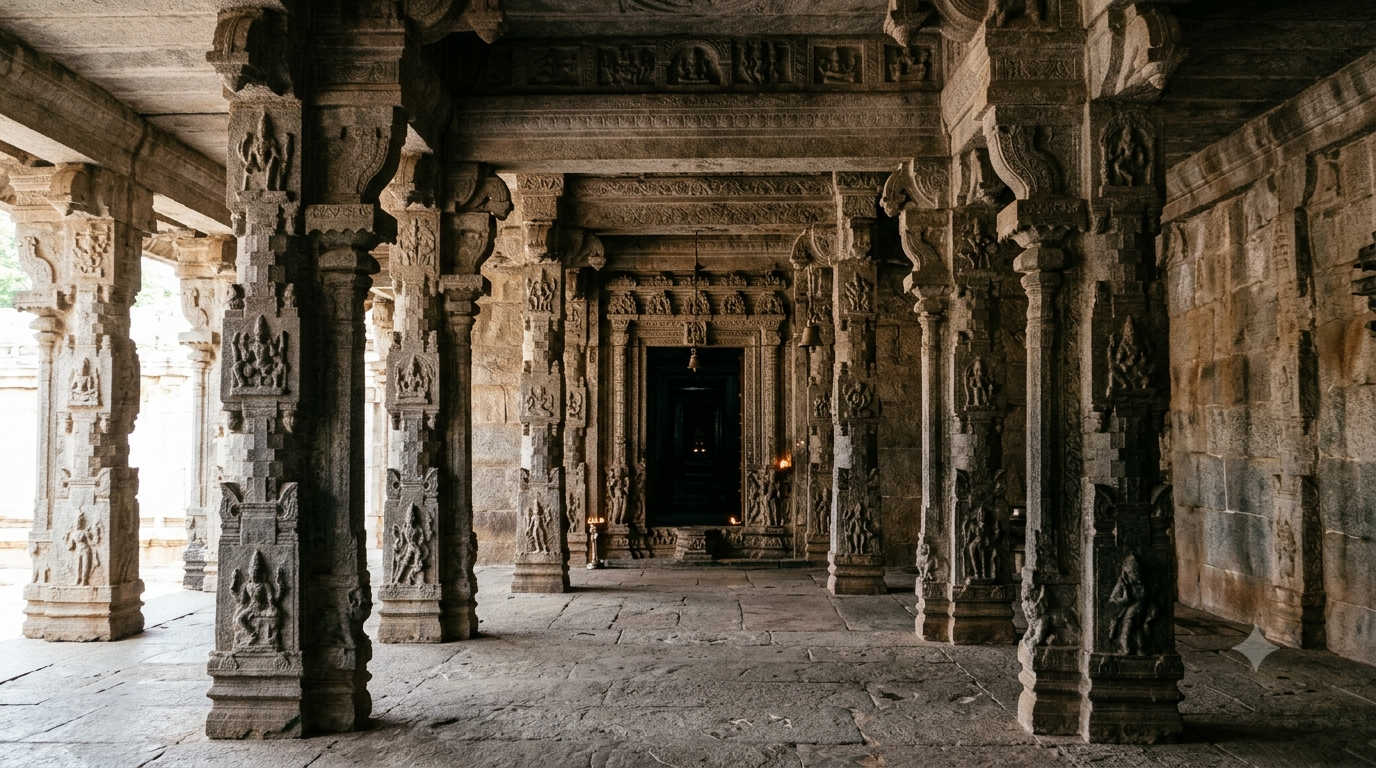
For readers searching for antarala meaning, the answer is the vestibule between a Hindu temple’s sanctum and its hall. It describes a physical part of the building, so it is not a type of darshan ticket. Two detailed Hoysala temple plans also show exactly where this often-overlooked space sits.
TemplesMap is an independent heritage guide, not a temple authority or booking service. We are not affiliated with the temples discussed here and accept no bookings, donations or payments.
Antarala meaning in Hindu temple architecture
In Hindu temple architecture, the antarala is the small intermediate space that links the garbhagriha, or inner sanctum, with a mandapa, or hall. Architects also call it a vestibule or antechamber. Its defining feature is its position between those spaces, rather than its size or decoration.
For example, the Getty Research Institute’s Art & Architecture Thesaurus records antarala as an intermediate space or vestibule in a Hindu temple. This reference also supports the basic antarala meaning. It does not, however, define access rights or a ticket category.
For the antarala meaning on a floor plan, think of a building’s main axis: approach hall, connecting space, inner shrine. The antarala then occupies the middle position. This arrangement helps explain its architectural role without claiming that every temple follows an identical plan.
The three spaces at a glance
- Garbhagriha: the inner sanctum, where the principal sacred image or emblem belongs.
- Antarala: the short space that connects the sanctum to the next hall.
- Mandapa: a roofed hall or pavilion on the approach to the shrine, often with pillars.
- Darshan ticket: a temple administration’s visitor-access category, not an architectural room.
These terms establish the antarala meaning more clearly when you compare their positions. They describe different kinds of information. A temple plan describes spaces, while a ticket notice explains who may enter and under what conditions.
Antarala meaning on a temple floor plan
On a common axial plan, the antarala sits directly in front of the garbhagriha, beyond the main hall. When you trace the approach towards the deity, it lies after the mandapa and before the sanctum doorway. However, some shrines lack a clearly separate vestibule, while larger temples have several halls.
The antarala meaning becomes clear in the simplest mental sketch, which reads entrance → mandapa → antarala → garbhagriha. Use that sequence as a teaching aid, but not as a universal floor plan. Side entrances, adjoining shrines and later construction can change the route.
A labelled plan matters for the antarala meaning because a photograph rarely shows the entire sequence. A dark opening behind a pillared hall might lead to a vestibule or directly to a shrine. The building’s documented layout then resolves the difference.
Antarala meaning in the Belur temple plan
At the Channakeshava Temple in Belur, Karnataka, the vestibule appears clearly on an official heritage drawing. The Government of Karnataka’s Hoysala nomination dossier, hosted by the UNESCO World Heritage Centre, presents this as Figure 2.6 on printed page 27. INTACH’s Bengaluru Chapter documented the plan.
Its legend identifies 1 as garbhagriha, 2 as antarala, 3 as navaranga, and 4 as entrance halls. Here, navaranga means a pillared hall with nine internal divisions. The drawing also places the small vestibule between the sanctum and that hall.
For understanding antarala meaning, this is more useful than a general definition. The drawing shows the connecting space as a separate mapped unit. You can follow the numbered areas without guessing from a doorway’s shape.
What the Belur plan does not tell you
An architectural antarala meaning should never be read as a present-day visitor route. Instead, the plan identifies building parts, not admission rules. It cannot tell you whether worshippers may enter the vestibule during a particular service. Likewise, its labels say nothing about priority passes or paid darshan.
The same dossier also discusses ornate carving around the vestibule’s entrance. That detail also shows why a narrow transitional area may carry significant art. Yet ornament alone does not turn the vestibule into a mandapa or the sanctum.
A second verified plan: Keshava Temple, Somanathapura
The Keshava Temple at Somanathapura offers a useful contrast. Figure 2.62 in the same Hoysala nomination dossier, on printed page 88, records a three-shrine arrangement. Its legend again separates garbhagriha (1), antarala (2) and navaranga (3).
Each shrine joins the shared hall through its own intermediate space. As a result, the difference becomes easier to see: an antarala need not serve an entire temple complex. Its relationship is to a particular shrine and its adjoining hall.
Reading antarala meaning across both plans shows why one photograph can mislead. Belur presents one main sanctum on the drawing, while Somanathapura presents three. Still, the connecting function remains recognisable in both plans.
Antarala meaning in older temple remains
A ruined shrine may preserve its connecting space even after other parts have disappeared. The Archaeological Survey of India’s Champaner-Pavagadh account notes that only the gudhamandapa and antarala survive at an early Lakulisa temple. The site also belongs to a wider group of historic monuments in Gujarat.
This example adds an important caution to the antarala meaning. You cannot assume every original room survives simply because a current plan shows a wall or doorway. Read the surviving masonry beside the archaeological description, since lost portions can change how the building looks today.
It also helps distinguish two questions. One asks what a space was in the original temple scheme, while the other asks what remains visible now. Heritage plans, archaeological reports and physical remains may answer those questions in different ways.
Can the antarala be just a passage?
Yes. Depending on the site, the connecting space may look like a short passage rather than a room large enough for a gathering. That does not weaken the antarala meaning. Its location between sanctum and hall remains the central clue.
However, do not call an opening an antarala unless the source identifies a distinct connecting zone. Some shrines open straight into their hall. Others have a narrow vestibule with its own walls or roof treatment.
The Belur and Somanathapura plans make these distinctions visible on paper. Therefore, read the drawing’s legend first, then use the building photograph to understand the form. The reverse approach often encourages guesswork.
Antarala, garbhagriha and mandapa: key differences
| Term | Main role | Clue on a labelled plan |
|---|---|---|
| Garbhagriha | Inner shrine chamber | Sanctum at the sacred core |
| Antarala | Vestibule linking shrine and hall | Small connecting space on the approach |
| Mandapa | Hall or pavilion | Often a larger, pillared area |
| Darshan category | Administrative access arrangement | Appears in visitor notices, not as a room type |
The TemplesMap guide to the garbhagriha explains the inner sanctum and its position on a temple plan. The TemplesMap guide to mandapas explains why halls have several names and forms. A mandapa might be open, enclosed or partly open. Therefore, identifying its roof and columns is helpful, but the published plan remains the stronger guide.
The antarala meaning also demands a distinction between architecture and ritual access. A room’s position does not by itself say who may stand there. Temple authorities control entry, so no architectural label guarantees access for visitors.
Antarala meaning versus paid or VIP darshan
No. Antarala names an architectural space, while a paid or priority darshan category is an administrative service. Some temple notices use a similar-sounding expression, antaralaya darshan, for access arrangements near the inner shrine. That wording does not make the vestibule itself a purchasable ticket or a universal visitor privilege.
The antarala meaning stays architectural even when visitor rules change during festivals or busy periods. Therefore, do not infer a price, access right or booking method from the word alone. Check the particular temple’s official notice for its current categories and permitted areas.
Even a ticket described as closer darshan does not automatically grant entry to every part of the sanctum complex. The temple authority decides the route and may restrict inner spaces for ritual or safety reasons.
Antarala meaning versus ardhamandapa and entrance porch
Questions about antarala meaning often start with the small size of the space. An ardhamandapa or mukhamandapa can also be a modest hall near a shrine’s approach. However, those names describe halls or porches, while antarala identifies the connecting vestibule nearest the sanctum in a plan that distinguishes them.
At Belur, the published legend makes the separation straightforward. It marks entrance halls, the navaranga, the antarala and the garbhagriha as different areas. Therefore, a small room should not receive the name antarala merely because it looks narrow.
Local naming conventions and building periods may vary. If the heritage source uses a different term, follow that source rather than force a textbook label onto the site.
Why this connecting space matters
The antarala meaning is easy to miss because attention tends to go to the deity, tower or spectacular pillared hall. Yet the vestibule joins two architecturally distinct areas. Its doorway, ceiling and carved frame can also reveal how builders treated the transition towards the shrine.
Heritage researchers sometimes discuss a symbolic movement from public space towards the sacred core. That is an interpretation of the architectural sequence, not a fixed ritual rule for every temple. The measured plan remains the best evidence for the room’s location and form.
Do not mistake the sacred meaning of a threshold for a claim about access. A viewer can learn from a plan even when the area remains closed to visitors.
How to identify an antarala without guessing
- Find the sanctum first. Look for the garbhagriha label or the innermost shrine chamber.
- Locate the main hall. It may carry a mandapa, navaranga or similar label.
- Trace the link. Check whether a small chamber or passage sits between the two.
- Read the legend. Confirm that the heritage plan names that link antarala.
- Check other shrines. A multi-shrine temple may have more than one vestibule.
- Separate design from access. Use official temple notices, not the floor plan, for visitor permissions.
This test for antarala meaning works particularly well with the Belur and Somanathapura drawings because both label the parts clearly. It also prevents a common mistake: treating every doorway before the deity as a distinct room.
Common mistakes about antarala meaning
Calling the vestibule the sanctum: the garbhagriha is the inner shrine chamber. The antarala lies outside it, even when they share the same central axis.
Calling any narrow space an antarala: a side passage, entrance porch or corridor may serve another purpose. Compare it with the shrine and hall before naming it.
Assuming every temple has one: temple layouts vary across periods and regions. Some plans join hall and shrine without a separately defined vestibule.
Confusing architectural terms with ticket names: a word on a heritage plan does not establish a service, fee or public right of entry. The current temple administration determines those matters.
To put the antarala meaning in a wider context, see our Indian temple architecture guide. It places halls and sanctums within Nagara, Dravida and regional layouts. Our prakaram guide explains the outer enclosure and corridors, which operate on a different scale from the antarala.
What to remember about the antarala
The antarala meaning comes down to a simple distinction: the sanctum houses the sacred focus, the hall forms part of the approach, and the antarala connects them. The numbered plans for Belur and Somanathapura make this relationship visible without guesswork.
Use a reliable plan before naming a small room, and avoid treating architecture as a visitor-access promise. That approach works for students, heritage readers and pilgrims alike.
Frequently asked questions
What is the antarala meaning in simple English?
Antarala means the vestibule or connecting antechamber between the inner sanctum and a temple hall. Its main architectural role is to link those spaces. The exact form depends on the temple.
Is antarala the same as garbhagriha?
No. The garbhagriha is the inner sanctum, while the antarala sits just outside it. A labelled floor plan can show the boundary between them.
Is antarala a type of mandapa?
In a basic architectural plan, they have different roles. A mandapa is a hall or pavilion, while the antarala is the link between that hall and the sanctum. Historical terminology can vary by text and region.
Does every Hindu temple have an antarala?
No. Some temples show a separate vestibule, while others join the sanctum and hall more directly. The safest answer comes from a site-specific plan.
What is the difference between antarala and ardhamandapa?
Antarala refers to the connecting vestibule next to the sanctum. Ardhamandapa usually refers to a smaller hall or porch. Their relative positions depend on the temple’s layout and source terminology.
Can visitors enter the antarala?
Not automatically. A plan describes the building, while the temple authority sets access rules. Check the current instructions on site or through the official temple administration.
Is antaralaya darshan the same as antarala architecture?
No. The first expression may appear in a temple’s visitor-access notices, while antarala is an architectural term. Do not assume a ticket exists or includes vestibule entry without official confirmation.
Which real temple plans label the antarala?
The Hoysala heritage dossier hosted by UNESCO labels the antarala in the Channakeshava Temple plan at Belur and the Keshava Temple plan at Somanathapura. See Figures 2.6 and 2.62 respectively.