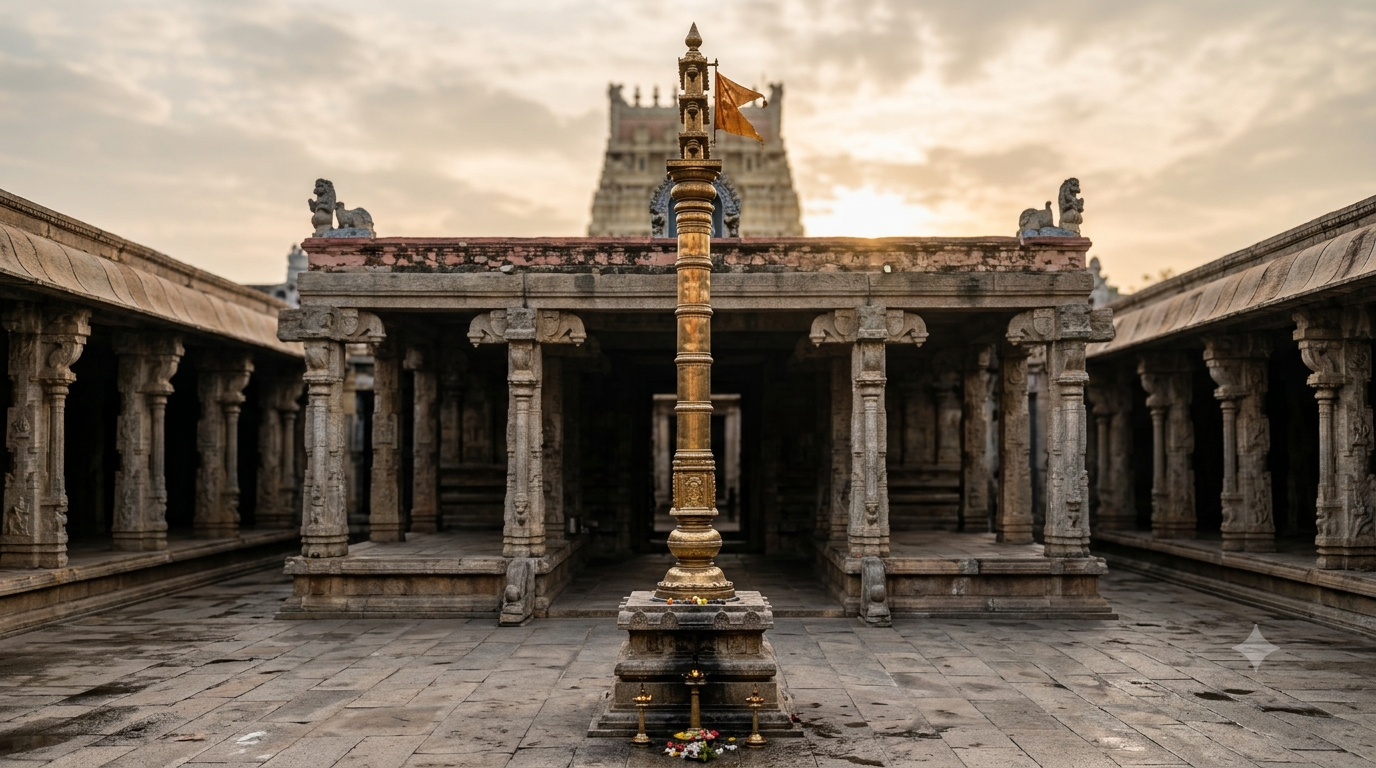
Temple dhwajasthambam meaning is straightforward: it names the sacred flagstaff, not the flag that flies from it. In many South Indian Hindu temples, this tall, slender pillar stands in a court along the approach to the main shrine. Its role becomes clearer when you separate architecture from festival ritual.
TemplesMap is an independent temple heritage guide, not a temple authority. We are not affiliated with the temples mentioned and accept no bookings, donations or payments.
What is the temple dhwajasthambam meaning?
A dhwajasthambam is a temple flagstaff, also written dhvajastambha or dwajasthambam. The Sanskrit words dhvaja and stambha mean flag or banner and pillar. The structure marks a sacred precinct and may also support a ceremonial flag during a festival. It is not itself a gateway, shrine or lamp.
The Getty Research Institute’s Art & Architecture Thesaurus defines a dhvajastambha as a tall, slender, freestanding pillar before an Indian temple. That architectural description is useful because it does not prescribe one design for every temple. Ritual meaning, however, comes from the community and its tradition.
Temple dhwajasthambam meaning at a glance
- Literal sense: a pillar for a flag or sacred banner.
- Tamil name: kodimaram, literally flag tree or flagstaff; kodikkambam is another usage.
- Main role: a permanent architectural and ritual feature where a ceremonial flag may rise.
- Common setting: a temple court or approach area, often near a bali pitha and the deity’s vehicle image.
- Festival action: dhwajarohanam, the raising of a sacred flag, where the temple observes that rite.
- Not the same as: the cloth flag, deepastambha, balipitha, gopuram or vimana.
These are identification clues, not a compulsory checklist. Small shrines, older monuments and different ritual traditions need not contain the same set of features.
Temple dhwajasthambam meaning in Tamil: kodimaram
Temple dhwajasthambam meaning also has a Tamil vocabulary. Here kodi means flag and maram means tree or wood. Together, kodimaram is the familiar name for the temple flagstaff. The expression recalls its wooden form, even when a shiny metal covering hides the core.
Another Tamil expression, kodikkambam, uses kambam for a pole or pillar.
English spellings vary because writers transliterate Sanskrit and regional pronunciation differently. Dhvajastambha, dhwaja stambha, dwajasthambam and dhwajasthambam can refer to the same architectural object. However, a regional spelling does not prove that two temples perform identical rites.
The term also matters during Tamil temple festivals. Kodiyetram or kodi yetram refers to flag-hoisting. That names an event, while kodimaram names the staff on which it takes place. A reader who keeps those two nouns separate will understand festival notices more easily.
What does the flagstaff actually look like?
Look for a relatively narrow vertical shaft rising from a substantial base. This visual clue makes temple dhwajasthambam meaning easier to grasp in photographs. Some examples have a metal-clad surface, ornamental bands, a finial or ritual fittings.
The pole may look golden, although it need not consist of solid gold. Wood under a protective metal sheath is one traditional form, but materials and details differ.
Do not identify the pillar from colour alone. Metal may shine, tarnish or reflect temple lamps, while another example may have a stone finish. Also, do not assume that every flagstaff carries a flag each day. Its permanent role and a temporary festival display are separate things.
Shrī Chitrāpur Math’s account of its dhwajastambha tradition discusses a pole bearing the insignia of the main deity. It also notes Garudastambha as a name at Vishnu-centred temples. This is a named institutional explanation, not proof that every shrine uses one emblem or design.
Temple dhwajasthambam meaning in a temple layout
On many South Indian temple approaches, a flagstaff stands in front of a principal shrine or its hall. However, a line drawn from outer gateway to sanctum is only a teaching model. Temple compounds grow over centuries, so entrances, subsidiary shrines and courts can change the arrangement. A photograph cannot establish a universal layout rule.
Begin by locating the main shrine rather than guessing where the pole ought to be. Our garbhagriha guide explains the inner sanctum. The mandapa guide identifies the halls around it. Those distinctions also help explain temple dhwajasthambam meaning without confusing the pole with an entrance.
Dhwajasthambam versus flag, lamp pillar and balipitha
Several upright or sacred objects may stand close together, so names matter. Their names describe different functions, so appearance alone can mislead. For example, ask whether an object carries a banner, holds lamps, receives offerings or forms an entrance.
| Feature | Main function | How to tell it apart |
|---|---|---|
| Dhwajasthambam or kodimaram | Temple flagstaff | Permanent slender shaft with fittings for a ritual banner |
| Dhvaja or kodi | Flag or banner | Cloth or emblem raised on the staff |
| Deepastambha or deepmal | Lamp pillar | Holds multiple lamps or niches for flames |
| Bali pitha or balipitha | Ritual offering altar | Low platform or pedestal, not a tall mast |
| Gopuram | Gateway tower | Tower above an entrance passage |
| Vimana | Shrine superstructure | Rises above the sanctum in Dravida terminology |
| Vahana image | Deity’s vehicle emblem or sculpture | May be Nandi or Garuda near the shrine approach |
Goa’s official temple architecture overview calls its distinctive lamp towers deepmal or deepa stambha and describes lighting them for festivals. The Indian Museum, Kolkata also describes the oil-holding plates of a deepasthambham. A lamp tower therefore serves a different purpose from a flagstaff, even if both are tall.
How is the dhwajasthambam different from a gopuram?
The dhwajasthambam is a separate pole, while a gopuram is a tower built above an entrance gateway. One may stand within the precinct reached through the other. A gopuram also has a usable passage below it, whereas the flagstaff is not a doorway. Their vertical shapes may look alike, yet they are not interchangeable.
A vimana, meanwhile, is different again. In South Indian temple vocabulary, it refers to the shrine superstructure above the sanctum. If a picture shows a pole, a gateway tower and a shrine tower, it shows three different elements. See our gopuram and vimana comparison for the tower distinction.
Temple dhwajasthambam meaning during flag-hoisting
In temples that observe a flag-raising festival rite, the ceremony publicly marks the opening of a period of worship and procession. The physical flag and the permanent pole play different roles. Ritual explanations go further, but those meanings belong to particular temple traditions and should carry their names. In this setting, temple dhwajasthambam meaning includes both the fixed staff and its ceremonial use.
Tirumala Tirupati Devasthanams (TTD) explains dwajarohanam at Sri Venkateswara Temple as the hoisting of a Garuda flag to begin Brahmotsavam. TTD states that devotees believe Garuda invites divine beings to the celebrations. That is the temple’s Vaishnava ritual account, not a measurable effect produced by the mast.
TTD also identifies dhwajavarohanam as lowering the flag at the festival’s end. Together, the two actions frame the celebration in a way visitors can recognise. Yet a flag visible in one festival photograph does not establish what is flown at another temple or on another date.
At Tirumala’s Venkateswara temple, the Garuda banner identifies a distinct Vaishnava festival setting. TTD describes the flag as a ceremonial invitation to divine participants. Garuda’s presence reflects his relationship with Vishnu and his role during that temple’s worship. This is a devotional interpretation within a named institution’s practice.
The Shri Chitrapur Math account separately notes the name Garudastambha in Vishnu-centred settings. That helps explain why some readers also associate a temple flagstaff with Garuda. However, it does not follow that every Vaishnava temple has an identical finial, cloth design or daily flag-hoisting custom.
What does it symbolise in Shaiva traditions?
For a documented Shaiva example, TTD describes the Nandi flag at Sri Kapileswara Swamy Temple in Tirupati. Its festival account explicitly links the rite to Saivagama practice. Here the banner carries Nandi, Shiva’s vehicle, rather than Tirumala’s Garuda emblem. The contrast shows how the deity’s tradition changes the ritual image.
Nandi may also appear as a separate sculpture or in a Nandi mandapa. That sculpture is not the flagstaff, even when it sits nearby. Here temple dhwajasthambam meaning names the pole, not Nandi’s sculpture. It also does not follow that an image on the festival banner must appear on top of every pole.
Is the dhwajasthambam an energy conductor?
Some modern accounts claim a metal-coated pillar attracts cosmic energy, protects visitors through a physical field or works like a scientific antenna. However, those claims need testable evidence, not merely a religious analogy. Metal and ritual alone do not demonstrate any particular electromagnetic or medical effect.
It is fair to describe the flagstaff as a sacred marker, an emblem of belonging or a focus for worship when a named tradition gives that explanation. It is not fair, however, to present a symbolic reading as settled physics. For temple dhwajasthambam meaning, ritual evidence and architectural evidence answer different questions.
How to identify a kodimaram without guessing
- Find the object. Look for a freestanding shaft rather than a tower containing a gate.
- Check its use. Seek a temple description or ritual notice naming a flagstaff or flag-hoisting.
- Separate its neighbours. A Nandi sculpture, offering altar and lamp tower may stand close by.
- Read the local term. Tamil notices may say kodimaram or kodiyetram; Telugu and Sanskrit-based spellings differ.
- Compare official records. Temple histories and published photographs also outrank assumptions from generic diagrams.
If you cannot identify the object confidently, describe what the image shows instead of assigning a ritual name. Visitors should follow barriers and temple instructions, since the sacred structure may not be open to touch. Respectful observation is enough to learn its form.
Common mistakes when reading temple photographs
A cloth banner is not the same object as the staff below it. Nor is every tall metal column a dhwajasthambam: deepastambhas have a lighting purpose. A cropped photo can hide the lamp holders, pedestal or gateway, so seek a wider view. Look for the whole setting before writing a caption.
Another mistake is turning a common sequence into a rule. For example, a diagram might line up the gopuram, flagstaff, bali pitha, vehicle image and sanctum. Real temple histories, however, are more complex. Our prakaram guide explains why enclosures and added courts affect circulation.
Finally, the material does not decide the meaning. A lustrous metal surface can be a protective covering rather than a solid precious-metal pillar. The name refers to temple ritual, so temple dhwajasthambam meaning does not imply metal purity or invisible energy.
What to remember about the flagstaff
Temple dhwajasthambam meaning rests on a practical distinction: the kodimaram is the standing pillar, and the kodi is the flag. Nearby lamp pillars, offering altars and towers have their own functions. Tirumala’s Garuda banner and Kapileswara’s Nandi banner show why a particular tradition matters more than a universal symbolism chart. When describing an unfamiliar temple, use its own records before interpreting the pole.
Frequently asked questions
What is the temple dhwajasthambam meaning in simple words?
It means the sacred temple flagstaff. The name joins the ideas of a banner and a pillar. In temples that raise ceremonial flags, the staff provides their fixed architectural setting.
Is kodimaram the same as dhwajasthambam?
Yes, kodimaram is a Tamil term for the temple flagstaff. Dhwajasthambam reflects a Sanskrit-derived name. Spelling and pronunciation change across languages, but both can identify the pole.
Does every Hindu temple have a flagstaff?
No universal claim is safe. Many South Indian temples have a dhwajasthambam, while others have different plans, scales or traditions. Check the individual temple’s documentation before expecting one.
What is the difference between dhwajasthambam and deepastambha?
A dhwajasthambam carries or marks a ceremonial banner. A deepastambha holds lamps or provides places to light them. They may both stand in a courtyard, but they serve different functions.
What is the difference between dhwajasthambam and balipitha?
The dhwajasthambam is a tall flagstaff; the balipitha is an altar or pedestal for ritual offerings. Some temples place them near each other. Their proximity, however, does not make them one feature.
Why is Garuda on a temple festival flag?
At Tirumala, TTD says the Garuda banner announces Brahmotsavam and symbolically invites deities to attend. That explanation belongs specifically to the worship of Sri Venkateswara. Other temples may use different emblems.
What does a Nandi flag mean at a Shiva temple?
TTD documents a Nandi flag during the Saivagama-based festival at Sri Kapileswara Swamy Temple. Nandi is associated with Shiva. However, this example should not become a claim that all Shaiva festivals look identical.
Is touching the dhwajasthambam required?
No universal visitor requirement follows from the term. Temple-specific customs and access rules vary, while some poles have protective railings. Follow the local administration’s directions rather than assuming touching is permitted.