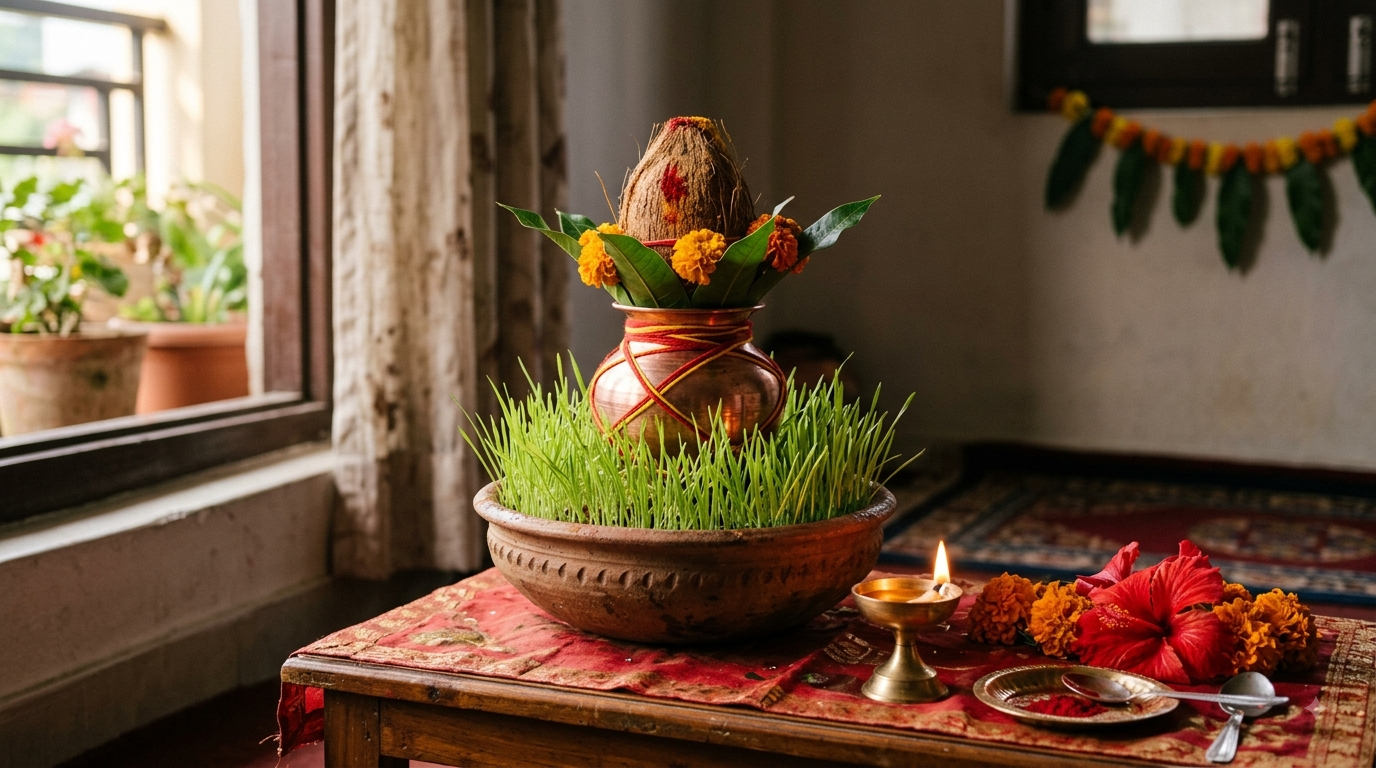
The Navaratri Durga Pooja date and time for 2026 falls on Sunday, 11 October, when Ghatasthapana opens the nine nights. Vijayadashami then closes the festival on Tuesday, 20 October. So the whole run sits nearly three weeks later than the calendar many families still remember.
That late start is not a misprint. Because the Hindu calendar added an extra month in 2026, every autumn festival slid back by roughly twenty days. Yet dozens of pages still list last year’s September dates under a 2026 heading.

Temples Map is an independent festival guide. We are not affiliated with any temple, trust, or panchang authority, and we take no bookings or payments. So always confirm your own muhurat with your family panchang or purohit before you perform puja.
Here is the short version of the Navaratri Durga Pooja date and time, before the day-by-day detail below.
- Festival: Sharad Navaratri, also called Shardiya Navratri, Dasara Navaratri, and Devi Navaratri.
- 2026 start: Sunday, 11 October, when families perform Ghatasthapana.
- Ghatasthapana muhurat: roughly 6:19 AM to 10:12 AM, with an Abhijit window later that morning.
- Durga Ashtami: Sunday 18 October or Monday 19 October, since panchangs split on it this year.
- Maha Navami: Monday, 19 October in the most widely printed reckoning.
- Vijayadashami: Tuesday, 20 October, although Bengal keeps it on 21 October.
- Tithi span: Ashwin Shukla Pratipada to Navami, so ten calendar days this year.
Notably, the goddess is worshipped in nine forms across these nights. Each form carries its own story, so the mood of the puja changes as the week moves on.
Sharad Navaratri 2026 begins on Sunday, 11 October, because Ashwin Shukla Pratipada holds the morning of that day. The tithi itself starts at about 9:19 PM on 10 October. Then it runs until roughly 9:30 PM on 11 October.
Ghatasthapana must happen while Pratipada is active and before the Hindu midday. Therefore the main window for the kalash falls between about 6:19 AM and 10:12 AM. If you miss it, the Abhijit muhurat from about 11:44 AM to 12:31 PM works as the accepted fallback. Those two windows fix the Navaratri Durga Pooja date and time on day one.
These clock times use a North Indian reference city, so your own town will shift by a few minutes. Always set your city on a panchang such as Drik Panchang before you fix the hour.
| Date (2026) | Tithi | Main observance |
|---|---|---|
| Sunday, 11 October | Pratipada | Ghatasthapana before midday, then Shailaputri puja |
| Monday, 12 October | Dwitiya | Brahmacharini puja |
| Tuesday, 13 October | Tritiya | Chandraghanta puja |
| Wednesday, 14 October | Chaturthi | Kushmanda puja |
| Thursday, 15 October | Panchami | Skandamata puja, also Lalita Panchami |
| Friday, 16 October | Shashthi | Katyayani puja, when Bengal begins Durga Puja |
| Saturday, 17 October | Saptami | Kalaratri puja, also Saraswati Avahan |
| Sunday, 18 October | Saptami continues | Mahagauri and Durga Ashtami in some panchangs |
| Monday, 19 October | Ashtami into Navami | Sandhi Puja, then Maha Navami and homam |
| Tuesday, 20 October | Dashami | Vijayadashami, so the festival closes |
Why 2026 Runs for Ten Calendar Days
Navaratri means nine nights, yet this year the calendar shows ten. The reason is simple once you look at the Saptami tithi. It covers two sunrises, on 17 and 18 October, so two civil days share the same tithi label.
Consequently the nine forms still get their nine turns of worship. Only the English dates stretch. This is a normal panchang event, and it happens every few years.
The Navaratri Durga Pooja date sits in mid-October this year because 2026 carried an Adhik Maas, the Hindu leap month. That extra month ran from 17 May to 15 June 2026 as Adhik Jyeshtha. Since a lunar year is about eleven days shorter than a solar year, the calendar inserts a whole extra month roughly every thirty-two months.
Without that correction, festivals would drift out of their seasons. After the insertion, though, every festival that follows it moves later by close to twenty days instead of earlier by eleven.
That single fact explains most of the wrong dates circulating online. Navaratri opened on 22 September in 2025, so a lazy calculation shifts it to mid-September for 2026. The real answer is 11 October, and it is nearly a month away from the guess.
This is also why last year’s saved calendar is never safe for a lunar festival. Whenever an Adhik Maas appears, recheck every single date rather than counting forward from memory.
This is the one point where the Navaratri Durga Pooja date genuinely splits, since panchangs disagree about Durga Ashtami this year. Both readings are defensible. The Ashtami tithi begins at about 8:27 AM on 18 October. Then it ends at roughly 10:51 AM on 19 October.
Because Ashtami is short and ends soon after sunrise, some panchangs place Durga Ashtami and Maha Navami together on Monday, 19 October. Others, including several widely used almanacs, keep Ashtami with Mahagauri on Sunday, 18 October. Neither camp is careless, since each applies a different sunrise rule.
So what should a family actually do? Follow the panchang your household has always followed, and keep Kanya Puja on that day. If you have no family tradition, ask the priest at the temple you plan to visit, because the temple schedule will follow one reckoning.
Sandhi Puja is the one ritual that ignores the argument entirely. It sits at the exact junction of Ashtami and Navami, so it falls in the late morning of 19 October regardless of which day you call Ashtami.
Bengal’s Durga Puja Runs on a Different Set of Dates
Bengali households follow a separate almanac tradition, so their Durga Puja days do not match the North Indian list. The public festival opens on Maha Shashthi, Friday, 16 October 2026. Then it closes with Vijaya Dashami and immersion on Wednesday, 21 October.
- Mahalaya: Saturday, 10 October, when Devi Paksha begins after Pitru Paksha ends.
- Maha Shashthi: Friday, 16 October, with Bodhon, Amantran, and Adhivas in the evening.
- Maha Saptami: Saturday 17 and Sunday 18 October, since the tithi stretches across two sunrises.
- Maha Ashtami: Monday, 19 October, when Pushpanjali, Kumari Puja, and Sandhi Puja take place.
- Maha Navami: Tuesday, 20 October, followed by the Navami homa.
- Vijaya Dashami: Wednesday, 21 October, with Sindoor Khela and visarjan.
So the Navaratri Durga Pooja date you keep depends on your family’s almanac. A Telugu family and a Bengali family can therefore observe Ashtami a day apart and both be correct. Kolkata’s Durga Puja is inscribed on the UNESCO Representative List of Intangible Cultural Heritage, listed in December 2021.
The Nine Forms of Goddess Durga, Night by Night
Every night of Navaratri belongs to one form of the goddess. The sequence stays fixed, although the English dates move each year.
- Shailaputri: daughter of the mountain, worshipped first, right after Ghatasthapana.
- Brahmacharini: the ascetic form, honoured second for patience and study.
- Chandraghanta: the warrior form, invoked third for courage.
- Kushmanda: the creator of the cosmic egg, worshipped fourth.
- Skandamata: mother of Kartikeya, honoured fifth by parents.
- Katyayani: the fierce form, invoked sixth, and often for marriage prayers.
- Kalaratri: the dark, fear-removing form, worshipped seventh.
- Mahagauri: the serene white form, honoured eighth on Ashtami.
- Siddhidatri: the giver of accomplishment, worshipped ninth on Navami.
Colour lists circulate widely for these nine days, yet no panchang authority fixes them. Because the colours change with the weekday sequence, treat any colour chart as a custom rather than a rule.
Ghatasthapana at Home: A Simple Sequence
Ghatasthapana looks elaborate, although the core of it is short. Prepare everything the previous evening, since the muhurat window closes before midday.
- Clean a low table in the north-east corner, then cover it with a fresh red cloth.
- Spread a bed of soil in a wide clay pot, and sow barley seeds across it.
- Fill an earthen kalash with clean water, before adding a coin, supari, and a few mango leaves.
- Place a coconut on the kalash mouth, then tie mauli thread around the neck.
- Set the kalash on the soil bed, and place the Durga image behind it.
- Light the diya inside the muhurat, then offer red flowers, kumkum, and rice.
Keep the lamp and the barley pot undisturbed until Navami. Water the seedlings lightly each morning, because their green growth is read as a good sign.
Aggregator pages distort the Navaratri Durga Pooja date in a handful of predictable ways every single year. Correcting them is the whole reason to check a dated source rather than a search snippet.
- Recycled 2025 dates: several pages still print 22 September to 2 October under a 2026 label, although that was last year’s calendar.
- Navaratri called a ten-day festival: it is nine nights, while Vijayadashami is a separate tenth-day festival that follows it.
- One date for all of India: Bengal’s panjika runs a day behind the northern list, so a single date misleads half the readers.
- Fixed day colours: no almanac authority standardises them, since the colour order tracks the weekday of each tithi.
- A single fixed puja hour: only Ghatasthapana and Sandhi Puja are muhurat-bound, whereas the rest of the day stays open.
Our own earlier version of this page carried the ten-day error too. We have corrected it here, because an inherited mistake is still a mistake.
The Navaratri Durga Pooja date and time also decide when temples fill up. Crowds peak sharply on Ashtami and Navami, so plan around those two days. Vijayawada, Mysuru, and Kolkata draw the heaviest footfall in their regions.
At Vijayawada’s Kanaka Durga temple on Indrakeeladri hill, the Dasara Sharannavaratri utsavams run right through the festival window. The temple decorates the goddess in a different alankaram each day. However, the alankaram list is published closer to the dates, so check the temple’s official announcement rather than an old list. Background on the shrine sits on the NTR district administration site.
If you are planning a temple visit, our guides to the Kanaka Durga Navaratri prasadam list and to Mysuru Dasara cover what happens on the ground. For the tenth day itself, see our Vijayadashami date and timings guide.
Mornings are consistently the calmer window everywhere. Because most families come after work, the queues thicken sharply after 5 PM.
Fasting, Crowds, and a Short Safety Note
Navaratri fasting varies from a single fruit meal to a full nine-day vrat. Yet a long fast is a real physical load, especially in the humid October heat.
Drink water even while fasting, unless your tradition forbids it. Anyone who is pregnant, elderly, diabetic, or on regular medication should speak to a doctor before committing to nine days. Ritual fasting is a devotional practice, so please do not treat it as a medical treatment.
Crowd safety matters just as much. Hill temples such as Indrakeeladri involve long stair climbs, while pandal grounds get tightly packed after dark. Agree a meeting point with your group, keep children close, and follow the marshals near immersion ghats.
Before You Go
The Navaratri Durga Pooja date and time for 2026 open on Sunday, 11 October, with Ghatasthapana in the morning window. The nine forms are worshipped through to Navami on 19 October. Vijayadashami then arrives on 20 October, or on 21 October if you follow the Bengali panjika.
Fix your regional reckoning first, and only then fix your clock times. Because the Adhik Maas moved everything this year, never carry a 2025 calendar forward. Confirm the final muhurat for your own city on a panchang, or ask your family purohit.
Frequently Asked Questions
Sharad Navaratri 2026 begins on Sunday, 11 October, with Ghatasthapana between about 6:19 AM and 10:12 AM. The festival runs to Maha Navami on Monday, 19 October. Vijayadashami follows on Tuesday, 20 October for most of India.
An Adhik Maas, or leap month, ran from 17 May to 15 June 2026. Because that extra lunar month was inserted, every festival after it moved later by roughly twenty days. So Navaratri shifted from late September into mid-October.
Is Durga Ashtami on 18 or 19 October 2026?
Panchangs genuinely differ this year. Ashtami tithi runs from about 8:27 AM on 18 October until roughly 10:51 AM on 19 October. Some almanacs therefore list Durga Ashtami on 18 October, while others merge it with Maha Navami on 19 October. Follow your family panchang or your temple’s schedule.
When is Ghatasthapana muhurat in 2026?
The main Ghatasthapana window on 11 October runs roughly from 6:19 AM to 10:12 AM. If that is missed, the Abhijit muhurat from about 11:44 AM to 12:31 PM is accepted. Ghatasthapana is not performed after the Hindu midday.
When does Durga Puja start in Kolkata in 2026?
Bengal’s public Durga Puja opens on Maha Shashthi, Friday, 16 October 2026. Maha Ashtami falls on Monday, 19 October, and Maha Navami on Tuesday, 20 October. Vijaya Dashami with visarjan follows on Wednesday, 21 October.
Navaratri is nine nights, and Vijayadashami is the separate tenth-day festival that follows. In 2026, though, the calendar shows ten days because the Saptami tithi covers two sunrises. The nine forms still receive nine turns of worship.
Chaitra Navratri 2026 was already observed from 19 to 27 March. It is the spring Navaratri, which ends with Rama Navami. The autumn festival in October is Sharad Navaratri, which is the larger public celebration.
Set your own city on a panchang before you finalise the Navaratri Durga Pooja date and time, since muhurat minutes shift with local sunrise. Drik Panchang and your regional printed almanac both allow this. When two sources disagree, follow the tradition your family already keeps.