The Vijayadashami date and timings for 2026 fall on Tuesday, 20 October 2026. Specifically, in South India the Vijaya Muhurat runs roughly from 1:58 PM to 2:44 PM. Maybe you arrived here after reading that Dussehra happens “at 8:30 AM.” That single-time claim is wrong, and this guide corrects it.
Even so, Vijayadashami has no one fixed clock time. Instead it follows the Dashami tithi of the Hindu month of Ashwin. So the auspicious window shifts by city and by year.
Temples Map is an independent festival guide. We are not affiliated with any temple, trust, or panchang authority. We also take no bookings and no payments. Always confirm your local muhurat on an official panchang before you perform puja.
Vijayadashami Date and Timings at a Glance
Here are the Vijayadashami date and timings in short, before the detail below.
- Festival: Vijayadashami, also called Dussehra, Dasara, and Dashahara.
- 2026 date: Tuesday, 20 October 2026 for most of India, chosen by muhurat.
- Bengal date: Wednesday, 21 October 2026, set by the tithi rule.
- Tithi: Dashami of the bright fortnight (Shukla Paksha) of Ashwin.
- Marks: Rama’s win over Ravana, and Durga’s win over Mahishasura.
- Follows: the nine days of Sharad Navratri; it also opens the run to Diwali.
Vijayadashami Date and Timings in 2026
So families celebrate Vijayadashami on Tuesday, 20 October 2026 across most of India. Notably, the panchang chooses the day by muhurat, not by a fixed hour. So the key detail is not a start time but the auspicious windows within the day.
Clearly, the strongest window is the Vijaya Muhurat. The wider Aparahna time is when families perform the main rituals.
The timings below come from Drik Panchang for a South Indian reference city, Hyderabad. Naturally, muhurat clock times move by a few minutes across cities. So treat these Vijayadashami date and timings as a close guide, then check your own location.
| Timing | Details (20 October 2026) |
|---|---|
| Vijaya Muhurat | 1:58 PM to 2:44 PM (about 47 minutes) |
| Aparahna Puja time | 1:11 PM to 3:31 PM (about 2 hours 20 minutes) |
| Dashami Tithi begins | 12:50 PM on 20 October 2026 |
| Dashami Tithi ends | 2:11 PM on 21 October 2026 |
| Shravana Nakshatra | 3:38 PM (19 Oct) to 6:02 PM (20 Oct) |
In Delhi, the Vijaya Muhurat runs about 1:59 PM to 2:45 PM. So northern and southern cities land within a minute or two of each other. These are volatile, year-specific values. Please re-verify them each year on the official panchang before you plan or perform rituals.
City-Wise Vijayadashami Date and Timings
The date stays the same for most of India, yet the exact minutes do not. A muhurat depends on local sunrise and the sun’s position. So a coastal city and an inland city see slightly different clock times.
Usually the gap is small, often under five minutes. Still, if you want the precise Vijayadashami date and timings for your town, set your city on the panchang first. Bengaluru, Chennai, Mumbai, and Kolkata each show their own local window.
How the Vijayadashami Date and Timings Are Decided
The Ashwin Shukla Dashami tithi fixes the Vijayadashami date and timings, not the English calendar. A tithi is a lunar day, so it never sits still. It drifts against the solar calendar every year.
That is why Dussehra can fall from late September to late October. It is also why last year’s date never guides this year safely.
Most Indian states pick the day when the Dashami tithi covers the afternoon. The key rituals belong to the Aparahna period, so the afternoon matters most. Sometimes the tithi spans two afternoons.
Then the panchang applies rules of nakshatra and muhurat to choose the correct day. Karnataka, Telangana, Andhra Pradesh, Tamil Nadu, and most of North India follow this muhurat-based method.
Why Bengal Sometimes Celebrates a Day Later
West Bengal often observes Vijayadashami one day after the rest of India. The Bengal tradition weights the Dashami tithi itself. It does not weight the afternoon muhurat.
So in 2026 the Bengal date is Wednesday, 21 October. That is also the day of Durga Visarjan, when devotees immerse the Durga idols. A Bengali family and a Telugu family can both be right on different dates.
Vijaya Muhurat versus Aparahna Puja Time
The Vijaya Muhurat is a short, especially auspicious window, since it sits in the early afternoon. People prize it for starting anything new. Meanwhile, the Aparahna time is the wider afternoon period.
Priests and families perform Shami puja, Aparajita puja, and Seema Avalanghan during it. If you have only a few minutes, use the Vijaya Muhurat. If you plan a fuller puja, the Aparahna window gives you room.
What to Do During the Vijayadashami Date and Timings
Vijayadashami is an abhuja muhurat. Tradition treats the whole day as pure enough to begin new work. You do not need to hunt for a separate slot.
Still, most families focus their important acts inside the Vijaya Muhurat. Here is what people commonly do on this day.
- Start something new: a business, a course, music or dance lessons, or a first purchase.
- Ayudha Puja or Shastra Puja: worship of tools, instruments, and vehicles, common in South India.
- Vehicle puja: many people buy or bless a new vehicle on this day.
- Shami puja: honouring the Shami tree, tied to the Pandavas and their hidden weapons.
- Seek elders’ blessings: children touch elders’ feet and receive good wishes.
How Vijayadashami Is Celebrated Across India
Naturally, one festival wears many faces. The look of Dussehra depends heavily on where you stand. Knowing this helps you plan a visit or a puja correctly.
North India: Ramlila and Ravana Dahan
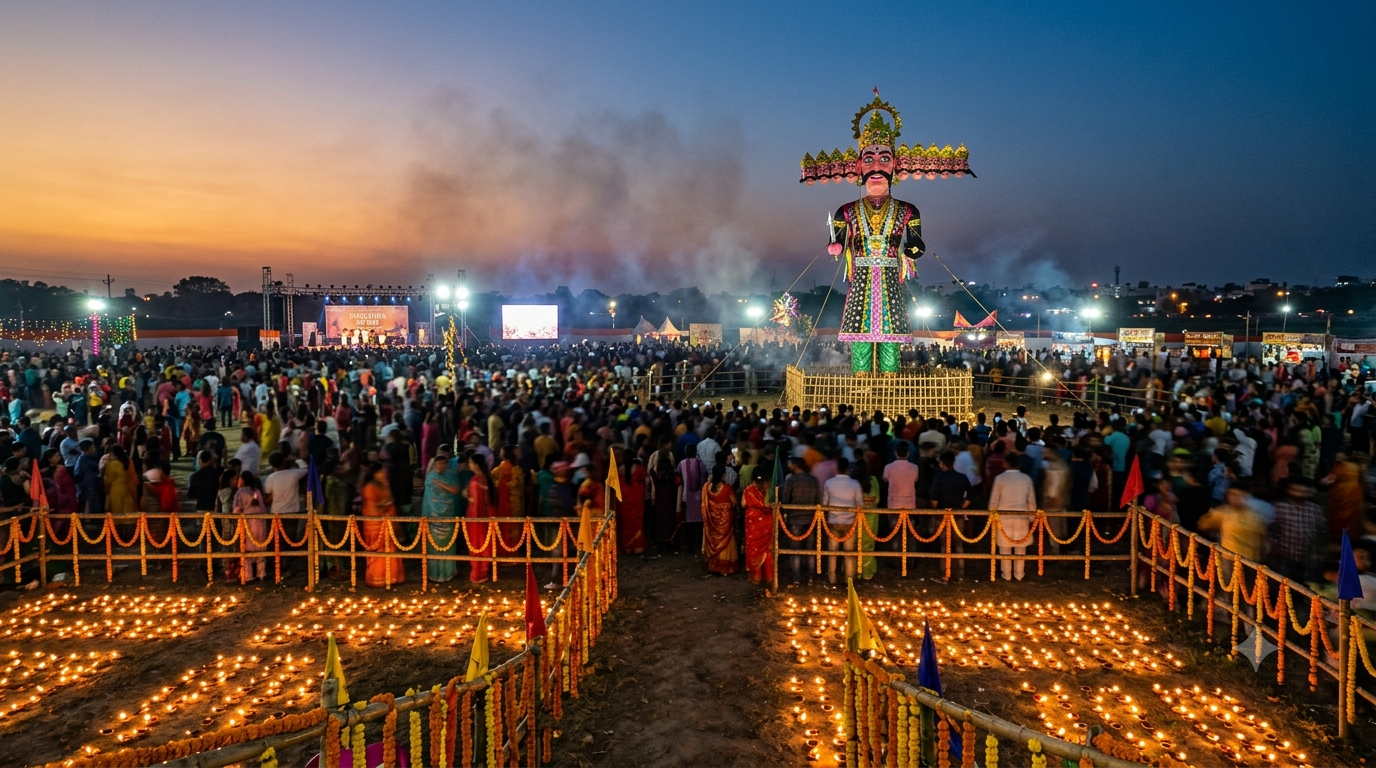
In the north, Dussehra retells the Ramayana. Communities stage Ramlila plays for the nine days before. On Vijayadashami they burn towering effigies of Ravana, Kumbhakarna, and Meghnad.
This Ravana Dahan usually starts after sunset, not during the afternoon muhurat. So plan to arrive in the evening for the spectacle.
South India: Ayudha Puja and Mysuru Dasara
Meanwhile, the south leans toward Ayudha Puja and Saraswati Puja. Families honour tools, books, and knowledge. Karnataka’s Mysuru Dasara is the grandest example.
The lit-up palace and the Jamboo Savari elephant procession draw huge crowds. In Vijayawada, devotees throng the Kanaka Durga temple through Navaratri and Dasara. So check the Kanaka Durga Navaratri details before you go.
East India: Durga Visarjan
In Bengal, Odisha, and Assam, Vijayadashami closes the great Durga Puja. Families perform Sindoor Khela with joy. Then they carry the clay idols of the Goddess to rivers and immerse them.
The Bengal reckoning can differ by a day. So the visarjan may fall after the northern Dussehra.
History and Significance of Vijayadashami
Vijayadashami means “the tenth day of victory,” because dharma wins on it. It joins vijaya, or victory, with dashami, or tenth. Several traditions meet on this one day. Each carries the same message: dharma outlasts adharma.
In the Ramayana, Lord Rama learned a secret from Vibhishana. Ravana held a hidden strength. So Rama worshipped Goddess Durga for nine days and won her blessing.
He then slew Ravana on the tenth day. Those nine nights became Navaratri. The tenth became Vijayadashami.
The Devi tradition remembers a different victory. Goddess Durga battled the buffalo demon Mahishasura across nine nights. She destroyed him on the tenth.
The Mahabharata adds another thread too. The Pandavas recovered their weapons from the Shami tree after their year in hiding. They worshipped the tree before returning to battle.
Because of these stories, the festival links courage, weapons, and fresh beginnings.
Rituals and Puja Vidhanam
Fortunately, the core rituals of Vijayadashami stay simple. Families time them to the Aparahna window. You do not need an elaborate setup to observe the day well at home.
- Shami puja: pray to the Shami tree, or to Shami leaves if no tree is near.
- Aparajita puja: worship Goddess Aparajita for assured success and protection.
- Seema Avalanghan: the symbolic “crossing of the boundary” toward victory.
- Ayudha and vehicle puja: clean tools or vehicles, then offer flowers and turmeric-kumkum.
Finally, families usually finish with a shared sweet. Then they seek blessings from elders. Vijayadashami sits right before Diwali. So many people also begin their festival shopping and home cleaning around now.
Planning Around the Vijayadashami Date and Timings
Clearly, a little planning turns a busy festival day into a smooth one. First, fix your regional date, since Bengal may differ from the south. Next, note your city’s Vijaya Muhurat and keep that slot free.
Do the important acts, such as a new purchase or Ayudha Puja, inside that window. Save the evening for Ramlila or Ravana Dahan if your town holds one. Keep a simple thali ready with flowers, kumkum, and a sweet.
That way the Vijayadashami date and timings work around your day, not against it.
What Most Guides Get Wrong
Many aggregator pages repeat errors that can mislead you. Getting these right is the whole point of checking a trusted source.
- The “fixed 8:30 AM” myth: Vijayadashami has no universal clock time. The key acts belong to the afternoon Vijaya Muhurat and Aparahna window.
- One date for all of India: Bengal often celebrates a day later. So never copy a northern date for an eastern family.
- Reusing last year’s timings: the day rides on a lunar tithi. So the Vijayadashami date and timings change every year, and even by city.
A Quick Safety Note
Navaratri fasting leads into Vijayadashami. If you fasted for nine days, break it gently and stay hydrated. Public Ravana Dahan grounds and immersion ghats draw huge, tightly packed crowds.
Effigy burnings involve fire and firecrackers. Keep children close, watch your footing near water, and follow the marshals. Anyone elderly, pregnant, or managing a medical condition should plan for shade, rest, and easy exits.
Before You Go
The Vijayadashami date and timings for 2026 land on Tuesday, 20 October. The Vijaya Muhurat falls in the early afternoon. The Aparahna window holds the main rituals.
Pick your day by your regional tradition. Do the important acts in the muhurat. Then confirm the exact minutes for your city on an official panchang.
Whether you burn Ravana, worship your tools, or immerse the Goddess, the meaning stays the same. For the fuller nine-day context, read our guide to the Navaratri Durga Pooja dates.
Frequently Asked Questions
What is the Vijayadashami date and timings in 2026?
Vijayadashami falls on Tuesday, 20 October 2026 across most of India. The Vijaya Muhurat runs roughly 1:58 PM to 2:44 PM as a South India reference. The wider Aparahna puja window is about 1:11 PM to 3:31 PM. West Bengal observes it on 21 October.
Why does Dussehra have no single fixed time?
Dussehra follows the Dashami lunar tithi, not a fixed hour. The rituals tie to the afternoon Vijaya Muhurat and Aparahna period. Those windows shift by year and by city. So any “8:30 AM” style claim is inaccurate.
Is Vijayadashami the same as Dussehra and Dasara?
Yes. Vijayadashami, Dussehra, Dasara, and Dashahara all name the same festival. Notably, northern India tends to say Dussehra. The south and Karnataka often say Dasara.
Why does West Bengal celebrate a day later?
Bengal weights the Dashami tithi rather than the afternoon muhurat. So its Vijayadashami can land one day after the rest of India. In 2026, the Bengal date and Durga Visarjan fall on Wednesday, 21 October.
What can I start on Vijayadashami?
Vijayadashami is an abhuja muhurat, treated as pure enough to begin anything new. People start businesses, studies, and music or dance lessons. Many buy vehicles or perform Ayudha Puja on their tools, ideally within the Vijaya Muhurat.
Vijayadashami is the tenth day, right after the nine nights of Sharad Navratri. Navaratri honours Goddess Durga’s battle. The tenth day marks her victory, as well as Lord Rama’s defeat of Ravana.
Where can I confirm the Vijayadashami date and timings for my city?
Use an official panchang such as Drik Panchang. It lets you set your city and shows the local Vijaya Muhurat, Aparahna time, and tithi. Because the Vijayadashami date and timings vary slightly by location, always check your own city first.