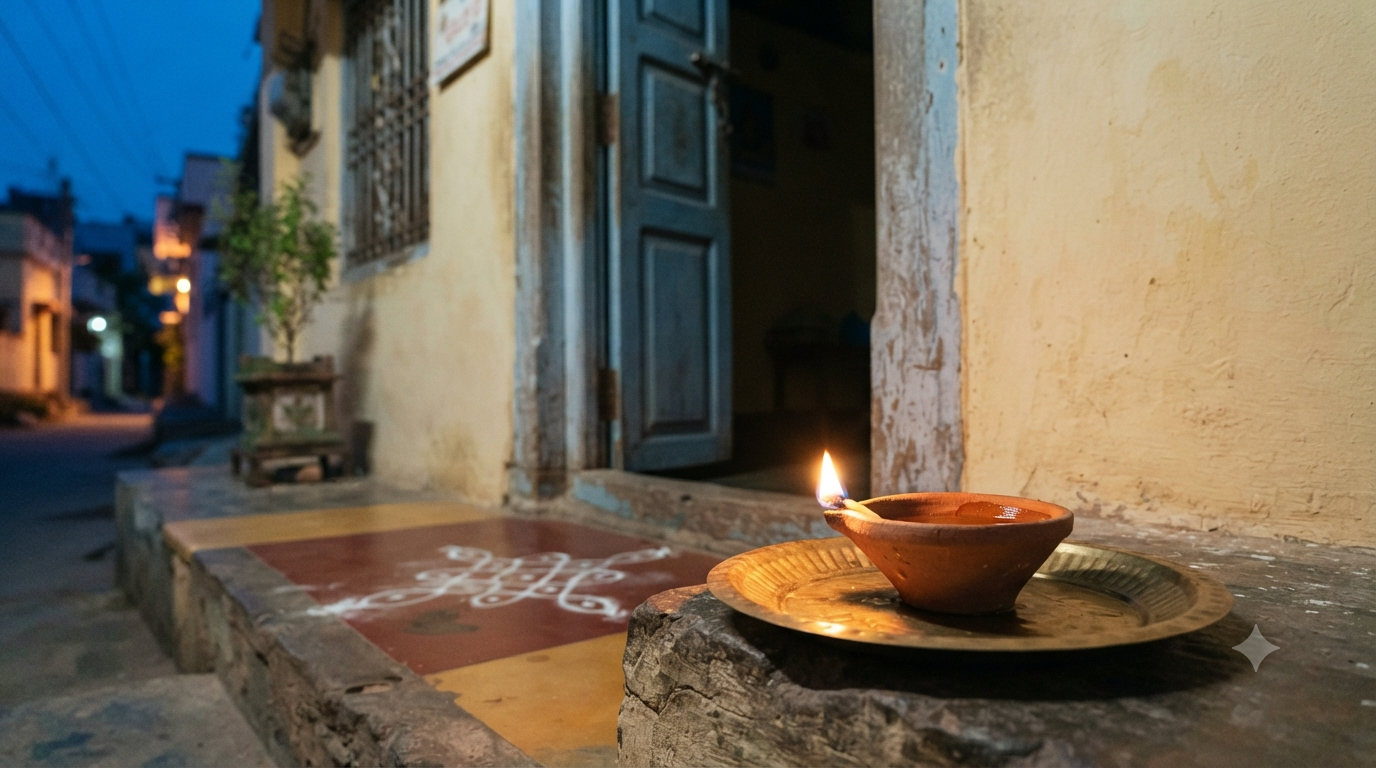
Yama Deepam 2026 Date falls on Friday, 6 November 2026, and the lamp is traditionally offered after sunset during the evening Sandhya period. For Telugu families in Andhra Pradesh and Telangana, the key point is simple: this is a Dhanatrayodashi observance, not the main Deepavali night. Tradition places the lamp outside the home facing south, the direction linked with Lord Yama.
Temples Map is an independent Hindu festival and temple guide. We are not affiliated with any temple, trust or endowments department, and we do not accept pooja bookings, donations or payments. Panchang timings change by city, so use the local-city setting on a reliable panchang before fixing your exact time.
Yama Deepam 2026 Date at a Glance
- Date: Friday, 6 November 2026.
- Observance: Yama Deepam or Yama Deepa Daan on Dhanatrayodashi.
- Trayodashi Tithi: about 10:30 AM on 6 November to about 10:47-10:48 AM on 7 November in Indian Standard Time.
- Hyderabad reference: 5:42 PM to 6:58 PM for Sayan Sandhya in the LB Nagar/Hyderabad area.
- Direction: place the lamp outside the home facing south.
- Common lamp: a clay diya with cotton wick; sesame oil is widely used in Telugu households and other regional traditions.
- Main Deepavali: Sunday, 8 November 2026.
Two independent calendar references place Dhanteras and Yama Deepam on 6 November 2026. Drik Panchang gives the Yama Deepam date and city-based Sandhya timing, while Prokerala places Dhanteras on 6 November in its 2026 Diwali calendar.
Yama Deepam 2026 Date and Puja Timing
Observe Yama Deepam 2026 on the evening of Friday, 6 November. The reason is not the weekday alone. Trayodashi prevails during the evening period used for Dhanatrayodashi and Yama Deepa Daan, so the ritual belongs to that evening.
For Hyderabad, Drik Panchang gives the Yama Deepam Sayan Sandhya window as 5:42 PM to 6:58 PM for the LB Nagar area. However, Vijayawada, Tirupati, Visakhapatnam, Nellore and other cities have different sunset times. Therefore, do not copy one fixed clock time for all of Andhra Pradesh and Telangana.
The tithi itself begins at about 10:30 AM on 6 November and ends at about 10:47-10:48 AM on 7 November. A second daily panchang source, Panchangam.org, gives the same Trayodashi transition within about one minute.
For families outside Hyderabad, the safest method is to open the city selector on the panchang source and note the local Sayan Sandhya window. This matters because sunset shifts across Andhra Pradesh and Telangana. Even a small location change can move the preferred clock time by several minutes.
Why the date can look confusing in a Telugu Panchangam
At sunrise on 6 November, Dwadashi is still running in many Telugu panchang displays. Trayodashi begins later that morning. Yet the evening tithi decides this observance, so Dhanteras and Yama Deepam still fall on 6 November.
Month names also create confusion. Telugu Amanta calendars call this Ashwayuja Krishna Paksha, while many North Indian Purnimanta calendars call the same lunar phase Kartika Krishna Paksha. The civil date and tithi transition are the useful points to compare.
Yama Deepam 2026 Date Direction and Lamp Placement
The traditional direction for Yama Deepam 2026 is south. Place the diya outside the main entrance or in another safe exterior spot, with the flame or lamp orientation toward the south according to your family custom. Hindu ritual tradition links the south direction with Yama.
This south-facing placement sets Yama Deepa Daan apart from many everyday lamp-lighting practices. A temple guidance page from Shree Sita Ram Mandir also describes taking the lit diya outside and placing it toward the south.
Apartment residents do not need to create a fire hazard to follow the custom. Use a stable metal or stone base near the doorway, keep the flame away from fabric and footwear, and follow building fire rules. If an open flame is unsafe, family tradition should never override basic safety.
Simple Yama Deepam Puja Procedure for Telugu Families
The ritual can be simple because Yama Deepa Daan is mainly an evening lamp offering. Household customs vary, so follow your family sampradaya first when it differs from a general guide. The steps below describe a widely followed home practice rather than a compulsory universal rule.
- Clean the entrance before sunset. Choose a stable place outside the main door where the lamp can sit safely.
- Prepare a clay diya. Add sesame oil and a cotton wick. Some families use a four-wick or four-faced lamp, while others use one diya.
- Wait for the local evening window. Light the lamp after sunset during Sayan Sandhya or Pradosh, based on your city.
- Face the lamp south. Keep the diya at the threshold or another safe exterior position.
- Offer a short prayer to Yama Dharmaraja. Recite the traditional verse if your family uses it.
- Pray for the family’s well-being. In tradition, devotees ask for protection from untimely death and remember the limits of human life.
- Keep the area safe. Do not leave the flame where children, pets, wind or loose cloth can reach it.
What oil and how many wicks should you use?
There is no single practice followed by every region. Sesame oil is common in several Telugu and South Indian traditions, while some North Indian families use mustard oil. Many families prefer a four-wick lamp, while others use one clay diya.
Therefore, treat the lamp style as a family custom rather than a test of whether the prayer is valid. The date, evening timing and south-facing placement are the more consistent elements across the sources reviewed.
Yama Deepam 2026 Date Telugu Mantra
A commonly recited Yama Deepa Daan verse appears in Telugu religious references and older panchang traditions. Small wording differences exist between recensions, so families may use the version taught by their priest or elders.
తెలుగు శ్లోకం:
మృత్యునా పాశదండాభ్యాం కాలేన శ్యామయా సహ ।
త్రయోదశ్యాం దీపదానాత్ సూర్యజః ప్రీయతాం మమ ॥
Transliteration:
Mrityunā pāśadaṇḍābhyāṁ kālena śyāmayā saha |
Trayodaśyāṁ dīpadānāt sūryajaḥ prīyatāṁ mama ||
The sense of the prayer is a request that Yama, described as the son of Surya, be pleased by the lamp offering made on Trayodashi. Devotees traditionally connect the prayer with protection from untimely death. This is a matter of religious faith, not a medical or scientific guarantee.
Why Is Yama Deepam Lit on Dhanatrayodashi?
Yama Deepam belongs to the Dhanatrayodashi evening because Hindu tradition combines more than one observance on this tithi. Dhanteras traditions honour Dhanvantari and include wealth-related worship, while Yama Deepa Daan adds a separate lamp offering after sunset.
A popular legend tells of King Hima’s young son, whose horoscope foretold death from a snake bite soon after marriage. His wife kept him awake, filled the entrance with light and ornaments, and sang through the night. In the story, Yama arrives in serpent form but leaves without taking the prince.
The story explains why later tradition connects a lamp at the threshold with prayer against untimely death. It should be read as sacred folklore and devotional tradition rather than as a historical account.
Yama Deepam, Naraka Chaturdashi and Yama Dwitiya Are Different
One of the biggest calendar mistakes is treating every Yama-related Diwali observance as the same event. They are not. In 2026, Yama Deepam, main Deepavali and Yama Dwitiya fall on different civil dates.
| Observance | 2026 date | Main idea |
|---|---|---|
| Yama Deepam / Dhanatrayodashi | 6 November, Friday | Evening lamp offering to Yama |
| Naraka Chaturdashi / Deepavali observances | 8 November, Sunday | Deepavali rites, regional morning and evening worship |
| Yama Dwitiya / Bhai Dooj | 11 November, Wednesday | Brother-sister observance linked with Yama and Yamuna |
Drik Panchang lists Yama Deepam with Dhanteras on 6 November and Yama Dwitiya with Bhai Dooj on 11 November. Therefore, a page that labels 11 November as the Yama Deepam lamp day is mixing two different rituals.
Common Yama Deepam 2026 Mistakes to Avoid
- Reusing 2022 timings: lunar tithis move each year, so old dates and muhurats are not reusable.
- Using one all-India clock time: Sandhya and Pradosh depend on local sunset, so select your city.
- Confusing the tithi start with the lamp time: Trayodashi begins in the morning, but the lamp is an evening observance.
- Combining Yama Deepam with Yama Dwitiya: the latter is the Bhai Dooj observance several days later.
- Turning a custom into a rigid rule: wick count, lamp material and oil can vary by family and region.
- Ignoring fire safety: a south-facing lamp should still sit on a stable, non-flammable base.
If you are also planning the main festival worship, see the Temples Map guide to Dhana Lakshmi Pooja procedure in Telugu. Families observing a Deepavali vow can also check the refreshed Deepavali Nomulu 2026 timings.
What Telugu Households Should Remember
The most useful rule is to separate the date from the clock time. The 2026 observance falls on 6 November, while your own city determines the evening clock window. That approach prevents the common mistake of copying a Delhi, Mumbai or Hyderabad time into every location.
Also keep Yama Deepam separate from the main Deepavali puja. In 2026, main Deepavali falls on 8 November. Telugu families moving into Karthika Masam can then refer to the site’s Karthika Masam 2026 date guide for the next set of observances.
Before lighting the diya, check the local weather too, since strong wind can make an outdoor flame unsafe. A sheltered, non-flammable spot keeps the ritual practical without changing its devotional purpose.
Yama Deepam 2026 Date: Final Checklist
- Use Friday, 6 November 2026.
- Check your city’s sunset-based Yama Deepam or Sandhya window.
- Place the diya outside in a safe position facing south.
- Use your family’s customary oil and wick arrangement.
- Recite the Yama Deepa Daan verse if it is part of your practice.
- Do not confuse Yama Deepam with Yama Dwitiya on 11 November.
- Treat promised spiritual benefits as matters of faith, not guaranteed outcomes.
Frequently Asked Questions
When is Yama Deepam 2026 Date?
Yama Deepam 2026 is on Friday, 6 November 2026. It coincides with Dhanatrayodashi or Dhanteras, and families observe it in the evening after sunset. Main Deepavali falls later, on Sunday, 8 November 2026.
What is the Yama Deepam 2026 Date time in Hyderabad?
For the LB Nagar/Hyderabad area, Drik Panchang gives Sayan Sandhya from 5:42 PM to 6:58 PM on 6 November. Other cities differ because the timing follows local sunset, so always choose your city before using a muhurat.
Which direction should Yama Deepam face?
The diya is traditionally placed outside the home facing south. Hindu ritual tradition associates the south direction with Yama, which is why this lamp is deliberately oriented that way.
Is Yama Deepam done on Dhanteras or Naraka Chaturdashi?
For the 2026 calendar used here, families observe Yama Deepam on Dhanatrayodashi, Friday, 6 November. Naraka Chaturdashi and the main Deepavali observances fall later, so keep those dates separate.
Is Yama Deepam the same as Yama Dwitiya?
No. Yama Deepam is the lamp offering on Dhanatrayodashi, while Yama Dwitiya belongs with Bhai Dooj. In 2026, Yama Dwitiya falls on Wednesday, 11 November.
Can I use one wick instead of four?
Yes, many families use a single clay diya, while others prefer a four-wick lamp. Customs vary by region and lineage, so follow your household tradition rather than treating one wick count as universal.
Which oil is used for Yama Deepam?
Sesame oil is common in Telugu and several South Indian practices, while mustard oil appears in some North Indian traditions. If your family has an established practice, follow that custom.
Can Yama Deepam be kept inside the house?
The widely followed practice is to place it outside near the entrance or on the southern side. If an exterior flame is unsafe or prohibited, choose the safest permitted arrangement and consult your family priest about a suitable alternative.
Does lighting Yama Deepam guarantee protection from accidents or death?
The ritual does not guarantee any physical outcome. Devotees perform it as an act of faith and prayer for well-being and protection. It should never replace normal safety measures, medical care or other practical precautions.