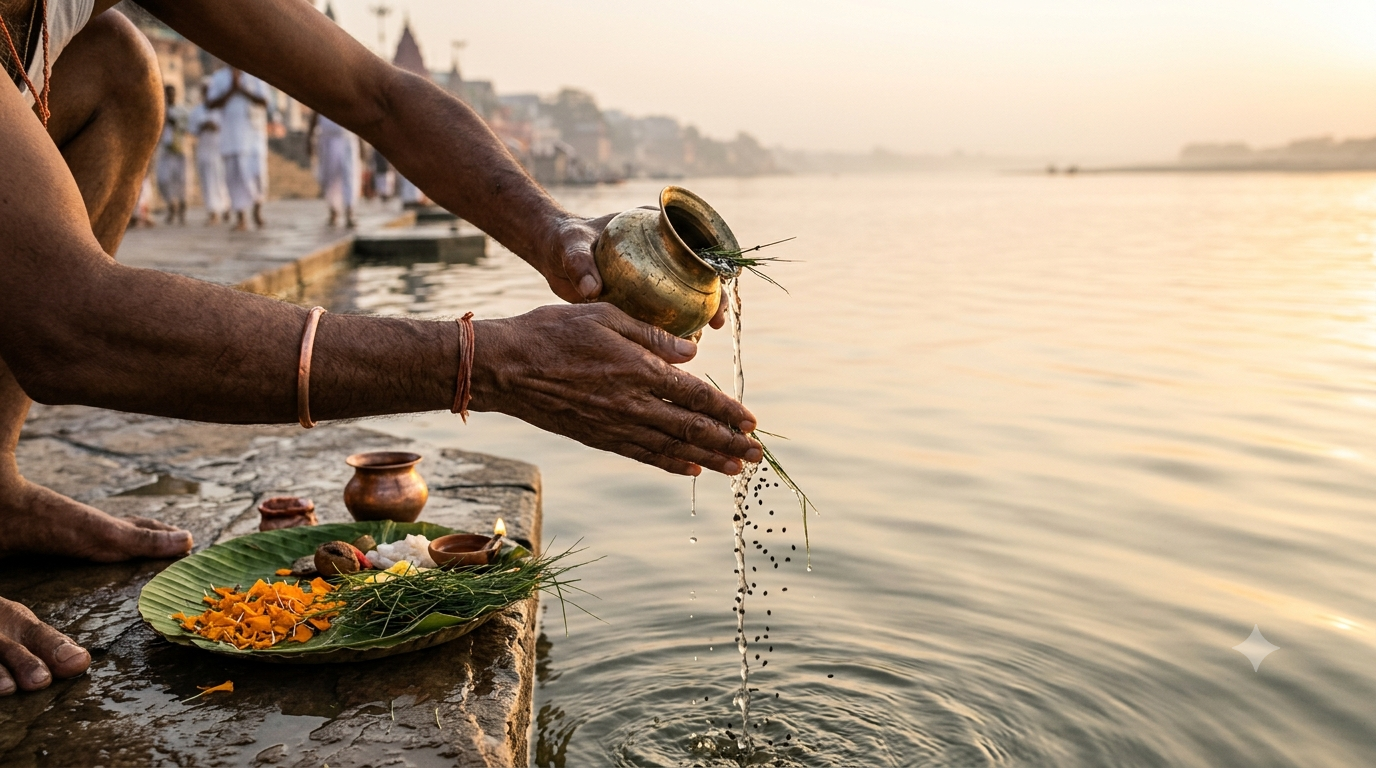
The Mahalaya Pitru Paksha date in 2026 runs as a fortnight from 26 September to 10 October. The most important day, Mahalaya Amavasya, falls on Saturday, 10 October 2026. This is the annual sixteen-day window when Hindu families offer shraddha, tarpan, and pind daan to their ancestors.
Because the fortnight follows the lunar calendar, the Mahalaya Pitru Paksha date moves every year. A page that still shows an old year is simply wrong. So here you get the verified 2026 dates, the full tithi calendar, the correct ritual timing, and the regional differences most guides skip.

Temples Map is an independent information guide. We are not affiliated with any temple, math, or priestly body, and we take no bookings, donations, or payments. For panchang timings in your own city, use the Drik Panchang links below or ask a local purohit.
Mahalaya Pitru Paksha Date 2026 at a Glance
- Fortnight: 26 September 2026 to 10 October 2026
- Opens with: Purnima Shraddha on 26 September, then Pratipada on 27 September
- Ends with: Sarva Pitru Amavasya, or Mahalaya Amavasya, on 10 October 2026
- Best ritual window: the afternoon Aparahna Kala on each shraddha day
- Lunar span: Bhadrapada Krishna Paksha into Ashwin Amavasya
- What follows: Sharadiya Navratri and Durga Puja begin the very next day
Mahalaya Pitru Paksha date and time in 2026
The Mahalaya Pitru Paksha date and time in 2026 rests on two anchors. The fortnight starts on 26 September and closes on Mahalaya Amavasya, 10 October 2026.
The opening day, 26 September, is Bhadrapada Purnima Shraddha. Pratipada, the first tithi of the dark fortnight, follows on 27 September. After that, each lunar day carries its own shraddha until the new moon.
Mahalaya Amavasya, the closing day, is the single most significant date of the period. According to Drik Panchang, the Amavasya tithi runs from the evening of 9 October 2026 to the evening of 10 October 2026. The exact clock time shifts by region, so treat the window below as indicative and confirm it for your city.
- South, North, and East India: roughly 8:58 PM on 9 October to 8:33 PM on 10 October
- Western India (Maharashtra, Gujarat, Goa): roughly 9:36 PM on 9 October to 9:20 PM on 10 October
Do you have to finish rituals during the night tithi?
No, and this is where many pages mislead readers. The Amavasya tithi may span the night. Yet you perform shraddha and tarpan during the daytime of 10 October, not before dawn. The correct window is the Aparahna Kala, the afternoon period, with the earlier Kutup and Rohina muhurats.
So you need not rush a ritual at 3 AM. Instead, plan it for the day itself, and check the muhurat on a panchang for your location.
Why Mahalaya Amavasya matters
Mahalaya Amavasya honours the pitrs, the departed ancestors of a family line. Hindus believe the souls of ancestors visit the earthly realm during Pitru Paksha. They return to Pitru Loka, their abode, on the Amavasya day. Devotees offer water and food to give them peace and to repay pitru rin, the debt owed to those who came before.
The custom traces to the Mahabharata. When the warrior Karna died and reached the divine realm, the gods offered him gold and jewels to eat instead of food. Karna asked Yama why. Yama explained that Karna had given away wealth in charity, yet had never offered food to his ancestors.
So Yama allowed Karna to return to earth for fifteen days to complete the rites. We remember that fortnight today as Pitru Paksha, which is why the story sits at the heart of these rituals.
Mahalaya Pitru Paksha Date: 2026 Shraddha Calendar
You should ideally perform shraddha on the tithi that matches the lunar day of an ancestor’s death. If you know that tithi, use the table below to find the 2026 date. When the death date is unknown, Sarva Pitru Amavasya on 10 October covers all ancestors at once.
| Shraddha Tithi | 2026 Date | Note |
|---|---|---|
| Purnima Shraddha | 26 September | Bhadrapada full moon; opens the period |
| Pratipada | 27 September | First tithi of the dark fortnight |
| Dwitiya | 28 September | |
| Tritiya | 29 September | |
| Chaturthi | 30 September | |
| Panchami | 1 October | Often kept for those who died young |
| Shashthi | 2 October | |
| Saptami | 3 October | |
| Ashtami | 4 October | |
| Navami | 5 October | Matri Navami; for mothers and female ancestors |
| Dashami | 6 October | |
| Ekadashi | 7 October | |
| Dwadashi / Trayodashi | 8 October | |
| Chaturdashi | 9 October | Often kept for unnatural deaths |
| Sarva Pitru Amavasya | 10 October | Mahalaya Amavasya; for all ancestors |
Tithi overlaps can merge two lunar days onto one calendar date. So a panchang for your region may shift a single row by a day. That is normal for lunar dating, and it is why we point you to Drik Panchang for the final check.
How the Mahalaya Pitru Paksha date is fixed each year
The Mahalaya Pitru Paksha date is not tied to the Gregorian calendar. It always begins the day after Bhadrapada Purnima and ends on Ashwin Amavasya. Because these are lunar markers, the fortnight drifts across September and October each year.
In some years the calendar inserts an extra lunar month, called Adhika Masa. This leap month pushes later festivals back by roughly four weeks.
This is exactly why you must never carry an old year’s date forward. The 2025 fortnight ran in early-to-mid September, while 2026 lands much later, from 26 September. Verifying each year against a fresh panchang is the only safe method, so we have done that for the coming years too.
- 2026: 26 September to 10 October
- 2027: around 15 September to 29 September
- 2028: around 3 September to 18 September
The 2027 and 2028 windows are early lunar estimates. So confirm them nearer the time rather than treating them as final.
Mahalaya Pitru Paksha date across different regions
India shares the Mahalaya Pitru Paksha date, yet regions read the same Amavasya differently. In Bengal, Odisha, and Assam, families celebrate the closing Amavasya as Mahalaya. It marks the dawn of Devi Paksha and the awaited arrival of Goddess Durga. People there listen to the Mahishasura Mardini broadcast at daybreak, and the festive Navaratri Durga Puja season begins from this point.
The Telugu and Kannada states keep the day mainly for pitru karya, the ancestral rites. It sits just before Sharadiya Navratri in the Ashwayuja Masam. Because tithi start and end times vary between panchangs, a family in Andhra Pradesh may see a slightly different clock window than one in Maharashtra. The calendar date of 10 October 2026 stays the same, while the muhurat timing is what shifts.
How to observe Pitru Paksha rituals
The rites are simple, and you can perform most of them at home with a priest’s guidance. The core practice is daily tarpan, an offering of water mixed with black sesame seeds while you remember ancestors by name. Feeding animals also matters, since tradition treats a crow as an ancestral soul. This practice is known as kagwal.
- Bathe in the morning, adding a little Ganga jal to the water if a river is not nearby.
- Wear clean white or unstitched clothing, and sit facing south, the direction of Yama.
- Offer jal and til, water and sesame, as tarpan while you name your ancestors.
- Prepare simple sattvic food such as kheer, rice, dal, and pumpkin for the offering.
- Feed a crow, a cow, or a dog, and share a portion with a brahmin or a needy person.
- On the death tithi, or on Sarva Pitru Amavasya, perform pind daan with rice balls under guidance.
Devotees consider Gaya in Bihar, Varanasi, and Prayagraj the most sacred sites for pind daan. Yet the rituals carry full meaning at home too, so a pilgrimage is not compulsory.
Shubh muhurat for shraddha
Shraddha is a parvan rite, and the traditional windows are Kutup Muhurat and Rohina Muhurat. The Aparahna Kala follows them. You offer tarpan at the close of the shraddha.
On Sarva Pitru Amavasya, families often extend the observance across two to three hours because the day carries so much weight. Confirm the precise muhurat for 10 October 2026 on a panchang set to your city.
What to avoid during the fortnight
Pitru Paksha is a solemn, reflective period rather than a festive one. So families traditionally pause auspicious activities until the fortnight ends and Navratri begins. Most households keep life simple during these days.
- Weddings, housewarmings, and other mangal karya usually wait until later.
- People often defer major purchases such as gold, vehicles, or property.
- Many households keep a sattvic diet and skip onion, garlic, and non-vegetarian food.
- New ventures often wait for the Devi Paksha that follows.
Pitru Dosha: what people look for
In Vedic astrology, an astrologer reads Pitru Dosha from the horoscope and links it, by belief, to unfulfilled ancestral duties. These are matters of faith and tradition, not verified medical or scientific outcomes, so treat them that way. Many families treat Pitru Paksha as the prime window to address the dosha through shraddha. Practitioners commonly point to the patterns below.
- Recurring health issues within the family
- Obstacles or repeated delays in career and success
- Difficulty finding a match, or delays in marriage
- Challenges related to children in the family
- A general sense of stagnation despite real effort
If any of this concerns you, a qualified astrologer can read your chart. Still, the remedy on offer is ritual, and it is not a substitute for professional medical or financial advice.
What if you miss a shraddha tithi?
This is the practical question official calendars rarely answer, so here is the honest picture. If you miss the exact tithi of your ancestor, you are not out of options. Sarva Pitru Amavasya on 10 October 2026 serves exactly this need. Shraddha done that day reaches all ancestors, known and unknown.
If you cannot manage even the Amavasya, tradition allows a Hiranya shraddha, a simplified offering, under a priest’s direction. Should the whole fortnight pass, families generally wait for the next year’s Pitru Paksha rather than picking a random later date. There is no shortcut around the tithi framework, so plan the day in advance.
A note on fasting and health
Some devotees fast until the puja ends, taking only water or a single sattvic meal. If you are elderly, pregnant, diabetic, or on regular medication, do not fast without checking with your doctor first. Ancestral rites aim to bring peace, so protecting your own health fits fully within them.
Mahalaya Pitru Paksha Date: Key Points to Remember
For 2026, mark the fortnight from 26 September to 10 October. Keep Saturday, 10 October, free for Mahalaya Amavasya, the day that covers every ancestor. Match your shraddha to the death tithi where you can, and lean on Sarva Pitru Amavasya when you cannot.
Above all, verify the muhurat for your own city on a trusted panchang such as Drik Panchang before you begin. The calendar date is fixed, while the timing stays local.
Frequently Asked Questions
What is the Mahalaya Pitru Paksha date in 2026?
The Mahalaya Pitru Paksha date in 2026 is the fortnight from 26 September to 10 October. It opens with Purnima Shraddha on 26 September. It ends with Sarva Pitru Amavasya, or Mahalaya Amavasya, on Saturday, 10 October 2026.
When is Mahalaya Amavasya in 2026?
Mahalaya Amavasya, also called Sarva Pitru Amavasya, falls on Saturday, 10 October 2026. The Amavasya tithi runs from the evening of 9 October to the evening of 10 October. The exact clock time varies by region.
At what time should shraddha be performed on Mahalaya Amavasya?
You perform shraddha during the daytime of 10 October 2026, in the Aparahna Kala or afternoon window, with the Kutup and Rohina muhurats. You need not complete rituals during the night when the tithi technically starts. Confirm the muhurat on a local panchang.
Can I do shraddha if I do not know my ancestor’s death tithi?
Yes. Sarva Pitru Amavasya on 10 October 2026 exists for exactly this situation. Rituals you perform that day reach all ancestors, including those whose death date is forgotten or unknown.
Why does the Mahalaya Pitru Paksha date change every year?
The Mahalaya Pitru Paksha date follows the Hindu lunar calendar, not the Gregorian one. It always runs from just after Bhadrapada Purnima to Ashwin Amavasya. A leap month in some years shifts it further, so it drifts across September and October each year.
Is Mahalaya the same as the start of Durga Puja?
In Bengal, Odisha, and Assam, Mahalaya Amavasya marks the ceremonial threshold of Durga Puja and the start of Devi Paksha. The very next day begins Sharadiya Navratri across much of India. So the two observances sit back to back.
What should be avoided during Pitru Paksha?
Families generally avoid auspicious activities such as weddings, housewarmings, and major purchases during the fortnight. It is a reflective period, so people keep their conduct simple. They reserve celebrations for the Navratri that follows.
Where is pind daan traditionally performed?
Devotees rate Gaya in Bihar the most sacred site for pind daan, followed by Varanasi and Prayagraj. However, you can perform the rituals at home under a priest’s guidance, so a pilgrimage is not mandatory.