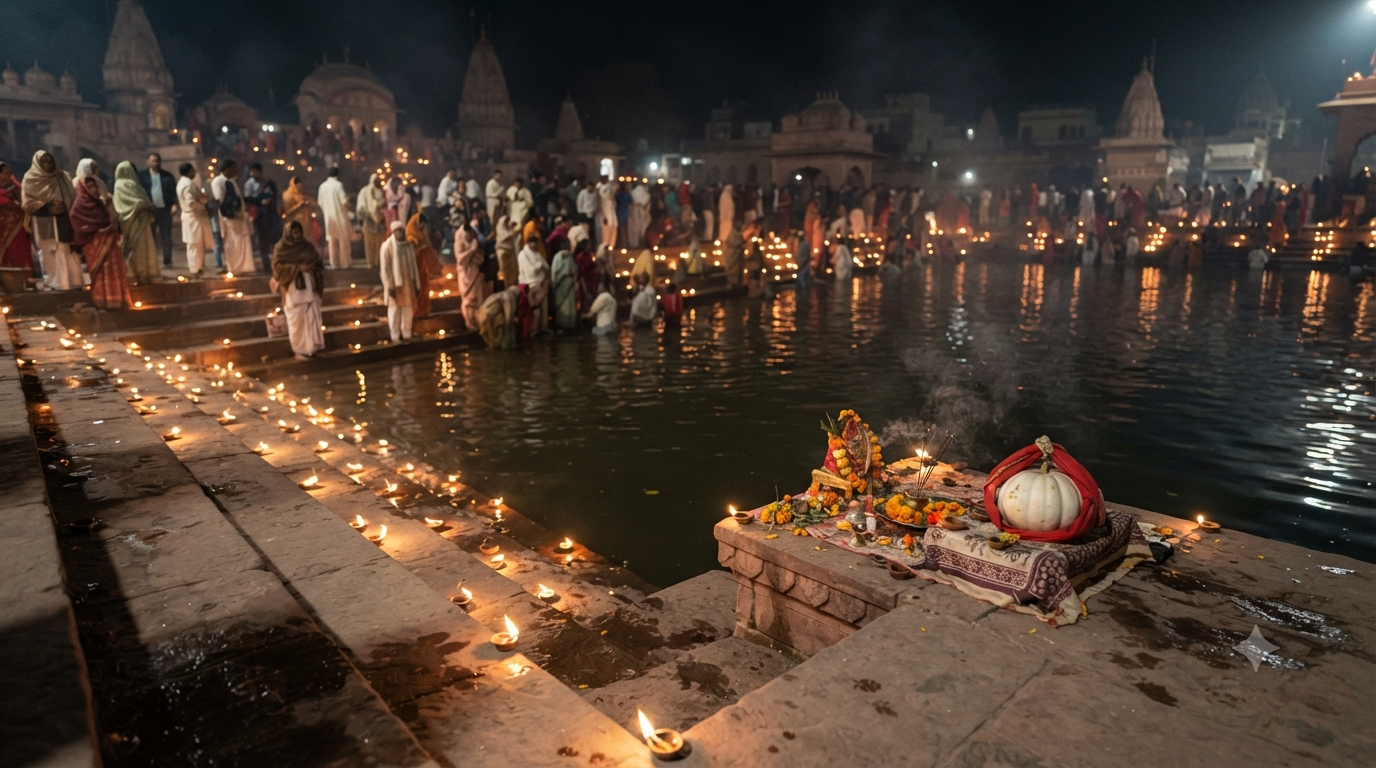
Radha Kunda Snan on Ahoi Ashtami falls on Sunday, 1 November 2026, in Mathura. The main midnight bathing window runs from 11:37 PM to 12:29 AM. The observance also draws devotees to Radha Kund near Govardhan for prayer, sacred bathing and traditional offerings. This guide gives the corrected tithi and timing, plus crowd advice and the difference between Ahoi puja and the midnight snan.
Temples Map is an independent pilgrimage guide. We are not affiliated with Radha Kund, any temple trust or Mathura district administration. We do not accept bookings, donations or payments.
Radha Kunda Snan 2026 at a glance
For 2026, the key date is 1 November. Drik Panchang lists the Radha Kunda Snan window from 11:37 PM to 12:29 AM. Meanwhile, the Ashtami tithi starts at 2:51 PM on 1 November. It ends at 1:10 PM on 2 November.
| Event. | Date. | Mathura timing. |
|---|---|---|
| Ahoi Ashtami. | 1 November 2026. | Sunday. |
| Ashtami tithi begins. | 1 November 2026. | 2:51 PM. |
| Ardha Ratri snan begins. | 1 November 2026. | 11:37 PM. |
| Ardha Ratri snan ends. | 2 November 2026. | 12:29 AM. |
| Ashtami tithi ends. | 2 November 2026. | 1:10 PM. |
These times are location-specific, so a panchang set for another city can show slightly different clock times. For the Mathura calculation, check Drik Panchang’s Radha Kunda Snan page before travel. Prokerala independently places Ahoi Ashtami on 1 November 2026 and shows nearly identical Ashtami tithi boundaries for India.
Why the old 2022 information needed correction
The earlier version of this page was tied to 17 October 2022. It also said the bath began at noon. That does not match the Mathura-specific midnight window used for Radha Kunda Snan. The current 2026 panchang gives a 52-minute period crossing midnight from 1 to 2 November.
The old article also described Ahoi Ashtami as a major Assamese festival, so that claim needed correction. That framing is misleading. Ahoi Ashtami is primarily a North Indian observance. Instead, the Radha Kund bathing tradition belongs to Braj in Mathura district.
One more correction matters. Sacred bathing is a religious practice, not a medical fertility treatment. Devotees may pray for children according to tradition. However, the ritual should never be presented as increasing the medical chance of pregnancy.
What is Radha Kunda Snan?
Radha Kunda Snan is the sacred bathing observance held at Radha Kund on Kartik Krishna Ashtami. The same tithi is associated with Ahoi Ashtami in the North Indian Purnimanta calendar. Devotees gather near midnight and offer prayers to Shri Radha Rani. Then they take a ritual dip according to family or local tradition.
Radha Kund sits on the Govardhan pilgrimage circuit in Mathura district. The District Mathura administration lists Radhakund among the major places on the 21 km Govardhan Parikrama route. That official listing helps place the kund within the wider Braj pilgrimage geography.
Vaishnava tradition links Radha Kund and neighbouring Shyam Kund with Shri Radha and Shri Krishna. The story follows Krishna’s encounter with the bull demon Arishtasura. Different sampradayas tell the episode with small variations, so treat it as sacred tradition rather than modern historical documentation.
Radha Kunda Snan timing and Ahoi Ashtami tithi
The 2026 timing can look confusing because the festival date is 1 November. The bathing window ends after midnight on 2 November. This does not create a second festival date. The snan begins late on Ahoi Ashtami night and continues into the next civil date.
Drik Panchang’s Mathura calculation gives 11:37 PM to 12:29 AM for the Ardha Ratri snan. It also places Ashtami from 2:51 PM on 1 November to 1:10 PM on 2 November. Therefore, the entire midnight bathing window falls within Ashtami tithi.
Another established panchang source, Prokerala, also places Ahoi Ashtami on 1 November 2026. Its Ujjain tithi runs from about 2:52 PM to 1:11 PM the next day. The close agreement supports the date, while the small clock difference shows why location matters.
Ahoi Ashtami vrat and the midnight snan are not the same ritual
Ahoi Ashtami vrat is commonly observed by mothers for the wellbeing of their children. Many families break the fast after sighting the evening stars, while some follow a family tradition connected with moonrise. The Radha Kunda Snan, however, is a separate Braj pilgrimage observance centred on the midnight bathing period.
This distinction prevents a common mistake. A person can observe Ahoi Ashtami at home without travelling to Radha Kund. A pilgrim at Radha Kund should still follow their own family or spiritual tradition. There is no need to combine every regional practice into one rigid procedure.
If you are fasting, plan for the physical demand before travelling. A strict fast plus a late-night crowd can be tiring. This matters especially during pregnancy, for older adults, people with diabetes or anyone taking regular medicine. Ask a qualified clinician for personal medical advice when needed.
Traditional Radha Kunda Snan puja steps
There is no single universal ritual manual followed by every devotee, so keep the procedure simple and respectful. The recurring tradition described by panchang sources centres on bathing, prayer to Shri Radha Rani and a Kushmanda offering. A Kushmanda is a white pumpkin, also called petha in this context.
- Arrive before the midnight window. Festival crowds can slow the final approach, so do not plan to reach the ghat at the exact starting minute.
- Follow local crowd-control instructions. Use the entry path, barricades and bathing area that police or volunteers permit on the night.
- Make your sankalpa or prayer. Keep the intention devotional and personal, according to your family or guru tradition.
- Take the ritual dip only where permitted. Move carefully because stone steps can become wet and slippery.
- Offer prayers and the traditional Kushmanda if your tradition uses it. Some devotees decorate the white pumpkin with red cloth before the offering.
- Leave space for others. The ghats are shared sacred spaces, so avoid blocking steps for photos or prolonged rituals.
Do not pay a private website merely because it claims to provide a compulsory “snan booking.” A panchang gives the sacred timing. It does not turn the bath into an online reservation service. If authorities announce access rules, follow District Mathura or on-ground police instructions.
How to reach Radha Kund for Ahoi Ashtami
Radha Kund lies in Mathura district near Govardhan, within the Braj pilgrimage area. Mathura Junction is the practical major rail hub for visitors arriving from outside the region. From Mathura, use local road transport toward Govardhan and Radha Kund, but allow extra time on the festival evening.
The District Mathura website confirms that Radhakund is a major stop on the Govardhan Parikrama. Its Brij Parikrama page lists the route at about 21 km. It also includes Radhakund among the principal places. See the District Mathura Brij Parikrama information for official route context.
If you are building a wider Braj visit, Temples Map’s Uttar Pradesh temple guide covers Mathura and Vrindavan. Keep the festival night lightly scheduled because traffic, parking and pedestrian movement may change.
What to carry for Radha Kunda Snan
Carry only what you can manage in a dense night-time crowd. A light bag is easier than a large puja kit, while a towel and dry clothes help after bathing. Keep valuables to a minimum because wet ghats and moving crowds make loose items easy to lose.
- Simple traditional clothing and a dry change of clothes.
- Small towel and footwear that is easy to manage.
- Drinking water for after the ritual, subject to your fasting practice.
- Regular medicines and any essential medical items.
- Minimal puja items required by your own tradition.
- Kushmanda and red cloth only if your tradition includes that offering.
- A waterproof pouch for phone, cash and identification.
Avoid carrying glass containers, bulky bags or anything that can obstruct the steps. Since local security rules can change for major gatherings, cooperate with bag checks and any temporary restrictions.
Safety at the kund during the midnight crowd
The most important practical issue is not the ritual sequence but crowd and water safety. Stone ghats can be slippery, visibility may be poor at night and devotees can bunch near the same access points. Stay within permitted areas and never climb over barricades to reach the water faster.
Children, older adults and anyone with limited mobility should avoid the densest edge of the crowd. If you feel weak from fasting, step away from the water and rest. A devotional observance does not require you to ignore a medical warning sign.
The same caution applies to fertility claims. Couples may visit Radha Kunda Snan seeking blessings for children as a matter of faith, yet infertility and recurrent pregnancy loss need evidence-based medical assessment. Religious prayer can coexist with medical care, but it should not replace it.
Calendar confusion: Kartik, Ashwin and the 2026 shift
Ahoi Ashtami is described as Kartik Krishna Ashtami in the North Indian Purnimanta calendar. Some Amanta calendars used in western and southern India may label the same period differently, often as Ashwin Krishna Paksha. The observance date itself still follows the local panchang rule for Ahoi Ashtami.
Calendar confusion is especially easy in 2026 because an extra lunar month shifted several festival dates. Many dates therefore fall later than people expect. That is why copying a 2025 or 2022 date forward fails. Every annual festival date must be recalculated for the specific year.
For an Amanta calendar comparison, see Temples Map’s Karthika Masam date guide. It explains why North Indian Kartik and South Indian Karthika can begin on different Gregorian dates. Both systems remain valid within their own rules.
Common mistakes to avoid
First, do not use an old year-specific date. The 2022 observance was on 17 October, but Radha Kunda Snan in 2026 is on 1 November. Lunar dates do not move by a fixed number of days each year.
Second, do not confuse the evening Ahoi Ashtami puja with the midnight Radha Kund bath. They are connected by the same tithi, yet they serve different devotional customs. Third, do not treat a faith tradition as a medical guarantee for pregnancy or child health.
Finally, avoid private booking or puja-service links that imply payment is required to access the ritual. Temples Map does not arrange priests, snan access, puja packages, donations or accommodation. Use official district updates and your own trusted family or spiritual tradition for any on-ground religious guidance.
Before you go for Radha Kunda Snan
The key facts are simple. Ahoi Ashtami falls on 1 November 2026, while the Mathura midnight window runs from 11:37 PM to 12:29 AM. Arrive early and travel light because the ghats can become extremely busy.
Also follow local crowd instructions on the night. Above all, treat fertility-related blessings as a matter of faith rather than a health claim.
Check the Mathura-specific panchang again shortly before departure, since local religious timing depends on place. Also review District Mathura notices for traffic, parking or access changes closer to the event.
Radha Kunda Snan frequently asked questions
When is Radha Kunda Snan in 2026?
Radha Kunda Snan falls on Sunday, 1 November 2026, on Ahoi Ashtami. The main Ardha Ratri bathing window begins late that night and ends shortly after midnight on 2 November.
What is the Radha Kunda Snan time in Mathura?
The Mathura-specific Ardha Ratri snan runs from 11:37 PM to 12:29 AM. It crosses from 1 November into 2 November 2026. Drik Panchang lists a 52-minute duration, and the whole window falls within Ashtami tithi.
What are the Ashtami tithi timings in 2026?
For Mathura, Ashtami begins at 2:51 PM on 1 November. It ends at 1:10 PM on 2 November 2026. Panchang clock times vary slightly by location, so use Mathura when planning the Radha Kund ritual.
Is Radha Kunda Snan the same as Ahoi Ashtami puja?
No. Ahoi Ashtami puja and fasting are household observances in many North Indian families. The midnight bath is a Braj pilgrimage tradition at Radha Kund. A devotee may observe one without performing the other.
Why do couples visit Radha Kund on Ahoi Ashtami?
Traditional belief links the Ahoi Ashtami bath at Radha Kund with prayers for children and family wellbeing. This is a religious belief, not a medical fertility treatment or guarantee. Discuss health concerns with a qualified clinician.
What is offered during the Radha Kund ritual?
Many descriptions mention Kushmanda, a white pumpkin, decorated with red cloth and offered to Shri Radha Rani. Customs differ by family and sampradaya. Therefore, follow your trusted tradition rather than treating one online list as compulsory.
Do I need an online booking for Radha Kunda Snan?
No compulsory private online booking is established by the panchang sources used here. Do not pay an unofficial website merely for “snan access.” If the district administration issues crowd-control or entry instructions, follow those official directions.
Where is Radha Kund?
Radha Kund is near Govardhan in Mathura district, Uttar Pradesh, within the Braj pilgrimage region. District Mathura lists Radhakund as a major place on the 21 km Govardhan Parikrama route.