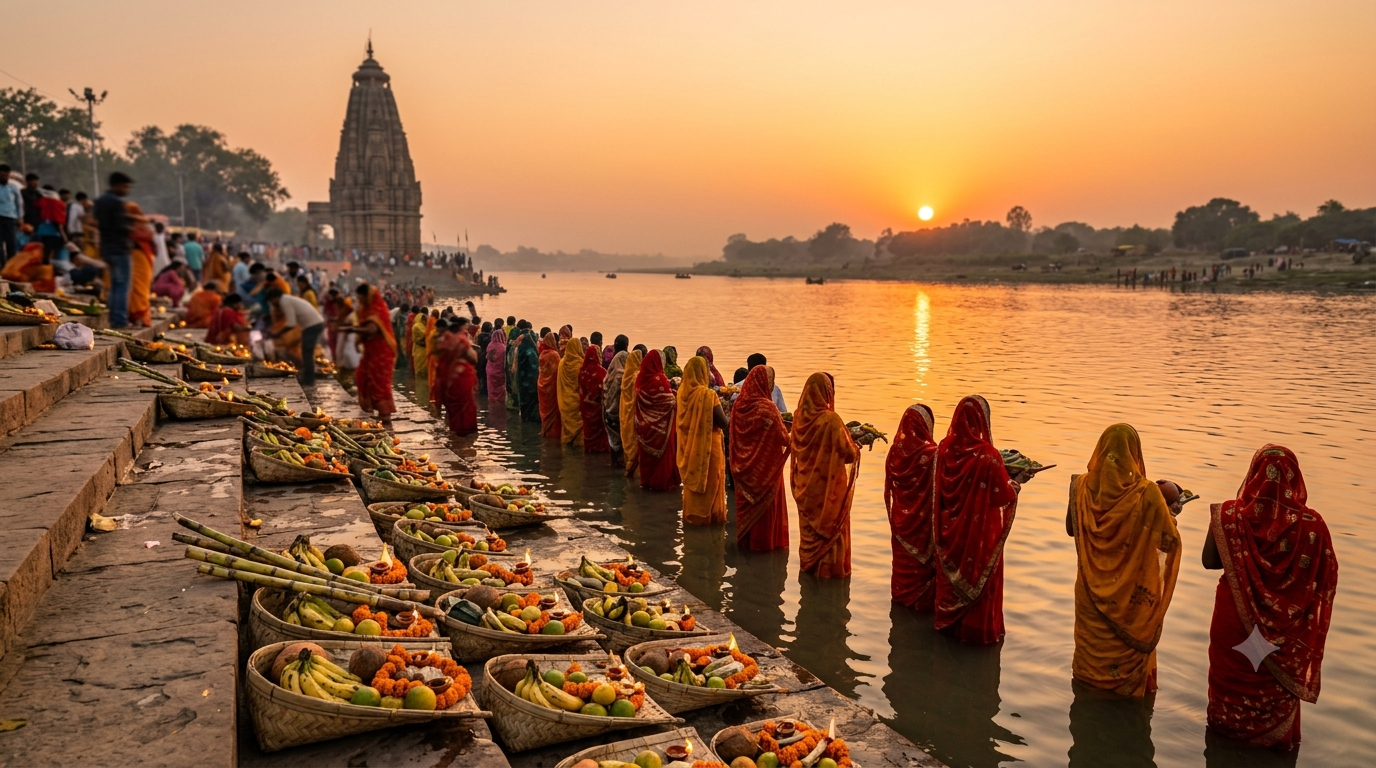
Chhath Puja 2026 runs from Friday, 13 November, to Monday, 16 November, with Sandhya Arghya on Sunday evening and Usha Arghya on Monday morning. Both Drik Panchang and Prokerala confirm the four-day sequence, while exact sunrise and sunset times depend on your city. For a Bihar temple visit, Deo Sun Temple in Aurangabad is especially important because official Bihar sources link it closely with Chhath worship.
Temples Map is an independent temple and festival guide. We are not affiliated with Deo Sun Temple, Bihar Tourism, Aurangabad district authorities, or any temple trust. We do not accept bookings, donations, or payments, so use official government or temple channels for current access instructions.
Chhath Puja 2026 at a Glance
The key dates are straightforward, although the ritual timing is local. Drik Panchang lists Nahay Khay on 13 November, Kharna on 14 November, Sandhya Arghya on 15 November, and Usha Arghya with Parana on 16 November. Prokerala gives the same four-day sequence, so the civil dates agree across two independent panchang sources.
| Day | Date in 2026 | Main observance |
|---|---|---|
| Day 1 | Friday, 13 November | Nahay Khay |
| Day 2 | Saturday, 14 November | Lohanda / Kharna |
| Day 3 | Sunday, 15 November | Sandhya Arghya to the setting Sun |
| Day 4 | Monday, 16 November | Usha Arghya to the rising Sun and Parana |
For the date calculation, see the Drik Panchang 2026 Chhath calendar and the Prokerala Chhath calendar. Use their location tools, or another trusted local panchang, when you need the actual sunset or sunrise for your city.
How the Four Days of Chhath Puja 2026 Unfold
Chhath follows a four-day discipline rather than a single puja hour. The sequence moves from preparation and food rules to Kharna, then to the evening and morning arghya. Customs can vary by family and region, so local tradition should guide the finer ritual details.
Day 1: Nahay Khay on 13 November
Nahay Khay begins the observance on Friday, 13 November. Families clean the home and kitchen, while the vratin or vrati begins a period of strict ritual purity. A simple sattvik meal is common after bathing, although exact food customs differ between households.
The point of the first day is preparation, not spectacle. If you are visiting a ghat or temple only as an observer, respect the space used for cooking and offerings. Avoid handling prasad, baskets, or utensils unless the family invites you to help.
Chhath Puja 2026 Day 2: Kharna on 14 November
Kharna falls on Saturday, 14 November. The observer traditionally keeps a daytime fast and prepares prasad for the evening. After the Kharna offering and meal, many vratis begin the long nirjala phase, which continues through the next sunrise observance.
This is also when families start final preparations for the ghat. Families also arrange bamboo soop or daura baskets, fruit, sugarcane, thekua, lamps, and other customary offerings before the main evening arghya. Practices differ, so do not treat any single checklist as universal.
Chhath Puja 2026 Day 3: Sandhya Arghya on 15 November
Sandhya Arghya 2026 falls on Sunday, 15 November. Devotees gather near a river, pond, tank, or prepared water body before sunset, then offer arghya to the setting Sun. This is the most visible public moment of the festival, so major ghats and Sun temples can become extremely crowded.
Do not copy an “arghya time” from another city. Sandhya Arghya follows the local sunset, which changes with longitude and location even within India. Do not reuse a Delhi, Patna, or Kolkata time for Aurangabad without checking the local sunset.
Chhath Puja 2026 Day 4: Usha Arghya on 16 November
Usha Arghya 2026 takes place on Monday, 16 November, at the next local sunrise. Families usually reach the ghat well before dawn because they offer arghya as the Sun rises. Parana, the formal breaking of the fast, follows according to the family’s tradition.
The morning gathering can be just as dense as the evening one. If you are travelling to a major site, reach the area early and expect walking restrictions. Keep footwear, valuables, and loose items simple because crowded riverbanks and temple approaches leave little room to manage bags.
Why Chhath Puja 2026 Arghya Times Are Location-Specific
There is no single all-India clock time for Sandhya Arghya or Usha Arghya. The evening offering follows sunset on 15 November, while the morning offering follows sunrise on 16 November. Because sunrise and sunset vary by place, a city-specific panchang matters more than a viral national timing card.
For Chhath Puja 2026, this distinction prevents one of the easiest festival-date mistakes to make. The date can be the same across India while the clock time differs. Therefore, use the four-day calendar for planning leave and travel, then confirm your local solar time closer to the observance.
If you are travelling in Bihar, check the city or district nearest your ghat. Do the same for Delhi, Mumbai, Kolkata, Nepal, or diaspora locations. Panchang services with a location selector are more useful here than a single static graphic shared on social media.
Chhath Puja 2026 at Deo Sun Temple, Aurangabad
A Deo Sun Temple Chhath Puja visit is one of Bihar’s notable temple-linked festival experiences. Bihar Tourism identifies the shrine as an important place of worship dedicated to Lord Surya in Aurangabad district. Its official destination page also notes that the temple attracts its largest crowds during Chhath Puja.
Aurangabad district authorities describe Deo as an established centre of Sun worship with a long history of Chhath observances. The district website also mentions Brahma Kund, a water tank associated with the temple’s religious traditions. These details help explain why devotees travel to Deo during the festival rather than limiting their observance to neighbourhood ghats.
Visitors should distinguish the temple’s religious importance from its festival-day operating arrangements. The official sources confirm Deo’s significance, but they do not establish a complete November 2026 programme or special access schedule. Therefore, pilgrims should check local government notices before relying on specific entry routes or ceremonial timings.
For a broader pilgrimage route, our Bihar and Jharkhand temple guide places Deo among the region’s important shrines. If your November trip continues after Chhath, the Kartik Ganga Snan guide covers the later Kartik Purnima observance.
What is confirmed for Deo, and what is not?
Official sources confirm the temple’s location, Chhath importance, ordinary visitor information, and basic transport context. However, those pages are not a festival traffic order or a 2026 Kartik Chhath programme. Therefore, do not assume ordinary opening hours, vehicle access, queue routes, or event schedules will operate unchanged on 15–16 November.
| Planning point | Status | What to use |
|---|---|---|
| Temple location | Confirmed | Deo, Aurangabad district, Bihar |
| Chhath significance | Confirmed | Bihar Tourism and district pages |
| Sun worship tradition | Confirmed | Bihar Tourism and Aurangabad district |
| Nearest railhead | Confirmed | Anugrah Narayan Road, about 20 km from Deo |
| Festival vehicle access | Not yet confirmed | Check Aurangabad district notices close to travel |
| 2026 Kartik Chhath programmes | Not yet confirmed | Check district and Bihar Tourism updates |
The Bihar Tourism Deo Sun Temple page describes the shrine’s religious importance and visitor context. The official Aurangabad district Deo Temple page covers the temple’s local history, its connection to Chhath, and transport access.
The district website identifies Anugrah Narayan Road as the nearest railway station, approximately 20 km from Deo. These are useful planning details, but they do not guarantee unrestricted transport during the festival.
How to Plan a Deo Visit Without Relying on Unconfirmed Schedules
Build your trip around the confirmed festival dates, not around an unverified event timetable. Book transport and accommodation with enough flexibility to absorb road diversions, long walking approaches, and queue delays. Then check official district notices again in the final week before departure.
- Anchor the trip to the dates. Plan for Sunday, 15 November, if Sandhya Arghya is your main purpose, or Monday, 16 November, for Usha Arghya.
- Check the local Sun time. Use Aurangabad or the nearest precise location in a trusted panchang instead of a Delhi or Patna screenshot.
- Recheck district advisories. Look for traffic diversions, parking zones, pedestrian routes, barricading, and emergency instructions.
- Keep the last leg flexible. Large Chhath crowds can change vehicle access, so be prepared to walk farther than on an ordinary temple day.
- Do not prepay unofficial agents. Use government or verified temple channels if any booking, pass, or programme registration is later announced.
For travellers planning Chhath Puja 2026 at Deo, the official pages checked did not publish a Kartik Chhath access plan or event programme at the time of writing. That can change quickly in the weeks before the festival, so this article separates confirmed facts from still-pending local arrangements.
What First-Time Visitors Often Get Wrong
The biggest mistake is treating Chhath as a one-day festival. The main public arghya is on 15 November, yet the observance begins two days earlier and ends only after sunrise on 16 November. Travel plans that ignore the morning arghya often miss the emotional close of the festival.
A second mistake is assuming Chhath requires a temple visit. Chhath is widely observed at rivers, ponds, tanks, temporary water bodies, and community ghats, so families do not need to visit Deo or another Sun temple. A temple visit is a pilgrimage choice, not a condition for observing the vrat.
A third mistake is mixing separate Aurangabad events. District pages contain notices for Surya Mahotsav and for Chaiti Chhath activities earlier in 2026. Those documents do not confirm the November Kartik Chhath programme, so do not reuse them as current event schedules.
Safety During Fasting, Crowds and Water-Side Rituals
Chhath can be physically demanding because many vratis fast for a long period and stand in water during the arghya. Crowds, cool dawn temperatures, slippery steps, and prolonged standing add further strain. If you have a medical condition, are pregnant, or have been advised against fasting, speak with a qualified clinician before attempting a strict fast.
Observers should also plan for basic crowd safety. Keep children close, avoid pushing toward the waterline, and follow local barricades when authorities install them. Since temporary ghats can become slick, use stable steps and avoid entering water beyond the area marked for worship.
Faith practices should not replace medical care or prescribed treatment. Families can still participate respectfully even when a member cannot fast or stand in water for health reasons.
Chhath Puja 2026: Practical Planning Checklist
Use this checklist during the week before the festival. It combines the fixed calendar with the details that can still change locally, so you do not confuse a confirmed date with a pending access arrangement.
- Confirm Nahay Khay for 13 November and Kharna for 14 November.
- Confirm Sandhya Arghya for Sunday, 15 November.
- Confirm Usha Arghya and Parana for Monday, 16 November.
- Check your city’s actual sunset and sunrise times.
- For Deo, recheck Aurangabad district and Bihar Tourism notices.
- Allow extra walking time near the temple or major ghats.
- Carry drinking water for non-fasting family members and regular medicines.
- Avoid unofficial payment links, agents, and “special entry” claims.
Before You Go
The main Chhath Puja 2026 date for Sandhya Arghya is 15 November, while the full festival dates are firm enough to plan around now: 13–16 November, with evening arghya on the 15th and morning arghya on the 16th. The piece that still needs a final check is local execution, especially at high-crowd places such as Deo.
Use the confirmed calendar to book leave and travel, but keep temple-day logistics flexible. For Deo Sun Temple, rely on Bihar Tourism and Aurangabad district updates rather than social posts that present old festival notices as current information.
Chhath Puja 2026 FAQs
When is Chhath Puja 2026?
Chhath Puja 2026 runs from Friday, 13 November, through Monday, 16 November. Nahay Khay is on the 13th, Kharna on the 14th, Sandhya Arghya on the 15th, and Usha Arghya with Parana on the 16th. Drik Panchang and Prokerala list the same sequence.
When is Sandhya Arghya in 2026?
Sandhya Arghya falls on Sunday, 15 November 2026. Devotees offer arghya to the setting Sun, so the relevant clock time is your local sunset. Check a city-specific panchang because sunset differs from place to place.
When is Usha Arghya in 2026?
Usha Arghya falls on Monday, 16 November 2026. Devotees offer arghya to the rising Sun and then complete Parana according to family custom. Reach the ghat before dawn because the ritual begins around local sunrise.
What are the Nahay Khay and Kharna dates?
Nahay Khay is Friday, 13 November 2026, while Kharna or Lohanda is Saturday, 14 November. These are the first two days of the four-day Chhath sequence, before the evening and morning arghya observances.
Is there one Chhath arghya time for all of India?
No. The date may be shared, but Sandhya Arghya follows local sunset and Usha Arghya follows local sunrise. Therefore, use a location-specific panchang instead of copying a timing from another city.
Why is Deo Sun Temple important during Chhath?
Bihar Tourism identifies Deo Sun Temple as an important shrine dedicated to Lord Surya in Aurangabad district. The official tourism website notes that the temple attracts its largest crowds during Chhath. Aurangabad district authorities also describe the temple’s long association with Sun worship and the festival.
Is Deo Sun Temple access confirmed for 15–16 November 2026?
The official pages checked for this guide did not yet confirm festival-specific access. Ordinary visitor information exists, but Chhath can bring separate traffic and crowd controls. Recheck Aurangabad district notices shortly before travel.
What is the nearest railway station to Deo Sun Temple?
The Aurangabad district website lists Anugrah Narayan Road as the nearest railway station, about 20 km from Deo. Festival-day road access can change, so allow extra transfer time and check current traffic arrangements before travelling.
Do I have to visit a Sun temple to observe Chhath?
No. Chhath is commonly observed at rivers, ponds, tanks, and community ghats, so a temple visit is not required. Visiting Deo Sun Temple is a pilgrimage choice for devotees who want a temple-centred experience.