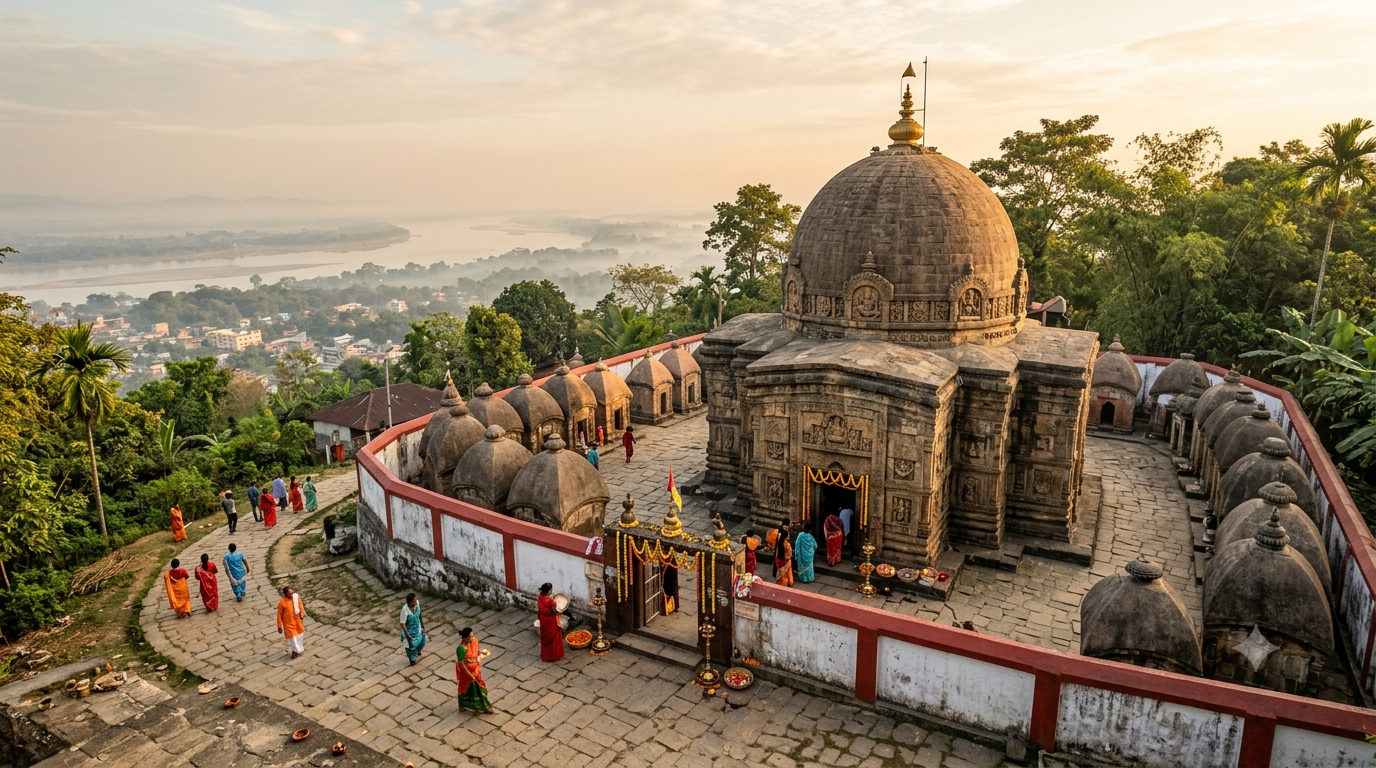
Most people planning a tour of the temples in Assam begin with the same worry: the Kamakhya queue. That worry is fair, because the line can swallow three or four hours on a busy weekend. The rule for skipping it also changed in mid-2026. So a lot of travel pages now carry advice that will strand you at the gate.
This guide maps the state’s major shrines, the wider Northeast circuit, and the details that decide how your trip goes.
Temples Map is an independent travel and pilgrimage guide. We are not affiliated with, endorsed by, or the official website of Maa Kamakhya Devalaya or any of the temples in Assam covered here. We take no bookings, donations, or payments. Please use the official portals linked below for passes and notices.
Temples in Assam at a Glance
- Anchor shrine: Maa Kamakhya Devalaya, Nilachal Hill, Guwahati.
- Special darshan pass: ₹501 per person, while the general queue stays free.
- Big change: since 15 June 2026, morning and afternoon special darshan slots move online only.
- Entry fees: most temples in Assam charge nothing for basic darshan.
- Best season: October to March, when the Brahmaputra valley cools and dries out.
- Northeast bonus: the region holds three of the 51 Shakti Peethas, not one.
- Typical circuit: two days in Guwahati, half a day at Hajo, one day at Sivasagar.
Kamakhya Devalaya: The Most Visited of All Temples in Assam
Kamakhya anchors almost every list of temples in Assam, and it earns that place. The shrine sits on Nilachal Hill in western Guwahati. There is no idol in the sanctum.
Instead you climb down a narrow, damp flight of rock steps into a cave. Inside, a natural cleft in the bedrock stays wet because an underground spring feeds it.
The Devalaya describes itself as the oldest of the 51 Shakti Peethas. Since 2015, the Bordeuri Samaj has run its religious and secular administration through elected Doloi. Ten Mahavidya shrines spread across the same hill. So keep two extra hours if you want the full circuit.
Darshan timings and the ₹501 special pass
Maa Kamakhya Devalaya publishes an official daily programme. The Snana of the Pithasthana starts at 5:30 AM, and Nitya puja follows at 6:00 AM. Temple doors then open for devotees at 8:00 AM. They shut at 1:00 PM for cooked offerings, then reopen at 2:30 PM.
Doors shut for the night at 5:15 PM, while the Aarati happens at 7:30 PM. On Durga Puja days the morning opening shifts later, to 9:00 AM. Always cross-check the current schedule on maakamakhya.org before you travel, since festival days move these hours.
The booking change most guides still get wrong
Here is the correction that matters most before you book. The Doloi issued a public notice on 10 June 2026. It ended counter booking for offline special darshan tickets from 15 June onwards. Both the morning and afternoon slots now run through the upgraded official special darshan portal.
So the standard advice you still see online no longer works for those slots. Many pages still tell you to buy the ₹501 pass at the window on arrival. Book before you leave home instead.
The Devalaya also runs a separate portal for defence personnel. There is a free general queue booking portal too, which very few articles mention.
| Facility | Cost | Where to book |
|---|---|---|
| General queue | Free | Official general queue portal |
| Special darshan | ₹501 per head | Official online portal only |
| Defence personnel entry | Free | Separate official defence portal |
| Children below 10 | No pass needed | Walk in with family |
Ambubachi Mela and the annual closure
Once a year the sanctum shuts completely for the goddess’s symbolic menstruation. For Ambubachi Mahayog 2026 the Devalaya fixed Prabritti at 9:26 PM on 22 June. Doors then stayed shut to devotees from 23 to 25 June. Nribritti fell on the morning of 26 June.
Because the timing follows the almanac, these dates shift every year. The Devalaya publishes them a few weeks ahead, so never assume last year’s window. During the 2026 mela the ₹501 special darshan was suspended on 26 and 27 June owing to the crush. Our deeper feature on the Kamakhya Ambubachi Mela covers the ritual side in detail.
Umananda: A Shiva Shrine on a River Island
Ten minutes by boat from central Guwahati, Umananda occupies Peacock Island in the Brahmaputra. Locals call it the smallest inhabited river island in the world. The Ahom king Gadadhar Singha’s reign gave the shrine its present form in the late 17th century. Rock-cut figures still survive on its walls.
Ferries leave from Kachari Ghat, which sits beside the Deputy Commissioner’s office. Government inland water transport boats charge a nominal fare, so ask for them first. Hired private boats cost many times more, so ask the rate before boarding.
Roughly 230 steps climb from the jetty to the shrine. Golden langurs, an endangered species, live here and deserve a respectful distance.
The Guwahati Cluster Beyond Nilachal Hill
Guwahati holds more temples in Assam than a single day allows. The Navagraha Temple on Chitrachal Hill honours the nine planets, or grahas. Ahom king Rajeswar Singha built it in the late 18th century, when Ahom power still held. Astrologically inclined visitors treat it as one stop for all nine grahas.
Basistha Ashram sits where three hill streams meet in the south of the city. So it stays cool even in May. Meanwhile Sukreswar Temple looks straight onto the Brahmaputra from the riverbank. Across the water, Doul Govinda draws enormous Janmashtami crowds, while Dirgheswari, Ugratara and Aswaklanta fill out a full temple day.
Hajo: One Small Town, Three Faiths
Hajo lies about 30 km west of Guwahati, and it is the most underrated stop in the state. The Hayagriva Madhava Temple crowns Manikut hill, so the climb is short. Koch king Raghudeva Narayan raised the present stone structure in 1583. Still, several historians trace an earlier shrine on the same hill to the Pala period.
Look at the exterior carvings before you go inside. They show the ten avatars of Vishnu, with the Buddha as the ninth. So Buddhist pilgrims from Bhutan and the Himalayan belt also revere the site.
Hajo additionally holds Poa Mecca, a Muslim shrine, which means three traditions share one small town. The silk-weaving village of Sualkuchi makes a short detour.
Ahom-Era Temples in Assam: Sivasagar and Tezpur
Upper Assam is where the Ahom builders left their clearest signature. At Sivasagar, three temples stand on the bank of the Borpukhuri tank: Sivadol, Vishnudol and Devidol. Bar Raja Ambika, queen of Swargadeo Siba Singha, had them built in 1734. The great tank itself took shape between 1731 and 1738.
How tall is Sivadol, really?
This is worth settling, since the internet still repeats two different numbers. Most documented descriptions put Sivadol at 104 feet, roughly 32 metres. The base perimeter runs to 195 feet, topped by an eight-foot golden kolosi. The Sivasagar district administration page, however, lists 180 feet.
The 104-foot figure appears far more consistently in architectural surveys, so treat that as your working number. Either way, guides on site will call this the tallest Shiva temple in India. That claim rests on the lower measurement, though it remains widely accepted. Nobody publishes a modern survey certificate, so we flag the conflict rather than quietly pick a side.
Further east and north, Negheriting Shiva Doul near Dergaon carries a similar Ahom profile. Tezpur adds Mahabhairab, whose linga ranks among the largest anywhere, plus the early carved doorframe at Da-Parbatia. Nagaon holds Bordowa Than, the birthplace of Srimanta Sankardeva and the cradle of Assamese Vaishnavism.
Northeast Shakti Peethas Beyond the Assam Border
The best-known temples in Assam sit inside a much wider sacred circuit. Northeast India holds three of the 51 Shakti Peethas, and pilgrims often plan around only one. Kamakhya is the famous name, yet Tripura and Meghalaya each hold another.
Tripura Sundari Temple, locally called Matabari, stands on a tortoise-shaped hillock at Udaipur. Agartala lies about 55 km away. Maharaja Dhanya Manikya established it in 1501 CE in the Bengali Ek-ratna style.
Two black stone idols sit in the sanctum, and the larger stands about five feet tall. Beside the temple, Kalyan Sagar lake draws visitors for its huge turtles.
Nartiang Durga Temple in the West Jaintia Hills of Meghalaya completes the trio. Locals still know it as the Jayanti Shakti Peeth. It is roughly six centuries old and sits on a quiet hillock around 60 km from Shillong. Arunachal Pradesh adds Parshuram Kund and Malinithan if you have extra days.
Best Time to Visit Temples in Assam
October to March is clearly the best window. Humidity drops, the Brahmaputra settles, and hill roads stay reliable during those months. Durga Puja and Navaratri bring the most intense energy at Kamakhya, though crowds swell accordingly.
Avoid mid-June to early September unless you specifically want Ambubachi. Monsoon flooding regularly disrupts road travel in the valley, and stone steps turn slick. Bohag Bihu in mid-April opens a beautiful cultural window, while Shivaratri fills Sivasagar and Tezpur. The Assam Tourism calendar lists the current festival dates.
Routes and Distances Between Temples in Assam
Most temples in Assam sit within a day’s drive of Guwahati, which makes the city an easy base.
| From Guwahati | Distance | Time needed |
|---|---|---|
| Kamakhya (Nilachal Hill) | About 8 km | Half to full day |
| Umananda (by ferry) | Kachari Ghat | Two hours |
| Hajo | About 30 km | Half day |
| Tezpur | About 180 km | One day |
| Sivasagar | About 360 km | One to two days |
Lokpriya Gopinath Bordoloi International Airport serves Guwahati, and Kamakhya has its own railway station. A sensible four-day plan runs like this. Start with Nilachal Hill and Umananda, then cover the Guwahati cluster. Next comes Hajo with Sualkuchi, before an overnight run to Sivasagar via Tezpur.
Dress Code and Safety at Temples in Assam
Dress rules at the temples in Assam stay simple and consistent. Men usually wear full-length trousers or a dhoti, while women choose a saree or salwar kameez. Footwear comes off well before the gate. During Ambubachi the Devalaya designates footwear camps on the approach road itself.
Before you go, two physical cautions matter. The Kamakhya sanctum involves a steep, dark and often crowded descent. That climb is hard for anyone with knee trouble, heart conditions or claustrophobia. Umananda’s flight of roughly 230 steps is similar.
Also carry water and any regular medication. Consult your doctor before long fasting or a strenuous climb if you are elderly, pregnant or unwell. Rituals and vows belong to faith and tradition, so treat them that way rather than as medical treatment.
The entire Nilachal Hill complex has been a declared no-tobacco zone since 1 January 2016. Rules on photography vary shrine by shrine, so ask rather than assume.
Fake Portals and Online Puja Scams
Fake portals shadow the biggest temples in Assam, especially Kamakhya. Maa Kamakhya Devalaya has issued a public notice about online puja services sold in its name. Certain websites and apps collect large sums from devotees this way. Notably, the Devalaya authorises no platform to conduct pujas on its behalf.
The same administration has confirmed it runs only two official websites: maakamakhya.org and maakamakhyadevalaya.org. Treat every other “official Kamakhya” site with suspicion. Book passes only through the Devalaya’s own portals.
Never pay a WhatsApp number that asks for advance money. If a page cannot show a temple notice backing it, walk away.
Insider Tips Most Guides Miss
- Book the free general queue slot online too, because most visitors never learn that portal exists.
- Reach Nilachal Hill before 7:30 AM even with a pass, since the approach road jams by mid-morning.
- Hire a shared vehicle from the foot of the hill instead of driving up on festival days.
- Visit Hajo on a weekday, as weekend crowds from Guwahati fill the narrow Manikut hill path.
- Give Sivasagar an overnight stop, since Rang Ghar and Talatal Ghar sit minutes from the dols.
- Carry small denomination cash, because offerings and ferry fares rarely accept cards.
Before You Go
The temples in Assam reward a slow circuit rather than a checklist sprint. So anchor the trip on Kamakhya, book that pass online well ahead, and give Hajo and Sivasagar the time they deserve. If you have a week, add Tripura Sundari and Nartiang. You then complete all three Northeast Shakti Peethas in one journey.
Verify timings and fees on the official portal before you set out, since festival schedules move without much notice. For comparable state guides, see our roundups of famous temples in Maharashtra and famous temples in Telangana.
FAQs About Temples in Assam
Which is the most famous of the temples in Assam?
Maa Kamakhya Devalaya on Nilachal Hill in Guwahati is the most famous. It is one of the 51 Shakti Peethas. Pilgrims arrive from across India, especially during Ambubachi Mahayog in June and Durga Puja in autumn.
How much does the Kamakhya special darshan pass cost?
The special darshan entry pass costs ₹501 per person. Children below the age of 10 do not need a pass at all. Other services such as puja-parvan, panda charges and offerings are billed separately, so carry extra cash.
Can I still buy the ₹501 pass at the counter?
No, not for the regular morning and afternoon slots. A Devalaya notice dated 10 June 2026 ended offline counter booking for those slots from 15 June. All devotees now use the official online portal instead.
What are the Kamakhya Temple darshan timings?
Doors open for devotees at 8:00 AM and close at 1:00 PM for cooked offerings. Then they reopen at 2:30 PM. Closing for the night happens at 5:15 PM, while the Aarati is at 7:30 PM. Festival days follow a different schedule.
How many Shakti Peethas are there in Northeast India?
Three of the 51 Shakti Peethas lie in the Northeast. They are Kamakhya in Assam, Tripura Sundari at Udaipur in Tripura, and Nartiang Durga Temple in Meghalaya. Many itineraries mistakenly cover only the first.
Is the Kamakhya climb difficult for elderly pilgrims?
The sanctum requires a steep, narrow and damp descent into a cave, which many older visitors find hard. Vehicles reach the hilltop, so the outer complex stays manageable. Anyone with knee, heart or breathing problems should seek medical advice first.
When is Ambubachi Mela held each year?
It usually falls in the second half of June, though the exact dates follow the almanac. In 2026 the temple stayed shut from 23 to 25 June and reopened on the morning of 26 June. Always confirm the current year’s dates on the official website.
Which temples in Assam should first-time visitors prioritise?
First, cover Kamakhya, Umananda and Navagraha in Guwahati. Next, add Hayagriva Madhava at Hajo for its shared Hindu and Buddhist heritage. If time allows, travel upriver to the Sivasagar dols for the finest surviving Ahom temple architecture.
Do the temples in Assam charge an entry fee?
Almost none of them charge for basic entry, including Umananda and the Sivasagar dols. You only pay for optional priority darshan at Kamakhya, ferry fares, and any puja booked through the temple itself.