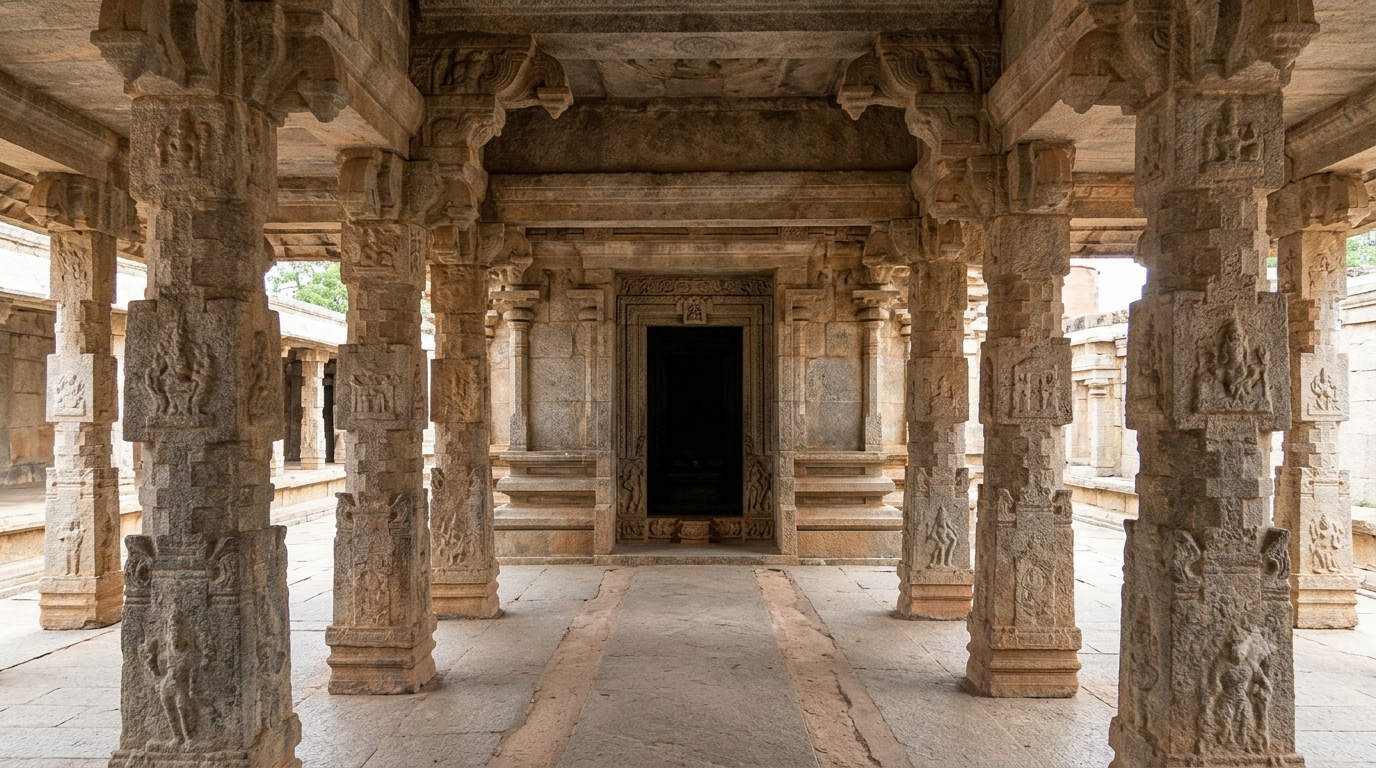
Garbhagriha meaning begins with the Sanskrit idea of a “womb-house”: the innermost shrine chamber of a Hindu temple. It usually holds the principal sacred image or symbol. Yet the garbhagriha is not the pillared hall, the entrance tower or the whole temple building. Its place becomes clear when you read a floor plan from the centre outward.
Independent architecture guide: TemplesMap is not affiliated with UNESCO or any temple authority. We do not arrange entry, accept bookings, donations or payments. Check the relevant temple administration for current visitor instructions.
What is the garbhagriha meaning in a Hindu temple?
The garbhagriha is the inner sanctum of a Hindu temple. Its Sanskrit name means “womb-house”, a term for the sacred chamber at the core of the shrine. The main deity’s image or emblem usually occupies this space, while adjoining halls and passages serve different roles in the building.
The Karnataka government’s Hoysala nomination dossier hosted by UNESCO glosses garbhagriha as “womb-house, sanctum”. That short definition supplies the key distinction: the term names a chamber, not every structure around it.
In plan, the chamber often lies at the end of an approach through one or more halls. The garbhagriha meaning therefore combines a physical location with its sacred purpose. However, no single hall sequence describes every Hindu temple.
Garbhagriha meaning at a glance
- Literal sense: Womb-house, referring to the sacred inner chamber.
- Architectural role: The innermost sanctum, rather than an assembly hall.
- Typical focus: The main image, linga or other principal sacred emblem.
- Usual connection: A doorway and, in many plans, an antarala or vestibule.
- Above the chamber: A shrine superstructure, with names that vary by region.
- Not the same as: A mandapa, gopuram, prakara or circumambulatory path.
The garbhagriha meaning stays consistent across these descriptions, even when the plan changes shape. Its scale, construction and relation to adjoining spaces still depend on the particular monument.
Garbhagriha meaning in a temple layout
On many temple plans, a series of spaces leads from a porch or hall towards the inner sanctum. The garbhagriha sits at the sacred end of that sequence, so garbhagriha meaning cannot describe the entire route. Yet it may have a separate doorway, a surrounding passage or more than one adjoining shrine.
The UNESCO World Heritage Centre’s Khajuraho description sets out an especially clear sequence. It moves from an entrance porch through a mandapa and antarala to the garbhagriha. That sequence clarifies garbhagriha meaning in context, but it is not a rule for every region.
- Entrance porch: An ardhamandapa or another named approach space may mark the start.
- Mandapa: A hall or pavilion forms a larger space before the inner shrine.
- Antarala: A vestibule may connect the hall to the sanctum doorway.
- Garbhagriha: The core chamber contains the principal sacred focus.
Read these as functions rather than mandatory rooms. Some early shrines have a simple chamber and porch. Larger complexes, meanwhile, may add several halls, subsidiary shrines and enclosure walls.
What does a labelled UNESCO temple plan show?
A labelled plan helps separate rooms that may look similar in photographs. Figure 2.6 in the Hoysala nomination dossier maps Channakeshava Temple at Belur. Its legend marks the garbhagriha, the antarala, the navaranga hall, entrance halls and the surrounding platform as distinct elements.
In that Belur plan, label 1 marks the sanctum, while label 2 identifies its vestibule. Label 3 names the navaranga, a hall with nine internal bays. The drawing comes from INTACH’s Bengaluru documentation within the Karnataka government dossier.
Open the UNESCO-hosted Hoysala floor plan and glossary and look for “Figure 2.6” on printed page 48. Following the numbered legend makes the garbhagriha meaning easier to grasp because a photograph hides room boundaries.
Garbhagriha versus other parts of the temple
Several familiar temple words name spaces close to the sanctum, but none is interchangeable with it. For garbhagriha meaning, ask one question first: does the label name a chamber, hall, connector, tower, boundary or path?
| Term | What it means | How to identify it |
|---|---|---|
| Garbhagriha | Inner sanctum | Sacred chamber at the shrine’s core |
| Antarala | Vestibule or antechamber | Transition between hall and sanctum |
| Mandapa | Pillared hall or pavilion | Roofed space adjoining or near the shrine |
| Shikhara or vimana | Shrine superstructure | Rises over the sacred core; usage varies |
| Gopuram | Gateway tower | Marks an entrance, often in an enclosure |
| Prakara or prakaram | Enclosure wall or precinct | Surrounds part of the temple complex |
| Pradakshinapatha | Circumambulatory passage | Route around the sanctum, where present |
This table also uses distinctions in the Hoysala heritage glossary and UNESCO’s temple descriptions. Regional terms overlap at times, so the garbhagriha meaning is safest to check against the named monument’s documentation.
Is the garbhagriha the same as the mandapa?
No. A garbhagriha is the inner shrine chamber, while a mandapa is a hall or pavilion. The hall may lie on the approach to the sanctum, but it serves a different architectural role. Some temples also have several named mandapas, rather than a single hall.
The TemplesMap mandapa guide explains entrance halls, navaranga halls and other pavilion types. It also shows why a hall’s name does not establish what visitors may do there.
What is the antarala between the hall and sanctum?
The antarala is a vestibule or short antechamber between a hall and the garbhagriha in many temple plans. It creates a spatial transition rather than another main hall. Its size and form vary, and some shrines do not follow this arrangement at all.
At Belur, the Hoysala plan labels the antarala separately from the navaranga and sanctum. Therefore, a doorway between two spaces does not make them the same room. The garbhagriha meaning describes the destination, not the connector.
Is the garbhagriha a shikhara, vimana or gopuram?
No. The garbhagriha is a chamber, while a shikhara or vimana describes a shrine’s upper structure in regional architectural usage. A gopuram, by contrast, marks a gateway. Although towers can dominate the skyline, the room beneath the sanctum tower remains a separate architectural element.
UNESCO describes Khajuraho’s Nagara temples with shikharas over their sanctums. In South Indian Dravida descriptions, writers commonly use vimana for the sanctum superstructure. For gateway forms, see the TemplesMap gopuram guide.
Is the garbhagriha inside a prakaram?
A prakara means an enclosure wall, while garbhagriha names the sanctum inside a shrine. The enclosure may surround one shrine, several buildings or a broader precinct. Therefore, the wall and the central room occupy different levels of the same temple plan.
A surrounding walkway is another feature again. The TemplesMap prakaram guide distinguishes enclosure walls from corridors and the act of circumambulation. It also cautions against treating every enclosed circuit as an entry route.
Garbhagriha meaning: why is it called a womb-house?
Together, the Sanskrit words garbha and griha convey the idea of a womb or inner core and a house or chamber. In temple architecture, the name identifies a concentrated sacred centre. This symbolic reading helps explain the term, but it is not a universal claim about every ritual tradition.
Architectural descriptions often contrast the small inner chamber with larger halls outside it. The garbhagriha meaning reflects that inner focus, so the doorway may gain visual weight. Yet the exact lighting, ornament and ritual arrangements depend on the monument.
The garbhagriha meaning is about sacred placement, not a guarantee that all sanctums share identical size or darkness. Do not infer a fixed shape from the name alone, either. The next examples show why that matters.
Garbhagriha meaning across three UNESCO-described temple plans
Comparing three heritage descriptions reveals a stable idea inside very different building forms. The sanctum retains its role even as halls, outer walls and tower styles change. These examples also show how to read authoritative plans without forcing them into one diagram.
Belur: a star-shaped Hoysala shrine
The Karnataka government’s Hoysala dossier describes Channakeshava Temple at Belur as an ekakuta, or single-cell shrine. Its numbered plan separates the garbhagriha from the vestibule and nine-bay navaranga. The dossier also notes the shrine’s sixteen-pointed, star-like external plan profile.
That external form adds nuance to garbhagriha meaning because the sanctum need not look square from outside. If you see projecting walls, do not mistake them for several separate sanctums. The legend, instead, identifies the room and its relationship to the hall.
Khajuraho: a North Indian axial sequence
UNESCO describes the Khajuraho temples through a sequence of aligned spaces. The entrance porch leads towards a mandapa, then a vestibule and finally the garbhagriha. Above the sanctum, a Nagara shikhara gives the building its striking vertical profile.
The useful insight for garbhagriha meaning is that plan and elevation tell different stories. A tower’s height does not make it the sanctum itself. First locate the room on the ground plan, then match it to the structure above.
Modhera: a sanctum with a surrounding passage
India’s UNESCO Tentative List submission for Modhera Sun Temple describes a sanctum measuring 3.35 metres square inside. It also identifies an antarala beside the enclosed hall. A passage surrounds the sanctum between its walls and the outer temple walls.
This example sharpens garbhagriha meaning because a passage around the shrine does not become part of its chamber. It also shows a distinct architectural choice. Modhera appears on UNESCO’s Tentative List; that listing alone does not mean the property has World Heritage inscription.
Does every garbhagriha have a walking passage around it?
No. Some temples provide a pradakshinapatha, a passage for circumambulation around the sanctum, while others do not. The Hoysala glossary distinguishes sandhara temples with such a path from nirandhara temples without one. Neither term changes the basic garbhagriha meaning.
Modhera provides a documented example of a surrounding passage. At other sites, a platform or outer court may shape movement differently. A visible corridor also does not prove that visitors can use it today.
When reading a plan, trace the chamber wall first. Only then look for a continuous route outside it. This prevents the common garbhagriha meaning mistake of labelling the whole circuit as the inner sanctum.
How many garbhagrihas can one temple have?
A temple complex can contain more than one sanctum, especially when it includes multiple shrines. The Hoysala glossary uses ekakuta, dvikuta and trikuta for single-, double- and triple-cell arrangements. These names describe shrine configurations, so they do not set a universal count for every temple.
Belur’s Channakeshava building provides a single-cell example. Larger precincts may also hold separate subsidiary shrines beyond the main building. For accurate garbhagriha meaning at a multi-shrine site, count distinct chambers before giving a number.
This matters for the garbhagriha meaning because “innermost” does not always mean “only one in the whole compound”. A complex can contain several sacred cores. Each belongs to its own shrine arrangement.
Garbhagriha meaning on a floor plan
Begin with the plan’s legend rather than guessing from a photograph. A small chamber at the end of a hall may suggest the sanctum, yet a heritage label gives stronger evidence. The garbhagriha meaning becomes practical when you can distinguish that chamber from nearby rooms.
- Find the principal shrine. Large sites may contain subsidiary buildings, so locate the specific temple first.
- Follow the approach axis. Mark the entrance, porch and larger halls, if the plan shows them.
- Read the doorway labels. Look for an antarala before the chamber, but do not assume one exists.
- Identify the sanctum outline. Compare its room boundary with the outer wall profile.
- Check the surrounding path. A pradakshinapatha lies around the chamber, rather than inside it.
- Separate plan from elevation. Match the sanctum with any tower above, but keep their names distinct.
For broader context, the Indian temple architecture guide compares Nagara, Dravida and Vesara forms. Use the monument’s own documentation when its design differs from a simplified textbook plan.
Garbhagriha meaning does not determine visitor access
The garbhagriha meaning defines an architectural space; it does not state who may enter it. A historic plan can show a doorway, but it cannot explain current worship rules, barriers or visitor arrangements. Therefore, never turn a floor-plan label into an access promise.
Some monuments remain active places of worship, while others function in different heritage settings. Rules may also vary by shrine, ceremony or conservation requirement. For a visit, check the relevant temple administration or monument authority and follow its posted instructions.
The same caution applies to halls and passages. A drawing can explain how spaces connect, but it cannot confirm whether a route opens to the public. Keep the garbhagriha meaning as an architectural definition, separate from practical permission.
Common garbhagriha meaning mistakes
The biggest mistake is calling the entire temple the garbhagriha. Another is using the same word for the tower above it. Both errors obscure how a temple’s chambers, roofs and boundaries work together.
- Hall confusion: A mandapa is not the sanctum, even when the two connect directly.
- Vestibule confusion: An antarala is a connecting space, not another name for the core chamber.
- Tower confusion: A gopuram belongs to a gateway; a shrine superstructure rises over the sacred core.
- Path confusion: A circumambulatory passage runs around the shrine and should not merge with its room label.
- Shape confusion: A star-like external profile can still enclose one sanctum.
- Access confusion: Historic architectural terminology never confirms present-day entry permission.
Avoid another tempting shortcut: treating one North Indian floor plan as a universal template. Local building traditions and later additions can change the sequence. Cross-check the plan labels before assigning garbhagriha meaning to a photographed space.
Garbhagriha meaning: the essential distinction
The garbhagriha is the sacred inner chamber, not the hall, vestibule, tower or enclosure around it. UNESCO-hosted heritage plans make that distinction visible by naming each element separately. Start with a labelled floor plan, then compare its room boundaries and approach spaces. If you plan a visit, use current instructions from the responsible authority rather than inferring access from architecture.
Garbhagriha meaning: frequently asked questions
What is garbhagriha called in English?
Garbhagriha means the inner sanctum or sanctum sanctorum in English. “Womb-house” expresses the literal Sanskrit sense. In an architectural description, inner shrine chamber is often the clearest plain-English wording.
What is kept inside the garbhagriha?
The main deity’s image, linga or another principal sacred emblem usually forms its focus. The form depends on the temple’s religious tradition. A heritage site may also have a different present condition from its original arrangement.
Is garbhagriha the same as sanctum sanctorum?
Yes, in Hindu temple descriptions, sanctum sanctorum commonly translates garbhagriha. The phrase identifies the sacred inner chamber. It does not name every hall or court in the compound.
What is the difference between garbhagriha and antarala?
The garbhagriha houses the shrine’s sacred focus, while the antarala connects it to an adjoining hall. A labelled plan shows them as separate spaces. Not every temple contains the same type of vestibule.
What is the difference between garbhagriha and mandapa?
Garbhagriha refers to the inner sanctum, while mandapa refers to a hall or pavilion. A mandapa can stand immediately before the shrine. Larger temples may have several halls with different names.
What is above the garbhagriha?
A temple’s shrine superstructure often rises above the sanctum. North Indian Nagara descriptions commonly use shikhara, while South Indian Dravida descriptions use vimana. Those terms describe structures above the chamber, not the chamber itself.
Does every Hindu temple have a garbhagriha?
The inner shrine chamber forms the sacred core of many Hindu temple types. However, building forms vary across regions and periods, so not every site follows the same enclosed-room plan. Check the site’s architectural description before applying a standard label.
Can visitors enter the garbhagriha?
No single answer applies to every temple because access rules come from its responsible authority. A historic plan only shows the building’s layout. Before a visit, consult official instructions and follow signs at the site.
Is a pradakshina path part of the garbhagriha?
No. A pradakshinapatha is a passage around the sanctum, where the temple has one. The garbhagriha remains the inner chamber. In some plans, a surrounding platform or court provides another route, while garbhagriha meaning still identifies the inner room.