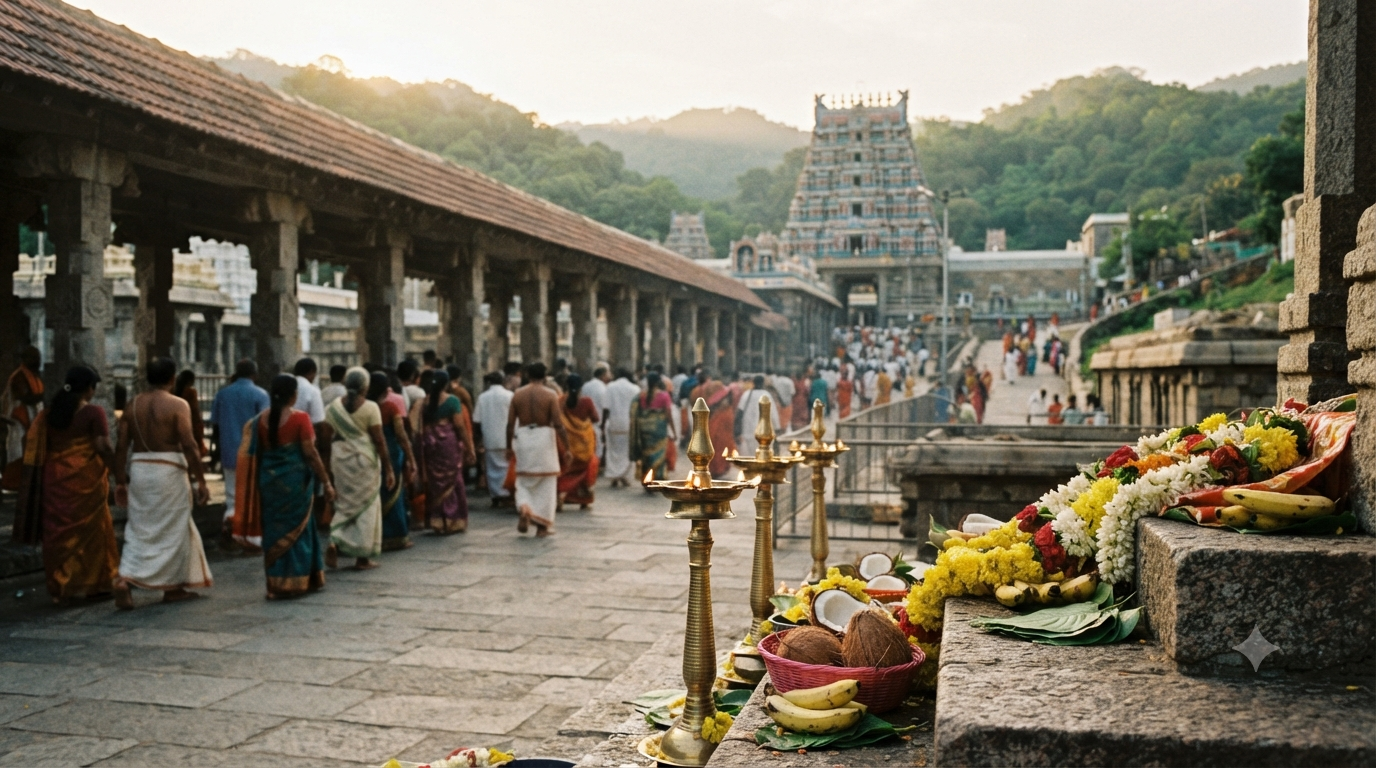
Tirumala Sanivaralu in 2026 fall on September 19, September 26, October 3, October 10 and October 17. These are the Saturdays of the Tamil month of Purattasi, when many families worship Lord Venkateswara or another form of Vishnu. This year needs extra planning because the first and fifth Saturdays overlap with TTD Brahmotsavam periods.
Independent guide: Temples Map is not affiliated with, endorsed by, or the official website of Tirumala Tirupati Devasthanams (TTD). We do not sell darshan tickets, seva tickets, rooms, donations or pooja services. Use only the official TTD booking portal for transactions and the official TTD website for temple information.
Tirumala Sanivaralu 2026 at a Glance
Tamil calendar publishers differ by one day on the exact 2026 Purattasi month boundary. However, the established calendars checked for this refresh agree on all five Tirumala Sanivaralu dates: September 19, September 26, October 3, October 10 and October 17. Each one is a Saturday.
| Date | Observance | Planning note |
|---|---|---|
| 19 September 2026 | First Purattasi Saturday | Annual Brahmotsavam; Garuda Vahanam in the evening |
| 26 September 2026 | Second Purattasi Saturday | Pournami Garuda Seva is on the TTD 2026 schedule |
| 3 October 2026 | Third Purattasi Saturday | Regular Saturday; expect weekend demand |
| 10 October 2026 | Fourth Purattasi Saturday | Mahalaya Amavasya also falls on this date |
| 17 October 2026 | Fifth Purattasi Saturday | Falls during Navarathri Brahmotsavam |
The most important 2026 difference is the festival overlap. Tirumala Tirupati Devasthanams has announced the annual Srivari Brahmotsavams from September 15 to 23 and the Navarathri Brahmotsavams from October 12 to 20. TTD also scheduled Garuda Vahanam from 6:30 PM to 11:30 PM on September 19, the first Tirumala Sanivaralu date.
What Are Tirumala Sanivaralu and Purattasi Saturdays?
Tirumala Sanivaralu are the Saturdays that fall within Purattasi, the sixth month of the traditional Tamil solar calendar. Devotees especially associate these Saturdays with worship of Lord Venkateswara, also known as Srinivasa, Balaji and Venkatachalapathi. In Telugu-speaking families, the observance may also be called Sanivaralu Panduga.
The custom is especially familiar in Tamil Nadu and parts of Andhra Pradesh, Telangana, Karnataka and among families with Tirupati traditions. However, household practice varies. Some families fast, some prepare a full naivedyam meal, while others keep the observance simple with a lamp, flowers, Tulasi leaves and prayer.
One useful correction is important here: Tirumala Sanivaralu is a devotional observance, not the name of a separate TTD ticketed seva. TTD may hold other temple rituals, darshan schedules and festival events on the same dates. Those official events follow TTD’s own calendar.
Why Purattasi Saturdays Matter
Devotees treat Purattasi Saturdays as special days for Vishnu worship, particularly Lord Venkateswara. The practice comes from regional religious tradition rather than from a single uniform rule followed by every family. Therefore, the exact fasting method, food menu and pooja sequence can differ by community.
Many households use the day for focused prayer, simple food and charity. Some recite Sri Venkateswara Suprabhatam, Govinda Namalu, Vishnu Sahasranamam or Venkateswara Ashtakam. TTD itself describes Suprabhatam as the pre-dawn hymn used to awaken Lord Venkateswara at the Tirumala temple.
Claims that the vratam guarantees wealth, removes every problem or cures illness should be understood as matters of faith. They are not medical or financial guarantees. The value of the observance lies in devotion, discipline and family tradition.
Tirumala Sanivaralu Pooja at Home
A simple Tirumala Sanivaralu pooja can be done at home without turning it into a complicated ritual. The safest approach is to follow your family sampradaya, or established custom, when you have one. If not, the steps below offer a respectful basic format.
- Begin after bathing and cleaning the pooja space. Place a clean image or vigraham of Lord Venkateswara, Vishnu or your family deity.
- Light a lamp safely. Families commonly use ghee or sesame oil. Keep the lamp on a stable surface and away from curtains, children and pets.
- Offer flowers and Tulasi if available. Tulasi is traditionally associated with Vishnu worship, although no household should feel forced to use an item it cannot obtain.
- Recite prayers. You may chant Govinda Namalu, Vishnu Sahasranamam, Venkateswara Suprabhatam or a short personal prayer.
- Offer naivedyam. Fruit, milk or a simple vegetarian dish is enough. Families that follow a detailed custom may prepare pongal, pulihora, vada, payasam or a Purattasi thaligai meal.
- Perform harati and share prasadam. Conclude with a prayer for the well-being of the family, then distribute the offered food respectfully.
This method keeps the focus on devotion rather than on fear about doing one step incorrectly. If your elders or family priest prescribe a different order, follow that tradition instead.
Pindi Deepam and Mavilakku Traditions
Some Telugu families prepare pindi deepam, while many Tamil families know a related rice-flour lamp tradition as maavilakku. Recipes and the number of wicks vary by family. Because these are household customs, there is no single TTD rule that every devotee must follow.
Older English pages sometimes contain odd phrases such as lighting a lamp with “cow hair” or a “cow’s head.” Those are translation errors, not pooja instructions. Use a normal lamp with an appropriate fuel such as ghee or sesame oil, and handle any edible flour lamp carefully around a flame.
Fasting and Food Rules
Some devotees fast until the pooja ends, while others eat one vegetarian meal or avoid onion, garlic and non-vegetarian food according to family practice. There is no need to copy another household’s rule if it conflicts with your own tradition or health needs.
If you are pregnant, elderly, diabetic, taking regular medicine or managing another health condition, do not undertake a strict fast without medical advice. A devotional observance can be kept with prayer and suitable food when fasting is unsafe.
Tirumala Sanivaralu Pooja Timings
There is no single universal clock time published by TTD for a home Tirumala Sanivaralu pooja. Many families worship in the morning after bathing, while others complete the main offering around midday or visit a Perumal temple in the evening. Family custom should guide the exact time.
Do not confuse home pooja timing with the Sri Venkateswara temple’s daily schedule. Tirumala follows a detailed sequence of Suprabhatam, archana, darshan and other kainkaryams. That schedule can change during Brahmotsavam and other major festivals, so check TTD notices before travelling.
This distinction matters in 2026 because two Brahmotsavam periods overlap the Purattasi month. A blog that gives one fixed “Saturday pooja time” for Tirumala without checking TTD’s event schedule can easily mislead pilgrims.
Planning a Tirumala Visit on Tirumala Sanivaralu
A Tirumala visit on Tirumala Sanivaralu is possible, but no darshan outcome is guaranteed. Saturdays already attract weekend traffic, and festival overlaps can increase pressure on roads, rooms and queues. Book only through official TTD channels when advance inventory is available.
For darshan planning, see the current Tirumala Rs 300 ticket booking guide. If you are driving uphill, also check the Tirupati to Tirumala ghat road timings. Pilgrims planning to walk can review the Srivari Mettu footpath timings before leaving Tirupati.
September 19 Needs the Most Careful Planning
The first Tirumala Sanivaralu date falls inside the annual Srivari Brahmotsavams. TTD has scheduled Mohini Avataram at 8 AM and Garuda Vahanam from 6:30 PM to 11:30 PM on September 19. That makes this date religiously important and operationally demanding.
TTD has also cancelled several arjitha sevas and special darshan categories during the annual Brahmotsavam period. Therefore, do not arrive assuming the normal non-festival routine will apply. Check the latest TTD announcement immediately before travel.
September 26 Has Pournami Garuda Seva
The second Tirumala Sanivaralu date, September 26, also appears on TTD’s 2026 Pournami Garuda Seva schedule. That is separate from the Brahmotsavam Garuda Vahanam on September 19. Pilgrims should treat the two dates as different events rather than combining them into one schedule.
This is also a good example of why a yearly refresh matters. A page that simply changes “2022” to “2026” without checking TTD’s event calendar would miss an important planning detail.
The fifth Tirumala Sanivaralu date falls during TTD’s Navarathri Brahmotsavams, scheduled from October 12 to 20. TTD announced this second Brahmotsavam because 2026 has an Adhika Masa, or extra lunar month, effect in the religious calendar.
That does not change the Purattasi Saturday date itself. However, it changes the likely crowd pattern and temple operations around October 17. Therefore, treat accommodation, transport and darshan planning as festival-period travel.
What Can Go Wrong With Tirumala Sanivaralu Travel Plans?
The most common failure is assuming that a devotional date guarantees an easy darshan. It does not. Advance tickets may sell out, accommodation may be tight, and TTD can change or cancel certain sevas when crowd-control needs require it.
If your preferred paid darshan or room is unavailable, do not buy from agents or private numbers. Check the official portal for another date or available category. If nothing suitable is available, the safest fallback is to move the Tirumala trip and keep the Tirumala Sanivaralu pooja at home.
Travel plans can also fail because pilgrims use old road or footpath timings. Recheck current access rules shortly before departure. Festival-day restrictions can differ from ordinary weekends.
Common Mistakes and Misinformation to Avoid
- Using old-year dates: the 2022 calendar is not valid for 2026. Purattasi dates must be checked for the specific year.
- Treating it as a TTD ticketed seva: Tirumala Sanivaralu is a devotional observance, not a separate online booking product.
- Following mistranslated lamp instructions: use a normal lamp with ghee or sesame oil rather than copying phrases such as “cow hair.”
- Assuming every Saturday in September and October counts: only Saturdays that fall within Purattasi belong to this observance.
- Presenting faith claims as guarantees: spiritual benefits belong to belief and tradition, not to provable promises.
- Ignoring festival overlaps: September 19 and October 17 fall during major TTD Brahmotsavam periods in 2026.
Before You Observe the 2026 Purattasi Saturdays
The 2026 calendar gives devotees five Purattasi Saturdays: September 19, September 26, October 3, October 10 and October 17. For families observing Tirumala Sanivaralu, keep the pooja simple if that suits your tradition, and treat fasting rules as flexible when health requires it.
If you plan to visit Tirumala, the calendar alone is not enough. Check TTD’s latest festival, darshan and transport notices because the first and fifth Saturdays fall inside Brahmotsavam periods. Most importantly, use only official TTD channels for any booking or payment.
Tirumala Sanivaralu Frequently Asked Questions
What are the Tirumala Sanivaralu dates in 2026?
The Tirumala Sanivaralu dates in 2026 are September 19, September 26, October 3, October 10 and October 17. All five dates fall within the Tamil month of Purattasi. Calendar publishers differ by one day on the exact Purattasi month boundary, but they agree on these five Saturday dates.
How many Purattasi Saturdays are there in 2026?
There are five Tirumala Sanivaralu in 2026. They fall on two Saturdays in September and three Saturdays in October. The exact count changes from year to year because Purattasi does not begin on the same weekday every year.
When does Purattasi start and end in 2026?
Published Tamil calendars show a one-day difference in the 2026 Purattasi boundary. Prokerala and Drik Panchang label September 17 as Purattasi 1, while HinduPad and Skanda News list September 18 as the month start. The five Saturday dates are unchanged, so use your family panchang for day numbering.
Is there a special TTD ticket for these Saturdays?
No. Tirumala Sanivaralu is not the name of a separate TTD ticketed seva. If you want darshan at Tirumala, use the darshan or seva options that TTD officially lists for your date on its booking portal.
Can the pooja be done at home?
Yes. Many families observe the day at home with a lamp, Tulasi, flowers, prayer and vegetarian naivedyam. Some follow a detailed pindi deepam or maavilakku tradition, while others keep the pooja brief. Family custom can decide the format.
What prayers can I recite on Purattasi Saturday?
Common choices include Sri Venkateswara Suprabhatam, Govinda Namalu, Vishnu Sahasranamam and Venkateswara Ashtakam. You can also offer a short personal prayer. A long recitation is not required for the observance to be meaningful.
Is fasting compulsory on Purattasi Saturday?
No single fasting rule applies to every devotee. Some people fast until pooja, while others eat one vegetarian meal or simply avoid non-vegetarian food. Health needs should come first, especially for pregnant, elderly or medically vulnerable devotees.
Which Purattasi Saturday may be busiest in Tirumala?
September 19 deserves the strongest caution because it falls during the annual Brahmotsavam and includes Garuda Vahanam in the evening. October 17 also falls during Navarathri Brahmotsavam. Actual crowd conditions can still change, so check TTD updates close to travel.