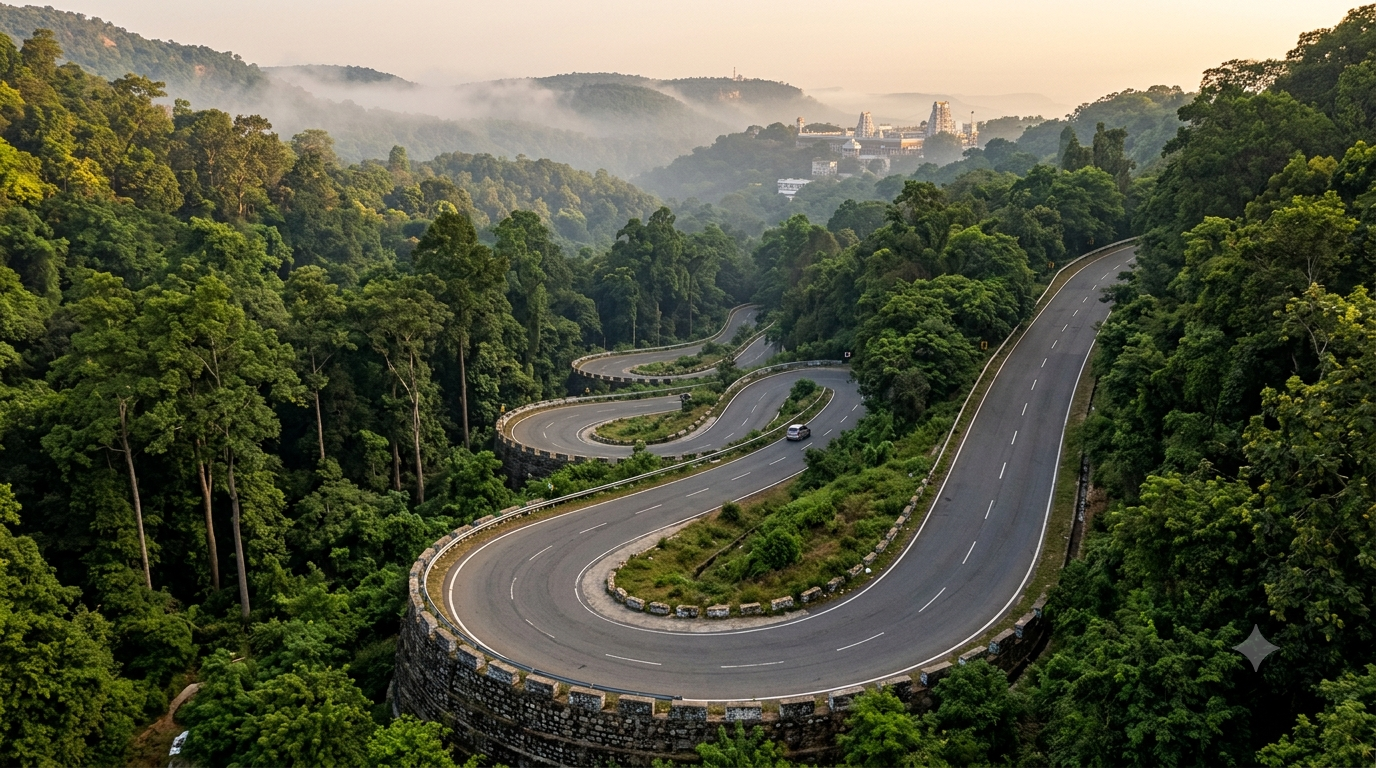
The Tirupati to Tirumala Ghat Road is the winding hill route most pilgrims take to reach Lord Venkateswara’s shrine. Its opening hours are not the same for every vehicle. Cars and buses get a longer daily window than two-wheelers, and the road also shuts for a few hours after midnight.
On top of that, a token system quietly clocks how fast you drive. Get these details wrong and you can be turned back at the toll gate after a long trip. So here is the current, verified picture, with the old rules that no longer apply cleared away.
Temples Map is an independent pilgrim guide. We are not affiliated with, endorsed by, or the official website of Tirumala Tirupati Devasthanams (TTD). We do not accept bookings, donations, or payments. Please use the official TTD portal for tickets, and reconfirm timings before you travel, since TTD can revise them without notice.
Tirupati to Tirumala Ghat Road at a Glance
Here are the essentials before we dig into each one:
- Two roads, one-way each: you go up on the newer ghat road and come down on the older one.
- Distance: roughly 18 km by road, with more than 35 hairpin bends.
- Four-wheelers: broadly open through the day, though the road closes to all traffic for a window after midnight.
- Two-wheelers: a shorter daytime window than cars, because riding the curves after dark is risky.
- Toll: a small charge for cars at the Alipiri gate, while two-wheelers usually pass free.
- Minimum travel time: drive too fast and the token system fines you for over-speeding.
Tirupati to Tirumala Ghat Road Timings for Cars and Buses
For four-wheelers, the Tirupati to Tirumala Ghat Road is generally open from the early hours until close to midnight. TTD describes the road as open roughly between 3:00 AM and 12:00 midnight on normal days. In practice, cars, jeeps, and APSRTC buses run through most of the day.
The road then closes to traffic for a short spell after midnight. So vehicles arriving in the small hours may have to wait at the base.
These exact hours do shift, though. Different TTD notices have listed the four-wheeler cut-off anywhere from about 10:30 PM to 11:45 PM. Because the figures vary, and because TTD revises them for festivals or weather, treat any single time as approximate. Always reconfirm the current window on the official TTD portal a day before you set off.
Two-Wheeler Timings on the Ghat Road
Two-wheelers get a narrower window than cars. Riders are usually let up from early morning, and the evening cut-off comes earlier than for four-wheelers. Reported hours differ widely, though. Older notices list a roughly 6:00 AM to 6:00 PM slot, while some show a longer morning-to-evening window.
The reason for the shorter window is simple. TTD limits bikes after dark because the hairpin bends turn far more dangerous on two wheels at night. So if you plan to ride up, start early and reconfirm the day’s timing. A late arrival at Alipiri can mean you are turned away.
The Vaccination Rule No Longer Applies
You may have seen a warning in older guides about vaccination proof. They say you must show a two-dose COVID certificate at the Alipiri checkpoint to enter the ghat road. That rule belonged to the pandemic period, and it no longer applies. You do not need a vaccination report or an RT-PCR test to drive up to Tirumala today.
This is worth flagging because many pages still repeat it. As a result, pilgrims scramble for paperwork they simply do not need. What you do still need is a valid darshan or accommodation booking during busy spells.
You also face the standard vehicle and licence checks described below. When in doubt, the official TTD portal is the source that stays current.
Tirupati to Tirumala Ghat Road Toll and Token System
At the Alipiri toll gate, four-wheelers pay a small road toll, while two-wheelers generally pass through a free lane after security checks. The car toll has been reported at around ₹50 to ₹100, with higher charges for buses and heavy vehicles. Since these figures differ across sources and can change, confirm the exact amount at the counter. A FasTag lane is available if your vehicle carries one.
The token system is the part first-timers miss. When you enter at Alipiri, your vehicle receives a timestamped token. Staff scan it again near the top at the GNC checkpoint. If your drive beats the minimum allowed time, the system flags you for over-speeding, and a fine can follow.
That minimum travel time exists for safety on the curves. Reported figures range from about 28 to 40 minutes, depending on the direction and the notice. The practical takeaway is easy: do not rush the climb. Keep the token safe, since you need it at both the top and on your return.
Quick Comparison: Vehicle, Timing, and Toll
| Vehicle | Approx. window | Toll at Alipiri |
|---|---|---|
| Car / jeep / van | Broadly all day; closed a few hours after midnight | Around ₹50 to ₹100 (confirm at counter) |
| Two-wheeler | Shorter daytime window; no late-night entry | Usually free lane |
| Mini-bus / bus | Same as cars; private buses park at Alipiri | Higher slab (confirm at counter) |
| APSRTC bus | Round-the-clock service | Ticket fare, not a toll |
As the table shows, the exact numbers are best confirmed on the ground. TTD adjusts both timings and tolls from time to time.
Tirupati to Tirumala Ghat Road Rules Every Pilgrim Must Follow
The route runs through the protected Seshachalam forest, so TTD enforces a firm set of rules. Break them and you risk a fine or a refused entry. The main ones are worth memorising before you reach Alipiri.
- Register your entry: every vehicle records its entry time via the token at the toll gate.
- Helmets and licence: riders and pillions must wear helmets, and the rider needs a full driving licence, since a learner’s licence will not do.
- Seating limits: stick to the rated seating capacity, because overloading causes accidents on the bends.
- No overtaking on curves: avoid overtaking at bends, and never stop on the road except at marked parking spots.
- Banned items: non-veg food, alcohol, tobacco, gutka, fireworks, and weapons cannot go up the hill.
- Private buses: large private buses cannot climb, so park at Alipiri and switch to an APSRTC service.
Security staff check vehicles thoroughly at the gate. Passengers may be asked to step out with their luggage. Cooperating keeps the queue moving for everyone behind you.
Ghat Road, APSRTC Bus, or the Footpath: Which to Choose?
You have three real ways up, and the best one depends on who is travelling. Driving your own car offers flexibility for families with luggage and elderly members. Yet it also means taking dozens of hairpin bends yourself. Many first-time visitors find that stressful.
The APSRTC bus is the easiest option for most pilgrims. Buses run round the clock from the Tirupati bus stands and the railway station. They cost only a nominal fare, and an experienced driver handles the curves. If you would rather not drive at all, this is the stress-free choice.
The footpath is for those who want the traditional walking pilgrimage. Alipiri Mettu and Srivari Mettu are the two stepped routes, and pilgrims often walk up to fulfil a vow. These climbs are strenuous, so anyone with heart, knee, or breathing conditions should think carefully and carry water. Elderly and pregnant pilgrims are usually better served by the bus.
Why There Are Two Ghat Roads
The two-road system confuses many first-timers, so a little history helps. The older ghat road, completed in the 1940s, links to the famed engineer Sir M. Visvesvaraya, and it once carried traffic both ways. A second, newer ghat road opened in the 1970s to ease the load.
Today the newer road carries the uphill flow from Tirupati to Tirumala, while the older one handles the descent. Both wind through the forested hills over more than 35 hairpin bends each. This one-way split is why you cannot simply turn around midway. You go up on one road and come back on the other.
Is the Tirupati to Tirumala Ghat Road Safe at Night?
The Tirupati to Tirumala Ghat Road is safe when you respect the timings and drive within the limits. Even so, night driving deserves extra caution. The road is well maintained, CCTV-monitored, and patrolled, yet the bends are sharp and the forest stretches are dark. This is exactly why TTD narrows the two-wheeler window and closes the road for a spell after midnight.
If you must travel in the dark hours, the APSRTC bus is the safer bet, since professional drivers know every turn. For self-drivers, keep your speed low, and treat the 30 km/h limit as a ceiling. Never stop on a curve. Fog is common in the monsoon months, so slow right down when visibility drops.
What First-Time Drivers Get Wrong
A few practical lessons save a lot of trouble on the climb. First, do not race to the top, because the token system penalises speed. A calm drive is both safer and cheaper. Second, fill your fuel tank in Tirupati, since options on the hill are limited.
Motion sickness is common on the bends, especially for children. So carry a light snack, and avoid a heavy meal beforehand. Keep your darshan booking and ID handy for the checks. Finally, note where you park at Tirumala, since the lots are large and easy to lose track of after darshan.
One more tip that regulars swear by: start early. A dawn drive up the Tirupati to Tirumala Ghat Road brings cooler air and lighter traffic. The soft light over the Seshachalam hills turns a stressful climb into a genuinely lovely one.
Before You Set Off
The Tirupati to Tirumala Ghat Road is a straightforward drive once you know the rhythm. Cars get a long daily window, two-wheelers a shorter one, and everyone obeys the token-timed minimum drive. Ignore the old vaccination myth, carry your licence and booking, and keep your speed sensible on the bends.
If the curves sound daunting, take the APSRTC bus and enjoy the view instead. Whatever you choose, reconfirm the day’s timings on the official TTD portal, then start early for the smoothest journey. If you need a room near the hill, plan your TTD accommodation ahead too.
Frequently Asked Questions
What are the Tirupati to Tirumala Ghat Road timings today?
Four-wheelers run broadly through the day, though the road closes to traffic for a few hours after midnight. Two-wheelers get a shorter daytime window. Exact hours shift with festivals and maintenance, so reconfirm on the official TTD portal before you travel.
Do I need a COVID vaccination certificate to enter?
No. The two-dose vaccination and RT-PCR requirement was a pandemic-era rule, and it no longer applies. You do not need any vaccination report to drive up to Tirumala now. A valid darshan or accommodation booking still helps during busy periods.
How long is the ghat road and how long does the drive take?
The road runs roughly 18 km with more than 35 hairpin bends. The drive itself takes around 40 minutes to an hour. TTD enforces a minimum travel time, so reaching the top too quickly can attract an over-speeding fine.
Is there a toll on the Tirupati to Tirumala Ghat Road?
Cars pay a small toll at the Alipiri gate, reported at around ₹50 to ₹100, while two-wheelers usually pass through a free lane. Buses and heavy vehicles pay a higher slab. Confirm the current amount at the counter, since charges can change.
Can two-wheelers go up to Tirumala?
Yes, bikes are allowed on the ghat road, but within a shorter daytime window than cars. Riders and pillions must wear helmets, and the rider needs a full driving licence. Because the curves turn risky after dark, start your ride early in the day.
Which is better, driving up or taking the APSRTC bus?
The APSRTC bus is easier and safer for most pilgrims, since experienced drivers handle the bends and buses run round the clock at a low fare. Drive your own vehicle only if you want flexibility for luggage or family and feel comfortable on hairpin roads.
Are the ghat road timings different during festivals?
Yes. During major festivals and heavy-traffic days, TTD may extend, restrict, or change the windows, and vehicles sometimes run round the clock. Always check the latest updates on the official TTD portal close to your travel date.