The famous temples in Madhya Pradesh span a rare mix of traditions. In one accessible state you find two of the twelve Jyotirlingas, a hilltop Shakti Peeth, a UNESCO-listed group of thousand-year-old shrines, and a temple where Lord Rama reigns as a king. Because the state sits at India’s heart, most of these shrines lie along easy road and rail routes. So you can plan a real multi-temple yatra without long detours.
This guide also covers each major temple — its deity, timings, entry, and the honest travel detail that saves you time. Before publishing, we checked every changeable fact against official temple trusts, the Archaeological Survey of India, and Madhya Pradesh Tourism. Since fake booking sites and gate touts target every busy shrine, we also point you to the genuine portals.
TemplesMap is an independent temple guide. We are not affiliated with any temple trust, board, or government body, and we are not an official website. We take no bookings, donations, or payments, so please use the official portals linked below.
Famous Temples in Madhya Pradesh at a Glance
Here is a quick snapshot before we go temple by temple. Use it to shortlist the shrines that match your route and your reason for travelling.
- Mahakaleshwar, Ujjain — one of 12 Jyotirlingas, famous for the pre-dawn Bhasma Aarti.
- Omkareshwar & Mamleshwar — a Jyotirlinga on an Om-shaped island in the Narmada.
- Khajuraho — a UNESCO World Heritage group of Chandela-era temples.
- Maihar Sharda Devi — a hilltop Shakti Peeth with 1,063 steps or a ropeway.
- Kal Bhairav, Ujjain — the guardian deity who receives liquor as an offering.
- Bhojeshwar, Bhojpur — one of the largest single-stone Shiva lingams.
- Ram Raja, Orchha — the only temple where Rama reigns as a king.
- Pitambara Peeth, Datia — a Siddha Peeth of Goddess Baglamukhi.
Jyotirlinga Temples in Madhya Pradesh
Two of the twelve sacred Jyotirlingas of Lord Shiva stand in this state. Naturally, both anchor any Shaivite pilgrimage here. Devotees often pair them, because Ujjain and Omkareshwar lie roughly 130 km apart. So a two-day trip covers both in comfort.
Mahakaleshwar Jyotirlinga, Ujjain
Mahakaleshwar is the beating heart of the temples in Madhya Pradesh. It also draws pilgrims from across the country every day. It is also the only Jyotirlinga that faces south, a form called Dakshinamukhi, which adds special tantric weight. Devotees regard the lingam as Swayambhu, or self-manifested.
The temple opens very early, around 4:00 AM. It stays active until about 11:00 PM, after the Shayan Aarti. Its signature ritual is the Bhasma Aarti before sunrise, when priests anoint the lingam with sacred ash. The Mahakal Lok corridor, opened in 2022, now leads to the shrine through a wide, sculpture-lined promenade.
Bhasma Aarti, Fees and Fraud Warnings
The Bhasma Aarti needs advance booking with a valid photo ID, so plan it well ahead. You can study the routine on our guide to the Mahakaleshwar Bhasm Aarti timings and booking. General darshan is free. Quicker VIP or Sheeghra passes carry an indicative fee of roughly ₹250 per person.
Since these amounts change, confirm the current rate on the official Mahakaleshwar Temple portal rather than a third-party quote. Our Mahakaleshwar VIP darshan booking page walks you through each step. Only the official website issues genuine Bhasma Aarti passes, so ignore lookalike sites that demand extra “processing” charges. If a page wants heavy upfront fees or your Aadhaar copy for general darshan, treat it as fake.
Bhasma Aarti tickets sell out within minutes on Mondays, during Sawan, and on Mahashivratri. Book the moment the window opens, and carry the same ID you used online.
Omkareshwar and Mamleshwar Jyotirlinga
Omkareshwar sits on Mandhata Island in the Narmada. The island itself takes the shape of the sacred syllable Om. As the fourth of the twelve Jyotirlingas, it holds immense pull for Shiva devotees. Your pilgrimage counts as complete only after you also visit Mamleshwar, the partner Jyotirlinga across the river.
The temple usually opens around 5:00 AM and closes near 9:30 PM, with short aarti breaks. You reach the island by a footbridge or a short boat ride, so allow extra time during festivals.
Entry is free, while a quicker darshan pass costs an indicative ₹300. Confirm the latest figure on the Shri Omkareshwar Mandir Trust site. Our Omkareshwar darshan timings guide tracks day-to-day changes.
A newer draw sits nearby. In 2023, the state unveiled the 108-foot Statue of Oneness of Adi Shankaracharya at Ekatmata Dham. So many pilgrims now club the statue with their darshan. Finally, the evening Narmada aarti on the ghats makes a quiet, moving end to the day.
Khajuraho: UNESCO Heritage Temples in Madhya Pradesh
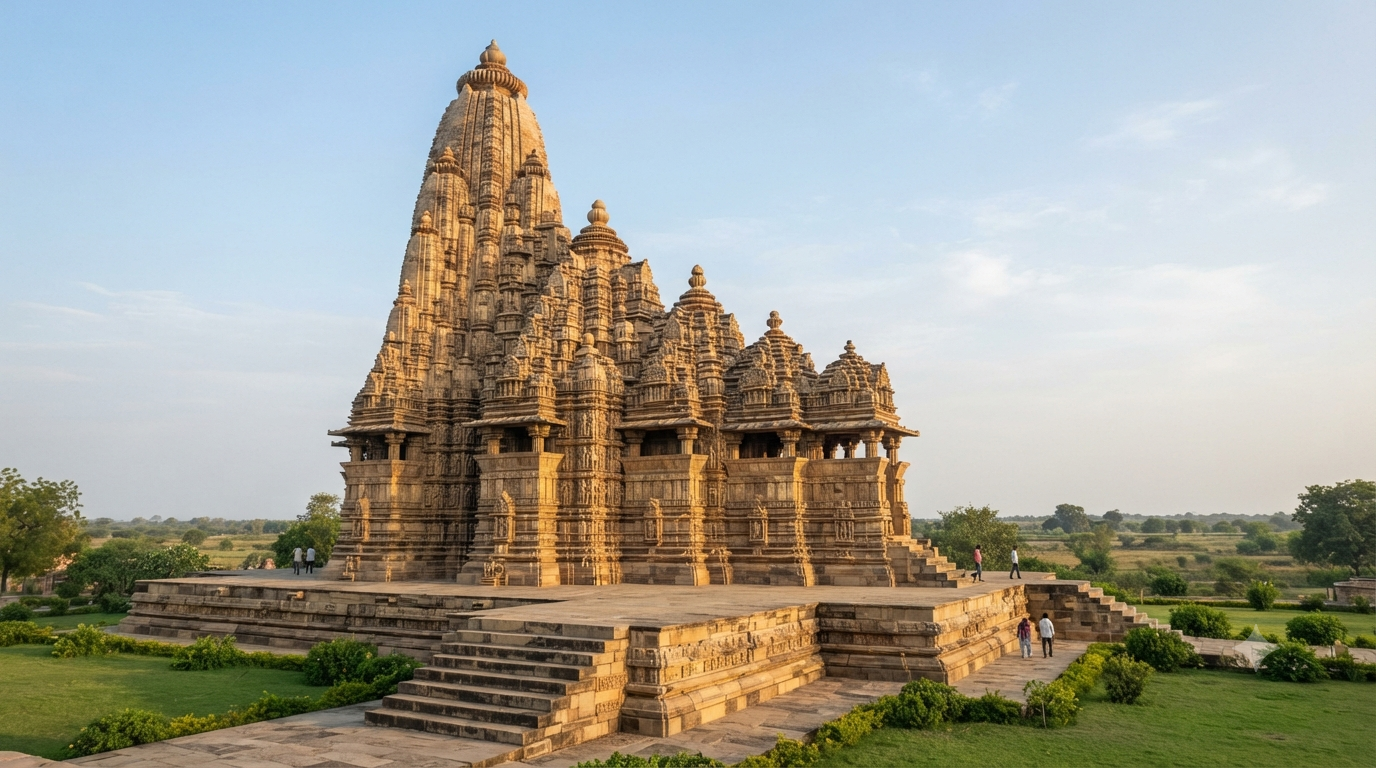
Among all heritage temples in Madhya Pradesh, the Khajuraho Group of Monuments stands apart. UNESCO listed it as a World Heritage Site in 1986. The Chandela dynasty raised these Nagara-style shrines between roughly 950 and 1050 AD. Around 25 of the original cluster survive today, and their sandstone carvings express the four aims of life in Hindu thought.
The temples fall into Western, Eastern, and Southern groups. The Western Group forms the ticketed, ASI-managed core. It holds the towering Kandariya Mahadeva, the largest and most ornate temple here. The Matangeshwara shrine beside it still hosts daily worship, and it stays free to enter.
The complex opens from sunrise to sunset, and the Western Group window generally runs until early evening. Indian nationals pay an indicative ₹40, while foreign nationals pay around ₹600. Children below 15 enter free. Because these ASI fees can change, verify them on the Archaeological Survey of India portal, also listed by Madhya Pradesh Tourism.
Insider note: the gate now runs a QR-code and online ticket system. So buy your own pass and skip the touts. A guide stays optional, and agents at the entrance often overcharge. Scan the official QR banner yourself, or book ahead if your phone signal is weak.
Shakti Peeth Temples in Madhya Pradesh
The goddess tradition runs deep here. Two of the most powerful Shakti Peeth temples in Madhya Pradesh reward the effort of reaching them. Both draw huge crowds during Navratri, when timings often extend and queues lengthen.
Maihar Sharda Devi Temple
Maihar’s Sharda Devi temple crowns Trikut Hill in Satna district. Devotees revere it as a Shakti Peeth, where a part of Sati is said to have fallen. People read the name Maihar as “mai” and “haar,” meaning the mother’s necklace. Pilgrims worship Maa Sharda as a form of Saraswati, so students and parents flock here for wisdom.
Reaching the sanctum traditionally means climbing 1,063 steps. A ropeway now carries pilgrims who cannot manage the stairs, with a round-trip ticket at an indicative ₹120.
One common myth needs correcting. The counter near the base sells the ropeway ticket in person only, and no official online booking exists. So ignore any site claiming to sell ropeway tickets in advance.
The temple usually opens around 5:00 AM and closes near 9:00 PM, though Navratri days run longer. Safety note: the climb is steep and can tire elderly or unwell pilgrims. Carry water, wear proper shoes, and choose the ropeway if a long ascent feels risky.
Pitambara Peeth, Datia
Pitambara Peeth in Datia honours Goddess Baglamukhi, also called Pitambara Devi. It also holds a rare shrine to Dhumavati. Devotees treat it as a Siddha Peeth linked to courage and the defeat of obstacles. Founded in the early twentieth century, it remains a serene ashram with a Sanskrit library.
Entry is free, and the temple generally opens from about 5:00 AM to 9:00 PM. Because the peeth keeps disciplined ritual practice, dress modestly and hold your place in the queue during yajnas. Gwalior, roughly 70 km away, is the nearest major transport hub.
More Must-Visit Temples in Madhya Pradesh
Beyond the Jyotirlingas and Shakti Peeths, three more shrines carry stories you will not find elsewhere in India. Each rewards a short detour.
Kal Bhairav Temple, Ujjain
Devotees worship Kal Bhairav as the Kotwal, or guardian, of Ujjain. Many treat a Mahakaleshwar visit as incomplete without stopping here. The temple’s most striking custom is the offering of liquor straight to the deity, a survival of ancient tantric worship. A priest pours a little from each bottle, and tradition holds that the god accepts it.
The offering stays entirely optional, so you may present flowers, coconut, or sweets instead. Because unlicensed sellers once cheated pilgrims, the state set up official liquor counters outside the temple. So buy only from those. The temple generally opens around 5:00 AM and stays open until about 10:00 PM.
Bhojeshwar Temple, Bhojpur
Bhojeshwar temple sits about 28 km from Bhopal, on the banks of the Betwa. Indeed, it holds one of the largest Shiva lingams in India. The lingam rises roughly 7.5 feet, and with its polished platform the monument nears 40 feet in total height. Raja Bhoj of the Paramara dynasty commissioned it in the 11th century, yet workers left it famously incomplete.
An earthen ramp still curves behind the shrine. Notably, it shows how builders once hauled huge stone blocks up to add height without pulleys. The masons raised it without mortar, so it stands as a marvel of early medieval engineering. Locals call it the Somnath of the East.
Entry is free, and the temple opens from sunrise to sunset.
Ram Raja Temple, Orchha
At Orchha’s Ram Raja temple, devotees worship Lord Rama as a king rather than only as a deity. It is the only such shrine in India.
According to legend, a queen carried an idol meant for a temple, but it settled in her palace and would not move. So the palace itself became the temple. Because Rama reigns here as a monarch, the daily rituals mirror a royal court.
Above all, the most remarkable sight is the daily Guard of Honour. Armed police present a ceremonial salute to Lord Rama each morning, much as they would to a king. No other temple in the country accords the deity a police salute. The 16th-century shrine sits beside the Betwa, near Orchha’s palaces and cenotaphs, so plan a full day.
Quick Comparison of Major Temples
The table below summarises the essentials. Treat all fees and timings as indicative, and confirm current details on the official portals before you travel.
| Temple | Main Deity | Indicative Timings | Highlight |
|---|---|---|---|
| Mahakaleshwar, Ujjain | Shiva (Jyotirlinga) | ~4 AM–11 PM | Bhasma Aarti |
| Omkareshwar | Shiva (Jyotirlinga) | ~5 AM–9:30 PM | Om-shaped island |
| Khajuraho (Western) | Shiva, Vishnu, Jain | Sunrise–Sunset | UNESCO carvings |
| Maihar Sharda Devi | Sharda (Shakti Peeth) | ~5 AM–9 PM | 1,063 steps or ropeway |
| Ram Raja, Orchha | Rama as king | Morning & evening | Police Guard of Honour |
How to Reach the Temples in Madhya Pradesh
Most shrines cluster around a few gateway cities, which keeps planning simple. Indore is the closest major airport for Ujjain, Omkareshwar, and Mahakaleshwar. Bhopal serves Bhojpur and the Sanchi region. Khajuraho has its own airport, with flights from Delhi and Varanasi.
By rail, Ujjain Junction anchors the western circuit, and Omkareshwar Road station lies about 12 km from that island shrine. Maihar sits on the main Mumbai–Howrah line, so trains reach it directly. Orchha is a short hop from Jhansi. Because road links are good statewide, taxis and state buses connect the temple towns easily.
Best Time to Visit Temples in Madhya Pradesh
October to March is the ideal window for the temples in Madhya Pradesh, since the weather stays pleasant for travel and hill climbs. Summers from April to June turn hot and tiring, especially at open sites like Khajuraho and Bhojpur. If you visit then, choose early-morning or evening darshan.
Festivals transform these shrines, but they also multiply the crowds. Mahashivratri floods Ujjain and Omkareshwar, while Navratri packs Maihar and Datia. Because queues stretch for hours on such days, arrive early and stay flexible.
If you are elderly, pregnant, or managing a health condition, treat the hilltop climbs and long waits with real caution. Pace yourself, and carry any medication you need.
Insider Tips Most Guides Skip
A little planning turns a rushed visit into a smooth one. These are the practical points that regular pilgrims learn the hard way.
- Book only on official portals. Fake sites clone temple names and charge inflated fees, so reach the genuine trust site directly.
- Carry the ID you booked with. Staff check Bhasma Aarti and VIP passes against your photo ID at entry.
- Skip the touts. At Khajuraho, scan the official QR code yourself instead of paying agents at the gate.
- Dress modestly. Most shrines expect covered shoulders and knees, and some ask you to remove footwear early.
- Deposit phones and leather. Many temples bar phones and leather items inside, so use the lockers provided.
Overall, these small habits protect both your time and your money. They also let you focus on the darshan itself, not the logistics.
Before You Plan Your Yatra
Madhya Pradesh packs an unusual range of sacred sites into one accessible state. You can move from Jyotirlingas and Shakti Peeths to a UNESCO heritage marvel and a temple ruled like a royal court.
For a first trip, the Ujjain–Omkareshwar Jyotirlinga circuit gives the deepest reward with the least travel. If art and history pull you more, pair Khajuraho with Orchha for a memorable long weekend. Whatever you choose, verify timings and fees on the official portals, book only through genuine channels, and travel in the cooler months.
Frequently Asked Questions
Which are the most famous temples in Madhya Pradesh?
The most famous temples in Madhya Pradesh include the Mahakaleshwar and Omkareshwar Jyotirlingas, the UNESCO-listed Khajuraho group, and Maihar’s Sharda Devi Shakti Peeth. Kal Bhairav in Ujjain, Bhojeshwar at Bhojpur, and the Ram Raja temple in Orchha complete the list. Together they span Shaivite, Shakta, and heritage traditions.
Which Jyotirlingas are in Madhya Pradesh?
Madhya Pradesh has two of the twelve Jyotirlingas: Mahakaleshwar in Ujjain and Omkareshwar on Mandhata Island. Mahakaleshwar is the only Jyotirlinga that faces south. Omkareshwar pairs with the Mamleshwar shrine across the Narmada, and pilgrims visit both to complete the yatra.
How do I book Mahakaleshwar Bhasma Aarti tickets?
The official Mahakaleshwar Temple website issues Bhasma Aarti passes, and they need advance registration with a valid photo ID. Slots fill within minutes on Mondays and festival days. So book as soon as the window opens, and avoid any third-party site charging extra fees.
Is there a ropeway at Maihar Sharda Devi Temple?
Yes, a ropeway carries pilgrims up Trikut Hill for those who cannot climb the 1,063 steps. The round-trip fare is an indicative ₹120. The counter near the base sells the tickets in person, because no official online booking exists for the ropeway.
What is the entry fee for Khajuraho temples?
The Western Group at Khajuraho charges an indicative ₹40 for Indian nationals and around ₹600 for foreign nationals. Children below 15 enter free. The Eastern and Southern groups stay free, and you should confirm all ASI fees before you visit.
Why is liquor offered at Kal Bhairav Temple in Ujjain?
Devotees offer liquor to Kal Bhairav as part of an ancient tantric tradition, and priests present it directly to the deity. The offering stays entirely optional. The state also runs official counters outside the temple, so unlicensed sellers cannot cheat devotees.
What is special about the Ram Raja Temple in Orchha?
Ram Raja in Orchha is the only temple in India where devotees worship Lord Rama as a king. Armed police perform a daily Guard of Honour, presenting a ceremonial salute to the deity much as they would to a reigning monarch.
What is the best time to visit temples in Madhya Pradesh?
October to March is the best time to visit temples in Madhya Pradesh, when cool weather suits travel and hill climbs. Festivals like Mahashivratri and Navratri feel spiritually charged but very crowded, so arrive early and plan for long queues.