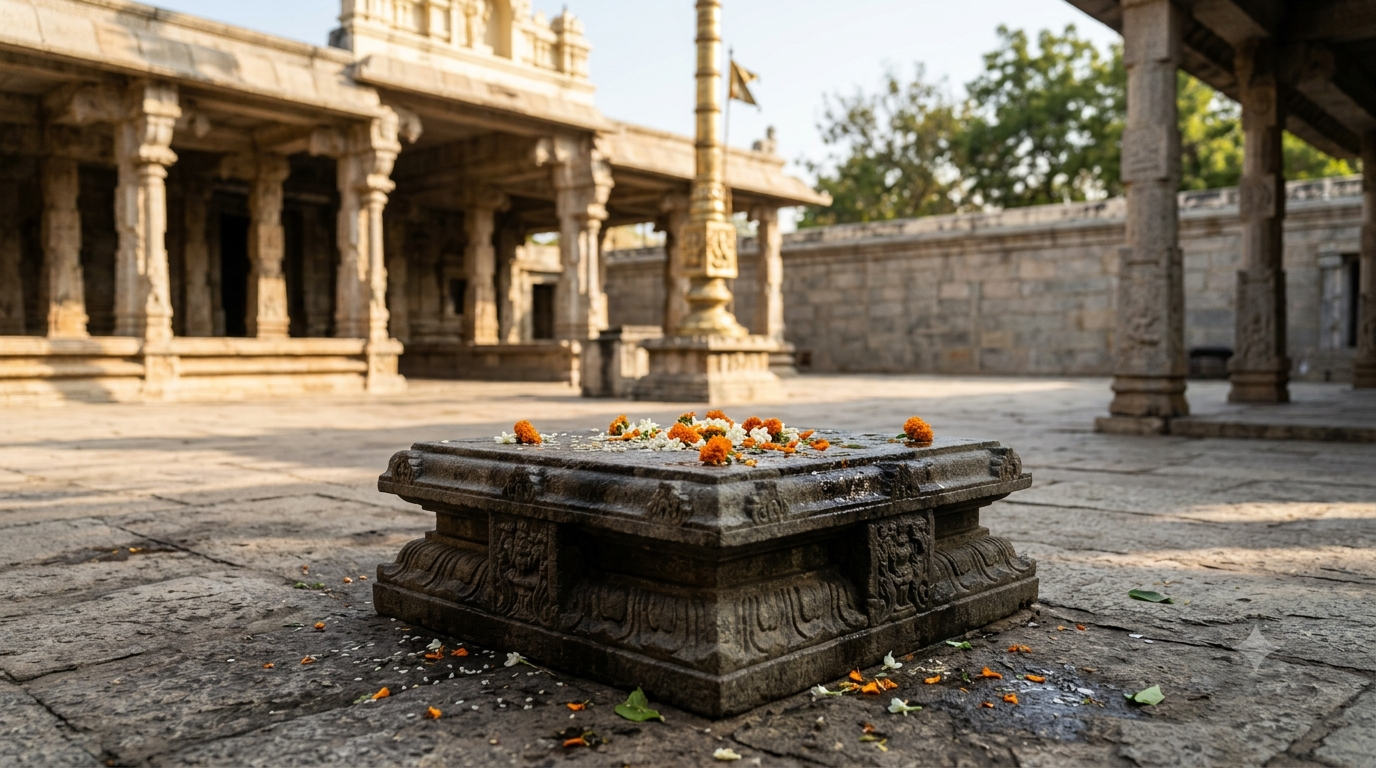
The temple balipitha meaning is simple: it is a pedestal for ritual offerings, not a flagstaff or a lamp pillar. In South Indian temple descriptions, this small architectural feature can sit near much taller structures, so it is easy to overlook. Its role becomes clearer when we read the altar alongside the worship it supports.
Independent heritage guide: TemplesMap is not affiliated with any temple authority or religious trust. We do not accept bookings, donations or payments. Ask the relevant temple administration about its current rituals and visitor access.
Temple balipitha meaning: the offering pedestal
A balipitha, also written bali pitha, bali peetha or balipitham, is an altar or raised platform for ritual offerings in a Hindu temple. The Sanskrit word bali refers here to an offering, while pitha means a seat or pedestal. The structure has a ritual purpose, even when it resembles a plain stone base.
The distinction matters because an altar does not need to be tall or visually dramatic. A flagstaff rises above the courtyard, while an offering pedestal may sit below a visitor’s line of sight. Its place in worship, rather than its height, identifies it.
Temple balipitha meaning at a glance
- Meaning: an altar or pedestal for ritual offerings.
- Related words: bali pitha, bali peetha and balipitham.
- Ritual setting: offerings connected with temple worship and attendant deities.
- Common neighbour: the dhwajasthambam, or ceremonial flagstaff, in some temple plans.
- Not the same as: a deepastambha lamp pillar, Nandi image, donation box or fire altar.
- Important caution: position, appearance and access depend on the particular temple.
Temple balipitha meaning in Shaiva worship
In a Shaiva setting, the balipitha belongs to the temple’s ritual order, not merely its decoration. Gayathri Balasubramanian’s study Temple Worship and Rituals as per Shaiva Agamas identifies it as the pedestal for bali near the dhvajastambha. The discussion links it with the temple’s halls, enclosure and Nandi image.
The source matters for its context. It describes the Shaiva temple as a complex of places with distinct ritual uses. In that account, the balipitha receives offerings, while the dhvajastambha is the flag mast. The two may stand close together, yet their functions remain separate.
The study’s adjoining discussion describes rice offerings placed on an altar. That helps explain bali in this specific context without turning every use of the term into the same ritual. Temple lineages and regional traditions can differ, so a single passage should not become a rule for all Hindu temples.
Naivedya commonly names food presented to a deity during worship. Bali, in temple ritual discussions, can name offerings connected with attendant divinities and other recipients within the sacred precinct. Some descriptions place these acts within a wider sequence of worship.
However, that distinction does not provide a universal recipe or fixed order of ceremonies. The temple’s Agamic school and local practice decide the details. That is the key to temple balipitha meaning: it names a place for bali, not every food rite in worship. For a visitor, the useful point is that a balipitha marks an offering location; it is not simply a stone for anyone to leave food on.
Why do temple texts mention attendant deities?
A temple precinct may contain shrines and places for worship beyond its principal sanctum. Shaiva temple descriptions discuss these attendant deities as part of a wider ritual setting. As a result, offerings at a balipitha make more sense when the whole complex is considered.
That does not mean every attendant deity has an identical altar or receives the same offering. A plan might mark a principal pedestal and smaller places for bali, while another temple uses a different arrangement. Since the text and the building can differ, use the temple’s own account before naming each stone.
Does bali always mean animal sacrifice?
No. In the Shaiva architectural discussion used here, the example involves food offerings, including rice. The English word “sacrifice” can mislead when it makes readers assume one specific practice. The term has a wider history across religious traditions, so the actual ritual must come from a named source.
Nor should one claim the opposite extreme: that every practice everywhere uses only rice. The temple balipitha meaning describes an offering altar, while the kind of offering is a separate question. Avoid using a dramatic image or an unsourced story to answer it.
Temple balipitha meaning in plans and photographs
A temple plan may show the balipitha beside or near a flagstaff along an approach to the shrine. Yet it is unsafe to turn that sketch into a fixed entrance-to-sanctum sequence. Temples differ in size, period, rebuilding history and ritual tradition.
National Sanskrit University, Tirupati, makes the variation explicit. In its Temple Culture and Temple Administration teaching material, the balipitha may stand before or behind the dhvajastambha. The lecture also connects its proportions with the sanctum doorway. Neither point supports one universal layout or one standard altar height.
Start with the main shrine and read outward, but do not guess the structure’s identity from position alone. Our garbhagriha guide explains the inner sanctum. The prakaram guide explains enclosure walls and paths, which can complicate a simple diagram.
What might an offering altar look like?
A balipitha may appear as a stone pedestal or a built platform, sometimes with shaped tiers or an ornamental top. There is no reliable identification rule based on colour, number of steps or a particular carving.
Look instead for a documented name, a plan label or a description of ritual use. A cropped photograph may show only the top, hiding the pedestal and neighbouring structures. When the evidence is thin, “stone platform near the flagstaff” is more accurate than an invented label. Thus, the temple balipitha meaning is best established from its documented role, not from a photograph alone.
Temple balipitha meaning: altar vs flagstaff and lamp pillar
Three objects can appear in the same general court, but each answers a different question. The balipitha is where an offering may be placed. A dhwajasthambam marks the temple through its ceremonial flag, while a deepastambha holds lamps. Their names describe functions rather than a required arrangement.
| Temple feature | Main function | Useful identification clue |
|---|---|---|
| Balipitha or bali peetha | Ritual offering altar | Pedestal or platform associated with offerings |
| Dhwajasthambam or kodimaram | Ceremonial flagstaff | Tall shaft linked to a banner or flag rite |
| Deepastambha or deepmal | Lamp pillar | Lamp holders or niches for flames |
| Nandi image | Shiva’s sacred bull or vehicle | Recognisable bull sculpture, often facing a Shiva shrine |
The difference between altar and flagstaff is especially useful because they may stand near one another. Our dhwajasthambam and kodimaram guide explains the flagstaff and its festival role. Reading the two guides together prevents the altar from being mistaken for the base of the pole.
For the lamp pillar, the Government of Goa’s temple architecture overview describes a deepmal or deepa stambha holding many oil lamps during festivals. That is a documented regional example, not a claim that every temple has a tall lamp tower. The altar’s function remains distinct from lighting.
Why the balipitha should not be confused with a homa kunda
A homa kunda is a ritual fire pit, whereas a balipitha is an offering pedestal. Both relate to religious offerings, but that shared word does not make them the same structure. A fire pit has a form suited to containing a fire; a bali altar serves a different purpose.
The temple balipitha meaning is therefore more precise than the loose phrase “sacrificial place.” In a photo caption, avoid calling an unidentified stone basin an altar. Check the temple plan, captions and descriptions of the actual ceremony before choosing a name.
How to read a temple courtyard without guessing
Architectural terms become easier when you look at relationships rather than isolated objects. A gopuram is a gateway tower, a mandapa is a hall, and a garbhagriha contains the central shrine. A balipitha can form part of that larger sacred setting without serving any of those roles.
- Find the main shrine. Identify the sanctum from a reliable plan or site description, rather than assuming every tower covers it.
- Check nearby features. Note any pole, bull image, pedestal or lamp tower, but keep each description provisional.
- Read the source label. A temple record or an archaeological plan is stronger evidence than an anonymous caption.
- Confirm the function. If the record names food offerings at a pedestal, balipitha becomes a well-supported identification.
- Leave room for exceptions. A different placement does not automatically mean the plan is wrong.
This is a method for understanding a temple, not a prescribed route for worship. The mandapa architecture guide can help if a hall obscures the line between entrance and sanctum. It explains why a roofed space may have more than one role.
Common mistakes about temple balipitha meaning
The first mistake is assuming that the temple balipitha meaning includes permission for visitors to place offerings there. A ritual structure may be part of priest-led worship. Unless the temple itself says otherwise, do not infer an invitation to touch it or leave food.
Another mistake is treating a popular act of devotion as a mandatory visitor rule. Some traditions associate respect or prostration with the altar, but practices differ. Follow the site administration’s directions, barriers and posted notices instead of applying an online instruction to every shrine.
Finally, beware of universal diagrams. For example, a row labelled gateway, flagstaff, altar, Nandi and sanctum can illustrate a particular type of layout. It cannot prove that every site has all five objects, or that they always stand in the same order.
The essential point
The temple balipitha meaning begins with ritual function: a place for bali offerings. Shaiva writing places it within a larger pattern of worship, often near the flagstaff and Nandi. Yet National Sanskrit University’s teaching notes show why its exact position cannot be universal.
When examining a photograph, identify the flagstaff by its banner function and the lamp tower by its lamps. Then look for temple documentation before naming a small pedestal. That approach respects both the architecture and the local ritual tradition.
Temple balipitha meaning: frequently asked questions
What is a balipitha in a Hindu temple?
A balipitha is a raised platform or altar for ritual offerings. In short, the temple balipitha meaning describes that function. It may appear near a flagstaff, although layouts differ. The name describes its purpose rather than a fixed shape.
What is the meaning of bali peetha in English?
“Offering pedestal” or “offering altar” conveys the architectural meaning. Bali refers to an offering in this context, while peetha refers to a seat or platform.
Where is the balipitha placed in a Shiva temple?
Shaiva discussions often place it near the dhvajastambha, or flagstaff. National Sanskrit University notes that it can stand before or behind the staff. Check a specific temple plan rather than expecting one sequence.
Is the balipitha the same as the dhwajasthambam?
No. The balipitha supports ritual offerings, whereas the dhwajasthambam is a temple flagstaff. Their proximity in some courts can make a photograph confusing.
Is a balipitha the same as a deepastambha?
No. A deepastambha, also called deepmal, provides places for oil lamps. The balipitha serves an offering function, even if both are part of one temple precinct.
Are balipitha offerings always animal sacrifices?
No. The Shaiva material discussed here describes food offerings, including rice. Other uses of the word bali need their own sources, so neither animal sacrifice nor its absence should be assumed for every temple.
Can visitors touch the balipitha or leave offerings on it?
Do not assume either action is permitted. Access and offerings depend on the temple’s own practice and current directions. Follow signs or ask the administration rather than treating a general guide as a rulebook.
Does every temple have a balipitha?
No single layout should be imposed on all Hindu shrines. A balipitha appears in several temple architectural traditions, but building plans and ritual arrangements differ. A site’s own documentation is the best guide.