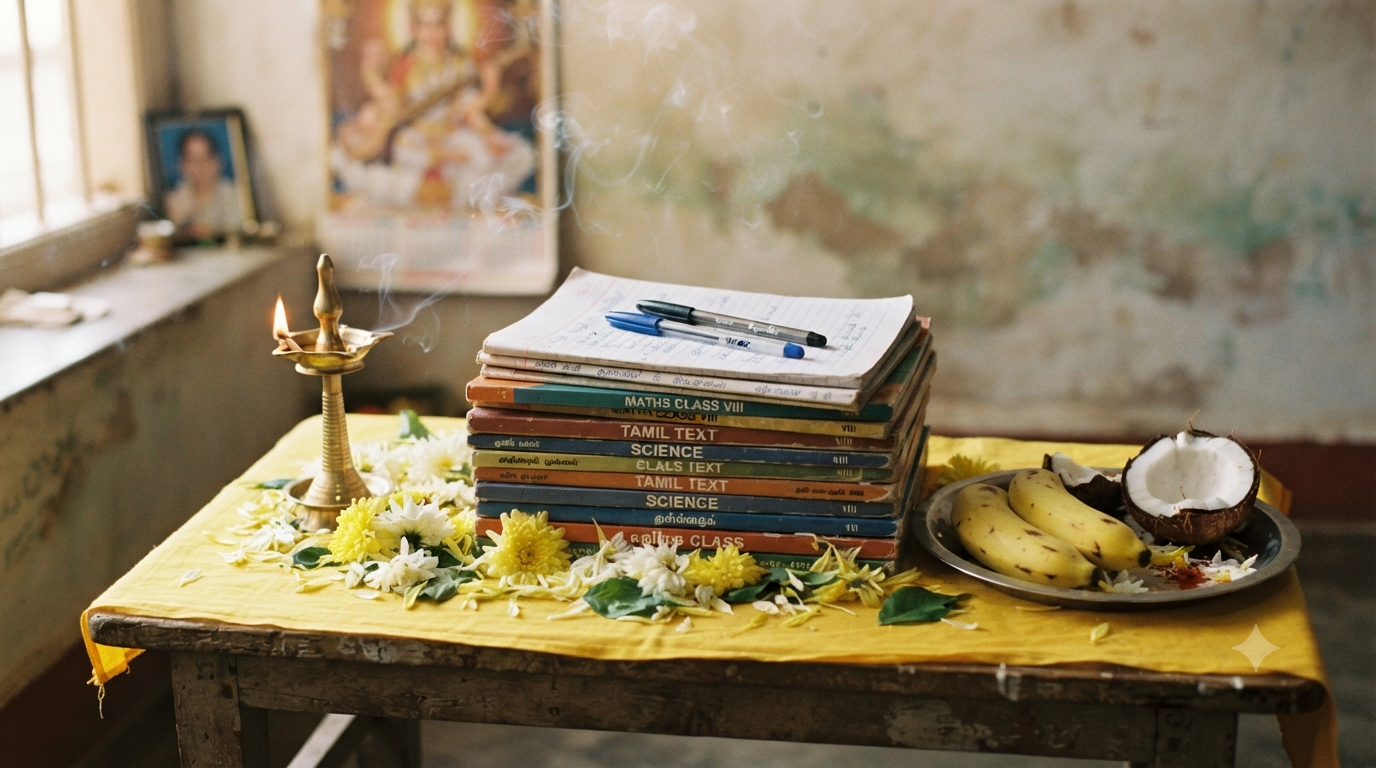
The Navratri Saraswati Puja date falls across four days in 2026, not one, and that single detail is where most guides go wrong. Devotees invoke Goddess Saraswati on Mula nakshatra, worship her on Purva Ashadha, and send her off on Shravana. So the “one day” answer you keep seeing online is only the middle of a longer sequence. Below you will find the verified 2026 dates, the reason several Telugu temples announce a different day, and the home procedure step by step.

Temples Map is an independent temple-information guide. We are not affiliated with, endorsed by, or the official website of any temple or devasthanam, and we do not accept bookings, sevas, donations, or payments. Please confirm every date, timing, and ticket detail on the official temple portal before you travel.
- Saraswati Puja during Sharad Navratri runs for four days, because it follows nakshatras and not tithis.
- The Navratri Saraswati Puja date shifts every year, since nakshatras move against the English calendar.
- In 2026 the sequence runs from Friday, 16 October to Monday, 19 October.
- The main worship day, called Saraswati Pradhan Puja, is Saturday, 17 October 2026.
- Vidyarambham and Aksharabhyasam follow on Vijayadashami, Tuesday, 20 October 2026.
- This is a South Indian observance; in Bengal and most of North India, Saraswati Puja means Vasant Panchami instead.
- Nakshatra windows shift by city, so a local panchangam always overrides a national list.
The Navratri Saraswati Puja date in 2026 begins on Friday, 16 October with Saraswati Avahan and closes on Monday, 19 October with Saraswati Visarjan. Drik Panchang lists the same four-day block, with a fifth linked day on Vijayadashami for Vidyarambham. Each day follows one nakshatra rather than a lunar tithi.
| Ritual | Nakshatra | Date in 2026 |
|---|---|---|
| Saraswati Avahan (invocation) | Mula | Friday, 16 October |
| Saraswati Pradhan Puja (main worship) | Purva Ashadha | Saturday, 17 October |
| Saraswati Balidan (offering) | Uttara Ashadha | Sunday, 18 October |
| Saraswati Visarjan (immersion) | Shravana | Monday, 19 October |
| Vidyarambham / Aksharabhyasam | Vijayadashami | Tuesday, 20 October |
Sharad Navratri 2026 itself opens with Ghatasthapana on Sunday, 11 October and ends on Tuesday, 20 October. Saraswati worship therefore sits in the last stretch of the festival, after several days of Durga worship. If your family observes only a single day, treat 17 October 2026 as the Navratri Saraswati Puja date.
Mula nakshatra in 2026 begins around 6:47 AM on 16 October and runs until roughly 9:47 AM on 17 October. Purva Ashadha then takes over from about 9:48 AM on 17 October. Panchang makers calculate these windows for one reference city, so check a panchangam for your own town before you fix a muhurat.
Nakshatra decides this festival, meaning the star the Moon is passing through. Tithi does not, even though tithi governs Ashtami, Navami, and Dashami. Many copied articles blur the two, and that remains the most repeated error on this topic.
The classical rule is straightforward. Avahan happens in Mula, the main puja in Purva Ashadha, Balidan in Uttara Ashadha, and immersion in Shravana. Because these four nakshatras always run back to back, the sequence stays intact even though the calendar dates move every year.
Mula usually arrives around Maha Saptami of Sharad Navratri, although the overlap is never exact. That is why the puja sometimes appears on the seventh day and sometimes on the eighth. Since the nakshatra leads and the tithi follows, never work out the Navratri Saraswati Puja date by counting days from Ghatasthapana.
Why the old “Moola Nakshatra tithi” line is wrong
An older version of this page, like dozens of others, said the puja happens when “Moola Nakshatram tithi begins”. Moola is a nakshatra, so it has no tithi of its own. We have corrected that here, because the confusion sends readers to the wrong day roughly one year in three.
Here is the part almost no other page explains. Panchang publishers pick the Avahan day using the aparahna window, so they land on 16 October 2026. Many South Indian temples instead use the nakshatra running at sunrise, and by that rule Mula falls on 17 October 2026.
That is why the Gnana Saraswathi temple at Basar, the Kanaka Durga temple at Vijayawada, and the Vidya Saraswathi temple at Vargal will usually announce Moola Nakshatra alankaram on 17 October 2026. Neither reckoning is a mistake. They simply answer two different questions about the same star.
For home worship, follow your family panchangam or your purohit. If you are travelling to a temple, follow the Navratri Saraswati Puja date the temple itself announces, because the queue and the alankaram run on that schedule. When the two disagree, the temple notice wins for a temple visit.
Two completely different festivals share the name Saraswati Puja, and search results mix them constantly. One belongs to autumn Navratri, while the other belongs to Magha month in January or February. Knowing which one you mean saves a wasted trip.
| Feature | Navratri Saraswati Puja | Vasant Panchami |
|---|---|---|
| Season | Ashwin, September or October | Magha, January or February |
| Reckoning | Nakshatra based | Tithi based |
| Duration | Four days, sometimes three or one | Single day |
| Strongest in | Tamil Nadu, Kerala, Andhra, Telangana, Karnataka | West Bengal, Odisha, Bihar, Uttar Pradesh |
Gujarat adds a third variant, where families worship Saraswati during Diwali as Sharda Puja. If a relative in another state quotes you a different day, this is usually why. Neither side has it wrong, because both traditions are genuinely old.
The home procedure is simple, and it needs no priest. Most families keep the ritual to twenty or thirty minutes on the main day. Below is the sequence as Telugu, Tamil, and Kannada households commonly follow it.
- Bathe early and clean the puja space before sunrise if you can manage it.
- Set a wooden plank or a low table, then spread a fresh white or yellow cloth over it.
- Place the Saraswati photo or idol at the centre, and light a lamp beside it.
- Arrange books, notebooks, pens, and musical or work instruments in front of the Goddess. Telugu families call this step Puja Vaipu.
- Offer white or yellow flowers, turmeric, kumkum, and sandal paste while you chant the Saraswati Vandana.
- Prepare a simple naivedyam such as payasam, pulihora, kesari, or plain jaggery rice, and offer fruits alongside.
- Perform harati, then leave the books untouched until the following morning.
- Take the books back on Vijayadashami morning, and let children write their first letters before school work resumes.
Families that observe all four days repeat a short lamp and flower offering each morning. Those who keep a single Navratri Saraswati Puja date simply do the full sequence on 17 October 2026. For a longer ritual text, see our Navaratri Durga Pooja Vidhanam in Telugu PDF and this detailed Saraswathi Pooja Vidhanam.
What you should not put out for Puja Vaipu
Keep the arrangement to items you will genuinely not need for the next two days. School textbooks needed for an exam are better left out of the pile. Nothing in the tradition demands that a student stop studying, although many families treat the pause as a rest day.
Vidyarambham and Aksharabhyasam on Vijayadashami
Vidyarambham falls on Vijayadashami, which is Tuesday, 20 October 2026. An elder seats a child of roughly three to five in their lap, then guides the small hand to trace the first letters in raw rice. In Kerala and Tamil Nadu, temples run organised sittings from dawn onward.
Telugu families call the same ceremony Aksharabhyasam, and Basar is the best known venue for it. Because demand is heavy on Vijayadashami, most temples issue tokens on the day itself. Confirm the arrangement on the temple’s official site rather than from a social media forward.
Ayudha Puja, when families honour their tools and vehicles, sits alongside this. Most South Indian traditions observe it on Maha Navami, though several panchangams place Navami between 19 and 20 October 2026. Since the two days run close together this year, confirm the exact day with your local panchangam.
Sri Gnana Saraswathi Devasthanam at Basar in Nirmal district draws the largest crowds in the Telugu states. The temple sits on the bank of the Godavari, and the Telangana Endowments Department administers it. Aksharabhyasam sittings there run through most of the day during Dasara.
Sringeri Sharada Peetham in Karnataka and the Mookambika temple at Kollur are the other major Saraswati centres in the south. Kanaka Durga temple in Vijayawada marks the Moola Nakshatra day with a dedicated alankaram, so check the Vijayawada Kanaka Durga temple timings before you plan the visit. Our nine-day Durga alankaram list explains where the Saraswati day sits within the wider Navratri schedule.
Entry is free at these temples, although paid seva and special darshan tickets exist. Book only through the official devasthanam portal, since private agents and lookalike sites multiply during Dasara. Temples Map does not sell tickets or accept any payment.
What Most Guides Get Wrong About This Puja
First, the festival is nine nights, not ten days. Vijayadashami is the tenth day and a separate observance, so we have corrected the old “ten day festival” line on this page. Devotees worship Durga in nine forms across those nine nights.
Second, Saraswati Puja is not only for students. Musicians, teachers, artisans, drivers, and anyone whose living depends on a skill place their tools before the Goddess. The ritual honours craft as much as classroom study.
Third, an expensive idol is not required. A photograph, a clean cloth, and a lamp are enough, because the tradition values intention over display. Many families simply use the same framed picture every year.
What to Do If You Miss the Right Day
Missing the exact nakshatra window is common, and it carries no penalty. If you miss Avahan, you can still perform the main puja on 17 October 2026 and continue normally. If you miss the Navratri Saraswati Puja date altogether, do the puja on Vijayadashami morning instead, which is itself one of the most auspicious days of the year.
If you are away from home entirely, a short prayer with a lamp works perfectly well. Travelling students often keep one notebook aside and offer it wherever they are staying. There is no prescribed expiation, so do not let a missed day become a source of anxiety.
On fasting, use judgement. Children, elderly relatives, pregnant women, and anyone with diabetes or another medical condition should not attempt a full-day fast without speaking to a doctor first. A light satvik meal is a perfectly traditional alternative, and no ritual replaces medical treatment.
Before You Set Up the Puja
The dates that matter in 2026 are 16 to 19 October for the four-day sequence, 17 October for the single main day, and 20 October for Vidyarambham. Fix the Navratri Saraswati Puja date first, then plan everything else around it. If you are visiting a temple, follow the temple’s own notice rather than a national calendar, because the sunrise rule can move the alankaram by a day.
For future years, look up Mula nakshatra on a panchangam you trust and count forward through Purva Ashadha, Uttara Ashadha, and Shravana. That method gives you the correct answer every year, without waiting for anyone to publish a list.
Frequently Asked Questions
The main Saraswati Puja day in 2026 is Saturday, 17 October. The full four-day sequence runs from Friday, 16 October through Monday, 19 October, covering Avahan, Pradhan Puja, Balidan, and Visarjan. Vidyarambham then follows on Tuesday, 20 October.
Is Saraswati Puja on Moola Nakshatra or on a tithi?
It follows nakshatras, not tithis. Mula marks the invocation day, while the main worship happens in Purva Ashadha. The widely copied phrase “Moola Nakshatra tithi” mixes two different units of the Hindu calendar, so ignore it.
Why do some temples say 17 October instead of 16 October?
Panchang publishers select the Avahan day using the afternoon window, which gives 16 October 2026. Several South Indian temples instead use the nakshatra running at sunrise, which gives 17 October. Both methods are traditional, so follow the temple notice for a temple visit.
Can Saraswati Puja be performed at home without a priest?
Yes, and most families do exactly that. Clean the space, place the books and instruments before a lamp and a Saraswati image, offer flowers and a simple naivedyam, then perform harati. The whole ritual usually takes under half an hour.
What food is offered to Goddess Saraswati?
Simple satvik preparations are standard. Payasam, kesari, pulihora, jaggery rice, coconut, bananas, and other fruits are the usual offerings. Families prefer white and yellow items, since both colours carry a link to the Goddess.
No, they are separate festivals with the same name. Navratri Saraswati Puja happens in Ashwin during autumn and is strongest in South India. Vasant Panchami falls in Magha during January or February and is strongest in Bengal, Odisha, and North India.
When can children start school after the puja?
Families take the books back on Vijayadashami morning, which is 20 October 2026. Temples hold Aksharabhyasam for young children on the same day, and normal study resumes afterwards. Many households treat the intervening days as a deliberate break.
Look up when Mula nakshatra falls during Sharad Navratri in a panchangam such as Drik Panchang. Avahan sits in Mula, and the next three days follow in Purva Ashadha, Uttara Ashadha, and Shravana. Official sites publish temple schedules separately, including the Telangana Endowments page for Basara and the Basara temple website.