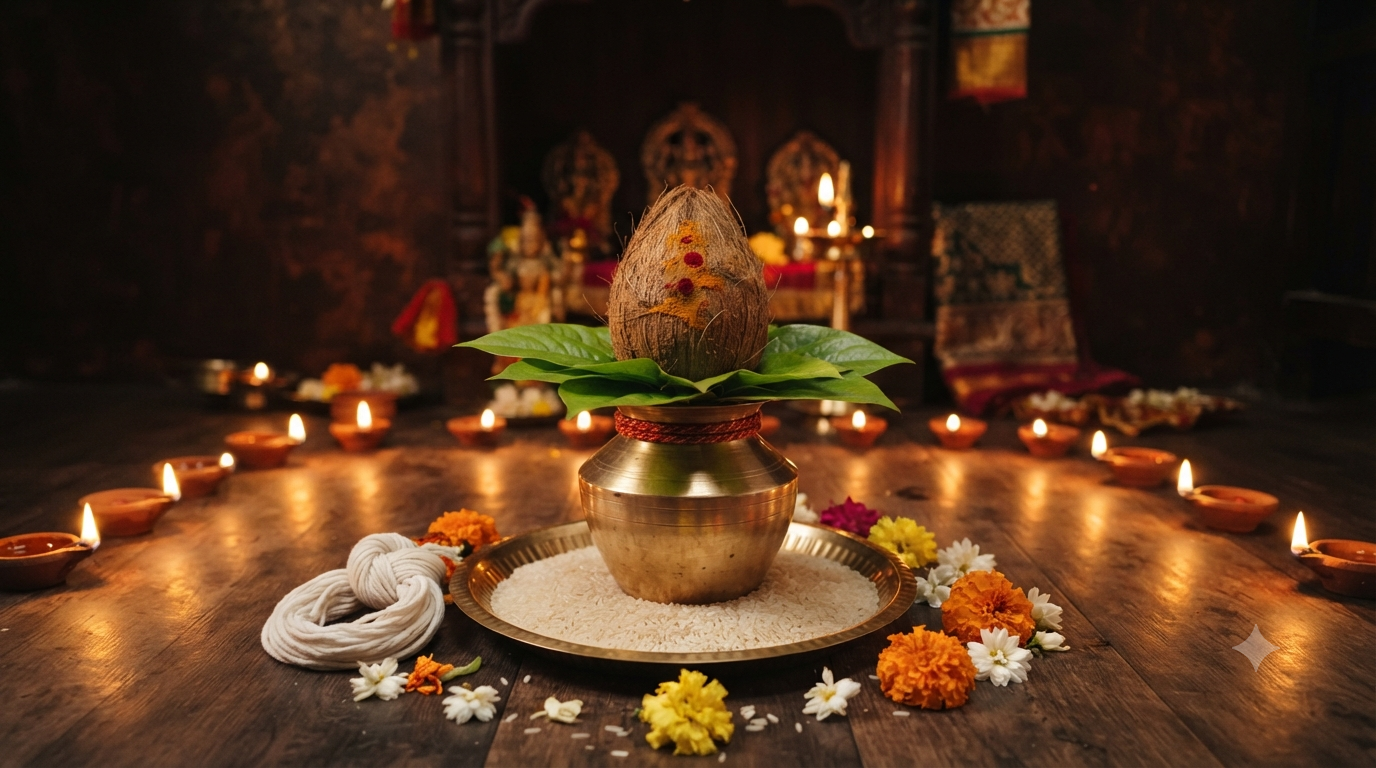
Kedara Gowri Vratham falls on Sunday, 8 November 2026, the Deepavali Amavasya night. That single line is what most devotees search for, so it sits at the top. But the date alone rarely settles the question, because families still argue over the 21-day start, the fasting rules and the knot count on the thread. This guide fixes the date first, then walks through the pooja vidhi, the fasting rules and what to do when a full vrat is not possible.
Temples Map is an independent temple information guide. We are not affiliated with any temple, trust or endowments board, and we do not accept bookings, poojas, donations or payments. Please confirm ritual timings with your family purohit or your local temple before you begin.
Kedara Gowri Vratham 2026 at a Glance
- Single-day vratham: Sunday, 8 November 2026
- 21-day vratham begins: around Monday, 19 October 2026
- Tithi: Deepavali Amavasya, the new-moon day of Ashwayuja masam
- Deities: Kedareswara (Lord Shiva) and Gowri (Goddess Parvati)
- Main puja time: evening, during Pradosh Kaal after sunset
- Observed mainly in: Tamil Nadu, Andhra Pradesh, Telangana and Karnataka
- Thread: a sacred thread of 21 knots, tied at the end of the vrat
Kedara Gowri Vratham 2026 Date and Time
Kedara Gowri Vratham 2026 is on Sunday, 8 November 2026. The vrat always concludes on Deepavali Amavasya, so the date moves every year with the lunar calendar. In 2026 that Amavasya lands on 8 November, which is also Lakshmi Puja night. Because the puja belongs to the evening, families perform it during Pradosh Kaal, roughly the first two hours after sunset.
| Detail | 2026 |
|---|---|
| Single-day vratham | Sunday, 8 November 2026 |
| 21-day vratham begins | Around Monday, 19 October 2026 |
| 21-day vratham ends | Sunday, 8 November 2026 |
| Tithi | Deepavali Amavasya (Ashwayuja Amavasya) |
| Main puja window | Evening, during Pradosh Kaal |
| Also called | Kedareswara Vratham, Kedara Gauri Vrat, Kethara Gowri Viratham |
Why we are not printing an exact tithi clock time
Published panchangams do not agree on the exact Amavasya start and end times for 8–9 November 2026. Some place the tithi beginning near 11:27 AM on 8 November, while others print an afternoon start. Since a wrong clock time is worse than no clock time, we give the date and the evening window instead. Check your city panchangam or ask your purohit for the precise muhurtham, because tithi timings shift with local sunrise and sunset.
Why the 2026 date is in November, not October
Many pages still carry an October date copied forward from an earlier year. That is the single most common error on this topic. Deepavali fell on 20 October in 2025, yet the lunar calendar pushed it to 8 November in 2026. So never assume last year’s date, and never subtract a fixed number of days from an older calendar.
When the 21-Day Vratham Begins in 2026
The 21-day Kedara Gowri Vratham begins around Monday, 19 October 2026, and ends on Deepavali Amavasya. Devotees count off twenty-one days with a knotted thread, adding one knot for each day of the vow. The count stays at 21, although traditions describe the starting tithi differently.
Tamil sources usually place the start on Shukla Paksha Ashtami in the month of Purattasi. Telugu and Kannada households often describe it as beginning from Ashwayuja Ashtami instead. Both traditions still finish on the same Amavasya, so the closing day never changes.
Which start date should you follow?
Follow your family tradition first, because this vrat is passed down through households rather than issued by any single authority. If your family keeps no record, the 19 October 2026 start aligns with the widely published Tamil and Telugu panchangam listings. When in doubt, ask the priest at the Shiva temple you normally visit.
The Story Behind Kedara Gowri Vratham
According to the Shiva Purana, the sage Bhringi Maharshi once travelled to Kailasam and offered worship only to Lord Shiva. He circled Shiva alone and did not acknowledge Goddess Parvati at all. Parvati felt slighted by this, and she approached the sage Gautama Maharshi for guidance.
Gautama Maharshi advised her to observe the Kedara vrat and explained its procedure. She kept the vow with complete devotion, and Lord Shiva then granted her half of his own body. That union is worshipped as the Ardhanareeswara form, which is why the vrat is so closely tied to marital harmony.
A second version of the legend circulates widely too. In it, Shakti withdraws her energy from Bhringi’s body, and that separated energy becomes Gowri herself, who then observes the vrat to rejoin Shiva. Both tellings carry the same message, so devotees treat them as complementary rather than contradictory. These accounts belong to Puranic tradition and faith, not to recorded history.
Kedara Gowri Vratham Pooja Vidhi Step by Step
The pooja vidhi is short, and most families finish it within an hour. Prepare the items in the afternoon so the evening stays unhurried. Then follow these steps in order.
- Take a head bath on the morning of the vratham and wear clean traditional clothes.
- Clean the puja space and spread rice on a plate as the base for the kalasam.
- Fill a kalasam three-quarters with water, then close its mouth with betel leaves.
- Place a coconut on top of the kalasam and apply turmeric and kumkum to it.
- Set the kalasam on the rice-covered plate and invoke Kedareswara and Gowri.
- Keep the thread of 21 knots beside the kalasam throughout the puja.
- Recite the Kedara Gowri Astottaram, the 108 names offered during this vrat.
- Offer naivedyam, then light the deepam and complete the aarti.
- Tie the sacred thread after the puja, and finish with the visarjana puja.
Pooja items checklist
Nothing on this list is expensive, yet the coconut and betel leaves are the two items families most often forget. Buy them a day early, since Diwali-eve markets get crowded.
- Kalasam (brass or silver pot) and a plate of raw rice
- Betel leaves, one coconut, turmeric and kumkum
- Cotton thread for the 21 knots, plus fresh flowers
- Deepam, ghee or oil, wicks, camphor and agarbatti
- Naivedyam items such as jaggery, banana, sesame and payasam
Kedara Gowri Vratham Fasting Rules
The fast is not a complete abstinence from food, and this is the point most articles get wrong. Devotees keeping the 21-day vow eat once a day, after the night puja is complete. The food eaten should ideally be what was first offered to Lord Shiva during that puja.
Through the day, many devotees take only light satvik items. Sesame seeds, raisins, bananas and betel leaves are traditionally allowed. Anyone may keep this vrat, because tradition places no limit on gender or community.
The thread of 21 knots
The knotted thread is the physical record of the vow. Men tie it on the right hand once the vrat concludes, while women tie it around the neck. Keep it on until it wears away naturally, or immerse it in a river or temple tank rather than discarding it in household waste.
One-Day or 21-Day: Which Version Should You Keep?
Both forms are valid, and neither is a diluted version of the other. Choose by what your household can genuinely sustain, because an abandoned vow causes more distress than a shorter one kept properly.
| Factor | Single day | 21 days |
|---|---|---|
| Duration | 8 November 2026 only | 19 October to 8 November 2026 |
| Best for | Working devotees, first-timers | Families with an existing tradition |
| Daily commitment | One evening puja | Short daily puja plus one meal |
| Thread | All 21 knots tied at once | One knot added each day |
Most urban households now keep the single-day form. That shift is practical rather than doctrinal, so nobody should feel the shorter vrat is inferior.
What to Do If You Miss a Day or Cannot Fast
The vrat is a personal sankalpa, and no scripture treats a missed day as a disqualification. If you break the 21-day chain, continue from the next day and complete the remaining count. Alternatively, drop to the single-day observance on 8 November and keep only that with full attention.
If fasting is medically unsafe for you, the tradition still leaves room. Many devotees perform the puja fully while eating normal satvik meals. Others ask a family member to observe the fast on the household’s behalf, which is an accepted practice. There is no guaranteed outcome attached to any of these choices, since a vrat is an act of faith rather than a transaction.
Health and safety note
A 21-day restricted diet is demanding, so treat it as a health decision as well as a spiritual one. Diabetics, pregnant women, elderly devotees and anyone on regular medication should speak to a doctor before starting. Never stop prescribed medicine for a vrat. The vratham is a devotional observance and not a treatment for any medical condition.
Regional Differences Worth Knowing
In Tamil Nadu the observance is known as Kethara Gowri Viratham, and Shiva temples conduct special abhishekams that evening. Andhra Pradesh and Telangana households usually call it Kedareswara Vratham or simply nomu, and the 21-day form remains common there.
Karnataka families observe it alongside the Deepavali Amavasya rituals, while some northern calendars link it to Kartik Amavasya instead of Ashwin. The Gregorian date stays the same in 2026 regardless, because both reckonings point to the same new moon.
What Devotees Most Often Get Wrong
Three mistakes come up again and again, and all of them are avoidable.
- Copying last year’s date. Lunar dates shift by weeks, so always check the current year.
- Doing the puja in the morning. The observance belongs to the Amavasya evening, after sunset.
- Cutting the thread short. The count must be 21 knots, not a rounded approximation.
One more point deserves attention. Kedara Gowri Vratham has no connection to Kedarnath in Uttarakhand, although the similar names confuse many first-time searchers. Kedareswara here is simply a name of Lord Shiva.
Before You Begin the Vratham
Mark Sunday, 8 November 2026 on your calendar, and decide early whether you are keeping the single-day or the 21-day form. Buy the coconut, betel leaves and thread a day in advance, because the Diwali rush makes last-minute shopping difficult. Confirm the evening muhurtham with your local panchangam, since tithi timings vary by city.
If you are also planning the rest of the festival week, our guides to Deepavali Dhana Lakshmi Pooja procedure and Yama Deepam timings and direction cover the days on either side. The month that follows is equally significant, so the Karthika Masam festival list is worth bookmarking too.
Kedara Gowri Vratham FAQs
What is the Kedara Gowri Vratham 2026 date?
Kedara Gowri Vratham 2026 falls on Sunday, 8 November 2026. It is observed on Deepavali Amavasya, the new-moon day that also carries Lakshmi Puja. For the 21-day version, the vow begins around 19 October 2026 and ends on the same 8 November.
What time should the puja be performed?
Perform the puja in the evening, during Pradosh Kaal, which starts shortly after sunset. Panchangams differ on the exact Amavasya clock times for 2026, so confirm the muhurtham for your city. The evening window is the constant that every tradition agrees on.
Who can observe Kedara Gowri Vratham?
Anyone may observe it, because the vrat sets no bar of gender, age or community. Married couples keep it most often, since the Ardhanareeswara story speaks to marital harmony. Unmarried devotees and men observing alone are equally welcome to keep the vow.
Why are there 21 knots in the thread?
The 21 knots represent the twenty-one days of the original vow. Devotees keeping the long form add one knot daily until the count is complete. Those observing the single day tie a thread already prepared with all 21 knots.
Where should the thread be tied?
Men tie the thread on the right hand and women tie it around the neck. It stays on after the vratham until it wears away on its own. Immerse it in a river or a temple tank when it eventually comes off.
Is Kedara Gowri Vratham the same as Kedarnath worship?
No, the two are unrelated despite the similar names. Kedareswara in this vrat is a form of Lord Shiva worshipped at home or in a local temple. The Kedarnath shrine in Uttarakhand is a separate pilgrimage with its own calendar.
Can the vratham be done without fasting?
Yes, many devotees complete the full puja while eating regular satvik food. Fasting is encouraged rather than mandatory, and health always takes priority. Consult a doctor first if you have a medical condition.
Do temples conduct Kedara Gowri Vratham pujas?
Many Shiva temples across South India hold special abhishekams and group pujas on that evening. Arrangements differ from temple to temple, so contact the temple office directly for details. This site does not arrange, book or accept payment for any puja.
What is offered as naivedyam?
Traditional offerings include jaggery, banana, sesame, betel leaves and payasam. Some families prepare twenty-one varieties of naivedyam to mirror the 21-day count. Keep the offerings simple if that scale is impractical for your household.
For panchangam cross-checks, see the Drik Panchang Kedar Gauri Vrat page and the Prokerala Kedara Gauri Vrata reference. Background on the wider festival is available on the Diwali entry at Wikipedia.