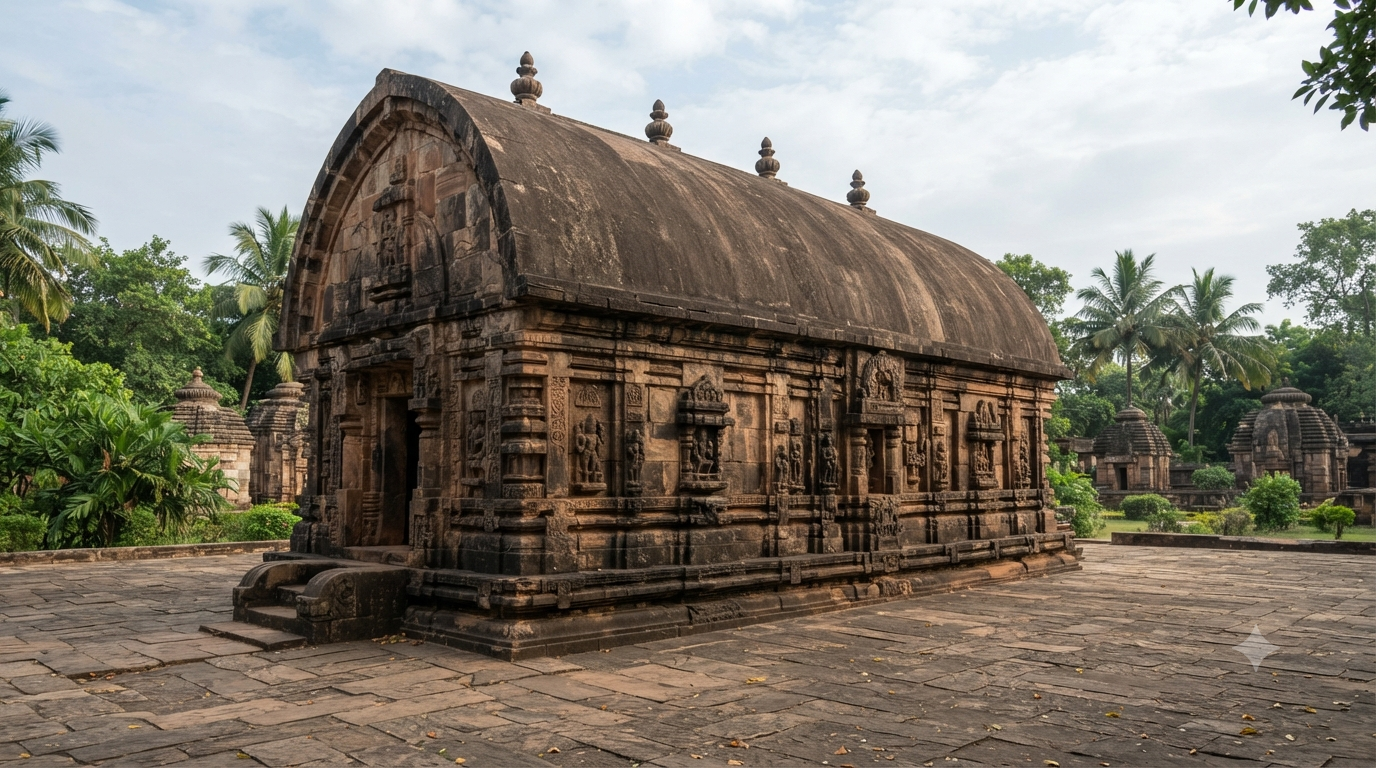
Khakhara deul is Odisha’s distinctive barrel-vaulted shrine form, recognisable by its long, rounded roof instead of a tall, curving tower. It belongs to Kalinga temple architecture, but its shape tells a different story from the familiar skyline of Bhubaneswar. The key, therefore, is to compare the roof above the sanctuary, not just its wall carvings.
TemplesMap is an independent heritage guide. We are not affiliated with any temple trust, heritage authority or government department, and we accept no bookings, donations or payments.
Khakhara deul at a glance
- Region: Odisha, within the Kalinga tradition of temple building.
- Defining shape: An elongated, barrel-like or wagon-vaulted roof above an oblong shrine.
- Related forms: Rekha deul has a curving tower, while pidha deul has a tiered, stepped roof.
- Wider comparison: Valabhi is a broader architectural term for related barrel-roofed Nagara temples.
- Notable examples: Vaital Deul in Bhubaneswar and Varahi Temple at Chaurasi.
- Religious setting: Several well-known examples honour goddesses, though roof shape alone cannot identify a deity.
What is a Khakhara deul?
A Khakhara deul is an Odishan shrine type with an oblong plan and an elongated vaulted roof. Rather than rising to a single curved summit, its roof forms a rounded ridge along the building. The form is uncommon beside the better-known rekha and pidha temples of Odisha.
The UNESCO World Heritage Centre’s Ekamra Kshetra documentation lists rekha, pidha and khakhara as Odisha’s three broad temple orders. That page describes the first two as frequent partners in the same complex. Khakhara represents a distinct alternative, especially in particular goddess shrines.
The word also appears as khakhara deula or khakara deul. These spelling differences reflect transliteration and local usage, so the basic architectural form stays the same. They do not point to separate building types.
Why the Khakhara deul roof looks different
First, look at a Khakhara deul from the side. The roof extends lengthwise and rounds over like a wagon cover. Meanwhile, the same structure can show a curved gable from the end. This contrast between side and end views makes the form easy to misread in photographs.
The elongated roof gives the building a distinct architectural character. While a rekha tower draws the eye towards a single summit, the khakhara profile emphasises the length of the shrine. The difference becomes especially clear when you compare their side elevations.
The mass below the roof still carries recognisable Odishan masonry and sculpture. A rounded top, therefore, does not make the shrine a separate national style. It is a regional form within a wider temple-building tradition.
The roof is not the same as the ground plan
Two questions matter: what shape is the building on the ground, and what shape rises above it? A Khakhara deul usually has a lengthened, oblong plan and a barrel-like upper form. Neither observation proves that its rear wall is apsidal or semicircular.
This distinction matters because writers sometimes mix up wagon-vaulted, elephant-backed and apsidal. Those terms can describe different aspects of a building. Check the actual plan before calling any shrine an apsidal temple.
Khakhara deul vs rekha deul vs pidha deul
Khakhara deul, rekha deul and pidha deul name distinct architectural forms in Odisha. Rekha often marks the main sanctuary through a tall, curving spire. Pidha commonly roofs the hall before it. Khakhara differs through its elongated, vaulted upper structure.
| Form | Main profile | Common role or clue |
|---|---|---|
| Khakhara deul | Long, rounded barrel-like roof | Uncommon sanctuary form; notable goddess shrines |
| Rekha deul | Tall, inward-curving spire | Often rises above the sanctum |
| Pidha deul | Stepped tiers that narrow upwards | Often covers the front hall, or jagamohana |
These labels describe architectural components as well as temple types. So they are not three buildings that every major complex must contain. The usual rekha-and-pidha pairing does not require a khakhara shrine to complete it.
Rekha: a vertical sanctuary silhouette
In a rekha deul, the tower draws the eye upward. Its walls bend inward as they rise, so the profile creates a continuous vertical sweep. This is the familiar sanctuary profile at many Odisha temples.
Some rekha towers carry a ribbed crowning stone called an amalaka. For that feature, see our guide to the temple amalaka. It explains why the crown matters without treating every Nagara temple as identical.
Pidha: the stepped hall roof
Instead, the pidha form builds height with receding horizontal tiers. In a typical Kalinga complex, that profile marks the jagamohana, the hall facing the sanctum. Its outline therefore looks stacked rather than smoothly curved.
UNESCO’s Ekamra Kshetra description explains this pairing of curved sanctuary and stepped porch. However, real monuments also record changes over time. Do not assume every older shrine had the same hall arrangement.
How does Khakhara deul relate to Valabhi?
Khakhara deul is the regional Odishan name for a form that architectural scholars place within the wider Valabhi family. Valabhi describes rectangular or oblong temples with barrel-shaped roofs across the Nagara tradition. The words overlap, but their scope differs: one is regional, while the other supports comparison across regions.
Architectural historian Adam Hardy discusses this relationship in Indian Temple Typologies, hosted by Cardiff University. He treats Valabhi as a barrel-roofed mode and identifies Odisha’s Khakara terminology within that broader discussion.
Consequently, a label such as Valabhi-type roof can help compare monuments. It should not erase the local Kalinga details of an Odisha shrine. Nor should a visitor rename every barrel-roofed structure in India a Khakhara deul.
Our guide to Valabhi temple roofs explains the broader barrel-vaulted architectural form. Read it alongside this regional guide to understand how similar roof profiles appear within different architectural contexts.
Does Valabhi mean a Dravidian gopuram?
No. Valabhi is a form used in discussions of Nagara temple architecture, while a gopuram is a gateway tower in a southern temple complex. Some barrel-vault forms across India look related. Visual similarity, however, does not turn the two building types into synonyms.
A few descriptions compare the khakhara outline with southern architectural features. Such parallels can be useful, but they do not prove that a surviving Odisha shrine copied a particular gateway. The location, purpose and full plan still matter.
Khakhara deul and goddess worship
Several prominent examples of Khakhara deul architecture have strong associations with Shakta worship, or traditions centred on the goddess. Vaital Deul is linked with Chamunda, while the shrine at Chaurasi honours Varahi. These examples help explain the form’s association with goddess temples.
That pattern is historically meaningful, yet it needs careful wording. A barrel-shaped roof is an architectural clue, not a ritual certificate. You cannot infer a temple’s full worship history, date or original patron simply from its roof.
The same caution applies to descriptions of Tantra. Some shrines have iconography associated with tantric traditions, but the term covers varied beliefs and practices. Stone sculpture alone does not document every ceremony that took place at a site.
Two important Khakhara deul examples in Odisha
Khakhara deul survives most clearly in particular monuments, not in a uniform row of identical temples. Vaital Deul and Varahi Temple provide useful examples for comparison. Their architectural features also show why building-specific details matter more than sweeping rules about one dynasty or century.
Vaital Deul, Bhubaneswar
Vaital Deul, also written Baitala Deula, is among the best-known examples of this form. Its oblong mass and elongated roof contrast with the rising rekha towers elsewhere in the old temple city. The shrine’s goddess imagery adds another layer to its architectural identity.
First, look at the roof from the side, then examine the shorter end. After that, study the carved wall divisions. This sequence separates the broad architectural profile from the smaller ornaments that can distract a first-time visitor.
For the setting, our overview of temples in Odisha places Bhubaneswar’s monuments within the state’s wider heritage landscape.
Varahi Temple, Chaurasi
The Varahi Temple at Chaurasi offers another significant Khakhara deul comparison. Its goddess dedication also makes the link with Shakta worship particularly clear. Yet visitors should look beyond the deity and examine the roof profile, wall carving and shrine proportions.
Art historian Sudipa Ray Bandyopadhyay has presented Chaurasi as a major example in a Tamil Heritage Trust lecture notice. That academic context is useful because it treats the temple as evidence for architectural study, not just a sightseeing stop.
What to compare between the two temples
Vaital Deul and Varahi Temple share the broad barrel-roofed architectural vocabulary. However, that shared classification does not mean their proportions, carvings or religious histories are identical. Each monument deserves individual attention.
When comparing photographs, start with the roof and the main shrine block. Then examine how the wall divisions and sculptural details relate to the overall structure. This approach helps distinguish the shared architectural form from the individual character of each temple.
How to identify a Khakhara deul in photographs
Start with the silhouette before reading the caption, because the profile gives the strongest initial clue. A Khakhara deul usually presents a longer roof ridge than the compact peak of a rekha shrine. Next, inspect the ends of the roof and the shape of the main shrine block.
- Find the sanctuary. Do not confuse a front hall with the shrine’s main superstructure.
- Look at the side elevation. A long rounded crown points towards a barrel-vaulted form.
- Check the end view. A curved gable can make the roof’s profile easier to understand.
- Compare the plan. Look for an oblong footprint, if a reliable measured plan exists.
- Read the site record. Confirm the monument’s name and classification through a heritage source.
Still, one photograph seldom settles every question. A tight frontal image may hide the roof’s length. Likewise, a sculpture detail can show a small vault motif without proving that the entire temple follows khakhara design.
Small khakhara forms in wall decoration
The barrel-shaped outline does not appear only as a complete shrine roof. Odisha’s builders also used miniature architectural motifs in temple wall decoration. Scholars sometimes call these small shrine-like forms khakhara-mundi.
A miniature form can frame a figure or fill a niche. It borrows the visual language of a building without becoming a full-sized sanctuary. So identifying one on a wall is different from classifying the entire monument as a Khakhara deul.
This is also a useful test for photographs of ornate facades. When the roof itself is missing from the frame, decorative details can suggest a regional vocabulary. They still cannot replace a view of the whole structure.
Origins, dates and claims that need caution
Some historians compare barrel-roofed Indian temples with older wooden halls or Buddhist chaitya architecture. Others note related forms in southern and central India. Such comparisons describe possible architectural relationships. They do not, by themselves, establish a single proven birthplace for Khakhara deul.
Dates need similar care. Early medieval is a useful broad historical setting for several prominent examples. Yet a firm foundation year, a named royal patron or a claimed original ritual must rest on specific evidence. A tourism article or repeated travel-page statement is not enough.
Different parts of one monument may also reflect repairs or later changes. Therefore, researchers should consider the roof, walls, sculpture and inscriptions together before drawing a historical conclusion.
Mistakes that distort Khakhara deul architecture
One common misunderstanding is to imagine three mandatory parts in every Odisha temple: rekha, pidha and khakhara. In reality, many major complexes pair a rekha sanctum with a pidha hall. Khakhara is a distinct, less common temple form, not an automatic third chamber.
Another mistake equates the roof’s rounded appearance with an apsidal floor plan. These are separate properties, so the ground plan needs its own evidence. Finally, the Valabhi comparison should explain a family resemblance, not erase Odisha’s local building language.
The wider context appears in our Indian temple architecture guide. That article places Kalinga within the Nagara tradition and explains why regional terms deserve careful use.
Distinguishing architectural form from construction technique
The term barrel-vaulted helps describe the visible shape of a Khakhara deul roof. However, the external profile alone does not establish the exact construction technique beneath it. That requires architectural surveys and evidence from the monument itself.
For this reason, identifying a roof as barrel-shaped is not the same as demonstrating how its masonry carries weight. Keep descriptions of visible form separate from technical claims about structural engineering.
Before you visit or use a temple photograph
For architecture study, compare a clear side view with an end view. Choose photographs that show the whole roof, rather than only a carved wall. Then check the monument’s identity through a reliable heritage authority.
If you visit a living shrine, respect access rules and ask before photographing worship areas. Opening hours, photography restrictions and access arrangements can change. Confirm them locally or through the responsible authority instead of assuming a heritage description is a current visitor notice.
For publication, use your own image or one with a suitable licence and credit requirements. A generated illustration may explain the shape, but it should never masquerade as a documentary photograph of a named monument.
Why Khakhara deul matters
Khakhara deul shows that Odisha’s temple tradition includes more than towering curved spires and stepped halls. Its long roof preserves another architectural possibility within the Kalinga vocabulary. The best way to understand it is to examine the plan, roof and sculpture together.
Begin with Vaital Deul, then compare Varahi Temple at Chaurasi through reliable photographs or monument records. Keep Valabhi as a broad comparison, not a replacement for the local name. That approach gives a clearer picture without forcing uncertain historical claims.
Frequently asked questions
What is the meaning of Khakhara deul?
Khakhara deul refers to an Odisha temple form with an oblong plan and an elongated, barrel-shaped roof. It belongs to the regional Kalinga architectural tradition. The form stands apart from the better-known curving rekha and stepped pidha profiles, making the roof an important clue for identification.
Is Khakhara deul part of Nagara architecture?
Yes. Odisha’s Kalinga architecture belongs within the broad Nagara tradition, while retaining its own local forms. Khakhara is one of the regional terms that describe this diversity. It is not a separate national architectural order alongside Nagara and Dravida, but a distinctive regional expression.
How is Khakhara deul different from rekha deul?
Khakhara deul has an elongated barrel-like roof, while a rekha deul rises in a tall, inward-curving tower. Both belong to Odisha’s temple vocabulary. Their different outlines help identify the shrine type before examining the carvings, especially when viewing the monument from the side.
Is a pidha deul the same as a Khakhara deul?
No. A pidha deul has stepped tiers, often above the front hall of a temple. The khakhara form uses an elongated, rounded roof. A single temple complex may combine different architectural forms, but these two labels describe different profiles.
Are Khakhara deul and Valabhi identical?
They overlap, but they are not interchangeable in every context. Valabhi is a wider term for barrel-roofed temple forms within architectural scholarship. Khakhara names Odisha’s regional expression of that family, so it carries more specific local meaning within the Kalinga architectural tradition.
Which temples are examples of Khakhara deul?
Two well-known examples are Vaital Deul in Bhubaneswar and Varahi Temple at Chaurasi. Both offer useful opportunities to study Odisha’s barrel-roofed shrine tradition. Each deserves separate attention because the monuments differ in architectural detail, sculptural features and historical documentation.
Were all Khakhara temples dedicated to goddesses?
Several prominent examples honour goddesses, and Shakta associations are important to their history. However, a roof shape alone cannot prove the original deity or every later ritual practice. Use inscriptions, images and reliable site studies when making claims about an individual temple’s religious history.
Does a barrel-shaped roof mean the temple is apsidal?
Not necessarily. The roof profile and the building’s ground plan describe different features, so neither proves the other. A temple can have a barrel-shaped roof over an oblong plan without a semicircular rear wall. Consult a measured plan before using the word apsidal.