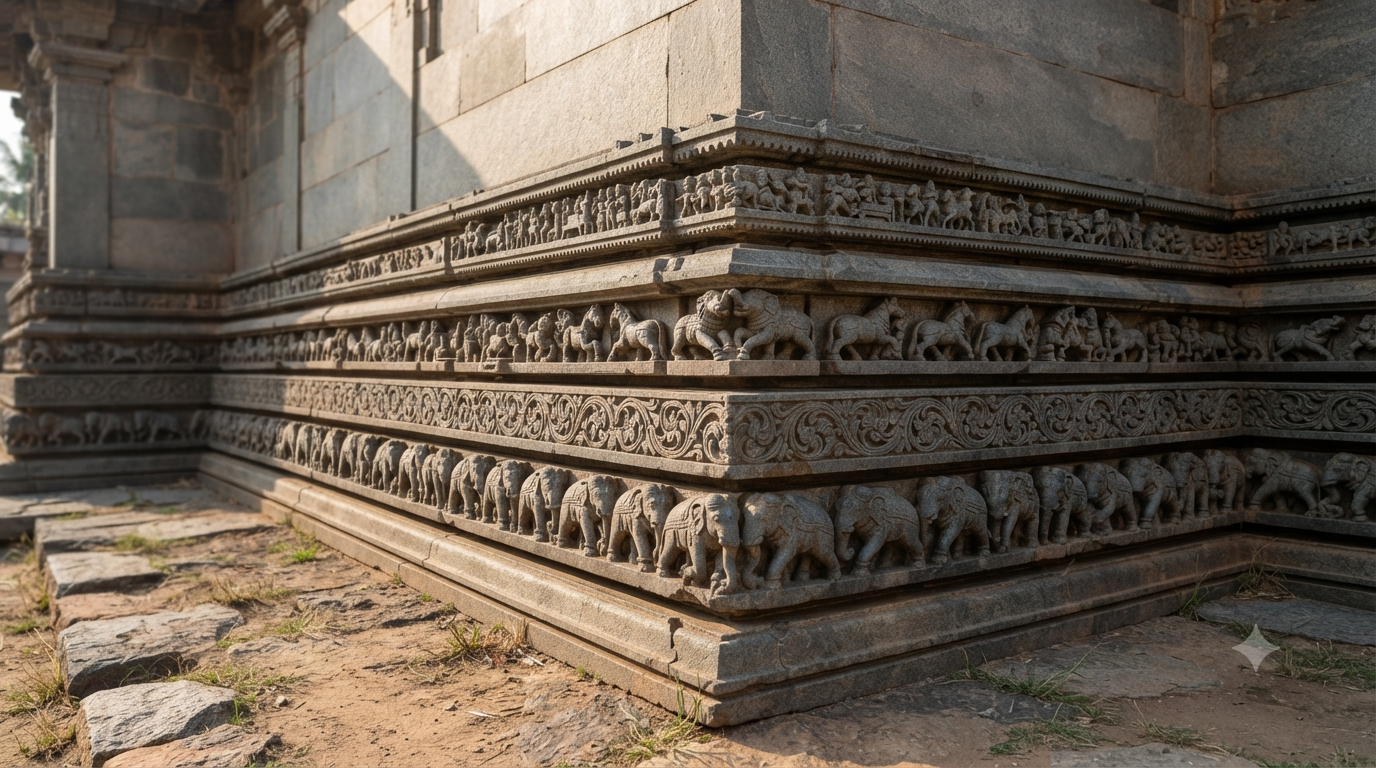
Temple adhisthana meaning becomes much clearer when you look below the carved wall, not at the temple tower. The adhisthana is the shaped stone base that carries the wall above it. At some Hoysala shrines, that base becomes a remarkable gallery of animals, foliage and epic scenes.
TemplesMap.com is an independent heritage guide, not an official temple or UNESCO website. We are not affiliated with temple authorities and accept no bookings, donations or payments.
Temple adhisthana meaning: what is the moulded base?
In Hindu temple architecture, the adhisthana is the moulded plinth or base beneath the main wall. It has a structural position and a visible architectural form. Its layers may be plain, shaped or richly carved. The exact profiles and sculptural programme vary across regions, periods and individual temples.
The Government of Karnataka’s Sacred Ensembles of the Hoysalas nomination dossier, hosted by the UNESCO World Heritage Centre, defines adhishthana as a moulded base or plinth. The dossier also distinguishes it from the jagati, the platform supporting a temple. Its glossary uses the spelling adhishthana; both spellings refer to the same architectural term. These are useful starting points, but the stonework needs a closer reading.
The stone base at a glance
- Position: The adhisthana sits below the wall section, often called the jangha or bhitti.
- Shape: Projecting, rounded, flat and recessed stone profiles define its layered outline.
- Decoration: Some bases carry animals, scrolling plants, mythical creatures and narrative reliefs.
- Variation: A temple may use different registers on its main walls and smaller projecting shrines.
- Key distinction: A jagati is commonly the wider supporting platform; an adhisthana is the moulded base of the temple fabric.
Think of the adhisthana as a transition between ground and sacred building. Yet that transition can be surprisingly elaborate. A visitor might notice a row of elephants first, while an architect sees the changing outline of the stone courses.
Temple adhisthana meaning: where the base sits
Read the temple exterior from bottom to top. First comes the ground or a raised platform, where one exists. Above it, the adhisthana forms a distinct base. Then the main wall rises, carrying niches, pillars or large sculptural panels.
Temple adhisthana meaning depends on that order because a carved wall contains several kinds of decoration. A freestanding deity above the plinth is not automatically part of a base frieze. Likewise, a decorated stair edge need not be the adhisthana of the shrine itself.
In the Hoysala dossier, a plan of Halebidu labels the jagati and adhisthana separately. The Somanathapura plan also gives each its own label. Thus, the distinction is not merely a modern visitor’s convenience; the architectural documentation uses both terms.
Temple adhisthana meaning in stone mouldings
A clear account of temple adhisthana meaning starts with mouldings. These shaped horizontal profiles can project forward, curve outward, flatten into a band or retreat into a recess. These shifts divide the base visually. They also create bright edges and shadows, especially when light strikes the wall from the side.
A sculptural band, or frieze, is related but not identical. It describes the carved subject running along a course, such as animals or a story. One part of a base can have a simple moulded profile, while another carries deep relief. Counting every ridge as a story band would confuse those two observations.
A few useful names from the dossier
The nomination glossary calls a rounded, torus-shaped moulding kumuda. It defines pattika as a rectangular fillet or plinth moulding. A kapota is a cornice or eaves moulding, while padma names a profile with a lotus-petal pattern.
These words describe particular shapes or decorative treatments. However, they are not a compulsory checklist for every temple. Local building traditions use differing combinations, so identify the visible form before assigning a technical name.
Profiles, grooves and the play of light
At Halebidu, the dossier draws special attention to deep grooves between sculpted registers. Each ledge casts a shadow onto the course below. Consequently, the horizontal rhythm remains visible even when many small figures compete for attention.
The effect is easiest to see at an angled corner. One face catches the light while the next turns into shade. That contrast lets visitors separate neighbouring bands without touching the historic stone.
Temple adhisthana meaning in sculptural bands
To explore temple adhisthana meaning in the carvings, begin at the lowest visible register and look upwards. Identify repeated subjects before trying to decode any individual scene. Animal processions, scrolling foliage and narrative episodes may occupy separate courses. Yet no single sequence applies to every temple or even every part of one temple.
Look for a continuous procession as well as interruptions. A row may turn around a corner, stop at a stair or yield to an architectural projection. These changes can reveal how the sculptural programme responds to the building’s shape.
Animal processions and plant scrolls
Elephants, lions and horses are striking because their silhouettes remain easy to recognise. At Hoysalesvara, the dossier records them in distinct lower registers. It also describes curling vines between some of the animal bands. Thus, a decorative scroll is not simply empty space between major scenes.
Closer inspection reveals a second design choice: repeated subjects need not mean identical carvings. The procession has a common theme, while individual figures may vary in pose or detail. Resist turning every elephant or horse into the same fixed message.
Stories embedded in horizontal friezes
A narrative frieze works differently from a repeated animal band. It gathers figures and actions into scenes, often within a long horizontal strip. At Halebidu, the dossier identifies material from the Ramayana, Mahabharata and Bhagavata Purana.
One documented example depicts Abhimanyu within the chakravyuha, the complex battle formation from the Mahabharata. The artists compress several views into the stone scene. Therefore, reading the band requires following actions and relationships, not just naming a figure.
Temple adhisthana meaning in the UNESCO-hosted Hoysala dossier
The Hoysala nomination supplies unusually clear evidence because it combines definitions, plans, photographs and sculptural analysis. Its Halebidu account describes a developed base with eight horizontal sculptural registers. It also identifies smaller wall shrines with fewer tiers. Both descriptions concern specific parts of a documented monument.
UNESCO’s Sacred Ensembles of the Hoysalas World Heritage entry places multi-tiered friezes among the defining features of these temple complexes. The listed group includes Belur, Halebidu and Somanathapura. That recognition does not make one moulding count compulsory for all Hindu temples.
Halebidu: a base that becomes a narrative gallery
The dossier describes Halebidu’s principal sequence from the bottom upwards: elephants, lions, a vine, mounted horses and another vine. Epic and Puranic scenes follow, with makaras and hamsas higher up. The two upper creatures are mythical aquatic beings and stylised geese, respectively.
It is tempting to treat the whole arrangement as a fixed formula. However, the same account notes a different treatment on large projecting wall shrines. For the complete site context, see our Halebidu Hoysaleswara architecture guide. This page focuses instead on how to recognise the base itself.
Somanathapura: similar language, another arrangement
At the Keshava Temple in Somanathapura, the dossier describes a six-tiered adhisthana along the hall walls. The carved subjects include elephants, mounted horses, foliage and episodes from sacred narratives. Its documentation also distinguishes wall sculptures above the base from carvings within it.
For temple adhisthana meaning, this comparison teaches a useful lesson. Shared Hoysala craftsmanship does not demand matching tier counts or identical sequences. Even related monuments can organise their moulded bases differently, while keeping the layered horizontal effect.
Temple adhisthana meaning compared with jagati
The jagati is a raised platform that supports a temple and may extend as a walking surface. The adhisthana is the moulded base associated with the building above. At Hoysala sites, both may appear in one view, which makes them easy to confuse. Their functions and positions are nevertheless distinct.
| Feature | Jagati | Adhisthana |
|---|---|---|
| Primary idea | Supporting platform | Moulded temple base |
| What to inspect | Broad level surface and outline | Stacked profiles and relief bands |
| Relation to walls | May project beyond them | Sits directly below the wall zone |
| Hoysala evidence | Platform follows angled plans | Grooved, carved horizontal registers |
The words still need care. Getty’s Art & Architecture Thesaurus entry for jagati also records a South Indian usage for a basal moulding. So context matters when a text uses the word jagati.
For the platform’s role in circulation and star-shaped plans, read our temple jagati meaning guide. Here, the central question remains the carved base beneath the wall, rather than the walkway beside it.
Temple adhisthana meaning and changing moulding counts
Temple adhisthana meaning cannot rest on one fixed count of mouldings or sculptural bands. Designs vary by architectural tradition, building phase and the part of a temple under discussion. In some cases, even neighbouring wall sections differ. A confident count must therefore name the monument and the specific area.
The Hoysala documentation provides a clear test. It describes eight sculpted tiers on Halebidu’s main temple base, fewer on certain projecting shrines, and six on Somanathapura’s hall walls. These are recorded examples, not rules for every Hindu shrine.
Nor should a band count be confused with a count of individual stone blocks. A frieze may run across several joints, while carved patterns continue visually. Record the architectural course first; count separate stones only when that is the question.
Are the carved bands always religious symbols?
No. A carved band may carry an architectural rhythm, a decorative pattern, a recognisable narrative or an interpreted symbolic theme. The same motif can also acquire different meanings in different contexts. Therefore, avoid assigning a single spiritual meaning to every lion, vine, horse or bird across India.
The Hoysala dossier does propose symbolic readings for its Halebidu sequence. It connects elephants with strength and describes lions in terms of royal power. It also interprets vines, aquatic creatures and birds within a larger vision of the world. Those readings belong to its documented analysis of that artistic programme.
That distinction is important. A careful study of temple adhisthana meaning separates the visible motif from the interpretation supplied by a text. When explaining temple adhisthana meaning, say which source supports a symbolic claim rather than presenting it as a universal rule.
Temple adhisthana meaning: identifying the base in photos
- Find the wall. Locate the main upright section with niches, pilasters or large deity panels.
- Move downward. Trace the courses immediately beneath that wall, noting projecting ledges and recessed grooves.
- Separate shape from subject. Note rounded or flat stone profiles, then describe the carved figures within particular bands.
- Check the corners. See whether the bands wrap around an angled projection or change at an attached shrine.
- Compare the plan. If a drawing labels jagati and adhisthana, use it before deciding where the plinth begins.
The UNESCO-hosted architectural documentation annex includes dedicated adhisthana details for Belur, Halebidu and Somanathapura. Those measured drawings offer a more reliable reference than an unlabeled social media photograph.
Use oblique light when photographing reliefs, but keep clear of fragile surfaces. A low viewpoint can emphasise the bands, while a wider image clarifies their position below the wall. Do not rub or climb on historic carving to capture detail.
Common mistakes when describing a temple plinth
A common mistake in explaining temple adhisthana meaning is calling every raised platform an adhisthana. A broad jagati may sit beneath the shrine, while the moulded base belongs to the temple wall above. The second is treating every carved deity panel as part of the plinth, even when it rises above the base.
Another error is counting decorative lines as complete sculptural registers. Thin separating fillets and deep carved friezes serve different visual roles. Similarly, copying Halebidu’s arrangement into an unrelated temple can produce a polished but false description.
Finally, a list of animal meanings is not a substitute for source-based interpretation. Describe what the stone visibly shows first. Then, where the historical dossier supports a reading, explain it with the proper attribution.
Temple adhisthana meaning: the essential distinction
Temple adhisthana meaning concerns the moulded base beneath the walls, not just a raised platform. The base can organise stone profiles, light, animal processions and narrative scenes into one architectural banded composition. Halebidu offers a rich example, but Somanathapura demonstrates why counts and details must remain site-specific.
When studying another temple, identify the wall and its base before naming decorative motifs. Use the UNESCO-hosted drawings for comparison, then let the actual stonework guide the description.
Frequently asked questions
What does adhisthana mean in temple architecture?
Adhisthana means the moulded plinth or base below the temple wall. It may contain several shaped profiles or sculpted horizontal bands. The arrangement varies with the temple and its architectural tradition.
Is an adhisthana the same as a jagati?
No, not in the usual distinction used by the Hoysala nomination dossier. The jagati is the supporting platform, while the adhisthana is the moulded base. However, regional vocabulary can overlap, so use the building plan and context.
What is a moulding on a temple plinth?
A moulding is a shaped stone profile that projects, curves or recedes along the base. It helps organise the base into visible horizontal sections. Some mouldings are plain, while others carry carved ornament.
How many layers does a Hindu temple adhisthana have?
There is no single count for every Hindu temple. The UNESCO-hosted Hoysala dossier documents different arrangements at Halebidu and Somanathapura. Even one complex may contain bases with differing numbers of sculptural tiers.
Why are elephants carved at the bottom of Hoysala temples?
Elephant processions are prominent in several Hoysala base friezes. The nomination dossier interprets Halebidu’s lowest elephant row as an image of strength and support. That is a site-specific reading, not a universal explanation for every elephant carving.
Are epic scenes carved on the adhisthana?
Yes, some Hoysala adhisthanas include narrative friezes from the Ramayana, Mahabharata and Bhagavata Purana. At Halebidu, the dossier identifies a scene featuring Abhimanyu and the chakravyuha. Not every temple base contains epic stories.
How is an adhisthana different from the jangha?
The adhisthana is the moulded base, while the jangha is the wall section above it. This distinction helps locate large sculptural panels correctly. A figure on the upper wall should not automatically count as a base frieze.
Where can I see documented Hoysala adhisthana details?
Start with the UNESCO-hosted Sacred Ensembles of the Hoysalas nomination and its architectural documentation annex. They include descriptions, plans and detail drawings for Belur, Halebidu and Somanathapura. Compare the plans with photographs before applying labels to individual bands.