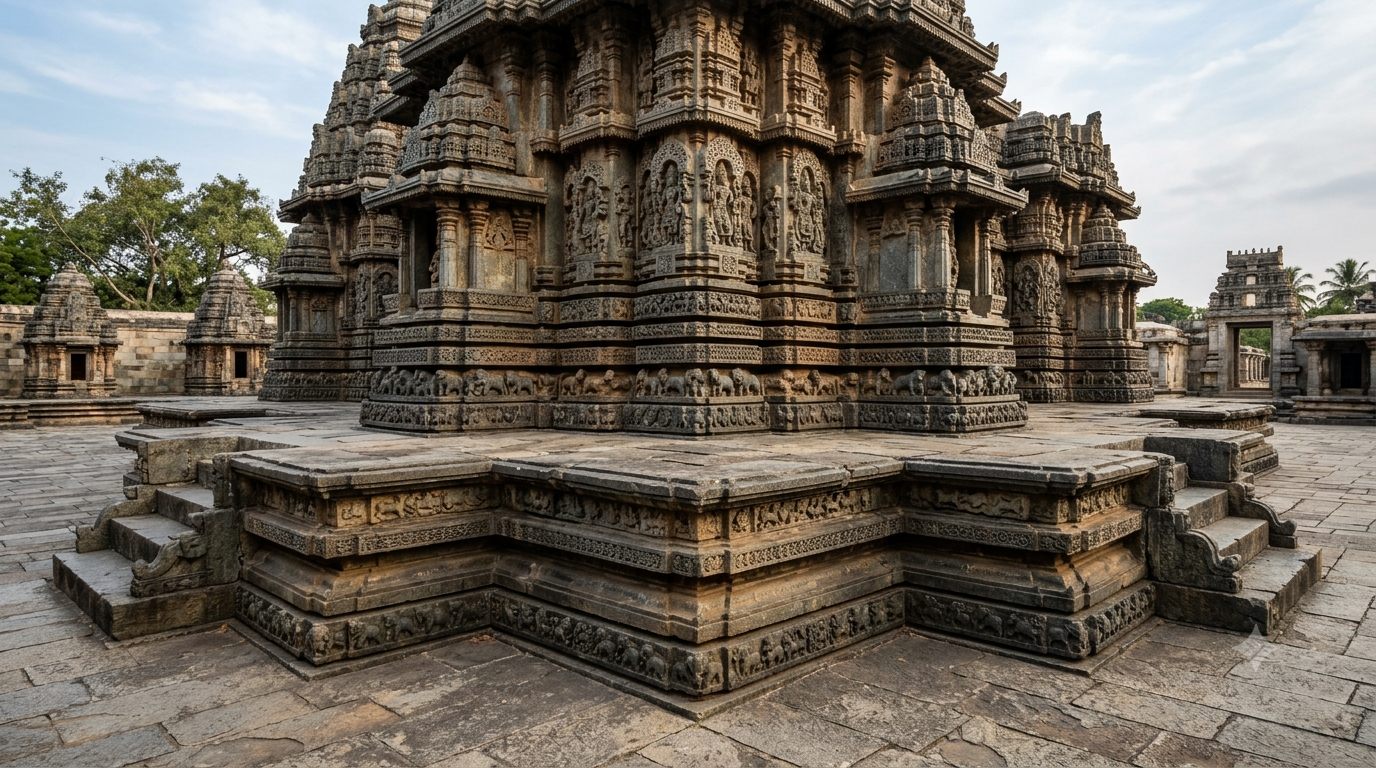
Temple jagati meaning refers to the platform that supports a temple. In some Hoysala monuments, that stone base does much more than raise the building. It follows the shrine’s angled outline and provides a route around its carved walls.
The term matters because visitors often notice the star-shaped walls but overlook the surface beneath their feet. At Belur and Somanathapura, the jagati helps explain how a temple’s plan, sculpture and movement fit together.
Independent guide: TemplesMap.com is not affiliated with UNESCO, the Archaeological Survey of India or any temple authority. We do not accept bookings, donations or payments. Consult authorised sources for official visitor information.
What Is the Temple Jagati Meaning in Architecture?
A jagati is the raised platform on which a temple stands. The Government of Karnataka’s Hoysala nomination dossier, hosted by the UNESCO World Heritage Centre, defines it as a “platform supporting a temple”. At several Hoysala shrines, the platform projects beyond the walls, allowing people to walk around the building.
That definition is architectural, so it does not promise any particular ritual. It describes a physical part of a temple, not a separate shrine, deity or special ticket. The exact shape and role depend on the monument, which is why historical plans and careful observation matter.
For the original wording, consult the UNESCO-hosted Sacred Ensembles of the Hoysalas nomination dossier. Its glossary provides the concise definition, while its plans show the feature in context.
Temple Jagati Meaning at a Glance
- Part of the building: The jagati supports the temple above it.
- Visible position: At the Hoysala examples here, it sits above the courtyard level.
- Possible use: A projecting platform can provide space for pradakshina, or walking around a sacred shrine.
- Possible shape: Hoysala jagatis may follow the temples’ star-like or stepped outlines.
- Key caution: Not every jagati has the same shape, width, decoration or ritual use.
To understand temple jagati meaning, separate what it is from what people can do on it. Supporting the building defines the feature. A walking route is one function that particular designs may provide.
Why Hoysala Builders Gave the Jagati a Star-Like Outline
Hoysala architects often shaped walls with repeated projections and recesses. This creates a stellate, or star-like, plan. At the best-known examples, the jagati echoes those turns instead of remaining a plain rectangle.
As a result, a visitor can read the shape near ground level. The platform’s corners lead the eye towards the angled walls above. Its edge is therefore an architectural clue, not merely an extra border around the temple.
The Hoysala nomination dossier also explains this design choice through a comparison with earlier raised platforms. It describes the Hoysala contribution as giving the supporting base a profile that tracks the temple’s plan. That does not mean Hoysala builders invented raised temple platforms.
UNESCO’s Khajuraho Group of Monuments description also uses the term jagati for ornate raised platforms. Those North Indian examples clarify temple jagati meaning beyond Karnataka: a jagati need not be star-shaped, and the term does not belong to Hoysala architecture alone.
Belur: How the Jagati Frames One Main Shrine
At the Channakeshava Temple in Belur, the jagati follows the complex outline of the principal temple. The Hoysala dossier describes a broad platform with five plain moulded layers. It also records steps at the north, south and east entrances.
At Belur, temple jagati meaning points to the base; the same wide surface also serves as a pradakshina route. Its shape matters because the shrine walls project and recede above it. Following the turns gives visitors a clearer view of carved surfaces than one fixed viewpoint can offer.
The dossier’s labelled Belur plan calls the jagati item 6. That is useful when reading drawings because the same plan separately marks the sanctum, vestibule and halls. The platform is outside those indoor spaces, so a plan helps prevent mistaken labels.
For the full setting, see our Belur Chennakeshava temple architecture guide. It covers the shrine’s sculptural programme and hall design, while this page concentrates on the raised base.
Somanathapura: A Jagati That Follows Three Shrines
The Keshava Temple at Somanathapura makes the idea especially clear. Three Vishnu sanctums share a central hall, and the temple rises from a moulded platform. The jagati follows the building’s star-like plan rather than forming one simple square.
The nomination dossier identifies the jagati as item 5 on its Somanathapura plan. It identifies the adhisthana, or decorated plinth, as item 6. Seeing both labels together clarifies temple jagati meaning because the two words are not exact synonyms.
The same source describes elephant figures at points of the jagati and naga and yaksha figures along parts of its edges. These carvings also give the Somanathapura example a symbolic layer. However, they do not prove that every temple platform carries the same figures or beliefs.
Our Somanathapura Keshava temple architecture guide explains the three-shrine layout and the carvings in more detail. Compare the plan there with the photographs in UNESCO’s Hoysala heritage gallery.
Temple Jagati Meaning Versus Adhisthana and Pradakshina
Three terms often appear close together in temple descriptions, so it helps to separate them. A jagati names the supporting platform. An adhisthana names a plinth or moulded base in the building’s lower structure. Pradakshina describes the ritual act of going around the shrine.
At Somanathapura, the official nomination plan gives the jagati and adhisthana different labels. This is stronger evidence than assuming every horizontal layer near the ground is a jagati, since adjacent layers have different names. It also explains why photographs alone can blur the distinction.
- Jagati: The platform carrying the temple, sometimes broad enough to walk on.
- Adhisthana: The moulded base of the temple walls, often bearing carved bands.
- Pradakshina: The clockwise act of circumambulation, not the stone platform itself.
- Pradakshinapatha: A route used for that circumambulation, which may follow a jagati in some temple plans.
These terms describe different things: a structure, another structural element, a practice and a path. Their relationships vary by site, so context is essential. Therefore, avoid treating one monument’s arrangement as a rule for all Hindu temples.
Why the Raised Platform Matters Beyond Its Height
The jagati has a structural role because it forms the support below the main temple. At some Hoysala monuments, however, its width also creates a place to move beside the exterior walls. This brings the carved surfaces into a sequence as people walk.
That sequence also changes what visitors can see. One corner reveals the next angled face, while a recessed wall may remain hidden until the walker moves. The platform and the building’s outline work together to shape the experience.
The Hoysala dossier also discusses symbolic readings. It refers to an architectural text that compares the jagati with a king’s throne and to traditions linking the base with a world beneath the shrine. These are recorded interpretations, not a universal explanation for every raised foundation.
Somanathapura offers a concrete case because its carved elephants and other figures support that reading in the dossier. At another temple, the decoration and historical evidence may differ. Therefore, start with the building you can identify before applying a symbolic claim.
How to Recognise a Jagati in a Temple Photograph or Plan
You do not need specialist training to grasp temple jagati meaning from a plan. Begin at ground level and look for the broad surface that supports the main shrine. Then check whether that surface continues around the building or stops close to its walls.
- Find the courtyard floor. Identify the level outside the temple before examining its raised parts.
- Locate the supporting platform. Look for a distinct stone surface beneath the main building and above the surrounding ground.
- Trace its edge. Notice whether it runs straight, steps inward or follows angled projections.
- Separate the wall plinth. Decorative bands immediately beneath the walls may belong to the adhisthana rather than the walking surface.
- Check the labelled plan. A trustworthy drawing can confirm which element the architect calls jagati.
For Belur, look for number 6 on Figure 2.6 in the nomination dossier. For Somanathapura, locate number 5 on Figure 2.62. These figure references also let you test a photograph against documented plans.
A photograph shows the shape, yet it cannot prove every function. Likewise, the existence of steps does not guarantee visitor access today. Follow the site’s current conservation and worship rules instead of treating an old plan as a visiting permit.
Common Mistakes When Explaining a Jagati
The first mistake is to say that all Hindu temples stand on an identical raised terrace, although their bases differ. Temple design varies across regions and periods, so that claim is too broad. Some monuments have a large projecting jagati, while others use different base arrangements.
The second mistake is to equate temple jagati meaning with a star-shaped platform. Star-like profiles help identify Hoysala examples, yet UNESCO also applies the term to Khajuraho. Shape alone cannot serve as the definition.
The third mistake is to call every carved band a jagati. At Somanathapura, the plan separates the platform from the adhisthana. A lower frieze, a moulded plinth and a broad walking ledge may belong to related but different elements.
Finally, avoid assuming the platform always functions as an accessible ritual route. At Belur, the dossier explicitly describes pradakshina on the wide jagati. Elsewhere, verify the actual plan and current access before making that claim.
A useful test is to ask what each source can prove. A glossary defines a term, while a plan locates the element.
Photographs reveal the shape, and current site guidance controls access. None replaces the others. This simple sequence prevents a visual guess from becoming an unsupported architectural or ritual rule.
Temple Jagati Meaning: The Essential Distinction
The temple jagati meaning begins with one architectural fact: it is the platform supporting a temple. Belur shows how that platform can provide a broad path around one principal shrine. Somanathapura shows how it can follow a more complex three-shrine design.
Look down before looking up. The outline beneath the carved walls often explains their shape, while a labelled plan clarifies what belongs to the jagati. Use the UNESCO-hosted dossier as the reference, then judge each monument on its own evidence.
Frequently Asked Questions About the Jagati
What does jagati mean in a Hindu temple?
Jagati means the platform that supports the temple. Some examples rise noticeably above the surrounding ground and extend into a walking surface. The term itself does not require a specific height, shape or religious use, although particular temples may add all three.
Is a jagati always star-shaped?
No. The star-like outline is a striking feature of several Hoysala temple platforms. UNESCO also describes raised jagatis at Khajuraho, where architectural plans differ. The supporting platform, not its outline, defines the term.
Why do Hoysala temples have raised platforms?
In the Belur and Somanathapura examples, raised platforms support the shrine and help express its plan. A broad jagati can also provide space to move around carved walls. Its particular design and purpose should be checked monument by monument.
Is the jagati the same as the adhisthana?
No, the terms are distinct in the Hoysala nomination plans. The jagati names the platform, while the adhisthana describes the moulded plinth at the base of the walls. Both may appear close together in a photograph, so labels matter.
Does pradakshina happen on the jagati?
It can. The Belur Channakeshava Temple’s broad jagati provides a path for pradakshina around the shrine. Yet pradakshina means circumambulation itself, and temples may organise that route in other ways.
Where can I see a clearly documented jagati?
Belur and Somanathapura offer well-documented Hoysala examples. The Government of Karnataka nomination dossier hosted by UNESCO labels their platforms in architectural plans. The UNESCO Hoysala gallery also includes useful views of the stone bases.
Do jagati carvings always carry the same symbolism?
No. The Hoysala dossier discusses specific symbolic readings of the Somanathapura platform, including elephant, naga and yaksha imagery. Those details belong to a documented example, not a fixed rule for every temple.