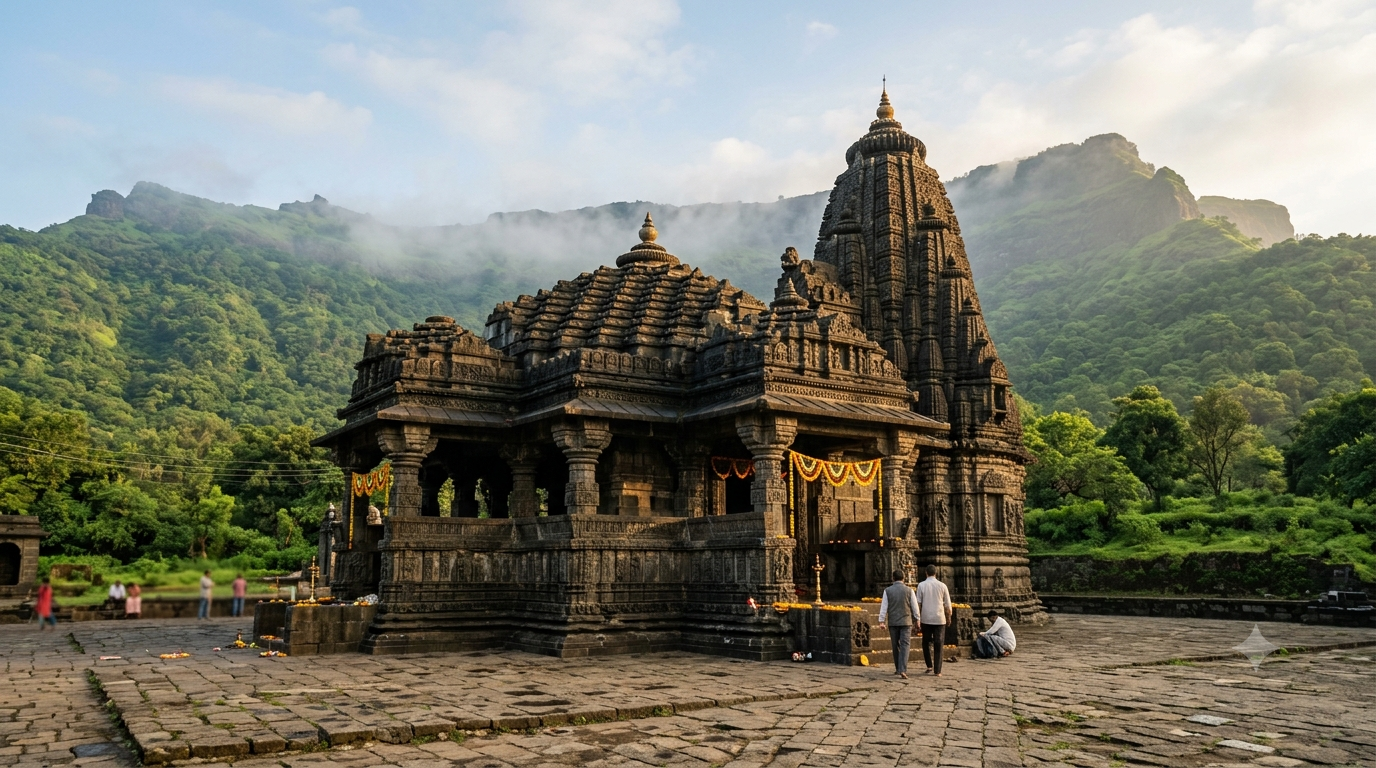
The famous temples in Maharashtra hold a distinction no other Indian state can match: five of the country’s twelve sacred Jyotirlingas stand within its borders. That single fact reshapes how you should plan a pilgrimage here. Most travel lists lump every shrine together, yet the state actually splits into clear regional circuits. This guide maps the biggest temples by region, verifies their timings against official trusts, and flags the booking scams that trap first-time visitors.
Temples Map is an independent temple-guide website. We are not affiliated with, endorsed by, or the official portal of any temple or trust mentioned here. We do not take bookings, donations, or payments. Please use each temple’s official website, linked below, for reservations and official information.
Famous temples in Maharashtra at a glance
- Jyotirlingas: Five of India’s twelve — Trimbakeshwar, Bhimashankar, Grishneshwar, Aundha Nagnath, and Parli Vaijnath.
- Shakti Peethas: Kolhapur Mahalakshmi and Tuljabhavani, two of the state’s most revered goddess shrines.
- Biggest crowds: Shirdi Sai Baba Temple draws tens of thousands of devotees daily, and far more on Thursdays.
- Mumbai’s favourite: Shree Siddhivinayak at Prabhadevi, busiest on Tuesdays.
- Booking reality: Several major shrines offer only free counter darshan, so the “online VIP” sites you find on Google are often scams.
What makes the famous temples in Maharashtra special
Maharashtra sits at a crossroads of faith. Because it borders both the Deccan south and the Gangetic traditions of the north, its shrines blend Shaiva, Vaishnava, and Shakta worship in one state. The result is unusual variety.
The Jyotirlinga count is the headline. Since Maharashtra holds five of the twelve, it draws Shiva devotees completing the all-India Jyotirlinga yatra. No other state comes close on that number, so the famous temples in Maharashtra rank high on any serious pilgrim’s map.
There is a second draw, too. Many of these shrines carry deep Maratha history. Tuljabhavani, for instance, was the family goddess of Chhatrapati Shivaji Maharaj. A temple visit here often doubles as a walk through the region’s warrior past.
Famous temples in Maharashtra: the five Jyotirlingas
If you visit only one category, make it the Jyotirlingas. These are the shrines where Shiva is worshipped as a pillar of light, and Maharashtra’s five are spread across the state. Below are the three most visited, followed by the two quieter ones.
Trimbakeshwar, Nashik
Trimbakeshwar is arguably the most distinctive Jyotirlinga in India. Its linga has three faces representing Brahma, Vishnu, and Shiva, and it sits in a hollow rather than rising up like the others. The temple stands at the foot of Brahmagiri hill, where the Godavari River begins.
The Shree Trimbakeshwar Devasthan Trust generally opens the temple from 5:30 AM to 9:00 PM. General darshan is free and viewed from a short distance, while a donation pass of around ₹200 buys a faster queue. Confirm current rates on the official trust site before you travel.
Bhimashankar, Pune district
Bhimashankar sits high in the Sahyadri hills, wrapped inside a wildlife sanctuary. The setting is glorious, yet it demands some fitness. You climb a long flight of steps to reach the shrine, so carry water and pace yourself, especially if you are elderly or travelling with children.
The Bhimashankar temple is free to enter for regular darshan. Weekends and the holy month of Shravan bring heavy crowds, because Shiva devotees flock here during the monsoon.
Grishneshwar, near Ellora
Grishneshwar is traditionally counted as the last of the twelve Jyotirlingas. You will find it in Verul village, a short hop from the Ellora Caves in Chhatrapati Sambhajinagar district. The red-stone temple was rebuilt by Rani Ahilyabai Holkar, and its carved pillars are a highlight.
Darshan at Grishneshwar is free, and there is no online ticket system, so simply join the queue at the counter. Pair it with Ellora in a single day, since both sit close together.
Aundha Nagnath and Parli Vaijnath
These two complete Maharashtra’s Jyotirlinga set, though far fewer tourists reach them. Aundha Nagnath lies in Hingoli district, while Parli Vaijnath sits in Beed. Both are deeply revered locally, yet both stay quiet compared with Trimbakeshwar. If you want a Jyotirlinga darshan without the crush, these reward the extra travel.
Shirdi: the most visited of the famous temples in Maharashtra
No roundup of the famous temples in Maharashtra is complete without Shirdi. The Samadhi Mandir houses the tomb of Sai Baba, the 19th-century saint revered by Hindus and Muslims alike. Shirdi sits in Ahmednagar district, which has been renamed Ahilyanagar.
The Samadhi Mandir stays open for darshan from early morning, around 4:00 AM, until roughly 11:15 PM after the night Shej Aarti. Timings shift on festival days, though, so check before you go. Thursdays are the most sacred and the most crowded, when queues can stretch for hours.
Here is the single most important tip. The Shree Saibaba Sansthan Trust runs the only official booking channel, at online.sai.org.in. The Trust has publicly warned that other websites collecting money for darshan, aarti, or pooja are unauthorised and illegal, so book only through the official portal.
Shree Siddhivinayak: Mumbai’s beloved Ganesh temple
Siddhivinayak at Prabhadevi is Mumbai’s most famous shrine, dedicated to Lord Ganesha. Film stars, cricketers, and lakhs of ordinary devotees pass through its doors every week. The temple opens around dawn and closes late in the evening, while Tuesdays run even longer because that day is sacred to Ganesha.
Darshan here is free at the counter. The temple trust does share information online, yet the core darshan does not require a paid ticket. As with Shirdi, treat any third-party “instant darshan” seller with suspicion and rely on the official temple channels instead.
Goddess shrines among the famous temples in Maharashtra
Maharashtra’s Shakti worship is powerful, and two goddess temples stand out. Both are counted among the country’s Shakti Peethas, the spots where parts of the goddess Sati are believed to have fallen.
Kolhapur Mahalakshmi (Ambabai)
The Mahalakshmi Temple in Kolhapur, known locally as Ambabai, is a Shakti Peetha of great antiquity. Devotees come for the Alankar Pooja, when the deity is dressed in gold ornaments and fine silk. That decoration ritual runs in the early afternoon and cannot be booked online, so you simply attend at the temple.
Tuljabhavani, Tuljapur
Tuljabhavani is the fierce mother goddess who, by tradition, blessed Chhatrapati Shivaji Maharaj before his campaigns. Her temple stands in Tuljapur, in Osmanabad district, which is now officially called Dharashiv. The shrine typically opens around 6:00 AM and closes in the evening. The self-manifested idol and the temple’s 12th-century roots make this one of the most atmospheric goddess shrines in the state.
Pandharpur, Shani Shingnapur and the Ashtavinayak circuit
Three more names belong on any list of the famous temples in Maharashtra, and each offers something the others do not.
Vitthal Rukmini Temple, Pandharpur
Pandharpur is the spiritual heart of the Warkari tradition. The Vitthal Rukmini Mandir, on the banks of the Chandrabhaga River in Solapur district, honours Vithoba, a form of Vishnu. Uniquely, devotees are allowed to touch the feet of the idol.
In 2014 this temple also made history by appointing female priests and priests from all communities. The great Ashadhi and Kartiki Ekadashi pilgrimages bring millions of walking devotees here.
Shani Shingnapur
Shani Shingnapur is famous for two things. The shrine to Shani Dev is a black rock on an open-air platform, and it stays open 24 hours. The village around it is equally famous, because homes here traditionally have no doors or locks. Devotees also perform their own abhishekam at the shrine, which is rare among major temples.
The Ashtavinayak temples
The Ashtavinayak circuit links eight Ganesha shrines scattered around Pune and its neighbouring districts. Each idol is swayambhu, meaning self-manifested, and each has its own legend. Pilgrims traditionally visit all eight in a set order. The full loop takes two to three days by road, so plan an overnight stop or two.
Famous temples in Maharashtra: darshan timings at a glance
The famous temples in Maharashtra keep hours that change on festival days and during Shravan, so treat this table as a planning guide and confirm on the official portal before you set out. All the shrines below offer free general darshan unless noted.
| Temple | Location | Typical darshan hours |
|---|---|---|
| Shirdi Sai Baba | Shirdi (Ahilyanagar dist.) | ~4:00 AM – 11:15 PM |
| Trimbakeshwar | Trimbak, Nashik | 5:30 AM – 9:00 PM |
| Siddhivinayak | Prabhadevi, Mumbai | ~5:30 AM – late evening |
| Grishneshwar | Verul, Sambhajinagar | ~5:30 AM – 9:30 PM |
| Tuljabhavani | Tuljapur, Dharashiv | ~6:00 AM – 8:00 PM |
| Shani Shingnapur | Shingnapur (Ahilyanagar) | Open 24 hours |
Booking scams at the famous temples in Maharashtra
This is the correction that most temple lists skip. Search “Shirdi darshan booking” or “Trimbakeshwar VIP pass,” and you meet dozens of slick sites promising instant entry. Many are not run by the temples at all. The Shree Saibaba Sansthan Trust has openly stated that unauthorised channels collecting money for darshan or pooja are committing an offence.
So protect yourself with three simple rules. First, book only on the temple trust’s own domain, never a lookalike. Second, remember that several shrines, including Grishneshwar and Kolhapur Mahalakshmi, do not sell online darshan tickets at all.
Third, never share card details on a site you reached through a random ad. When free darshan exists, a paid “shortcut” from a stranger is usually a trap. This one habit protects both your money and your peace of mind.
Districts have new names, so get the geography right
Older temple pages still use outdated place names, which confuses first-time visitors. In 2023 Maharashtra officially renamed two districts tied to major shrines. Aurangabad became Chhatrapati Sambhajinagar, the district of Grishneshwar and the Ellora Caves.
Osmanabad became Dharashiv, home to Tuljabhavani. Ahmednagar, where Shirdi and Shani Shingnapur sit, has likewise been renamed Ahilyanagar. Book train tickets and hotels under the new names to avoid confusion.
How to plan a famous temples in Maharashtra circuit
Geography is your friend here, because the shrines cluster. Group them by region and you cut travel time sharply. The official Maharashtra Tourism portal is a useful starting point for routes and stays.
Nashik anchors the north. From there you can cover Trimbakeshwar and Shirdi in one trip, since they sit only about 80 km apart. Pune anchors the centre, giving you Bhimashankar and the Ashtavinayak circuit.
Mumbai handles Siddhivinayak and other city shrines. The Marathwada belt, meaning Sambhajinagar, Dharashiv, and nearby districts, covers Grishneshwar and Tuljabhavani together. For reaching the state, Mumbai, Pune, and Nashik have the best air and rail links. Shirdi even has its own airport now, which shortens the pilgrimage considerably.
Best time to visit
October to February is the comfortable window, when the weather cools and hill temples like Bhimashankar feel pleasant. Shravan, roughly July to August, is spiritually charged for the Jyotirlingas, yet queues then stretch for hours. If you visit in summer, plan darshan for early morning and carry water, because the Marathwada heat is severe.
A quick safety note
Several of these shrines involve real physical demand. Bhimashankar means a long stair climb, and hill temples can be slippery during the monsoon. So wear proper footwear and pace yourself. Consult a doctor before a strenuous climb or a long fast if you have a medical condition, because faith and common sense travel well together.
Insider tips for the famous temples in Maharashtra
- Phones stay outside. Shirdi and several big shrines bar mobile phones near the sanctum, and locker queues can be long. Carry only your ID and some cash.
- Weekdays beat weekends. Monday to Thursday mornings give the shortest queues almost everywhere, except at Shirdi, where Thursday itself is peak.
- Dress for the sanctum. Some temples, including Trimbakeshwar, require traditional dress for inner-sanctum rituals. A dhoti is often available to rent nearby.
- Combine sights. Grishneshwar pairs with Ellora, while Trimbakeshwar pairs with Nashik’s vineyards and ghats. You get more from each trip.
- Check festival dates. The 2027 Simhastha Kumbh Mela at Nashik and Trimbak will bring vast crowds, so plan those dates far ahead.
The bottom line
Maharashtra rewards the pilgrim who plans by region rather than by wish list. Start with the Jyotirlingas if Shiva is your focus, then add Shirdi and Siddhivinayak for their sheer devotional pull. Fold in a Shakti Peetha or the Pandharpur pilgrimage for balance.
Above all, verify timings on official trust websites and refuse any stranger selling paid darshan. Do that, and a tour of the famous temples in Maharashtra becomes smooth, safe, and genuinely rewarding.
Frequently asked questions
Which are the most famous temples in Maharashtra?
The most famous temples in Maharashtra include the Shirdi Sai Baba Temple, Siddhivinayak in Mumbai, and the five Jyotirlingas: Trimbakeshwar, Bhimashankar, Grishneshwar, Aundha Nagnath, and Parli Vaijnath. The goddess shrines of Kolhapur Mahalakshmi and Tuljabhavani are equally revered.
How many Jyotirlingas are in Maharashtra?
Maharashtra has five of India’s twelve Jyotirlingas, more than any other state. They are Trimbakeshwar near Nashik, Bhimashankar near Pune, Grishneshwar near Ellora, Aundha Nagnath in Hingoli, and Parli Vaijnath in Beed.
Can I book Shirdi darshan online?
Yes, but only through the official Shree Saibaba Sansthan Trust portal at online.sai.org.in. The Trust has warned that other websites collecting money for darshan or pooja are unauthorised. Avoid any third-party “VIP” booking site.
Are darshan tickets free at these temples?
General darshan is free at most major Maharashtra shrines, including Trimbakeshwar, Grishneshwar, and Kolhapur Mahalakshmi. Some temples offer an optional paid priority pass, but the basic darshan does not require payment.
When is the best time to visit the famous temples in Maharashtra?
October to February offers the most comfortable weather for temple travel. Shravan, around July and August, is spiritually significant for Shiva temples but extremely crowded. Early mornings on weekdays give the shortest queues.
Why do some temple pages show old district names?
Maharashtra renamed several districts in 2023. Aurangabad is now Chhatrapati Sambhajinagar, Osmanabad is now Dharashiv, and Ahmednagar is now Ahilyanagar. Many older pages have not updated, so book travel under the current names.
Is Shani Shingnapur really open all day?
Yes. The Shani Shingnapur shrine, an open-air platform holding a black rock, remains open 24 hours. The surrounding village is also famous for homes traditionally built without doors or locks.
How many days do I need for a Maharashtra temple tour?
A focused trip to two or three shrines needs two to three days. Covering the Jyotirlingas plus Shirdi and a Shakti Peetha comfortably takes about a week, since the temples are spread across the state.