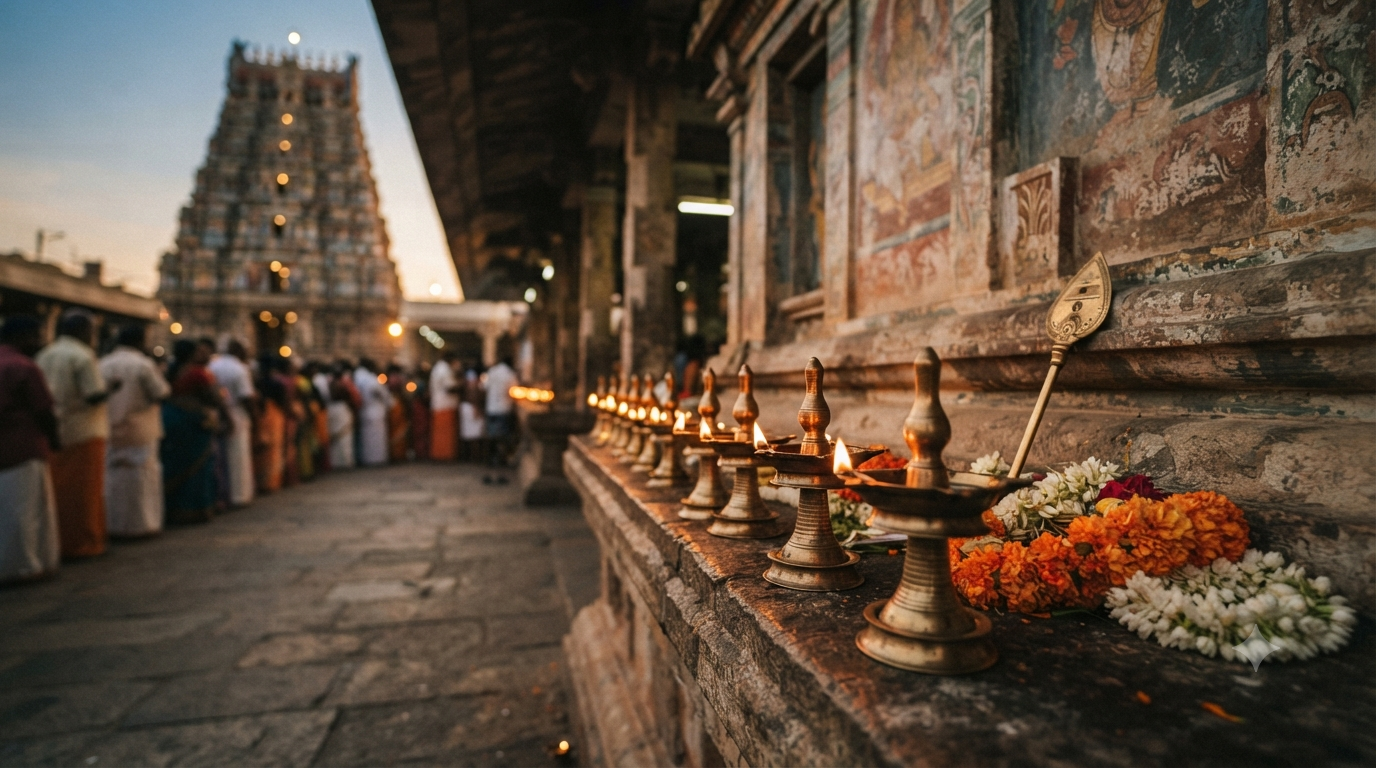
Skanda Shasti Vratam in 2026 falls on twelve separate days, and one of them sits almost a month later than usual. That happened because 2026 carries an extra lunar month, so any date list copied forward from last year goes wrong from June onward. Here are the verified dates, the tithi timings, the six-day Kanda Sashti schedule, and the fasting rules most calendar pages skip.
Temples Map is an independent temple information guide. We are not affiliated with, endorsed by, or the official website of any temple, trust, or devasthanam. We do not accept bookings, sevas, donations, or payments. Use the official temple portals linked below for darshan, seva booking, and official announcements.
Skanda Shasti Vratam 2026 at a Glance
- Monthly observance: the Shukla Paksha Shashti tithi of each lunar month, so roughly once every 29 to 30 days.
- Main festival: Kanda Sashti runs 10 to 15 November 2026, since the Kartika Shukla Shashti falls on Sunday, 15 November.
- Soorasamharam: Sunday, 15 November 2026, staged on the shore at Tiruchendur in the late afternoon.
- Thirukalyanam: Monday, 16 November 2026, the day after Soorasamharam.
- Calendar quirk: Adhik Jyeshtha ran 17 May to 15 June 2026, so May carried an Adhika Skanda Sashti.
- Deity: Lord Murugan, also called Skanda, Subrahmanya, Kartikeya, and Kumara.
Skanda Shasti Vratam 2026 Dates and Pooja Time
The table below gives every Skanda Shasti Vratam date in 2026 with the Shashti tithi window in Indian Standard Time. Because a tithi rarely starts and ends on the same day, this table gives both the start and the end date. Most calendar pages print only the clock times, which leaves readers guessing.
Full 2026 Skanda Shasti Vratam Calendar
| Month | Date (Day) | Shashti Tithi Window (IST) | Notes |
|---|---|---|---|
| January | 24 (Saturday) | 01:46 AM, 24 Jan to 12:39 AM, 25 Jan | Magha Shukla Shashti |
| February | 22 (Sunday) | 11:09 AM, 22 Feb to 09:09 AM, 23 Feb | Phalguna Shukla Shashti |
| March | 24 (Tuesday) | 06:38 PM, 23 Mar to 04:07 PM, 24 Mar | Some lists show 23 March |
| April | 22 (Wednesday) | 01:19 AM, 22 Apr to 10:49 PM, 22 Apr | Vaishakha Shukla Shashti |
| May | 21 (Thursday) | 08:26 AM, 21 May to 06:24 AM, 22 May | Adhika Skanda Sashti |
| June | 19 (Friday) | 04:59 PM, 19 Jun to 03:46 PM, 20 Jun | Nija Jyeshtha Shashti |
| July | 19 (Sunday) | 03:42 AM, 19 Jul to 03:29 AM, 20 Jul | Ashadha Shukla Shashti |
| August | 17 (Monday) | 05:00 PM, 17 Aug to 05:50 PM, 18 Aug | Shravana Shukla Shashti |
| September | 16 (Wednesday) | 08:59 AM, 16 Sep to 10:47 AM, 17 Sep | Bhadrapada Shukla Shashti |
| October | 16 (Friday) | 03:25 AM, 16 Oct to 05:54 AM, 17 Oct | Ashwina Shukla Shashti |
| November | 15 (Sunday) | 11:23 PM, 14 Nov to 02:00 AM, 16 Nov | Main Skanda Sashti, Soorasamharam |
| December | 15 (Tuesday) | 07:15 PM, 14 Dec to 09:19 PM, 15 Dec | Subrahmanya Sashti |
The Two Dates That Matter Most
To put the key dates in plain words: the main Skanda Shasti Vratam of 2026 is Sunday, 15 November, while the December observance on Tuesday, 15 December is Subrahmanya Sashti. Tithi timings shift slightly with your city, because sunrise differs across India.
Why May and June Both Carried a Jyeshtha Shashti
The single biggest date error in 2026 comes from an extra lunar month. Adhik Maas, also called Purushottam Maas or Mala Masa, arrived as Adhik Jyeshtha and ran from 17 May to 15 June 2026. As a result, the Hindu year had thirteen lunar months instead of twelve.
That is why two Shashti days both sat in Jyeshtha. The 21 May observance is the Adhika Skanda Sashti, while 19 June is the Nija, or true, Jyeshtha Shashti. Traditional practice treats the Nija month as the one for regular vrata observance.
The practical consequence matters more than the theory. Any site that offset a 2025 date list forward by about eleven days produced dates that are wrong by roughly a lunar month after May. Always check a fresh panchangam in an Adhik Maas year rather than reusing last year’s table. The next Adhik Maas is not expected until around 2029.
Why Two Panchangams Can Differ by a Day
Readers often find one site showing 23 March and another showing 24 March for the same vratam. Neither is careless. The two follow different rules for naming the day.
A tithi is a lunar day, so it can begin at any hour and does not match a calendar date. In March 2026 the Shashti tithi began at 6:38 PM on 23 March and ended at 4:07 PM on 24 March. Some lists label the day the tithi starts, while panchangams that follow udaya tithi label the day it is running at sunrise.
Skanda Shasti Vratam adds a second rule. When Panchami ends and Shashti begins between sunrise and sunset, tradition treats both tithis as joined, and families choose that day for the vratam. Dharmasindhu and Nirnayasindhu record this rule, and many Murugan temples in Tamil Nadu follow it. So if your family panchangam differs by a day, follow your family tradition rather than a website.
Kanda Sashti 2026: The Six-Day Festival and Soorasamharam
Although every Shukla Paksha Shashti belongs to Lord Murugan, the one in the lunar month of Kartika is the great one. Devotees keep a six-day fast that ends on Soorasamharam day. This is the festival Tamil devotees simply call Kanda Sashti.
At the Subramanya Swamy Temple in Tiruchendur, the six-day Kanda Sashti Viratham begins on Tuesday, 10 November 2026. Soorasamharam falls on Sunday, 15 November, and the temple stages the re-enactment by the sea in the late afternoon. Thirukalyanam, the celestial wedding, follows on Monday, 16 November.
Soorasamharam recreates Murugan’s victory over Surapadman with his vel. Lakhs of devotees reach Tiruchendur for it, so accommodation and transport fill up weeks ahead. Palani, Swamimalai, Tirupparankundram, and other Arupadai Veedu shrines hold their own celebrations on the same days. Confirm the ritual schedule on the official Tiruchendur temple website before you travel, since the temple announces timings closer to the festival.
What Is Skanda Shasti Vratam?
Skanda Shasti Vratam is a fasting observance dedicated to Lord Murugan, kept on the sixth tithi of the waxing moon each lunar month. Devotees fast through the day, light a lamp, recite the Kanda Sashti Kavacham, and offer puja at home or at a Murugan temple. The Kartika observance extends into a six-day fast.
Murugan is the son of Lord Shiva and Goddess Parvati, and the younger brother of Lord Ganesha in South Indian tradition. Temple iconography depicts him as a young warrior riding a peacock and holding the vel. Several popular pages wrongly describe him as the son of Parvati and Ganesha, which no scripture supports.
How to Observe Skanda Shasti Vratam at Home
You do not need a temple to keep the vratam. Families across Tamil Nadu, Andhra Pradesh, Telangana, Karnataka, and the Tamil diaspora observe it at home. The sequence below reflects common household practice.
- Bathe early and clean the puja space before sunrise.
- Light a lamp and place a picture or idol of Lord Murugan, along with fresh flowers.
- Take a sankalpam, a short spoken intention, naming the vratam you are keeping.
- Recite the Kanda Sashti Kavacham, and add Subrahmanya Ashtakam if your family follows it.
- Offer simple naivedyam such as panchamrutham, fruit, or sweet pongal.
- Keep the fast through the day, then break it after the evening deeparadhana.
During the six-day November fast, repeat this daily. Many devotees also visit a Murugan temple on the final day. Where devotees cannot travel, tradition counts a lamp lit at home as equally sincere.
Skanda Shasti Vratam Fasting Rules and Safety
Fasting practice varies widely, and no single rule applies to every family. Some devotees take only water, while others eat fruit and milk, and many take one sattvic meal after the evening puja. Devotees avoid onion, garlic, alcohol, and non-vegetarian food throughout.
Because a six-day fast is physically demanding, treat it sensibly. Anyone who is pregnant, elderly, diabetic, on regular medication, or recovering from illness should speak to a doctor before attempting a strict or multi-day fast. A partial fruit-and-milk fast is an accepted option, and tradition does not measure devotion by hardship.
If you travel to Tiruchendur or Palani in November, plan for heat, long queues, and very large crowds. Carry water, any regular medication, and identification. Kavadi bearers and those climbing hill shrines should pace themselves, since the physical strain is real. These observances are matters of faith and Vedic tradition, and they are never a substitute for medical treatment.
What Most Skanda Shasti Vratam Date Lists Get Wrong
Four errors circulate widely, and each one misleads devotees planning a fast.
- Calling the November fast seven days. The Kanda Sashti viratham runs six days, from Pirathamai to Soorasamharam, not seven.
- Reusing last year’s table. In an Adhik Maas year such as 2026, offsetting old dates breaks everything after May.
- Publishing one date for the whole year. Several large portals show a single Skanda Sashti date, usually geolocated to a foreign city, which is useless for Indian readers.
- Describing it as a Brahmin-only observance. Murugan devotees across many communities keep this vratam in Tamil Nadu, Sri Lanka, Malaysia, and the wider diaspora.
Cross-check any date you find against two independent panchangams. If they disagree, follow the one your family or local temple uses. You can also verify against Drik Panchang’s Skanda Sashti list.
Planning Notes Most Calendar Pages Leave Out
December’s Shashti is not just another monthly date. The Shashti after Soorasamharam is Subrahmanya Sashti, also called Kukke Subrahmanya Sashti, and it falls on 15 December 2026 in the lunar month of Margashirsha. Naga dosha remedies are traditionally associated with this day.
Since the November Skanda Sashti falls in Karthika Masam, it overlaps a crowded festival stretch. Our Karthika Masam festival list shows what else falls in the same weeks, which helps if you are combining temple visits. Devotees who keep monthly vratas may also follow the Sankashti Chaturthi dates in the same calendar.
Serpent worship connects Subrahmanya shrines to Rahu-Ketu remedies, which is why many devotees plan both in one trip. Our guide to Srikalahasti Rahu Ketu pooja timings explains how priests conduct that ritual. Booking and payment happen only on the temple’s own official channels, never through us.
Before You Begin the Fast
The dates in this guide come from two independent panchangams that agree on all twelve days. Mark 15 November 2026 first, because that is the Skanda Sashti that matters most, and the six-day fast starts on 10 November. For monthly observance, simply follow the table above.
Confirm ritual timings with your local Murugan temple or the Tamil Nadu HR and CE Department before travelling. Panchangam traditions differ, so your family practice takes precedence over any published list.
Skanda Shasti Vratam FAQs
When is Skanda Shasti Vratam in 2026?
Skanda Shasti Vratam falls on twelve days in 2026, one in each lunar month. The main observance is Sunday, 15 November 2026, which is the Kartika Shukla Shashti. You will find the remaining dates in the table above.
What is the Soorasamharam 2026 date?
Soorasamharam falls on Sunday, 15 November 2026. At Tiruchendur the temple stages it on the seashore in the late afternoon, and Thirukalyanam follows on 16 November. The six-day fast begins on 10 November.
How many days is the Kanda Sashti fast?
The Kanda Sashti viratham runs for six days. It begins on Pirathamai, the first day of the Kartika lunar month, and concludes on Soorasamharam day. Claims of a seven-day fast are incorrect.
Can I drink water during Skanda Shasti Vratam?
Yes, most devotees drink water and many also take fruit and milk. Complete nirjala fasting is optional and less common. Choose the form you can sustain safely, especially if you have a medical condition.
Why did two Skanda Sashti days fall in Jyeshtha in 2026?
An extra lunar month, Adhik Jyeshtha, ran from 17 May to 15 June 2026. That created an Adhika Skanda Sashti on 21 May and the Nija Jyeshtha Shashti on 19 June. Traditional practice favours the Nija month observance.
Is Skanda Shasti Vratam the same as Subrahmanya Sashti?
They are related but distinct. Subrahmanya Sashti is the Shashti that follows Soorasamharam, falling in Margashirsha, which is 15 December in 2026. It is closely linked to the Kukke Subrahmanya temple in Karnataka.
Which temple is best to visit for Skanda Sashti?
Tiruchendur draws the largest crowds for Soorasamharam, since the legend places Murugan’s victory there. Palani, Swamimalai, Tirupparankundram, Thiruthani, and Pazhamudircholai complete the Arupadai Veedu. Any local Murugan temple is equally valid for the vratam.
Why do panchangam sites show different Skanda Sashti dates?
Tithis begin and end at varying hours, so sites differ on which calendar day to name. Some use the day the tithi starts, while others use udaya tithi, the tithi running at sunrise. Follow your family or temple panchangam when lists disagree.