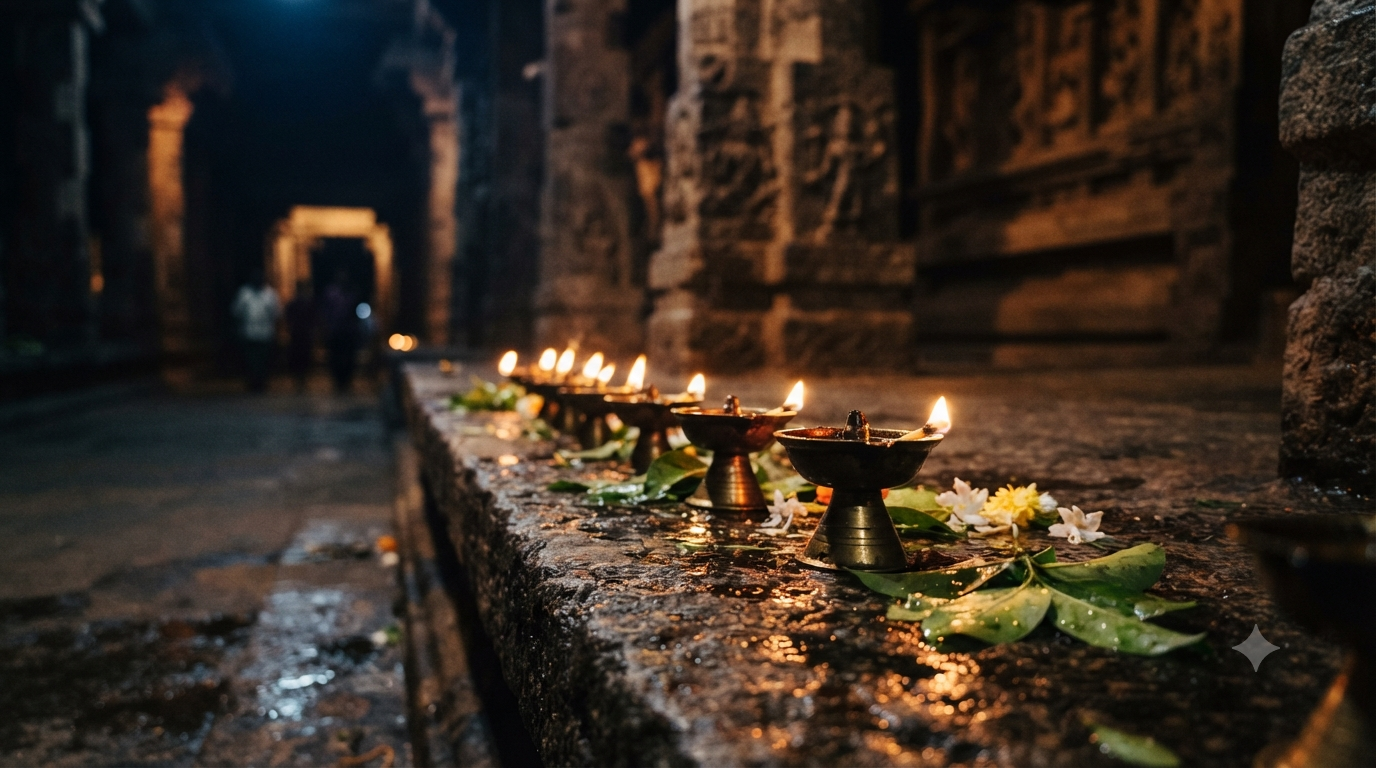
The Maha Shivaratri date and time for the next observance falls on Saturday, 6 March 2027. The Nishita Kaal puja window opens at 12:07 AM that night. Most calendar pages stop right there.
That single date is not enough, though, because the night worship, the fasting window and the parana all run on tithi timings. Those timings shift from city to city. This guide sets out every timing that matters. It also explains why the festival jumped 19 days later than in 2026, and flags the mistake that sends devotees on the wrong night.
Temples Map is an independent temple information guide. We are not affiliated with any temple, trust or devasthanam, and this is not an official temple website. We do not accept bookings, donations or payments. Please use the official temple portal for sevas and darshan reservations.
Maha Shivaratri Date and Time at a Glance
- Next observance: Saturday, 6 March 2027 across India
- Nishita Kaal puja: 12:07 AM to about 12:57 AM on the night of 6-7 March
- Chaturdashi tithi begins: 12:03 PM on 6 March 2027
- Chaturdashi tithi ends: 1:46 PM on 7 March 2027
- Parana (breaking the fast): 6:44 AM to 1:46 PM on 7 March 2027
- Following year: Wednesday, 23 February 2028
Every Maha Shivaratri date and time listed above follows New Delhi in Indian Standard Time. The tithi is astronomical, so your city’s windows will differ by a few minutes. Confirm them on a panchang set to your own location before the night.
Maha Shivaratri Date and Time in India for 2027
India observes Maha Shivaratri 2027 on Saturday, 6 March 2027. The Chaturdashi tithi of Krishna Paksha begins at 12:03 PM that afternoon. It then runs until 1:46 PM the next day. Because the tithi covers the midnight watch on the night of 6-7 March, that night carries the vigil.
The rule behind that night matters. Shivaratri does not simply follow a calendar day.
Devotees observe it on the night when Chaturdashi covers Nishita Kaal, the midnight watch. Classical texts such as the Dharmasindhu and Nirnayasindhu set this rule. So the panchang follows the moon rather than the clock.
Nishita Kaal: the window that matters most
Nishita Kaal is the eighth muhurta of the night. It is the roughly fifty-minute band centred on true midnight. For 2027 in New Delhi it runs from 12:07 AM to about 12:57 AM.
Tradition holds that Lord Shiva appeared as the Lingodbhava form during this window. That is why it outweighs every other hour of the night.
If you can manage only one round of worship, do it here. Many devotees cannot stay awake all night. They set an alarm, perform a short abhishekam during Nishita Kaal, and then rest. That practice is accepted, and it is no less sincere than the full vigil.
Maha Shivaratri Date and Time for the Four Prahars
Some devotees keep the complete vigil. They divide the night into four prahars, or three-hour watches, and perform one round of abhishekam in each. These windows track local sunset, so they shift by city. Below are the New Delhi windows for 2027, as published by Drik Panchang.
| Prahar | Start | End |
|---|---|---|
| First prahar | 6:32 PM (6 Mar) | 9:35 PM (6 Mar) |
| Second prahar | 9:35 PM (6 Mar) | 12:38 AM (7 Mar) |
| Third prahar | 12:38 AM (7 Mar) | 3:41 AM (7 Mar) |
| Fourth prahar | 3:41 AM (7 Mar) | 6:44 AM (7 Mar) |
Each prahar traditionally takes a different abhishekam offering. Households often use milk, curd, ghee and honey in turn. Devotees offer bilva leaves in every round, since tradition treats them as the offering Shiva values above all others.
Why the Maha Shivaratri Date and Time Shifts Every Year
The festival lands on Krishna Paksha Chaturdashi in the lunar month of Magha or Phalguna. So it never repeats on a fixed Gregorian date. A lunar year also runs about eleven days shorter than a solar year. As a result, most Hindu festivals normally drift roughly eleven days earlier each year.
That drift would eventually push winter festivals into summer. To stop it, the panchang adds an extra lunar month called Adhika Masa, or Purushottam Masa. This happens roughly every thirty-two months. Any lunar month without a solar ingress becomes the extra one.
Why 2027 arrives 19 days later than 2026
Here is the detail that trips up almost every calendar page. It is also the biggest single reason wrong dates circulate online.
In 2026, Maha Shivaratri fell on Sunday, 15 February. In 2027 it falls on Saturday, 6 March. That is nineteen days later, not eleven days earlier.
An intercalary month explains the jump. The Hindu year 2026-27, known as Parabhava Nama Samvatsara, carried an Adhika Jyeshtha Masa. It ran from 17 May to 15 June 2026.
Jyeshtha therefore occurred twice, which made it a thirteen-month lunar year. Every festival after that insertion moved forward by roughly a lunar month. The Maha Shivaratri date and time therefore advanced instead of retreating.
So anyone who took the 2026 date and subtracted eleven days would have landed in early February 2027. They would have been a full month wrong. Never carry last year’s Maha Shivaratri date and time forward. Recompute it for the specific year instead, or check a panchang that does.
Maha Shivaratri Date and Time for 2026, 2027 and 2028
The leap-month effect is easiest to see across several years. Below are three consecutive observances with their midnight puja windows for New Delhi.
| Year | Date | Day | Nishita Kaal puja |
|---|---|---|---|
| 2026 | 15 February | Sunday | 12:11 AM to 12:59 AM |
| 2027 | 6 March | Saturday | 12:07 AM to 12:57 AM |
| 2028 | 23 February | Wednesday | 12:09 AM to 12:59 AM |
Notice how 2028 swings back to late February. That is the calendar correcting itself after the extra month. The pattern repeats every few years, so the Maha Shivaratri date and time never settles into a rhythm you can predict by memory.
How the Maha Shivaratri Date and Time Changes by City
Tithi timings are astronomical, so they depend on longitude and sunset. The Maha Shivaratri date and time you read online may therefore not be the one for your city. A panchang calculated for Delhi will not match Chennai, Mumbai or Kolkata exactly.
Sunrise on 6 March 2027 varies by nearly an hour across the country. Kolkata sits at the eastern edge and Mumbai at the western one, so the night prahars stretch or compress accordingly.
For most Indian cities the gap runs to minutes, not hours. The date itself therefore does not change. Every Indian state keeps the vigil on 6 March. Both North Indian and South Indian panchangams agree on the day, although they name the lunar month differently.
Why the Maha Shivaratri Date and Time Abroad Can Show 5 March
This causes real confusion, and almost no guide explains it. Panchang websites detect your browser location. They then recalculate the Maha Shivaratri date and time for that timezone.
Someone opening the same page in California sees Friday, 5 March 2027. That happens because 12:03 PM IST on 6 March equals 10:33 PM PST on 5 March.
Neither figure is wrong. The tithi is one astronomical event, and it simply lands on a different local calendar day. If you observe in India, set the panchang location to your Indian city. If you are abroad, decide in advance whether you will follow local midnight or Indian timings, since the two rarely coincide.
Magha or Phalguna? Clearing Up the Calendar Confusion
Telugu, Kannada and Marathi calendars place the festival in Magha Masam. North Indian calendars place it in Phalguna. Readers sometimes assume one of the two is a mistake. Both are correct.
The difference lies only in the naming. South Indian calendars follow the Amavasyant system, where the month ends at the new moon. North Indian calendars follow the Purnimant system, where it ends at the full moon.
That offset renames the month without moving the day. So the Maha Shivaratri date and time stays identical in Andhra Pradesh and Uttar Pradesh.
Fasting Rules and When to Break the Fast
Plan the fast around the Maha Shivaratri date and time for your own city. The Shivaratri vrat usually begins the previous day. On Trayodashi many devotees eat only one meal. On the day itself they bathe, take a formal sankalpa, and keep the fast through the day and the night.
Practice varies by household. A nirjala fast excludes even water. A phalahar fast allows fruit, milk and sattvic foods such as sabudana. Neither is compulsory, so follow what your family observes.
The parana, or breaking of the fast, should ideally happen the next morning. Complete the night worship first. For 2027 that window runs from 6:44 AM to 1:46 PM on 7 March, which is when Chaturdashi ends.
A practical note on health before you fast
A full-day fast followed by a night vigil is physically demanding. Long temple queues make it harder still. Anyone who is pregnant, elderly, diabetic, or managing a heart or blood-pressure condition should speak to a doctor first. Devotion is not measured by strictness, and a phalahar fast or a shortened vigil remains a valid observance.
Carry water and any regular medication if you head to a temple. Queue times on this night routinely run into several hours. Fasting is a spiritual discipline, not a medical treatment, so never substitute it for prescribed care.
What Actually Happens at Temples on the Night
Shiva temples stay open through the night on Maha Shivaratri. That is unusual, because most close by evening on ordinary days. Continuous abhishekam runs through the four prahars. In many South Indian temples, priests perform Shiva-Parvati Kalyanam after dark, and bhajans and prasadam distribution follow.
Major Jyotirlinga shrines hold Brahmotsavams around the festival. Srisailam is among the busiest, and the temple alters its daily seva timings for the occasion. Festival schedules override normal ones, so verify them on the official Srisailam Devasthanam website before you travel.
What can go wrong, and what to do about it
Darshan on Maha Shivaratri is never guaranteed. Queues at popular shrines can exceed six hours. Paid quick-darshan tickets often sell out days in advance. Some temples suspend special-entry darshan entirely because of the crowd, and abhishekam sevas you can normally book on the spot are frequently closed.
Three fallbacks usually work when your preferred seva is unavailable. Visit a smaller neighbourhood Shiva temple, where the same four-prahar worship happens without the crush. Attend the early first-prahar session instead of the midnight one, since crowds peak near Nishita Kaal. Or perform the abhishekam at home, which tradition treats as fully valid.
Where a temple runs an official online booking portal, check it well before the festival week, because quotas close early. If the quota has already gone, no private agent can secure a slot for you, so treat any such offer as a scam.
The Story Behind Maha Shivaratri
Several traditions explain the night, and they coexist. The most widely told account holds that Shiva and Parvati married on this day. That is why temples perform Kalyanam after dark.
The Shiva Purana records another account. On this night Shiva manifested as an infinite column of light, the Lingodbhava form. Brahma and Vishnu had disputed which was greater, yet neither could find its end. Tradition places that manifestation at Nishita Kaal, which is why the midnight vigil carries such weight.
A third story describes Shiva drinking the halahala poison churned from the ocean. It turned his throat blue and earned him the name Neelkanth. Devotees kept vigil while he held it.
These accounts are matters of faith and Vedic tradition. We offer them here as devotional context rather than as historical record.
Mistakes Devotees Make With the Maha Shivaratri Date and Time
A few errors resurface every year.
- Copying last year’s Maha Shivaratri date and time. The leap-month shift makes this unreliable, as the nineteen-day jump into 2027 shows.
- Treating Delhi timings as universal. Nishita Kaal moves with local sunset, so check your own city.
- Expecting the puja in the morning. Shivaratri is a night observance, and the main worship falls after sunset.
- Breaking the fast too late. The parana should fall within Chaturdashi, which ends at 1:46 PM on 7 March 2027.
- Trusting aggregator sites for temple timings. Festival schedules override daily ones, so use the temple’s own portal.
Shaivite households also observe Karthika Masam, whose start and end dates move for the same lunar reasons. Remedial rituals such as the Rahu-Ketu pooja at Srikalahasti shift too. Check each one against a current panchang, and the confusion stops repeating.
Before You Go
Mark Saturday, 6 March 2027 for the next Maha Shivaratri. Plan the night around the 12:07 AM Nishita Kaal window rather than the daytime hours. Confirm the Maha Shivaratri date and time for your own city on a location-specific panchang, because that fifty-minute midnight band shifts with local sunset.
If you intend to visit a major shrine, check its official portal during the preceding week. Altered seva schedules and darshan quotas are published there first.
Above all, judge the observance by intent rather than by strictness. A short honest puja at midnight counts for as much as an unsustainable vigil. For a broader look at the festival, the Isha Foundation’s Mahashivratri page documents one of India’s largest public celebrations.
Frequently Asked Questions
What is the Maha Shivaratri date and time in 2027?
Maha Shivaratri 2027 falls on Saturday, 6 March 2027 in India. The Nishita Kaal puja window runs from 12:07 AM to roughly 12:57 AM on the night of 6-7 March, calculated for New Delhi. Chaturdashi tithi begins at 12:03 PM on 6 March and ends at 1:46 PM on 7 March.
Why does Maha Shivaratri fall in March in 2027 but February in 2026?
The panchang added an extra lunar month, Adhika Jyeshtha Masa, between 17 May and 15 June 2026. That intercalary month pushed every later festival forward by about thirty days. So instead of drifting eleven days earlier as usual, the festival moved nineteen days later.
Is Maha Shivaratri on 5 March or 6 March 2027?
In India it is 6 March 2027. Panchang websites that auto-detect a Western timezone will display 5 March, because the tithi begins on the previous local day there. Set your panchang location to your own city to see the correct Maha Shivaratri date and time.
Can I perform the puja only once instead of four times?
Yes. The four-prahar vigil is the fullest form, yet a single round of worship during Nishita Kaal is widely accepted. Many households perform one abhishekam at midnight and then rest.
When should I break the Maha Shivaratri fast?
Break it the following morning, once you have completed the night worship. Ideally do so before Chaturdashi ends. For 2027 that parana window is 6:44 AM to 1:46 PM on 7 March. Some traditions instead wait until the tithi has fully ended.
Is fasting compulsory on Maha Shivaratri?
No. Fasting is voluntary and comes in several forms, from nirjala without water to a light phalahar diet. Choose the level your health allows. Consult a doctor first if you have a medical condition.
Is Maha Shivaratri a public holiday in India?
Most Indian states declare it a holiday, although the list varies and a few do not gazette it. Check your state government’s holiday notification for the year, since central and state lists differ.
Which Shiva temple should I visit on Maha Shivaratri?
Any Shiva temple is appropriate, though the Jyotirlinga shrines draw the largest crowds. Srisailam, Srikalahasti, Rameshwaram and Somnath all hold extended festival programmes. For darshan without a long wait, a smaller local temple offers the same four-prahar worship in far greater calm.