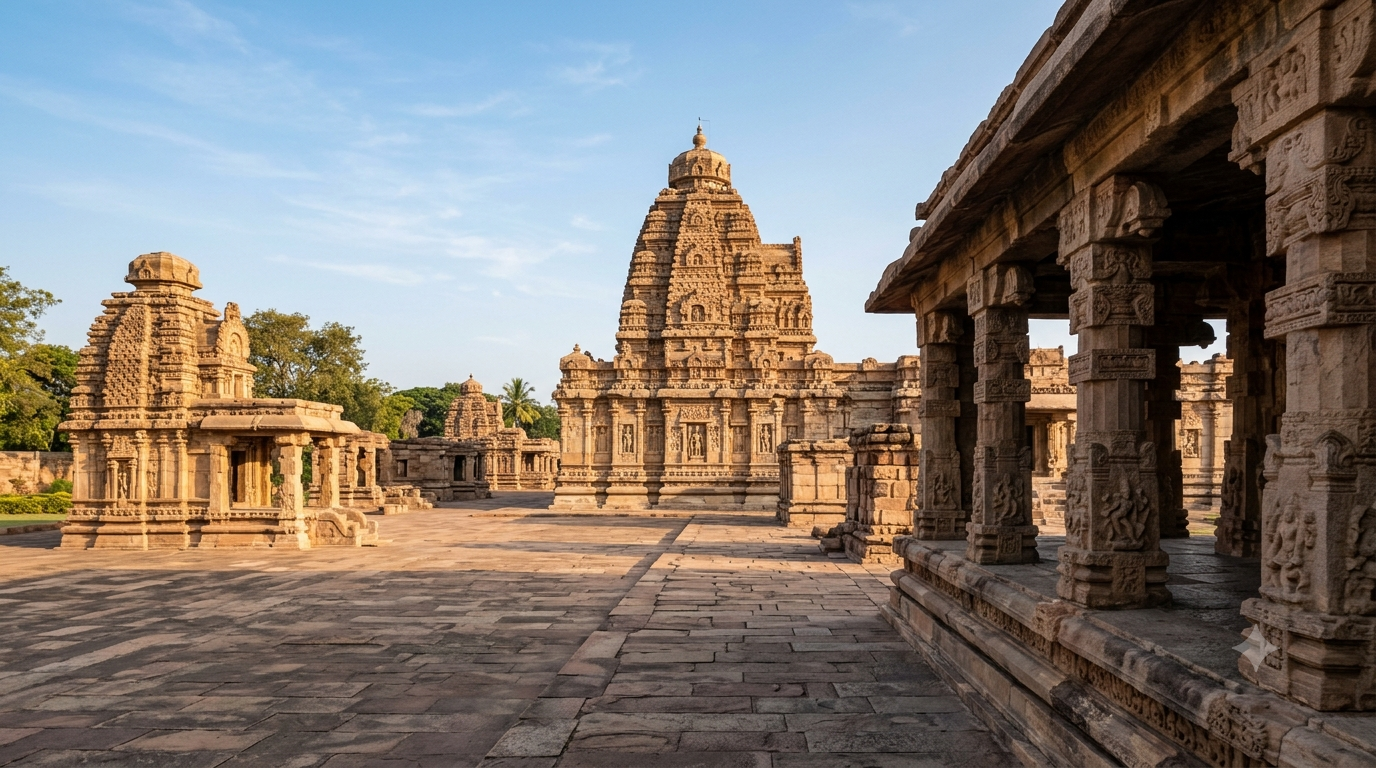
The Pattadakal Virupaksha Temple is a landmark Shiva shrine within Karnataka’s UNESCO-listed Pattadakal monument group. For visiting hours, two official sources give different guidance: the Archaeological Survey of India (ASI) provides a general sunrise-to-sunset rule, while Incredible India lists 8 AM to 6 PM for the destination. Neither confirms a separate daily worship timetable for the sanctum. Plan a daylight visit and check the notices at the entrance.
Independent guide: Temples Map is not affiliated with the Archaeological Survey of India, UNESCO or the temple authorities. We do not accept entry bookings, donations or payments. For official information, use the government and heritage sources linked below.
Pattadakal Virupaksha Temple at a glance
| Detail | What visitors should know |
|---|---|
| Location | Pattadakal, Bagalkot district, Karnataka |
| Deity | Lord Shiva as Virupaksha |
| Historical date | Built circa 740 CE, according to UNESCO |
| Patron | Queen Lokamahadevi, consort of Vikramaditya II |
| ASI monument rule | Sunrise to sunset under Rule 5(1), subject to exceptions and posted notices |
| Incredible India destination hours | 8 AM–6 PM; confirm actual gate access locally |
| Separate worship hours | Not reliably verified |
| Heritage status | Part of UNESCO’s Group of Monuments at Pattadakal |
| Nearest main sightseeing base | Badami, about 22 km away |
The difference matters: ASI’s general monument rule and the Ministry of Tourism’s fixed destination listing are not the same as daily sanctum or puja hours. Site notices can also alter access. So check current gate instructions rather than treating either publication as a guarantee of entry at a particular minute.
Pattadakal Virupaksha Temple opening and closing timings
ASI says sunrise to sunset. Rule 5(1) of the Ancient Monuments and Archaeological Sites and Remains Rules, 1959 sets this as the general opening period for protected monuments outside its listed exceptions. The same rule permits authorised officers to extend hours or temporarily close a monument through a displayed notice.
Incredible India says 8 AM to 6 PM. The Government of India’s Pattadakal tourism page gives 8:00 AM as the opening time and 6:00 PM as the closing time. These are published destination hours, not an authenticated Virupaksha sanctum or puja schedule.
The sources therefore describe different layers of visitor guidance, rather than proving that one precise gate schedule applies every day. Do not assume entry at sunrise or after 6 PM. For an easier visit, arrive well within the tourism window, finish before sunset and follow the ASI notice or staff guidance at the gate.
Is the Pattadakal Virupaksha Temple open today?
Live gate status is not confirmed by this guide. ASI’s general rule is sunrise to sunset, while Incredible India publishes 8 AM to 6 PM for Pattadakal. A conservation closure, event or local worship arrangement may still change access. Check the posted ASI notice before you travel, especially for an early or late visit.
Neither source promises sanctum access at its stated opening time. If you mainly want darshan, ask authorised site staff about worship access when you arrive. Do not arrange your journey around an unverified aarti or abhishekam schedule.
Why the former 9 AM to 7 PM claim needed correction
The older version of this page gave 9 AM to 7 PM without citing an official source. That 7 PM close conflicts with the Ministry of Tourism’s 6 PM listing. It may also extend beyond sunset on many dates, so it is unsafe advice for visitors.
ASI’s sunrise-to-sunset rule does not mean a visitor can ignore the fixed destination hours shown by Incredible India. Both references should appear here, with the discrepancy clearly explained. In practice, check the local ASI notice and leave a margin before the earlier applicable closing time.
Who built the Pattadakal Virupaksha Temple and when?
Queen Lokamahadevi commissioned the Virupaksha Temple at Pattadakal around 740 CE. UNESCO identifies the temple as a masterpiece of the monument group and links its construction to her husband’s victory over southern rulers. Her husband was Chalukya king Vikramaditya II, whose reign the ASI dates to 733–746 CE.
The temple honoured the Chalukya victory over the Pallavas of Kanchipuram. Its earlier name, Lokeshvara, reflects the royal patron’s name. This history helps explain why the structure is more ambitious than a small village shrine.
Why do some pages say 733 CE or 745 CE?
Those dates can refer to different things. The year 733 CE falls at the beginning of Vikramaditya II’s reign, while some popular descriptions use 745 CE for the temple. Neither figure should replace UNESCO’s more carefully qualified construction date of circa 740 CE.
The earlier page also mentioned an inscription dated 733 CE without a clear citation or explanation. An inscription’s date does not automatically mean that the whole standing temple was completed then. For this guide, the safest formulation is an eighth-century temple erected around 740 CE.
Lokamahadevi and Trilokyamahadevi: two royal patrons
The queens’ names are easy to mix up because both appear in the history of Pattadakal. UNESCO associates Virupaksha with Lokamahadevi. The ASI describes Mallikarjuna as the work of another queen, Trilokyamahadevi, who also celebrated Vikramaditya II’s victories.
Thus, Virupaksha and Mallikarjuna are related royal monuments, not two names for the same building. Look at them together when you visit. Their neighbouring positions let you compare differences in scale, plan and sculpture without leaving the complex.
Why is Pattadakal Virupaksha Temple important?
The Virupaksha Temple stands out because it brings royal history, Shiva worship and mature Chalukya stone architecture together. UNESCO calls it the outstanding monument of the World Heritage group. Pattadakal as a whole demonstrates how northern and southern Indian temple forms developed side by side.
ASI notes the influence of the Kailasanatha Temple at Kanchipuram on Virupaksha’s architecture. It also connects Virupaksha’s design with the later rock-cut Kailasa Temple at Ellora. This is an architectural relationship, not a claim that the buildings were constructed in the same year.
Dravida vimana, halls and the Nandi pavilion
Start by looking above the sanctum. The stepped tower, or vimana, is a major feature of the southern Dravida tradition. In front of the shrine, pillared halls create a route toward the sanctum, while a separate pavilion houses Nandi, Shiva’s sacred bull.
ASI describes the temple as an integrated complex, with surrounding shrines, enclosing walls and gateways. That layout matters because the design treats the whole enclosure as one composition. It is different from assuming each doorway or later-looking element represents a separate construction date.
Carvings worth taking time to see
The Pattadakal Virupaksha Temple rewards a slower visit than a quick photograph from the gate. Look for Shiva themes, including dancing Nataraja, as well as stories connected to the Ramayana and Mahabharata. ASI also records panels with Ardhanarishvara, Vishnu forms and other religious imagery across Pattadakal’s monuments.
Not every carving named in an online list belongs to the Virupaksha Temple itself. Some lists combine scenes from neighbouring Pattadakal shrines. Use the site’s labels or a qualified heritage guide to identify individual panels, and avoid touching fragile carvings.
How to visit Pattadakal Virupaksha Temple
A successful visit begins with a simple decision: are you coming mainly for worship, or to study the architecture? Both are valid, but they involve different timing questions. Worship access depends on local arrangements; sightseeing depends on ASI monument entry rules and the hours posted at the site.
- Check the ASI Pattadakal heritage page and Karnataka Tourism guide before the trip.
- Plan arrival in the morning or early afternoon rather than near closing time.
- Confirm the current entry route, any applicable ticket and worship access at the official site counter.
- Visit Virupaksha and its Nandi pavilion, then compare Mallikarjuna and the other monuments.
- Leave extra time to examine carvings carefully and move across uneven stone paths.
Allow roughly one to two hours if you mainly want the principal temples. A keen architecture visitor may prefer longer. These are planning estimates, not an official tour duration or an assurance that all interiors will be open.
Pattadakal Virupaksha Temple entry fee: the exact ASI rule
The ASI-hosted Ancient Monuments and Archaeological Sites and Remains Rules, 1959 state in Rule 6, Second Schedule, Part I, Category A, serial number 2 that the fee-bearing portion of Pattadakal’s Group of Temples is “Whole, except Virupaksha Temple.” This is the specific legal schedule behind the shrine’s exception from that monument-entry fee classification.
That wording does not make the entire Pattadakal complex free to enter. It also does not guarantee access to the sanctum or every entrance. The wider group may require a ticket, and current fees or visitor routes can change.
So check the official ASI counter and ASI’s ticketing website for today’s arrangements. This guide does not give an unverified current ticket price.
What if the gate or sanctum is closed?
Entry is not guaranteed merely because a website lists visiting hours. Temporary maintenance, a heritage restriction or a local religious event may affect access. If the sanctum is unavailable, ask authorised staff whether the exterior or other monuments remain accessible.
If the whole complex has closed for the day, return during the next confirmed opening period. Do not attempt side entrances or accept unofficial offers to bypass entry controls. For access questions, rely on the ASI and the staff responsible for the monument.
How to reach Pattadakal from Badami and Aihole
Pattadakal lies in Karnataka’s Bagalkot district, beside the Malaprabha River. Karnataka Tourism places it about 22 km from Badami, a practical base for visiting the region. Roads connect the historic sites, but allow flexibility for local transport and stops along the way.
Badami is also the nearest railway station listed by Karnataka Tourism, roughly 17 km from Pattadakal. Visitors arriving by train can arrange local transport onward. Confirm actual vehicle availability and the return journey, since heritage attractions are not the same as city transport hubs.
A simple Badami–Pattadakal–Aihole plan
If you have one full sightseeing day, start with a morning visit to Pattadakal. Next, continue toward Aihole or return to Badami, depending on transport and the time available. Splitting the circuit across two days gives more time for carvings, museums and rest.
For context before your trip, see our Aihole Durga Temple architecture guide. You can also compare Deccan tower styles in our guide to Indian temple architecture. These existing guides help explain why Pattadakal matters beyond a single shrine.
What to notice at the other Pattadakal temples
Virupaksha makes more sense when viewed alongside its neighbours. Mallikarjuna shares its Chalukya royal setting, while Sangameshvara shows another important southern-style arrangement. Elsewhere, the group displays northern-influenced towers and experimental plans.
UNESCO lists nine Hindu temples and a Jain sanctuary within the World Heritage group. The variety is the site’s central lesson: Chalukya builders did not follow just one rigid design. Instead, they refined several architectural ideas in the same cultural landscape.
| Monument | What makes it useful to compare |
|---|---|
| Virupaksha | Major Dravida shrine, royal patronage and rich sculpture |
| Mallikarjuna | Neighbouring royal Shiva temple associated with Trilokyamahadevi |
| Sangameshvara | Earlier major temple that helps explain Chalukya development |
| Galaganatha | Northern-influenced tower form within the same heritage landscape |
| Papanatha | An opportunity to examine architectural cross-currents |
The comparison also resolves a common misunderstanding. Not every structure at Pattadakal dates to 740 CE. That approximate date refers to Virupaksha, while the wider group developed across different reigns and periods.
Best time, clothing and site safety
October to February is the season Karnataka Tourism recommends for Pattadakal. Temperatures are often more comfortable for walking, especially compared with a hot afternoon on exposed stone. However, visitor numbers and weather still vary by day, so start earlier when possible.
Wear comfortable footwear for outdoor paths and carry drinking water. You may need to remove shoes before entering a worship area, even when shoes are suitable for the broader site. Follow posted instructions about photography, restricted interiors and preserving the monument.
Older visitors and anyone with limited mobility should allow more time because steps and uneven stone can be tiring. Avoid climbing on historic structures or leaning against carved panels. During heavy rain or high heat, shorten outdoor stops as needed.
Common mistakes that spoil a Pattadakal visit
- Mixing up Pattadakal and Hampi: both have a Virupaksha Temple, but they are different places with different histories and visitor arrangements.
- Relying on an old closing time: a 7 PM claim is not enough evidence for late-evening access.
- Calling 745 CE a proven completion date: UNESCO’s wording is more cautious, placing construction around 740 CE.
- Treating every Pattadakal temple as contemporary: the group developed over time and includes different architectural approaches.
- Confusing ticket and worship access: one set of entry conditions may not describe the entire site or sanctum.
- Rushing straight to Virupaksha: the nearby temples reveal why the wider ensemble earned World Heritage recognition.
The main practical lesson is to read the site as both a sacred place and a protected heritage landscape. That perspective gives meaning to the carvings while keeping your visit respectful and realistic.
Before you go
Use circa 740 CE for the Pattadakal Virupaksha Temple’s construction date, not an unsupported exact completion year. For visiting hours, ASI’s general rule is sunrise to sunset, while Incredible India lists 8 AM to 6 PM. Confirm the current entrance notice and separate worship arrangements before you go. Leave time to explore neighbouring shrines as well.
Pattadakal Virupaksha Temple FAQs
What are the opening and closing timings today?
ASI Rule 5(1) provides a general sunrise-to-sunset visiting period for protected monuments, subject to exceptions and notices. Incredible India lists 8 AM to 6 PM for Pattadakal. Neither is a verified daily timetable for Virupaksha’s sanctum. Check the displayed ASI notice and ask authorised staff about current entry or worship restrictions.
When was the Pattadakal Virupaksha Temple built?
UNESCO dates its construction to approximately 740 CE, during the Early Chalukya period. This is a qualified historical estimate rather than a proven exact completion day. It is more reliable than repeating 733 CE or 745 CE without context.
Who commissioned the Virupaksha Temple?
Queen Lokamahadevi, the consort of King Vikramaditya II, commissioned the temple. It commemorated her husband’s victories against southern rulers, commonly linked with the Pallavas. Do not confuse her with Trilokyamahadevi, the royal patron associated with neighbouring Mallikarjuna.
Is Pattadakal Virupaksha Temple the same as Hampi Virupaksha Temple?
No. Pattadakal Virupaksha is an eighth-century Chalukya monument in Bagalkot district. The Virupaksha Temple at Hampi belongs to a different heritage setting in the Hampi area, so its visiting hours and tourist advice should not be copied to Pattadakal.
Is there an entry fee for the Pattadakal Virupaksha Temple?
Rule 6, Second Schedule, Part I, Category A, serial number 2 of the ASI-hosted 1959 Rules excludes Virupaksha Temple from the fee-bearing portion of Pattadakal’s Group of Temples. This does not exempt the whole complex or guarantee sanctum entry. Check present ticketing and access arrangements at the official ASI counter.
How far is Pattadakal from Badami?
Karnataka Tourism gives a road distance of about 22 km from Badami. This makes Badami a convenient base for a heritage circuit. Check local transport timings before you plan a return trip, since sightseeing often takes longer than expected.
Which other temples should I see at Pattadakal?
Mallikarjuna, Sangameshvara, Galaganatha and Papanatha are useful comparisons with Virupaksha. Together, they reveal differences in royal patronage, sculpture and temple-tower designs. Allow enough time to see more than the largest building.
Are photography and puja allowed inside?
Specific access and photography rules depend on the area and instructions displayed on site. Do not assume that a monument’s outdoor photography policy covers its active sanctum. Likewise, do not rely on an unverified online schedule for daily puja or special services.