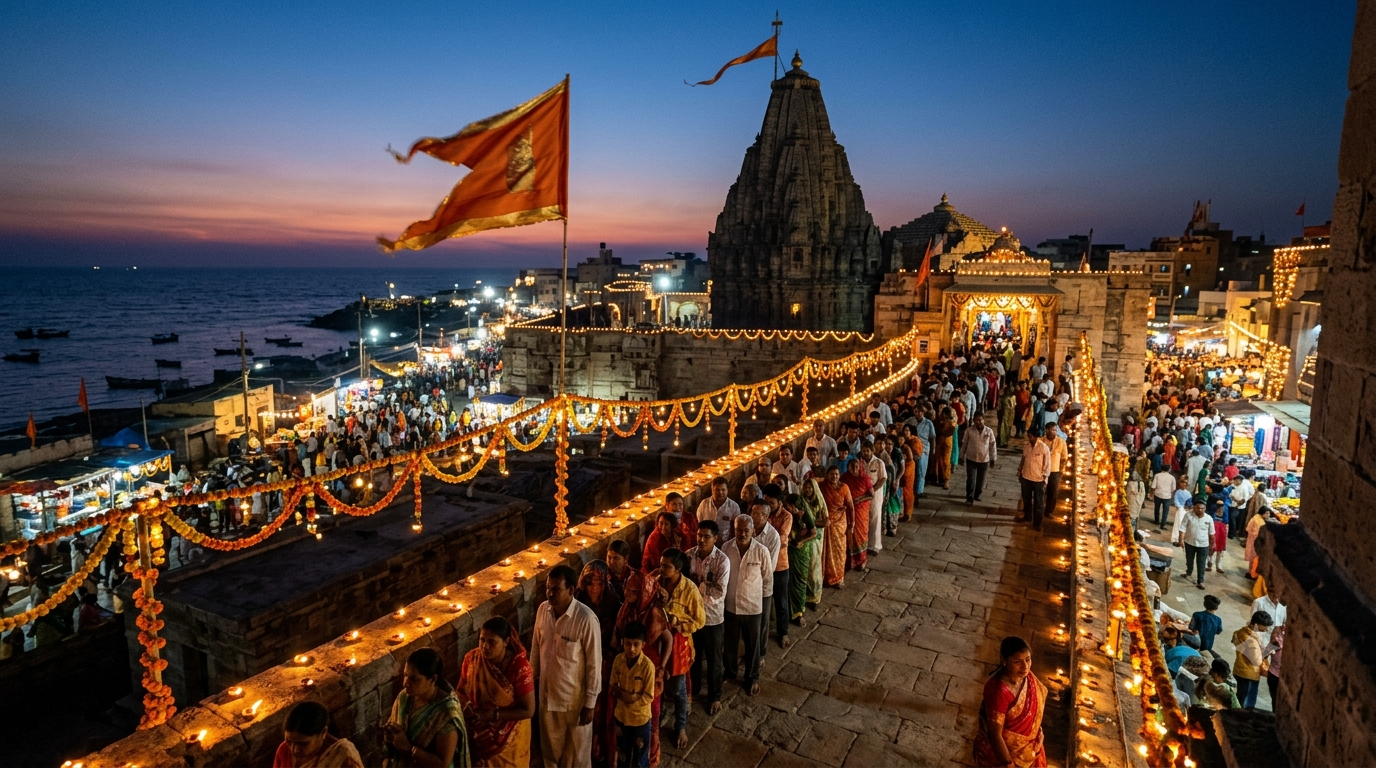
The festivals celebrated in Dwarka temple turn this quiet coastal town into one of India’s most vibrant pilgrimage centres, and Janmashtami alone draws lakhs of devotees to the seafront shrine of Lord Krishna. Dwarka is one of the four sacred Char Dham sites, so its temple calendar carries weight far beyond Gujarat. This guide lays out every major celebration, the likely month for each, the famous flag-changing ritual, and how festival days reshape your darshan plan. You will also find the verified Janmashtami date for this year, plus honest advice on crowds and timing that most festival lists skip.
Temples Map is an independent pilgrimage guide. We are not affiliated with, endorsed by, or the official website of the Dwarkadhish Devsthan Committee or the Shri Dwarkadhish Temple. We do not take bookings, donations, or payments. For official notices and live festival timings, use the temple’s official channels linked below.
Festivals Celebrated in Dwarka Temple at a Glance
Here are the quick facts before the detail:
- Biggest festival: Sri Krishna Janmashtami, usually in August or September.
- This year: Janmashtami falls on Friday, 4 September 2026 for most Vaishnava temples, including Dwarka.
- Signature ritual: priests change the 52-yard temple flag on the spire up to three times a day.
- Other big days: Holi, Rukmini Vivah, Ram Navami, Diwali and Annakut, Sharad Purnima, Tulsi Vivah.
- Busiest crowds: Janmashtami and Diwali, when the temple extends darshan hours.
- Best months to visit: October to February, when the weather is cool and festivals are frequent.
Major Festivals Celebrated in Dwarka Temple Through the Year
The festivals celebrated in Dwarka temple follow the Hindu lunar calendar, so their English dates shift every year. Because the tithi moves, always confirm a specific date closer to your visit. The table below maps the main celebrations to their usual month.
| Festival | Usual month | What it marks |
|---|---|---|
| Makar Sankranti | January | Sun’s northward journey; harvest |
| Vasant Panchami | January/February | Arrival of spring |
| Holi | March | Colours, in the Vrindavan spirit |
| Rukmini Vivah | March/April | Wedding of Krishna and Rukmini |
| Ram Navami | March/April | Birth of Lord Rama |
| Janmashtami | August/September | Birth of Lord Krishna |
| Sharad Purnima | October | Full-moon night of Krishna’s raas |
| Diwali & Annakut | October/November | Festival of lights; food offering |
| Tulsi Vivah | November | Ceremonial marriage of Tulsi |
Devotees observe each of these with special aarti, extra shringar, and larger crowds. Since Dwarka is a Krishna shrine, the biggest energy naturally gathers around the days tied to his life. So the calendar leans heavily toward Krishna’s story rather than a generic festival list.
Sri Krishna Janmashtami: The Biggest Festival at Dwarka
Janmashtami is the single biggest festival at the Dwarkadhish Temple, because it marks the midnight birth of Lord Krishna. Lakhs of pilgrims arrive, lights and decorations fill the whole town, and the temple streams the celebration live so distant devotees still take part. Rituals run from morning right through to midnight.
On this day the deity receives an elaborate abhishek, a ceremonial bath in panchamrit of milk, curd, ghee, honey, and sugar. Priests then dress the image in golden silk and precious ornaments for a special shringar. The aartis grow grander too, with drums, incense, and a lamp of many flames.
The climax comes at midnight, the moment tradition marks as Krishna’s birth. Bhajans, kirtans, and mantra chanting fill the temple, and the Maha-Aarti closes the night. If you plan to attend, arrive early because the queues stretch for hours.
When is Janmashtami in 2026?
Janmashtami in 2026 falls on Friday, 4 September for most Vaishnava temples, including Dwarka. Panchang calculated for Dwarka confirms this date. Some Smarta households observe it a day earlier, on 3 September, so the exact day varies by tradition. Always verify the date against the temple’s own announcement before booking travel.
The Daily Flag Ceremony You Should Not Miss
One of the most striking sights among the festivals celebrated in Dwarka temple happens every single day, not just on festival dates. A giant flag, about 52 yards long, flies above the sanctum on a 25-foot flagstaff. Priests change it up to three times daily, and each change becomes a small ceremony in itself.
The 52 yards represent the clans of devotees who flourished under Krishna’s rule in Dwarka. Weavers craft the flag in silk in seven colours, and families sponsor the honour of carrying it around the temple before the hoisting. Because devotees book these slots far ahead, this ritual is worth planning around if you want to witness it up close.
Holi and Rukmini Vivah: The Spring Celebrations
Holi at Dwarka carries the mood of Vrindavan, where Krishna spent his childhood. The temple courtyard fills with colour, bhajans, and joyful crowds. So if you visit in March, expect a festive rather than a quiet darshan.
Rukmini Vivah is special to Dwarka in a way it is nowhere else. It re-enacts the wedding of Krishna and his queen Rukmini, whose own temple sits a short distance away. This ceremony usually falls around March or April, on the Ekadashi of the Chaitra month. Devotees treat it as a deeply auspicious day for married life and family harmony.
Diwali, Deepotsavi and Annakut at the Jagat Mandir
Diwali lights up the Jagat Mandir with thousands of diyas, and the temple observes a longer festival of lights known locally as Deepotsavi. This period also marks the close of the old Hindu year, so it carries a sense of renewal. The atmosphere after dark ranks among the most photographed in Dwarka, though the temple restricts photography inside the sanctum.
Annakut, or Govardhan Puja, follows soon after Diwali. On this day devotees offer a mountain of food to Krishna, recalling the Govardhan hill he lifted. Volunteers prepare the offering with great care and later share it as prasad. Since crowds stay heavy across this whole stretch, plan darshan for the morning if you can.
More Festivals Celebrated in Dwarka Temple
Beyond the headline days, several smaller festivals fill the Dwarka calendar. Each brings its own aarti and a distinct mood to the shrine.
- Sharad Purnima (October): the autumn full moon linked to Krishna’s raas leela, marked with night-long devotion.
- Tulsi Vivah (November): the ceremonial marriage of the sacred Tulsi plant to Krishna, opening the Hindu wedding season.
- Vasant Panchami (January/February): a spring festival with special darshan at the Jagat Mandir.
- Ram Navami (March/April): the birth of Lord Rama, honoured with a special afternoon aarti.
- Makar Sankranti (January): the harvest and Sun festival, when devotees offer prayers and sweets.
During the winter month known as Dhanur Maas, the temple also keeps a distinct early-morning worship routine. So even an ordinary-looking date can carry special significance in Dwarka. This is why the festivals celebrated in Dwarka temple reward a little advance planning.
Best Time to Experience Festivals Celebrated in Dwarka Temple
The best time to experience festivals celebrated in Dwarka temple is between October and February, when the coastal weather turns pleasant and the calendar stays packed. Janmashtami in late summer is the grandest, yet it is also the hottest and most crowded window. If comfort matters to you, the cooler festival season is the wiser choice.
Summer months bake the Saurashtra coast, and monsoon travel can turn unpredictable. Because the temple sits right by the Arabian Sea, humidity stays high through much of the year. Plan around the weather, not only the festival.
How the Festivals Celebrated in Dwarka Temple Affect Darshan
On normal days the temple opens around 6:00 to 6:30 AM and stays open, with a midday break, until roughly 9:30 PM. During big festivals like Janmashtami, the temple extends these darshan hours to handle the crowds. So a festival visit needs more time, more patience, and an earlier start.
Expect long queues, tighter security, and slower movement on peak days. Carry water, keep valuables minimal, and follow the dress code of modest, traditional clothing. Since these timings can change without notice, confirm them on the temple’s official channels before you travel.
A quick safety note for festival crowds
Festival days at Dwarka draw very large gatherings, and the midnight Janmashtami rush turns intense. Elderly pilgrims, young children, and anyone with a health condition should avoid the tightest crowd windows. Stay hydrated, watch your footing near the ghats, and keep your group together.
Myths About the Festivals Celebrated in Dwarka Temple
Many older pages, including outdated 2022 lists, describe Dwarka’s festivals with generic copy that fits any temple. For example, they frame Navaratri and Dussehra around Goddess Durga while ignoring that Dwarka is above all a Krishna shrine. The truly Dwarka-specific days are Janmashtami, Rukmini Vivah, and the daily flag ceremony.
Another common error stamps the article with a single year, as if the festivals happened only once. In reality, the festivals celebrated in Dwarka temple recur every year on shifting lunar dates. So treat any fixed English date you see as indicative, and verify the current year’s tithi before you plan.
How to Reach Dwarka for the Festivals
Planning travel early matters, because the festivals celebrated in Dwarka temple pull heavy crowds onto every route into town. Dwarka Railway Station sits only about 2 km from the temple and connects to major cities across Gujarat and beyond. So the train is often the simplest arrival for pilgrims.
The nearest airport is at Jamnagar, roughly 137 km away, with Rajkot as a larger alternative. Regular buses and taxis run from Jamnagar, Rajkot, Porbandar, and Somnath. During Janmashtami, book transport and stay well ahead, since rooms and seats fill fast. If you also plan Bet Dwarka, keep a buffer day for the short boat crossing.
Before You Go
The festivals celebrated in Dwarka temple reward a visit timed with care, and Janmashtami remains the crown of the calendar. Still, the cooler October-to-February window offers frequent celebrations with far kinder weather. Confirm the exact dates and darshan hours on official sources, plan for crowds on the biggest days, and leave room to witness the flag ceremony. For darshan timings, see our guide to Dwarkadhish Temple darshan timings, and cross-check festival dates on Drik Panchang and the government’s Utsav portal.
Frequently Asked Questions
Which are the biggest festivals celebrated in Dwarka temple?
The biggest of the festivals celebrated in Dwarka temple is Sri Krishna Janmashtami. It marks Krishna’s midnight birth and draws lakhs of devotees. Celebrations run from morning to midnight, with a grand abhishek and Maha-Aarti.
When is Janmashtami in Dwarka in 2026?
Janmashtami in 2026 falls on Friday, 4 September for most Vaishnava temples, including Dwarka. Some communities observe it on 3 September. Confirm the date with the temple’s official announcement before booking travel.
What is the flag ceremony at Dwarka temple?
Priests hoist a 52-yard silk flag over the temple’s spire and change it up to three times a day. Devotee families sponsor the honour of carrying it. The 52 yards symbolise the clans that flourished under Krishna’s rule.
Is Holi celebrated at the Dwarkadhish Temple?
Yes, Dwarka celebrates Holi in the spirit of Vrindavan. The temple courtyard fills with colour, bhajans, and crowds. It usually falls in March, so expect a lively darshan.
What is Rukmini Vivah and why is it special to Dwarka?
Rukmini Vivah re-enacts the wedding of Krishna and Rukmini, his queen at Dwarka. It usually falls around March or April, on the Chaitra Ekadashi. Devotees see it as auspicious for marriage and family life.
Do the festivals celebrated in Dwarka temple change darshan timings?
Yes, on big festival days such as Janmashtami and Diwali, the temple usually extends darshan hours for the crowds. Queues run longer and security tightens. Arrive early and confirm timings on official channels before you go.
Which is the best time to visit Dwarka for festivals?
October to February is the best window, with pleasant weather and frequent festivals. Janmashtami in late summer is grand but hot and crowded. Choose the cooler months for a more comfortable pilgrimage.
Do I need to book anything to attend a festival at Dwarka?
General darshan does not require a booking. However, special honours like sponsoring the flag ceremony need arranging well in advance through the temple. Always use the temple’s own official channels for any arrangement.