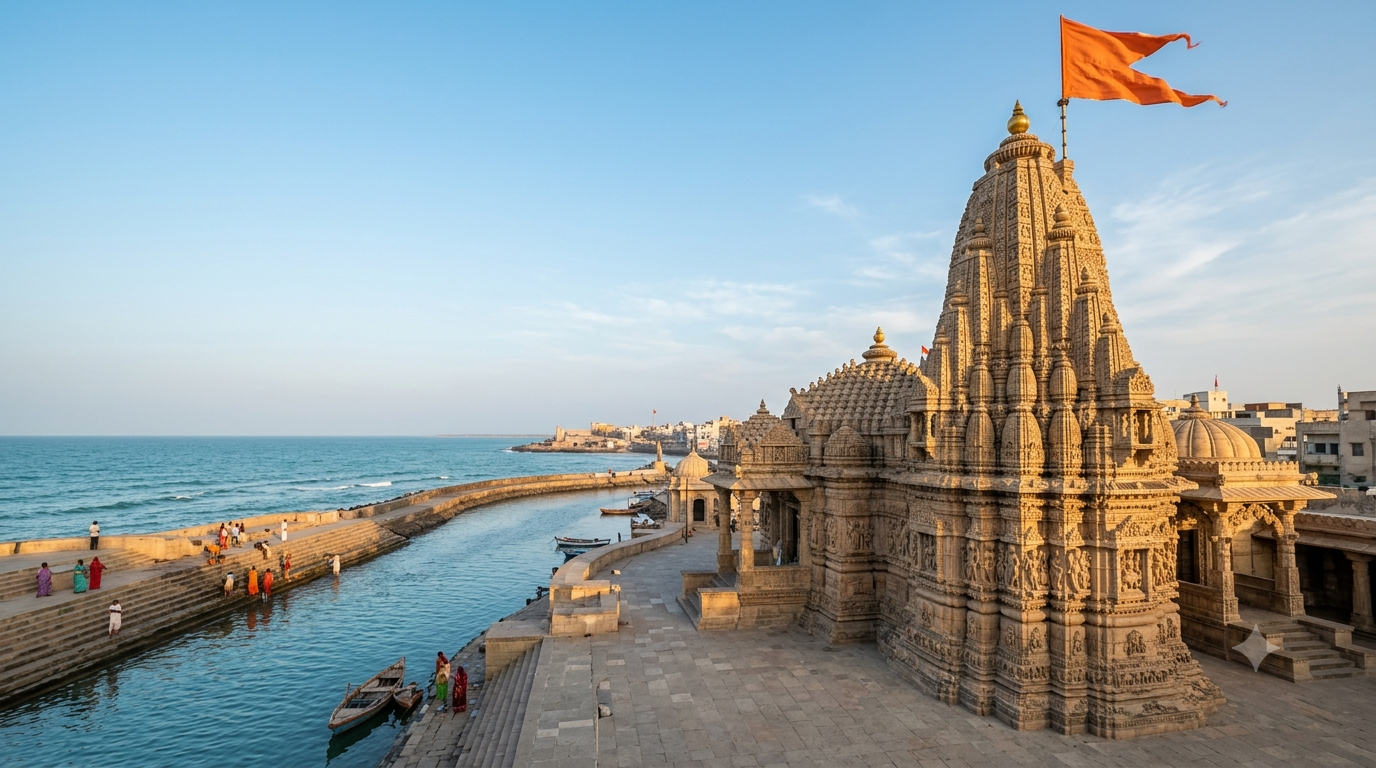
The Dwarakadhish Temple Darshan Timings run in two clear sessions each day. The temple shuts for a long midday break that catches many first-time pilgrims off guard. Morning darshan opens around 6:30 AM and continues until about 1:00 PM. The temple then closes, and evening darshan runs from roughly 5:00 PM to 9:30 PM.
So if you arrive at 2 PM expecting to walk straight in, you will wait outside a closed gate. This guide lays out the full schedule and the aarti windows. It also shows how the hours shift on festival days, plus the online-booking facts most pages get wrong.
TemplesMap is an independent pilgrim guide. We are not affiliated with, endorsed by, or the official website of the Dwarkadhish Temple or its management. We do not accept bookings, donations, or payments.
For seva booking and official notices, use the temple’s official website at dwarkadhish.org. For travel and district information, refer to Gujarat Tourism.
Dwarakadhish Temple Darshan Timings at a Glance
Here are the essential Dwarakadhish Temple Darshan Timings before you plan the day:
- Morning darshan: about 6:30 AM to 1:00 PM
- Midday break: temple closed roughly 1:00 PM to 5:00 PM
- Evening darshan: about 5:00 PM to 9:30 PM
- Entry fee: general darshan is free for everyone
- Photography: not allowed inside the main sanctum
- Best months: October to March, plus Janmashtami for atmosphere
Because these hours shift slightly on festival days and during special rituals, treat every time below as approximate. Always confirm the current Dwarakadhish Temple Darshan Timings on the official temple website before you travel.
Dwarakadhish Temple Darshan Timings: The Full Daily Schedule
The Dwarakadhish Temple Darshan Timings follow the Lord’s daily routine. So the doors open and close several times as priests perform the rituals. General darshan is split into a morning session and an evening session, with the gates shut during the afternoon. The exact minutes can move by ten or fifteen either way, since aarti and bhog pauses briefly halt the queue.
| Session | Approximate Timing | Notes |
|---|---|---|
| Morning darshan | 6:30 AM – 1:00 PM | Starts after Mangala Aarti |
| Afternoon | Closed (approx. 1:00 PM – 5:00 PM) | Temple shut for rest and cleaning |
| Evening darshan | 5:00 PM – 9:30 PM | Ends after Shayan Aarti |
Some sources list a 6:00 AM opening and a 9:00 PM close. A small variation is normal. When in doubt, plan to reach by 6:30 AM or by 5:30 PM. That way you clear security and join the queue before the sanctum fills.
Treat these Dwarakadhish Temple Darshan Timings as a guide, and reconfirm on the day you travel.
Dwarakadhish Temple Darshan Timings and Aarti Schedule
The aartis are the emotional high points of any Dwarka visit, and devotees plan their darshan around them. During each aarti the sanctum grows crowded, yet the sight of the decorated idol is worth the press of the crowd. The times below are indicative and can change on special days.
| Aarti / Darshan | Approximate Time |
|---|---|
| Mangala Aarti | 6:30 AM |
| Shringar / Snan Darshan | 10:30 AM – 11:00 AM |
| Rajbhog Darshan | 11:20 AM – 12:00 PM |
| Sandhya (evening) Aarti | 7:30 PM |
| Shayan Aarti | 8:30 PM – 9:00 PM |
Mangala Aarti at 6:30 AM is the day’s first ritual, when the Lord is woken and the crowds are still thin. If you want a calm darshan with a clear view, this is the slot to target. The evening Sandhya Aarti is the most atmospheric, though also the busiest.
How Dwarakadhish Temple Darshan Timings Change During Festivals
On major festivals the Dwarakadhish Temple Darshan Timings extend well beyond the usual hours, since huge crowds arrive and extra rituals are added. Janmashtami is the biggest occasion, when the temple stays open late into the night and queues can stretch past two or three hours. Diwali, Annakut, Kartik Purnima, and Holi also draw heavy footfall.
During these days the midday break may shorten or vanish, and the temple holds special abhishekam and decoration ceremonies. So if your trip falls on a festival, arrive very early and keep the whole day flexible. Check the temple’s festival notice before you set out, because the temple announces these dates afresh each year.
Do the Dwarakadhish Temple Darshan Timings Include VIP or Online Booking?
General darshan at the Dwarkadhish Temple is completely free, and the temple does not run an officially declared VIP darshan lane. This is the single biggest myth circulating online. Many pages advertise “VIP tickets” at inflated prices that the temple never charges for ordinary darshan. Do not pay any private agent for a “guaranteed” fast-track entry.
What the temple does offer is online booking for seva and bhog offerings, handled through its official website. Booking a seva does not buy queue-jumping, yet it lets you take part in specific rituals and plan your visit better. Because ritual closures pause the line for everyone, even a booked seva will not grant entry during an aarti break.
When you book, use only the official temple website and carry a digital or printed copy of the confirmation plus a valid ID. Avoid third-party portals that mimic the official site, as they may overcharge or collect your data. If a page asks for an upfront “processing fee” for free darshan, that is a warning sign of a fake portal.
Sevas and Bhog Offerings
Devotees can sponsor bhog, abhishek, and other traditional offerings at the temple. These are matters of faith and devotion rather than paid shortcuts, and the temple frames them as ways to serve the Lord. For the current list of sevas, amounts, and the online steps, check the official website or the temple’s seva counter. Our companion page on Dwaraka Temple daily seva timings breaks down the ritual day in more detail.
Best Time to Visit Dwarkadhish Temple
The best time to visit Dwarka is between October and March, when the coastal weather stays pleasant for long queues and sightseeing. Summers from April to June turn hot and humid, which makes the open temple courtyard tiring by midday. The monsoon brings its own charm but also heavy spells of rain.
For the calmest darshan, aim for a weekday morning right after the 6:30 AM opening. Weekends, public holidays, and festival days are far busier, so weekday mornings and the early evening reopening are the sweet spots. Sunrise over the Gomti Ghat near the temple is a quiet bonus if you arrive early.
Dress Code and Temple Rules
The Dwarkadhish Temple expects modest, traditional attire from every visitor. Men usually wear kurta-pyjama, dhoti, or a full-length trouser with a shirt, while women prefer sarees or salwar-kameez. The temple discourages shorts, sleeveless tops, and very short dresses, so dress conservatively to avoid trouble at the gate.
- Remove footwear before entering; use the shoe-token counter
- Photography and videography are not allowed inside the main sanctum
- Leather items are best left outside
- Mobile phones should be silent inside the shrine
- Follow the guided exit route after darshan
Because the sanctum can get crowded, keep valuables close and hold children’s hands through the queue. Cloakroom and locker facilities are available near the temple for bags.
How to Reach Dwarkadhish Temple
Dwarka sits on the western tip of the Saurashtra coast in Gujarat, where the Gomti River meets the Arabian Sea. The city is well connected by rail and road, though it has no airport of its own. The Devbhumi Dwarka district administration lists the same routes, and here is how to plan each leg.
By Air
The nearest airports are Jamnagar Airport, about 130 km away, and Porbandar Airport, roughly 95 km away. Rajkot Airport, around 225 km out, handles more flights if you need wider connections. From any of these, a taxi or bus covers the last stretch to Dwarka in about three hours from Jamnagar.
By Train
Train is the easiest option, since Dwarka Railway Station (DWK) lies just 2 km from the temple. It sits on the Ahmedabad–Okha line of the Western Railway and receives direct trains from Ahmedabad, Mumbai, Delhi, and other major cities. From the station an auto-rickshaw reaches the temple in a few minutes.
By Road
Dwarka is linked by national and state highways to the rest of Gujarat. State-run and private buses run from Jamnagar, Rajkot, Ahmedabad, and nearby towns. Self-driving is comfortable too, as the roads are well maintained and dotted with fuel stops and eateries.
About Dwarkadhish Temple: History and Architecture
The Dwarkadhish Temple, also called Jagat Mandir, is dedicated to Lord Krishna in his form as Dwarkadhish, meaning the King of Dwarka. It is one of the four sacred Char Dham sites and one of the seven Sapta Puri holy cities. Devotees also revere it among the 108 Divya Desams of Lord Vishnu. Pilgrims consider a Dwarka visit a once-in-a-lifetime blessing.
The temple follows the Māru-Gurjara, or Chalukya, architectural style. The five-storey main shrine rises on 72 intricately carved limestone pillars, and its tall shikhara dominates the skyline. Archaeological findings trace an early structure back roughly 2,000 years. The current temple dates largely to the 15th–16th century, after earlier damage.
Two ceremonial gates frame the visit. Pilgrims enter through the Swarga Dwara and exit through the Moksha Dwara toward the Gomti Ghat. Priests change the great flag atop the shikhara several times a day. It carries the sun and moon, a symbol that Krishna stays with his devotees as long as those two endure.
Nearby Temples and Places to Visit
Dwarka rewards a two or three-day stay, because several sacred sites sit close by. The Rukmini Devi Temple, about 2 km from the main shrine, honours Krishna’s consort and is a must-visit. Nageshwar Jyotirlinga, one of the twelve Jyotirlingas, lies a short drive away.
Bet Dwarka, an island reached by boat from Okha, is believed to be Krishna’s original residence. Gomti Ghat, Sudama Setu, and the Dwarka lighthouse round out the town. Many pilgrims combine Dwarka with Somnath, another Jyotirlinga temple on the same coast.
Insider Tips Most Guides Miss
A few practical habits make the visit smoother:
- Reach by 6:30 AM for the emptiest darshan and a front view during Mangala Aarti
- Keep the afternoon free for Rukmini Temple or Bet Dwarka while the main temple is closed
- Carry a light stole or dupatta, since the sea breeze cools quickly after sunset
- Deposit phones and cameras before the queue to avoid delays at security
- Drink water and wear a cap in summer, as the courtyard offers little shade
Because Dwarka is a coastal town, humidity stays high even in winter. Elderly pilgrims and anyone with mobility concerns should pace the stairs to the sanctum and rest as needed. If you plan a long fast or a strenuous day, consult a doctor first, especially in the summer heat.
Before You Go: Key Points
Plan your day around the two Dwarakadhish Temple Darshan Timings sessions, and never assume the temple is open in the afternoon. Morning is calmest, evening is most atmospheric, and festivals demand extra patience and an early start.
General darshan is free, so book only genuine sevas through the official website and steer clear of fake VIP offers. With a little planning, a Dwarka pilgrimage becomes one of the most moving stops on the Char Dham circuit. For another Char Dham stop, see our guide to Puri Jagannath Temple timings.
Frequently Asked Questions
What are the Dwarakadhish Temple Darshan Timings today?
The Dwarakadhish Temple Darshan Timings are roughly 6:30 AM to 1:00 PM in the morning. Evening darshan runs from 5:00 PM to 9:30 PM. The temple stays closed in the afternoon. Timings can shift on festival days, so confirm on the official website before your visit.
Do the Dwarakadhish Temple Darshan Timings cover the afternoon?
No, the temple is generally closed between about 1:00 PM and 5:00 PM. Use this window to visit nearby sites like Rukmini Temple or Gomti Ghat. Plan your darshan for the morning or evening session instead.
Is darshan free during the Dwarakadhish Temple Darshan Timings?
General darshan is completely free for all devotees. The temple does not run an official VIP darshan lane. Only optional seva and bhog offerings involve a contribution, booked through the official website.
Can I book Dwarkadhish darshan online?
You cannot pre-book free general darshan, since it is open to everyone. You can, however, book seva and bhog online through the temple’s official website. Always avoid third-party portals that charge extra fees.
What is the dress code at Dwarkadhish Temple?
The temple expects modest, traditional clothing. Men wear dhoti, kurta, or full trousers, and women wear sarees or salwar-kameez. Shorts and sleeveless tops are discouraged.
Is photography allowed inside the temple?
Photography and videography are not allowed inside the main sanctum for security reasons. You can take photos of the temple exterior and the surrounding ghats. Deposit cameras and phones before joining the queue.
How do I reach Dwarkadhish Temple?
The easiest way is by train to Dwarka Railway Station, just 2 km from the temple. The nearest airports are Jamnagar (about 130 km) and Porbandar (about 95 km). Buses and taxis connect Dwarka with major Gujarat cities.
What is the best time to visit Dwarka?
October to March offers the most pleasant coastal weather for a comfortable darshan. Weekday mornings are the least crowded. Janmashtami is spectacular but extremely busy.