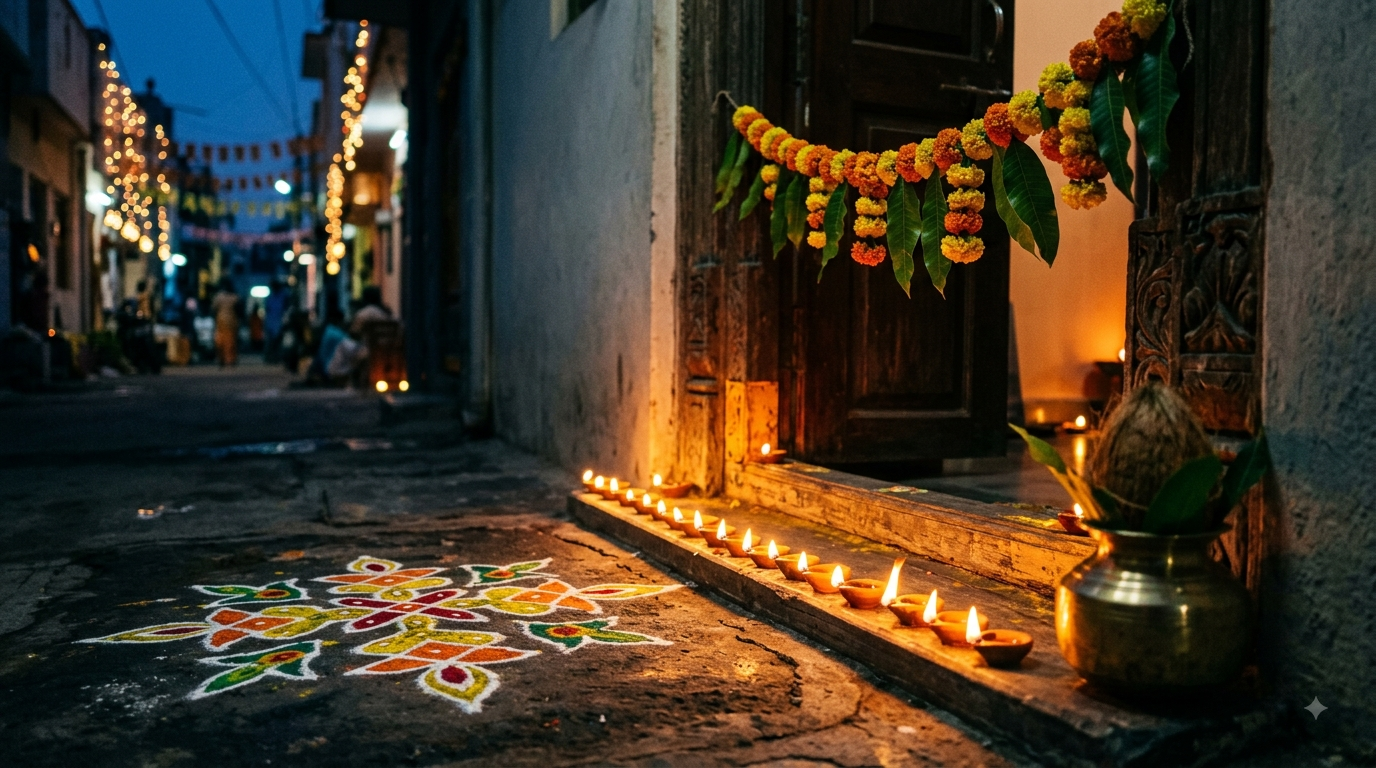
The Diwali 2026 date and time are now settled, and the festival falls on Sunday, 8 November 2026. Because the Lakshmi Puja window opens only after sunset, families across Andhra Pradesh and Telangana will light their lamps between roughly 6:07 PM and 8:08 PM that evening. There is a twist this year that most calendars gloss over. Naraka Chaturdashi and Lakshmi Puja land on the same Sunday, so the South Indian oil bath and the North Indian evening puja share one date.
Temples Map is an independent devotional guide. We are not affiliated with any temple trust, endowments board, or government department, and we do not accept bookings, donations, or payments of any kind.
Diwali 2026 Date at a Glance
- Deepavali (Lakshmi Puja): Sunday, 8 November 2026
- Lakshmi Puja muhurat, Hyderabad: 6:07 PM to 8:08 PM
- Kartika Amavasya begins: about 11:27 AM on 8 November
- Abhyanga snanam (oil bath): pre-dawn on Sunday, 8 November
- Five-day span: Friday 6 November to Tuesday 10 November
- Declared a General Holiday in Andhra Pradesh for 8 November 2026
When Exactly Is Deepavali? The Diwali 2026 Date Confirmed
The Diwali 2026 date is Sunday, 8 November. Kartika Amavasya, the new moon of the Kartika month, fixes it. The main puja then falls on the evening when that Amavasya prevails after sunset. Drik Panchang, the Andhra Pradesh holiday notification and the Tamil Nadu holiday list all point to the same Sunday.
That agreement matters more than it sounds. Because the festival follows a lunar reckoning, the Diwali 2026 date sits almost three weeks later than last year’s. Deepavali fell on 20 October in 2025, and it shifts to 28 October in 2027. Carrying an old date forward is the commonest mistake devotees make.
The Andhra Pradesh General Administration Department notified Deepavali as a General Holiday on 08.11.2026 through G.O.Rt.No.2276, issued on 4 December 2025. Since 8 November is already a Sunday, state employees do not gain an extra day off this year.
Diwali 2026 Date and Time for Major Indian Cities
The date is common across India, yet the muhurat is not. Sunset arrives at different clock times in different longitudes, so the Pradosh window shifts by city. Use the row closest to you rather than a national figure.
| City | Lakshmi Puja Muhurat (8 Nov 2026) |
|---|---|
| Hyderabad | 6:07 PM to 8:08 PM |
| Chennai | 6:07 PM to 8:09 PM |
| Bengaluru | 6:17 PM to 8:20 PM |
| Mumbai | 6:27 PM to 8:27 PM |
| New Delhi | 5:54 PM to 7:50 PM |
| Kolkata | 5:20 PM to 7:18 PM |
| Ahmedabad | 6:22 PM to 8:20 PM |
Coastal Andhra sits further east than Hyderabad, so sunset in Visakhapatnam and Kakinada arrives a little earlier. Readers there should shift the window forward by a few minutes. For an exact figure, check the city page on Drik Panchang before the day.
Why South India’s Deepavali Falls on the Same Sunday
In Andhra Pradesh, Telangana, Karnataka and Tamil Nadu, the defining ritual is not the evening Lakshmi Puja at all. It is the abhyanga snanam, the pre-dawn oil bath taken on Naraka Chaturdashi. Families rise before sunrise, apply sesame oil, bathe, wear new clothes, and burst crackers while it is still dark.
In many years that places Deepavali one day before the North Indian Lakshmi Puja. This year it does not. The Chaturdashi tithi begins around 10:47 AM on Saturday, 7 November and runs until about 11:27 AM on Sunday, 8 November. Since the oil bath must be taken while Chaturdashi prevails at dawn, the only qualifying sunrise is Sunday’s.
So a Telugu household keeps both observances on the Diwali 2026 date itself. The oil bath comes before sunrise, while the Lakshmi Puja follows after sunset the same day. Meanwhile the Amavasya begins mid-morning on the 8th and runs through the night. That is why the evening puja belongs to the same date.
The Five Days Around the Diwali 2026 Date
Deepavali is not one day but a cluster of five. Each day carries its own deity and its own ritual, although not every region observes all five with equal weight.
| Day | Observance | Date |
|---|---|---|
| 1 | Dhanteras (Dhanatrayodashi) | Friday, 6 November |
| 2 | Naraka Chaturdashi, oil bath at dawn | Sunday, 8 November |
| 3 | Lakshmi Puja (Kartika Amavasya) | Sunday, 8 November |
| 4 | Govardhan Puja, Bali Padyami | Monday, 9 November |
| 5 | Bhai Dooj (Yama Dwitiya) | Tuesday, 10 November |
North Indian calendars often list Choti Diwali on Saturday, 7 November. That is the evening Kali Chaudas observance, when lamps are lit for Yama. It is a genuine practice, yet it differs from the Southern dawn ritual. Confusing the two is where most calendars slip, though neither observance moves the Diwali 2026 date.
How the Diwali 2026 Date and Time Are Calculated
Three factors decide the muhurat, and understanding them helps you judge whether a timing you read elsewhere is trustworthy. First comes Amavasya, the new moon tithi. Second is Pradosh Kaal, the twilight period beginning shortly after sunset. Third is Vrishabha lagna, a fixed or sthir ascendant.
Classical texts such as Dharma Sindhu and Nirnaya Sindhu place Lakshmi Puja in the Pradosh period while Amavasya prevails. Astrologers then narrow that band further, because a fixed lagna is believed to keep the Goddess settled in the home. The published muhurat is simply the overlap of all three.
Some pandits also mention Mahanishita Kaal near midnight. That window suits tantric practitioners and trained priests rather than ordinary households. For a family puja, stay with the Pradosh muhurat listed for your city. If you track the lunar months, our guide to Ashwayuja Masam in the Telugu calendar explains where this Amavasya sits.
Diwali Pooja Procedure at Home, Step by Step
Most guides announce the Diwali 2026 date and stop there. The sequence itself is straightforward, though, and a household can finish it in roughly forty minutes without a priest.
Puja Samagri You Will Need
- Idols or framed images of Lakshmi and Ganesha, in clay, silver or brass
- A raised wooden platform, a red cloth, and a kalash of water
- Akshata (unbroken rice), haldi, kumkum, sandal paste and betel leaves
- Lotus or marigold flowers, mango leaves, and an unpeeled coconut
- Ghee lamps, cotton wicks, camphor, incense and matchboxes
- Naivedyam: sweets, jaggery, puffed rice, fruit and coins
The Sequence Itself
- Clean the house fully during the day, then draw a muggu or rangoli at the threshold.
- Bathe before the muhurat and wear fresh clothes, since the puja begins in a state of purity.
- Place the red cloth on the platform, then install Ganesha on the left and Lakshmi on the right.
- Light the ghee lamp and the incense, and keep the main door open throughout.
- Begin with Ganesha, because tradition holds that wealth without wisdom does not stay.
- Perform the Shodashopachara, the sixteen offerings, from invocation and seating through to bathing, clothing and adornment.
- Offer flowers, haldi and kumkum while chanting the Lakshmi Ashtottara Shatanamavali if you know it.
- Place the naivedyam before the deities, then offer coins, account books or business ledgers.
- Close with the aarti and camphor, then distribute prasadam to everyone present.
- Light rows of lamps at the doorway, windows and tulasi plant, and keep one burning overnight.
Families who prefer the full Telugu vidhanam can follow our detailed Dhana Lakshmi pooja procedure in Telugu, which sets out the mantras line by line. For the classical sixteen-step order, the Lakshmi Puja Vidhi reference is the standard text.
Abhyanga Snanam: Timing and Method
The oil bath is the heart of a Telugu Deepavali, so it deserves more than a passing line. The muhurat falls before sunrise on Sunday, 8 November, roughly between 5:40 AM and 6:40 AM on a North Indian reference. Because sunrise differs across the country, check your local panchangam for the precise band.
Elders traditionally apply warm sesame oil to the head and body, and nalugu or ubtan follows before the bath. Afterwards the family wears new clothes and lights fourteen lamps facing south. Only then do the crackers begin, which is why South Indian streets are noisy at dawn rather than at night.
What Most Diwali 2026 Date and Time Guides Get Wrong
Four errors about the Diwali 2026 date circulate widely, and each one is easy to check.
The first is the claim that Deepavali always falls one day earlier in the South. It usually does, yet in 2026 the tithi alignment collapses both observances into 8 November. The second error is publishing a single national muhurat. A Kolkata window opens nearly an hour before a Mumbai one, so one figure cannot serve everybody.
The third is treating Choghadiya slots as puja timings. Panchang authorities specifically discourage that, because Choghadiya suits travel rather than fixed worship. The fourth is the recycled claim that Lakshmi Puja can be done at any convenient hour. It cannot, if you want the traditional muhurat, since the ritual is tied to Pradosh and Amavasya together.
Crackers, Air Quality and Safety
Firecracker rules have tightened considerably, and they are no longer uniform across India. The Supreme Court’s standing position permits only green crackers certified by CSIR-NEERI, carrying a genuine QR code, and it restricts bursting to a two-hour evening window on Diwali night. Delhi and the National Capital Region operate under separate year-specific orders that change annually.
Andhra Pradesh and Telangana police typically issue their own district orders a week before the festival. Check those rather than assuming last year’s timings still apply. Online sale of firecrackers remains prohibited, and buying certified stock from a licensed dealer is the safer route in any case. The CSIR-NEERI site explains what the green cracker certification actually covers.
A brief word on safety, because the festival carries real risk. Keep lamps away from curtains, synthetic clothing and paper decorations, and never leave a lit diya unattended near children. Households with asthma, COPD or heart conditions should stay indoors during peak bursting hours, since particulate levels spike sharply. Anyone with a burn beyond a minor one needs medical attention rather than a home remedy.
What the Panchang Pages Do Not Tell You
Buy your ghee, wicks and clay lamps by Dhanteras on 6 November, two days before the Diwali 2026 date. Prices climb steeply in the final forty-eight hours, and silver coins in particular become scarce.
Book any temple visit for the morning of the 8th rather than the evening. Temples across Andhra Pradesh see their heaviest crowds after sunset, precisely when you should be at your own altar. Also remember that Karthika Masam begins the day after the Amavasya, so the lamp-lighting season continues well past Deepavali itself.
One practical detail catches many families out. If the muhurat ends at 8:08 PM and you begin at 7:55 PM, you will not finish the sixteen offerings in time. Start at least forty minutes before the window closes.
Before You Light the First Lamp
Mark the Diwali 2026 date, Sunday 8 November, on your calendar and plan the day in two halves. The oil bath belongs to the pre-dawn hours, while the Lakshmi Puja belongs to the Pradosh window after sunset. Confirm your own city’s muhurat on a trusted panchangam a week ahead, since a few minutes matter here. Buy the samagri by Dhanteras, follow the safety notes above, and check any social-media timing against a panchang you trust.
Frequently Asked Questions
What is the Diwali 2026 date and time?
The Diwali 2026 date is Sunday, 8 November. The Lakshmi Puja muhurat runs from 6:07 PM to 8:08 PM in Hyderabad, and from 5:54 PM to 7:50 PM in New Delhi. Because the window depends on local sunset, check your own city before the day.
Is the Diwali 2026 date 7 or 8 November in Andhra Pradesh?
It is 8 November. The Chaturdashi tithi prevails at sunrise on Sunday, so the abhyanga snanam is taken that morning. The Andhra Pradesh government has also notified 08.11.2026 as the Deepavali General Holiday.
Can Lakshmi Puja be performed in the morning?
Traditionally no. The puja is tied to Pradosh Kaal, the period after sunset, while Amavasya prevails. If an evening puja is genuinely impossible, consult your family priest rather than following a random online timing.
What time is the abhyanga snanam on Deepavali 2026?
The oil bath is taken before sunrise on Sunday, 8 November, in a window of roughly 5:40 AM to 6:40 AM on a North Indian reference. Sunrise varies by city, so confirm the band on your local panchangam.
Which items are essential for Diwali pooja at home?
You need Lakshmi and Ganesha idols, a red cloth, a kalash, akshata, haldi, kumkum, flowers, an unpeeled coconut, ghee lamps, camphor and naivedyam. Clay, silver or brass idols are preferred over glass or iron.
Why does the Diwali 2026 date cover two of the five days?
Because Naraka Chaturdashi and Lakshmi Puja share the Diwali 2026 date, Sunday 8 November. The Chaturdashi tithi ends late that morning and Amavasya takes over, so two observances fall on one civil date.
Is 8 November 2026 a public holiday?
Yes, Deepavali is a General Holiday in Andhra Pradesh under G.O.Rt.No.2276 dated 4 December 2025. Since the date is a Sunday, however, it does not add a working day off.
When does Karthika Masam start after Deepavali?
Karthika Masam begins the day after the Deepavali Amavasya, which places it on 9 November 2026 in the Telugu calendar. Our guide to Karthika Masam start and end dates explains the month’s observances, and you should confirm the year’s exact dates on your panchangam.