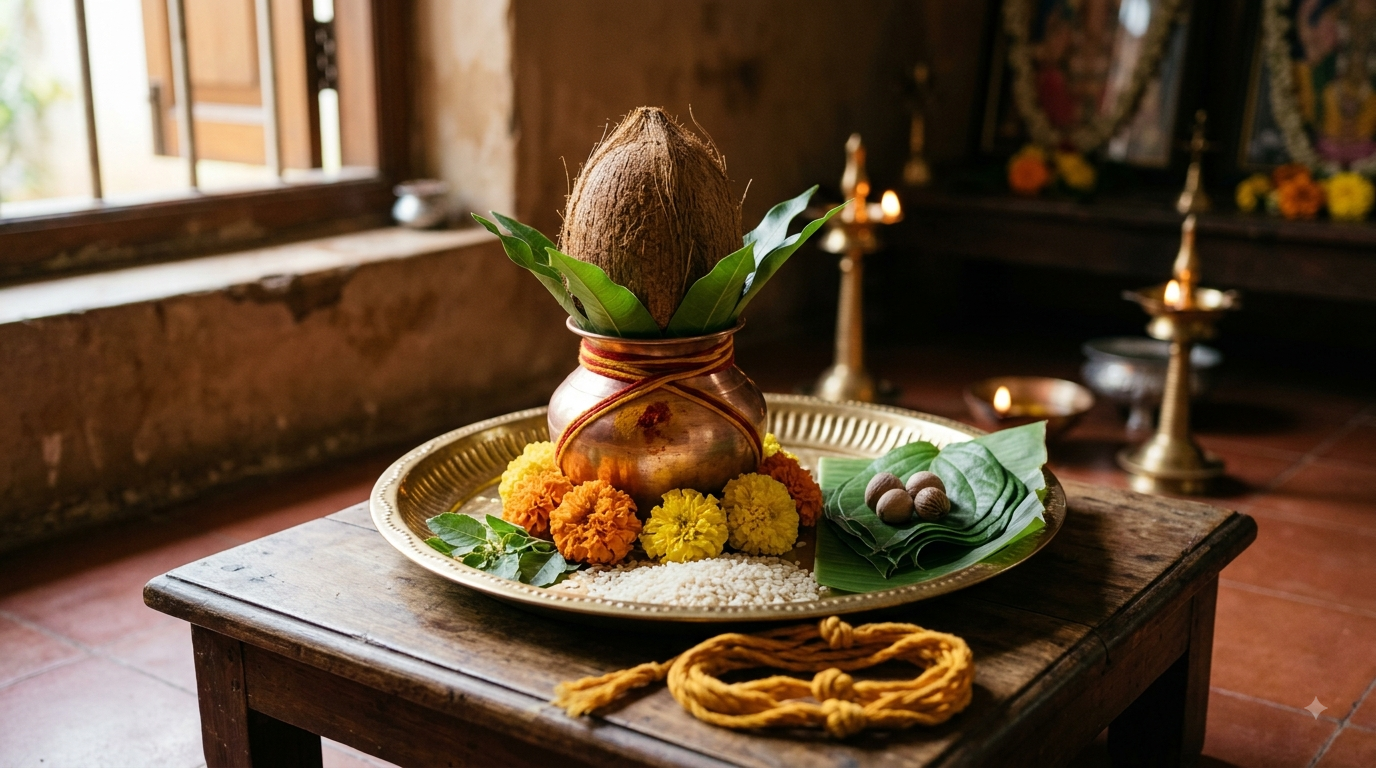
Anantha Padmanabha Vratham 2026 falls on Friday, 25 September 2026. That is almost three weeks later than the same vratham fell last year. The jump has already confused families, because several calendar pages still show the old early-September slot. An extra lunar month pushed every Bhadrapada observance forward, so the vratham moved with it.
Below you get the verified tithi window, the full puja vidhanam, the 14-knot thread rule, and an honest answer about the 14-year commitment.
Temples Map is an independent temple and festival guide. We are not affiliated with, endorsed by, or the official website of any temple, trust, or devasthanam. We do not accept bookings, poojas, donations, or payments of any kind. Please confirm timings on the official temple or panchangam sources linked in this guide.
Anantha Padmanabha Vratham 2026 at a Glance
- Date: Friday, 25 September 2026, Bhadrapada Shukla Chaturdashi.
- Chaturdashi tithi begins: 11:18 PM on 24 September 2026, IST.
- Chaturdashi tithi ends: 11:06 PM on 25 September 2026, IST.
- Practical puja window: from sunrise until the tithi closes that night.
- Also called: Anant Chaturdashi, Anant Chaudas, Ananta Vrata.
- Deity: Lord Vishnu in his Ananta form, reclining on Adi Shesha.
- Core ritual: tying the Anantha Sutra, a thread carrying 14 knots.
- Same day as: the ten-day Ganesh Visarjan.
Anantha Padmanabha Vratham 2026 Date and Time
Devotees observe Anantha Padmanabha Vratham 2026 on Friday, 25 September 2026. The Bhadrapada Shukla Chaturdashi tithi begins at 11:18 PM on 24 September. It then ends at 11:06 PM on 25 September. Because the tithi covers all of Friday’s daylight, the whole day qualifies for the puja.
| Detail | Timing (IST, New Delhi baseline) |
|---|---|
| Vratham day | Friday, 25 September 2026 |
| Chaturdashi tithi begins | 11:18 PM, 24 September 2026 |
| Chaturdashi tithi ends | 11:06 PM, 25 September 2026 |
| Traditionally preferred slot | Purvahna, the morning after the head bath |
| Ganesh Chaturthi 2026 | Monday, 14 September 2026 |
| Ten-day Ganesh Visarjan | Friday, 25 September 2026 |
Sunrise shifts by city, so your local tithi start and end move slightly either way. Devotees in Hyderabad, Bengaluru, Chennai, or Mumbai should check a city panchangam first. The calendar date for Anantha Padmanabha Vratham 2026 does not change anywhere in India this year.
You can cross-check the tithi on the Drik Panchang Anant Chaturdashi page. Set your own city there before reading the timings.
Why the 2026 date moved almost three weeks
The Hindu calendar added an extra lunar month this year. Adhika Jyeshtha Maas ran from 17 May to 15 June 2026. Every festival after it then slid forward by roughly one lunar month. That single insertion is why Ganesh Chaturthi landed on 14 September instead of late August.
Last year the vratham fell in the first week of September. Anantha Padmanabha Vratham 2026 falls on 25 September instead. So anyone who copied forward the old date is wrong by about nineteen days. Adhika Jyeshtha is genuinely rare, since the previous one arrived in 2018.
Is there a narrow muhurat you can miss?
No, and this is worth saying plainly. Chaturdashi covers the entire daylight of 25 September. No short window slips away while you are still getting ready.
Some pages publish a three-hour or four-hour muhurat for Anantha Padmanabha Vratham 2026. That figure is usually a city-specific slot converted from a foreign timezone.
Tradition prefers the Purvahna, the morning portion after sunrise, once the head bath and sankalpa are complete. Evening puja remains valid while the tithi still runs. Families that both work full time often settle on a late-morning start, which is perfectly acceptable.
Wrong Dates Circulating for Anantha Padmanabha Vratham 2026
At least one widely-read astrology portal still lists Anantha Padmanabha Vratham 2026 on 6 September. That is last year’s date, republished without recalculating for the leap month. Before trusting any festival page this season, check whether it also shows Ganesh Chaturthi on 14 September 2026.
Two further claims need correcting. First, the vratham is not merely “Ganesh Visarjan day”. The Ananta Vrata stands on its own as a Vishnu observance, and the Bhavishyottara Purana describes it in detail. Plenty of households keep the vrata while installing no Ganesha idol at all.
Second, the ten-day visarjan and the vratham never land on different days. Ganesh Chaturthi is Bhadrapada Shukla Chaturthi, so the tenth-day immersion falls on Shukla Chaturdashi. Shorter visarjans of one and a half, three, five, or seven days happen earlier. That is where the confusion usually starts.
Why Devotees Observe the Ananta Vrata
Ananta means endless. Devotees worship Lord Vishnu in the form that reclines on Adi Shesha. The serpent’s coils stand for time without end. Households honour Mother Yamuna and Shesha alongside him, so a kalasham of water represents the river during the puja.
Two stories anchor the vrata. In the Mahabharata, Krishna advises Yudhishthira to observe it after the Pandavas lose everything in the dice game. The second account comes from the Bhavishyottara Purana. It follows Sushila and sage Kaundinya, whose fortune collapses after he burns her Anantha thread in anger.
These outcomes belong to faith and Vedic tradition rather than to any measurable result. Households observe the vrata for stability, restored fortune, and family wellbeing. It deserves to be understood in that spirit, not as a guaranteed transaction.
Anantha Padmanabha Vratham Puja Vidhanam Step by Step
The vidhanam below reflects the widely-followed Telugu and Kannada household practice. Regional and family customs differ in small ways, so follow your own kula achara where it varies.
- Rise before sunrise and take a head bath, then clean the puja space thoroughly.
- Draw fourteen padmas, or lotus outlines, on a tray of uncooked rice.
- Set two kalashams on the tray, one invoking Lord Vishnu and one invoking Goddess Lakshmi.
- Place the Anantha vastra behind the kalashams, then add a seven-hooded serpent figure to each.
- Decorate the kalasham with turmeric, kumkum, betel leaves, and a coconut on top.
- Keep the Anantha Sutra threads ready in the puja area before you begin.
- Perform Ganapati puja first, then invoke Yamuna and Ananta Padmanabha Swamy using red akshata.
- Recite the Vishnu Sahasranama, offer the fourteen-fold naivedyam, and complete the harati.
- Tie the Anantha Sutra only after you complete the puja and harati.
- Perform the visarjana the next day with the appropriate mantra, then use the coconut for a sweet preparation.
The rule of 14 and your samagri checklist
Fourteen recurs throughout this vrata because the fourteen lokas are said to rest with Ananta Padmanabha. Keep the count consistent and the shopping becomes simple.
| Item | Quantity |
|---|---|
| Anantha Sutra thread (14 knots) | One per person observing |
| Flowers | 14 varieties where available |
| Fruits | 14 pieces, including banana |
| Betel leaves and betel nuts | 14 each |
| Turmeric fingers | 14 |
| Naivedyam vegetables | 14 varieties |
| Kalasham | 2, with coconut and mango leaves |
Fourteen flower varieties are hard to source in a city. Many households therefore substitute petals of whatever they find and keep the count symbolic. Most traditions accept that substitution, though a purohit in your sampradaya can confirm it.
How to tie the Anantha Sutra thread
The Anantha Sutra carries fourteen knots and takes a turmeric dye. Most Telugu and Kannada households tie it on the right arm for men and the left hand for women. Some Maharashtrian and North Indian families use the right arm for everyone. A few traditions place it around a married woman’s neck.
None of these is wrong. Follow whichever your family already keeps, since consistency across the years matters more than the variant you choose. The thread is usually worn until it wears away naturally or until the next year’s vrata replaces it.
The 14-Year Cycle and Udyapana
Devout families traditionally take the Ananta Vrata as a fourteen-year sankalpa. Each year adds one to the count. The fourteenth year then closes with an udyapana ceremony that formally releases the vow. Households usually invite a purohit for the udyapana, because that sankalpa wording differs from the annual puja.
Do not begin the vrata casually. Taking a fourteen-year vow and dropping it after three years causes real anxiety at home. So think the commitment through before your first sankalpa.
What if you miss a year or lose the thread?
This is the question official calendar pages never answer, yet it comes up constantly. Nothing catastrophic happens, and the standard remedies are practical rather than punitive.
- You missed a year: resume next year and extend the cycle, or ask your purohit for a prayaschitta sankalpa.
- The thread broke early: keep the pieces respectfully, immerse them in flowing water, and continue as normal.
- No Anantha Sutra available: most households accept a plain cotton thread, turmeric-dyed, with fourteen hand-tied knots.
- No purohit available: you can perform the annual vrata at home. Only the udyapana usually needs guidance.
- Travelling on the day: do a shortened sankalpa and puja wherever you are, then resume fully next year.
Our Anantha Padmanabha Vratham Telugu pooja vidhanam guide sets out the complete mantra sequence in order.
Fasting Safely During Anantha Padmanabha Vratham 2026
Many devotees keep a day-long fast until the puja concludes. Anantha Padmanabha Vratham 2026 falls in late September, when humidity still runs high across most of India. Dehydration therefore becomes a genuine risk during a long morning puja.
Anyone with diabetes, low blood pressure, or a heart condition should speak to a doctor before fasting. Tradition already exempts pregnant women, nursing mothers, elderly devotees, and children. Phalahara with fruit, milk, or sabudana works perfectly well instead.
A vrata is a devotional practice, not a medical treatment, so never stop prescribed medication for it. If you feel dizzy or unwell, break the fast immediately and complete the puja afterwards.
Anant Chaturdashi and Ganesh Visarjan 2026
Ganesh Chaturthi begins on Monday, 14 September 2026, and the ten-day immersion falls on Friday, 25 September. Households therefore do both on one day. The Ananta puja happens at home first, and the visarjan procession follows later.
Plan the sequence in advance if you keep a Ganesha idol. Finish the Ananta puja and thread-tying early, then join the visarjan. Tradition places the immersion before sunset.
City processions in Hyderabad, Mumbai, and Pune run late into the night. Families with young children therefore immerse at a local pond instead.
The Drik Panchang Ganesh Chaturthi page lists the sthapana muhurat for your city. Our Vinayaka Chavithi vratha kalpam guide covers the sthapana side of the same festival.
What Experienced Households Do Differently
A few habits separate families who have kept this vrata for years from first-timers. None of them appear on the standard calendar pages.
- Buy the Anantha Sutra a week early, since pooja shops sell out in the two days before Chaturdashi.
- Soak the turmeric-dyed thread and dry it fully, because a damp thread stains clothing.
- Write down the year of your first sankalpa somewhere permanent, so the fourteen-year count never gets disputed.
- Cook the fourteen-vegetable naivedyam the previous evening, since fasting while cooking a large meal is exhausting.
- Keep the visarjana kalasham water for the garden rather than pouring it down a drain.
- Photograph your tray arrangement once, so next year’s setup takes minutes instead of an hour.
Ananta Padmanabha shrines also draw heavy footfall on this day. For the Ananthagiri shrine, the Telangana government’s Vikarabad district devasthanam page carries the current visitor information.
Before You Begin the Vratham
Mark Friday, 25 September 2026, and ignore any page still showing an early-September date. Buy the thread early and keep the count of fourteen consistent. Then decide honestly whether you can hold a fourteen-year sankalpa before you take one.
Check your city panchangam for local sunrise, then begin the puja in the morning if your schedule allows. Our Bhadrapada masam Telugu calendar guide maps the wider festival month around Anantha Padmanabha Vratham 2026.
Anantha Padmanabha Vratham 2026: Common Questions
When is Anantha Padmanabha Vratham 2026?
Anantha Padmanabha Vratham 2026 falls on Friday, 25 September 2026. The Bhadrapada Shukla Chaturdashi tithi begins at 11:18 PM on 24 September. It ends at 11:06 PM on 25 September, IST. Because the tithi spans all of Friday’s daylight, you may perform the puja at any point that day.
Why is the date so much later in 2026?
The Hindu calendar inserted an extra lunar month, Adhika Jyeshtha Maas, between 17 May and 15 June 2026. Every Bhadrapada festival after it shifted forward by roughly one lunar month. Anyone carrying last year’s date forward lands about nineteen days early.
Is Anant Chaturdashi the same as Anantha Padmanabha Vratham?
Yes. Anant Chaturdashi, Anant Chaudas, and Ananta Vrata all name the same observance on Bhadrapada Shukla Chaturdashi. Telugu and Kannada households commonly call it Anantha Padmanabha Vratham, while North Indian families more often say Anant Chaudas.
Which hand should the Anantha Sutra be tied on?
Most Telugu and Kannada households tie it on the right arm for men and the left hand for women. Some traditions use the right arm for everyone, and a few place it around a married woman’s neck. Follow your family custom, because tradition accepts all these variants.
Do I have to observe the vratham for 14 years?
The traditional sankalpa runs for fourteen consecutive years and ends with an udyapana ceremony. However, many households observe it in single years without taking the long vow. Decide before your first sankalpa, since you take that commitment formally.
What happens if I miss one year?
Nothing irreversible. Most purohits advise resuming the next year and extending the cycle by one year, or performing a short prayaschitta sankalpa. Families who missed a year during illness or travel routinely continue without restarting from zero.
Can the vratham be performed without a priest?
Yes. Couples and individual devotees commonly perform the annual vrata at home. Families invite a purohit mainly for the fourteenth-year udyapana, because that sankalpa wording differs. A recorded Vishnu Sahasranama recitation works if you cannot chant it yourself.
Is the fast compulsory on this day?
No. The fast is customary rather than compulsory, and phalahara with fruit, milk, or sabudana is widely followed. Anyone with a medical condition should consult a doctor first. A day-long fast in late-September humidity gets demanding.
Does Ganesh Visarjan 2026 fall on the same day?
The ten-day visarjan always falls on the same tithi as the vratham, which is 25 September in 2026. Shorter observances of one and a half, three, five, or seven days conclude earlier. That difference is why visarjan dates appear to vary while the vratham date does not.