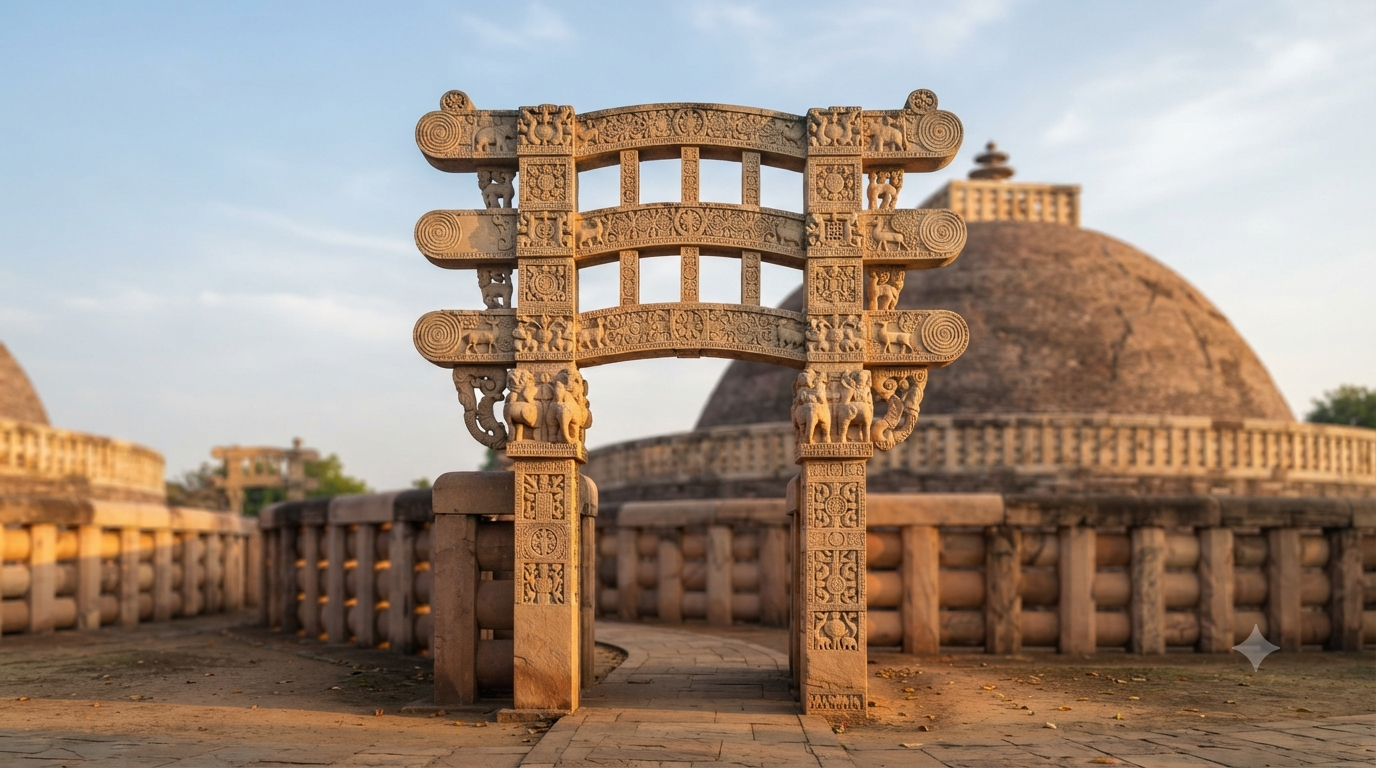
The temple torana meaning begins with a gateway, not a tower: a torana frames the approach to a sacred place. At Sanchi, carved pillars carry layered stone crossbeams. At some Hindu temples, the same architectural idea takes the form of a graceful arch. Knowing the difference helps you read a monument before you even enter it.
TemplesMap is an independent heritage guide, not an official temple or monument authority. We are not affiliated with the organisations cited here and accept no bookings, donations or payments.
Temple torana meaning: a clear definition
A torana is a gateway or ornamental entrance associated with Indian sacred architecture. It may stand on two pillars carrying horizontal beams, or form a carved arch. Buddhist stupas and Hindu temples use these forms in different ways, but both mark an important threshold rather than a tower above the shrine.
The Impart Encyclopedia of Art defines the term through both the beam-and-pillar gateway and the arched entrance. That range matters. A torana does not need the exact outline of Sanchi to qualify, yet it must be more than a random carved pattern.
Recognise the main features
- Threshold: it marks an entrance, approach or ceremonial passage.
- Supports: some forms rise from a pair of upright stone pillars or posts.
- Crossbeams: a Sanchi-style gateway has stacked horizontal members called architraves.
- Carved arch: other examples use a curved ornamental span instead of stacked beams.
- Relief: figures, plants, animals and stories may cover the visible surfaces.
These clues identify a kind of architectural feature, not a whole temple style. In practice, the temple torana meaning depends on the setting as well as the stonework. The gateway’s shape, setting and imagery help narrow down the monument’s tradition.
Temple torana meaning in pillars, crossbeams and carved arches
In a beam-and-pillar torana, two upright supports carry one or more crossbeams above the opening. These crossbeams are architectural members, not separate roofs. In arched Hindu examples, the upper span curves instead. Both designs frame movement through a space while giving sculptors a visible surface.
The upright pillars and capitals
Start by finding the two main supports. At Sanchi, they have square shafts, with carved panels rising toward capitals at the top. A capital is the upper portion of a pillar that helps carry the structure above it, while often displaying carved motifs. Figures or animals can also form part of its decoration.
Look along the whole pillar before focusing on one impressive figure, because the temple torana meaning becomes clearer in context. Carved stories can appear at several heights, so a single photograph rarely shows their sequence. Also, the supports are not the same as a separate commemorative pillar standing elsewhere on a site.
How temple torana meaning appears in the crossbeams
Crossbeams run across the opening between the supports, so they frame the passage. Architectural historians often call them architraves. At Sanchi, three curved beams sit one above another, while their ends project beyond the pillars. Scroll-shaped terminals make the layered outline especially easy to recognise.
The spaces between the beams also let light pass through. They also keep each carved register visually distinct. This means the temple torana meaning lies partly in its design: a gateway can display art without closing the passage below.
Is every torana a true stone arch?
No. People often call a torana an archway even when its upper members work as crossbeams. Sanchi has gently curved architraves, but that appearance does not make it a single masonry arch. At Mukteswara Temple in Odisha, the ornamental opening has a much more obvious arched profile.
For a careful description, say crossbeam gateway when beams sit across two posts. Say carved arched torana when the visible span curves above the passage. This distinction matters because every ornate entrance does not belong to the same structural type.
Temple torana meaning at Sanchi’s Buddhist monuments
Sanchi in Madhya Pradesh offers the clearest surviving lesson in the beam-and-pillar form. The Great Stupa, also called Stupa 1, has four monumental toranas around its stone railing. They face the cardinal directions and connect the surrounding path with the sacred monument. Here, the temple torana meaning includes both movement and sacred storytelling.
The UNESCO World Heritage Centre’s Sanchi account describes the site’s long development. Emperor Ashoka established an early sacred centre, while later rulers and craftspeople enlarged and embellished its structures. Therefore, the stupa’s original foundation and its carved gateways should not receive one undifferentiated date.
Why are there four Sanchi gateways?
The four gateways mark entrances on the north, south, east and west sides of Stupa 1, so they define a route. They break the stone railing at key points and make the approach visible. Their placement also connects the gateway with the path used for walking around the stupa in devotion. Thus, the gateway belongs to a route as well as a stone monument.
UNESCO singles out the gateways for their proportions and rich sculpture. The organisation also connects the stone railings and gateways to earlier timber forms. That helps explain why the stone structure looks like an intricate system of posts and beams rather than a solid wall.
What do the carvings at Sanchi show?
The gateways carry stories associated with the Buddha and the Jataka tales, which recount earlier lives in Buddhist tradition. Sculptors also placed plants, animals, attendants and sacred symbols among the narratives. A carved image can therefore serve as both decoration and a clue to a story.
Impart’s study of the gateways at Sanchi Stupa I explains the use of symbols such as the Bodhi tree and footprints. In these early scenes, such signs can represent the Buddha without showing him as a human figure. Scholars call that approach aniconic representation.
Do not assume every elephant is a Buddhist emblem or every plant is purely decorative, because context shapes their meaning. Read the surrounding panel before assigning meaning. Also, patron inscriptions and varied motifs remind us that craftsmen and donors helped shape the monument over time.
Temple torana meaning at Mukteswara’s Hindu gateway
A Hindu torana can look quite different from Sanchi’s three-beam design. Mukteswara Temple in Bhubaneswar, Odisha, is an especially clear example. Its freestanding ornamental gateway has a curved opening and finely worked stone details, so visitors often remember the arch before the shrine. Here, the temple torana meaning takes a distinct regional form.
Odisha Tourism’s Mukteswara Temple profile identifies the gateway as a notable feature of Kalinga architecture. Its account draws attention to the carved arch and motifs around it. Those details show how the torana idea adapts to a different region and religious setting.
For the wider context, see our guide to temples in Odisha. It places Mukteswara among Bhubaneswar’s historic shrines and explains the region’s temple forms. The arched torana remains an entrance feature, while the shrine tower and assembly hall serve different roles.
Temple torana meaning at the Sun Temple in Modhera
Modhera in Gujarat offers a useful second comparison. The UNESCO World Heritage Centre’s tentative-list account of the Sun Temple describes ceremonial freestanding gates between key parts of the complex. It records tall decorated pillars and ornate spanning members, with some portions no longer intact.
This example shows why the temple torana meaning cannot rest on a perfect arch alone. Even a gateway whose upper section has disappeared may still leave architectural evidence. Position, surviving pillars and the site plan all matter when historians identify the remains. Therefore, the temple torana meaning does not disappear when a stone beam falls.
Temple torana meaning vs gopuram and leaf toran
A torana is not simply another word for a gopuram. A gopuram is a gateway tower, especially prominent in South Indian temple compounds. A torana is normally a lighter freestanding gateway or ornamental arch. Meanwhile, a festive toran may be a hanging made from leaves, flowers or fabric.
| Term | Typical form | How to recognise it |
|---|---|---|
| Architectural torana | Pillars with beams or an ornate arch | Frames an approach or ceremonial threshold |
| Gopuram | Multi-level gateway tower | Rises above a doorway in a temple enclosure |
| Decorative toran | Leaves, flowers, cloth or beadwork | Hangs across the top of a doorway |
How is a torana different from a gopuram?
A torana frames a gateway without necessarily creating a towering building above it. A gopuram instead has a substantial superstructure over an entrance through a temple boundary. The words can both relate to entry, yet they describe different architectural forms.
A cropped photograph can hide that difference, especially when the base or surrounding wall falls outside the frame. Look for the high stepped storeys and enclosing wall around a gopuram. Then compare them with Sanchi’s open crossbeams or Mukteswara’s isolated arch. Our temple gopuram meaning guide explains the tower form in more detail.
Is a leaf or flower toran the same thing?
No: in household and festival use, a toran can mean a hanging over a door. People make these from mango leaves, flowers, fabric or other materials. The name shares a threshold idea with architectural toranas, but the object is not a stone monument. This is why the temple torana meaning differs from a festive doorway decoration.
The Cooper Hewitt, Smithsonian Design Museum documents a Gujarati textile doorway hanging and its link to the sacred gateway term. Its account also describes mango-leaf forms. A hanging may convey welcome or auspiciousness without carrying any architectural load.
Temple torana meaning in practice: identifying gateways
Begin with the opening, not the decoration. Then ask what rises around and above it, since the surrounding structure often settles the question. You can usually distinguish a gateway from a tower, shrine or festival hanging through a few simple checks. However, a damaged monument may need a site plan or conservation record.
- Find the passage. Check whether the feature marks an approach, entrance or ceremonial path.
- Look for upright supports. Two visible posts often point towards a freestanding architectural torana.
- Count the spans. Stacked crossbeams suggest the Sanchi type; a continuous curved opening suggests another form.
- Inspect the setting. A surrounding enclosure with tall tiers may indicate a gopuram instead.
- Read the motifs carefully. Figures and symbols can help with interpretation, but they rarely prove a date on their own.
- Check a trusted site description. Use UNESCO, the Archaeological Survey of India, museum research or the relevant heritage authority.
At Sanchi, follow the two pillars upward and notice where each architrave extends beyond them. This approach also makes the temple torana meaning easy to explain from a photograph. At Mukteswara, first trace the carved curve above the open space. The same method works on old photographs, where colour and modern restoration can distract from the form.
Mistakes that distort temple gateway history
- Calling every curved beam an arch: shape alone does not reveal how stone members support one another.
- Dating a whole site from one gateway: Sanchi developed in several stages, so distinguish the stupa from its later sculpture.
- Calling all entrances gopurams: many toranas have no multi-storeyed tower.
- Reading motifs in isolation: a small crop may hide the surrounding narrative.
- Assuming one religious meaning: Buddhist and Hindu settings give similar gateway forms different artistic contexts.
When visiting a protected monument, view carvings from permitted paths and avoid touching fragile stone. For close study, a museum image or conservation photograph can reveal details without risking the surface.
Temple torana meaning in the wider history of Indian art
Toranas turn an entrance into something visitors can read. At Sanchi, sculpture unfolds across the posts and beams as people approach the stupa. In Hindu architecture, an ornate arch can draw attention to the passage leading toward a sacred building.
The contrast also offers a useful lesson in regional history. A shared gateway idea need not produce a shared silhouette. Stoneworkers could use layers of crossbeams, curved spans or different carving schemes according to the monument’s design and artistic tradition.
For that reason, the temple torana meaning is both practical and symbolic. The feature guides movement, marks a threshold and offers space for ornament. Yet its exact significance depends on the site, so the carvings deserve more than a quick label.
What to remember about toranas
The simplest test is to look at the entrance and the stone above it. Sanchi shows pillars and layered beams, while Mukteswara shows a richly carved arch. If you see a high gateway tower, read it as a gopuram instead. If leaves or fabric hang from the doorway, you are looking at another use of the word toran.
Frequently asked questions
What is the meaning of torana in temple architecture?
A torana is a gateway or ornamental arch marking an entrance or special approach. It often has two pillars and crossbeams, although some Hindu examples use a carved curved span. The temple torana meaning concerns the gateway feature, not a whole building or shrine tower.
What is special about the Sanchi toranas?
Sanchi’s Great Stupa has four richly carved toranas at its cardinal approaches. Their pillar-and-crossbeam form preserves an important early stone gateway design. The reliefs also contain Buddhist stories, sacred symbols, plants and animals, so the gateways reward careful study.
How many crossbeams does a Sanchi gateway have?
The monumental gateways at Stupa 1 have three curved horizontal architraves over their supporting pillars. Those beams extend beyond the pillars and have distinctive scroll-like ends. Not every torana in India follows that three-beam pattern.
Are toranas used only in Buddhist monuments?
No. Toranas also appear in Hindu sacred architecture, including the arched entrance at Mukteswara Temple in Odisha. Different sites use the form in different ways. A Buddhist narrative gateway and a Hindu ornamental arch should not be treated as identical designs.
What is the difference between a torana and a gopuram?
A torana is a gateway made from pillars and spanning elements or an ornamental arch. A gopuram is a gateway tower that rises over an entrance in a temple enclosure. The tower’s scale and upper storeys are the easiest visual clues.
Is a torana the same as a toran made of mango leaves?
No. A leaf toran is a temporary or decorative hanging placed over a doorway, often for a celebration. An architectural torana is a structural or ceremonial gateway feature. Both terms relate to marking an entrance, but the materials and functions differ.
Is a torana always a curved arch?
No. The Sanchi gateways have layered, slightly curved crossbeams rather than one continuous arch. Some Hindu examples, such as Mukteswara, have a more clearly arched outline. Looking at the pillars and spanning members gives a better description than the word arch alone.
Can a damaged gateway still count as a torana?
Yes, if the surviving supports and site evidence establish its original gateway form. The Modhera Sun Temple account, for example, discusses torana remains with missing upper sections. A broken arch should therefore be identified through reliable documentation, not appearance alone.