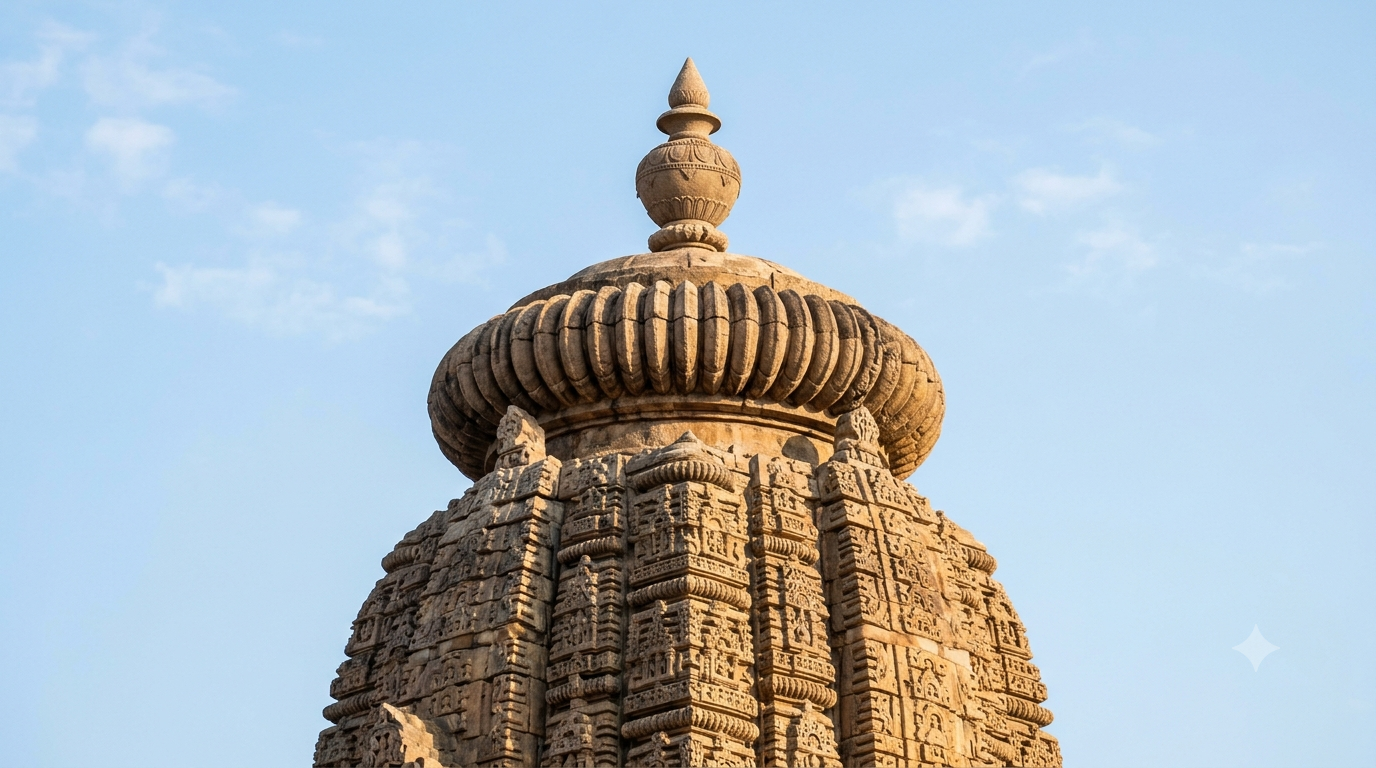
Temple amalaka meaning begins with a distinctive stone crown: a broad, ribbed disc near the summit of some Hindu temple towers. It belongs especially to the vocabulary of Nagara architecture, where a much smaller pot-shaped finial may rise above it. The two elements are easy to confuse from the ground, but they have different names and forms.
TemplesMap.com is an independent heritage guide, not an official temple authority or affiliate. We do not arrange visits or accept bookings, donations or payments.
What is the temple amalaka meaning in architecture?
An amalaka is a large, notched or ribbed stone disc that forms part of the crown of certain Indian temple spires. It appears prominently in Nagara and Kalinga architectural traditions. On a familiar northern tower, it sits near the top of the shikhara and below a separate kalasha finial, when that finial survives.
The Getty Research Institute’s Art & Architecture Thesaurus records the related term āmalasāraka. Its definition describes a large, cogged-wheel-shaped stone that crowns a North Indian shikhara. That careful description identifies the object by its form and location, rather than assigning it a single religious meaning. In short, temple amalaka meaning begins with a recognisable architectural form.
For a broader visual introduction, the Impart Encyclopedia of Art defines the amalaka as a ribbed or notched disc in Nagara and Kalinga temple architecture. Together, these references give readers a useful starting point without turning one regional pattern into a rule for every temple.
Temple amalaka meaning at a glance
- Object: A substantial stone disc or crown with visible ribs or notches.
- Common setting: The upper end of certain Nagara and Kalinga temple superstructures.
- Position: Often above the main tower and below a separate pot-shaped finial.
- Not the same as: The kalasha finial or the complete shikhara tower.
- Related term: Getty uses āmalasāraka for a cogged-wheel-like crowning element.
- Important caution: Surviving monuments and regional traditions do not share one fixed roof arrangement.
The fastest way to recognise the feature is to compare its width with the much narrower finial above it. Still, damage, repairs and later changes can hide or alter the original roof profile. A photograph alone may not settle every identification.
How to recognise the ribbed crowning stone
Look for a horizontal, rounded crown whose outer edge carries repeated grooves or projecting ribs. From a distance, this can resemble a fluted cushion or a stone wheel. The ribs matter more for identification than a precise count, because the shape varies between monuments. If you are checking temple amalaka meaning in a photograph, start with that outline.
Next, trace the building below that crown. On a typical curving Nagara spire, the tall rising mass is the shikhara. A smaller topmost vase-like piece, if present, is the kalasha. This sequence helps separate three elements that a low-resolution image may blur together.
The disc may look shallow from below yet substantial in a side view. Shadows also change its apparent shape during the day. For that reason, compare a frontal view with a photograph showing the summit at an angle before labelling a weathered stone.
Temple amalaka meaning versus kalasha and shikhara
The amalaka, kalasha and shikhara do not name three types of temple tower. They name different parts of a roof composition. Getty defines the kalaśa as a pot- or pitcher-shaped crowning component, while its śikhara entry describes the tower or spire itself.
| Term | What it names | What to look for |
|---|---|---|
| Amalaka | Ribbed crowning stone | Broad, notched disc near the summit |
| Kalasha | Finial | Smaller pot- or pitcher-like top piece |
| Shikhara | Temple tower or spire | The larger rising superstructure below |
| Bhumi-amalaka | Smaller related ornament | Ribbed element marking a tower level or corner |
A simple memory aid is tower, ribbed crown, finial. Read that sequence upwards on a suitable Nagara example. It describes a common arrangement, not a universal construction rule or a guarantee that every part remains intact. The temple amalaka meaning is clearer when each part has its own label.
Where does the amalaka appear on a temple?
The familiar large amalaka crowns the upper portion of certain North Indian temple spires. In those examples, it helps complete the outline of a curved sanctuary tower. Odisha’s Kalinga tradition also uses distinctive crowning forms, although its architecture has its own detailed terms and variations.
The Getty entry on Nagara architecture describes a curving tower with a crowning amalaka and a further finial in an important historical type. It also notes regional development. Therefore, the entry describes a recognisable tradition rather than the roof of every temple in India.
Our guide to Indian temple architecture explains how Nagara, Dravida and regional forms differ. That distinction matters here because a stepped southern vimana should not automatically receive the labels used for a curving northern shikhara. For temple amalaka meaning, regional context therefore matters as much as shape.
Is it found on every Hindu temple?
No. Many surviving North Indian towers show an amalaka, but temples differ by region, age and form. Some monuments use different roof systems, while damage or rebuilding may have changed a summit. Calling the amalaka a standard feature of every Hindu shrine would erase those differences.
Even within the Nagara family, buildings differ in tower shape and crowning detail. Compare individual monuments rather than expecting a fixed checklist. In addition, a missing finial does not prove that the original building lacked one.
Why the name evokes a fruit
The name amalaka is commonly linked to the amla or Indian gooseberry. The fruit has rounded divisions, so the comparison helps explain the repeated ribs around the stone disc. The Impart Encyclopedia of Art presents that derivation as a reported explanation rather than an established rule for every sculptor.
Names can preserve visual associations without revealing an architect’s complete intention. A modern observer may recognise a fruit-like outline, while a historical text may describe the same shape through a different technical term. That is why form, source and regional context should be read together.
Do not use the fruit connection to infer a particular temple’s date, deity or ritual. Those claims require evidence from the monument, inscriptions or a credible study. The ribbed crown by itself cannot supply that information.
Does the amalaka have one fixed symbolism?
No single symbolic reading covers every amalaka. Writers have associated the disc with a lotus and with ideas about the passage between earthly and sacred realms. Such readings belong to the history of interpretation, however, and should not be presented as the documented intention behind every stone.
The Impart Encyclopedia of Art’s definition records different symbolic interpretations. Yet Getty’s architectural record focuses on shape and placement. The contrast is useful: a visual description can be secure even when a symbolic explanation remains open to debate. Temple amalaka meaning should not become a claim about universal religious belief.
TemplesMap’s temple iconography and symbolism guide explores the wider language of sculptures and motifs. This article keeps the narrower task clear: identify the amalaka first, then examine any proposed meaning with the source that supports it.
Smaller ribs on a tower: the bhumi-amalaka
Not every ribbed circular detail on a tower is its main crowning stone. The bhumi-amalaka is a smaller related element that may mark a level or corner of a northern spire. Here, bhumi refers to a storey or level in the architectural description.
Getty’s bhūmi-āmalaka vocabulary record describes a miniature cogged-wheel form associated with symbolic storeys and tower corners. Its note includes regional terminology from Kalinga and western India. This makes size and location essential to a correct label.
For example, several little ribbed pieces along a tower’s sides should not all be called the main amalaka. Locate the summit before naming the crown. Then check whether the side ornaments mark repeated levels rather than the topmost transition.
Temple amalaka meaning in a real monument
Photographs of the Javari Temple at Khajuraho offer a concrete way to study the form. The Impart Encyclopedia of Art illustrates its definition with a view of amalakas crowning that temple. In the image, the profile makes more sense when you inspect the entire summit rather than isolating a small detail.
Khajuraho is useful because its Nagara temples display varied tower compositions. Still, the example should not become a pattern imposed on every region. The same visual clue can appear differently on a simpler shrine or a more elaborate temple.
When examining photographs, note the stone disc’s ribs, the silhouette beneath it and any finial above. If an image lacks a close view, mark the identification as tentative. Precise labels are more valuable than confident guesses made from poor angles. Also, a caption explaining temple amalaka meaning should point to the correct stone.
Reading the top of a temple without mixing up terms
Start with the whole building, not just the last few stones. Ask whether you are looking at the tower over the sanctum or a gateway tower. Our gopuram guide explains the gateway tower. The site’s garbhagriha guide explains the inner chamber below the shrine superstructure.
Then study the outline of the tower itself. A curved, tapering Nagara form provides a different context from a stepped southern tower. Also check whether small ribbed pieces repeat down its sides, since they may be bhumi-amalakas rather than the principal crown.
Finally, compare the summit with a credible drawing or glossary. Getty’s definitions help you label elements without inventing ritual functions. For a restored monument, a conservation report may be necessary before claiming that every visible stone is original.
Three common identification mistakes
- Calling the whole tower an amalaka: The shikhara is the larger superstructure, while the amalaka is one crowning element.
- Calling the ribbed disc a kalasha: The kalasha refers to the pot-shaped finial, not the broad notched stone beneath it.
- Applying one northern diagram everywhere: Regional vocabulary and surviving roof forms differ, so labels need context.
A fourth mistake is assigning a definite cosmic meaning from the object alone. Architectural identification and religious interpretation answer different questions. Keep them separate unless an inscription, text or documented local tradition connects them.
What the temple crown tells us—and what it cannot
An amalaka can help identify a temple’s architectural vocabulary because its shape is so distinctive. Combined with the tower profile and other details, it may support a cautious comparison with known Nagara examples. It cannot, by itself, establish a building’s precise age or ritual lineage.
The most reliable approach moves from the visible stone to the larger roof, then to the monument’s documentation. That order reduces errors, especially when an old site has lost its original summit. It also respects the variety that makes Indian temple architecture worth studying.
Frequently asked questions about the amalaka
What is the amalaka in temple architecture?
An amalaka is a broad ribbed or notched stone near the crown of certain Hindu temple spires. It is especially familiar in Nagara and Kalinga architecture. A separate kalasha finial may stand above it.
Is the amalaka the same as the kalasha?
No. The amalaka is the disc-like ribbed stone, while the kalasha is a pot-shaped finial. In many Nagara examples, the kalasha rises above the amalaka. They should receive separate labels in a diagram.
Is the amalaka the whole shikhara?
No. The shikhara refers to the temple tower or spire in the relevant architectural context. The amalaka is a smaller crowning component associated with some tower types. Getty maintains separate vocabulary records for these elements.
Why is the amalaka ribbed?
The ribs give the stone its distinctive fluted or cogged-wheel profile. Scholars also connect its name with the segmented amla fruit. Yet the exact design and intended meaning can vary by monument, so a single explanation should not cover every case.
Does every North Indian temple have an amalaka?
No. The form is characteristic of important Nagara traditions, but northern temples vary widely. Some surviving towers lack their original crowns, while other building types use different tops. Check the specific monument rather than assuming an identical arrangement.
What is a bhumi-amalaka?
A bhumi-amalaka is a smaller ribbed element that marks a storey or corner on certain temple spires. Getty identifies it separately from the large main crowning stone. Its repeated position on the tower is the main clue.
Does the amalaka always represent a lotus or the sun?
No universal symbolism has been established. Lotus and other cosmic readings appear in interpretive writing, but they do not prove every builder’s intention. Architectural records first describe the stone’s shape and position; symbolic claims need their own sources.
Where can I see a documented amalaka example?
The Impart Encyclopedia of Art illustrates its amalaka entry with the Javari Temple at Khajuraho. Its photograph provides a useful starting point for comparing the ribbed crown with the tower below. Study the complete building before applying the term elsewhere.