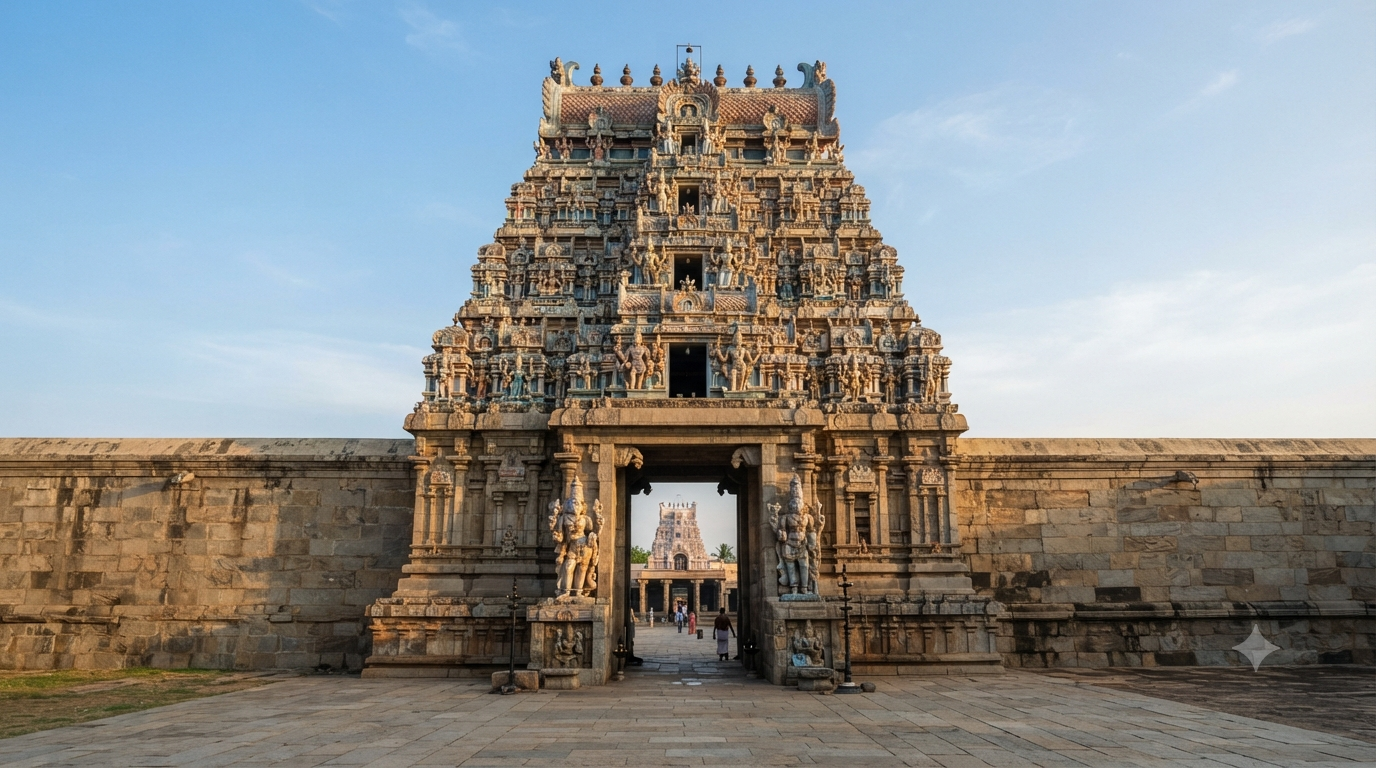
The temple gopuram meaning begins at the entrance: a gopuram is a tower that rises above a gateway into a Hindu temple complex. The tall, carved towers of South India are famous examples, yet they are not the same as the tower over the main shrine. That distinction changes how you read an entire temple.
Many visitors call every tower a gopuram. However, a temple plan often has several kinds of structures with different jobs. The gateway, the shrine, the hall and the enclosing wall each need their own name.
Editorial note: TemplesMap is an independent heritage guide, not a temple authority or affiliated booking service. We accept no temple bookings or payments. Check the relevant temple administration for current visitor rules.
Temple gopuram meaning: a clear definition
A gopuram, also written gopura, is a tower above a gateway in a temple enclosure. It marks a point of entry rather than the location of the main deity. Monumental, stepped gopurams are especially prominent in South Indian Dravida architecture, although gateway forms differ widely across regions and periods.
The UNESCO Great Living Chola Temples account describes a gopura at the main entrance to Brihadisvara Temple and a vimana above its sanctum. This makes the distinction clear: one marks the gateway, while the other rises over the shrine.
The essential features at a glance
- Location: a gateway through a temple boundary or between enclosed precincts.
- Function: an entrance marker and a striking part of the temple’s public face.
- Shape: often a broad gateway base with upper stages that narrow towards the top.
- Decoration: architectural bands, sculpted figures and sometimes painted stucco work.
- Number: one or several, depending on the temple and its later extensions.
- Not the same as: the vimana above a shrine, a mandapam hall or a prakaram enclosure.
These are useful clues rather than a universal design checklist. A modest gateway and a richly decorated tower can share the same architectural name. Thus, height alone cannot tell you what a structure does.
Temple gopuram meaning: how to recognise a gateway tower
Start at the bottom, not the summit. Look for a real passage through the structure and a boundary wall joining its sides. If the opening leads from a street into the temple grounds, the tower above it may be an outer gopuram. A second one may lead into an inner court.
Many large southern examples have a high stone entrance base. Their upper storeys form a tapering, stepped outline. In some traditions, brickwork and plastered sculpture rise above the base. Small architectural motifs repeat across the upper levels.
Yet the colour is not a reliable definition. Some gopurams display vivid paint, while others show stone or more restrained finishes. A photograph without the doorway can therefore mislead.
Look for the gateway’s place in the site plan before naming the tower. That is why temple gopuram meaning depends on the doorway below it.
What do the tiers and sculptures tell us?
Repeated tiers create a strong vertical rhythm, while sculptures give the gateway a distinctive visual identity. Figures may include deities, guardians and scenes drawn from religious narratives. Their selection reflects the site’s tradition and the period of the work.
The Metropolitan Museum of Art catalogues a South Indian door-guardian figure known as a dvarapala. Such figures help explain guardian imagery, but they cannot by themselves date a gateway. Repairs, repainting and additions may belong to different periods from the original entrance.
Temple gopuram meaning vs vimana, mandapam and prakaram
The easiest way to understand temple gopuram meaning is to place it beside the three terms people confuse with it. These words describe different parts of the same architectural setting. They are not four names for a temple tower.
| Term | What it describes | Where to find it |
|---|---|---|
| Gopuram | Gateway tower | At an entrance through an enclosure |
| Vimana | Sanctum tower in the Dravida tradition | Above the garbhagriha, or shrine chamber |
| Mandapam | Hall or pavilion | Along the approach or inside a court |
| Prakaram | Enclosure wall or surrounding precinct | Around a shrine or temple court |
What is the difference between a gopuram and a vimana?
A gopuram rises over a gateway, while a vimana rises over the sanctum in South Indian temple architecture. The first announces a threshold; the second marks the shrine itself. Their shapes can both include receding levels, so position in the plan matters more than a quick glance at the roofline.
Thanjavur’s Brihadisvara Temple makes the contrast especially clear. UNESCO’s Great Living Chola Temples account describes its towering vimana above the shrine and its separate entrance gopura. For another visible example, see TemplesMap’s Shore Temple architecture guide, where the Pallava sanctum towers dominate the silhouette.
How do mandapam and prakaram fit around the gateway?
A mandapam is a hall or pavilion, often with pillars. A prakaram is an enclosure or surrounding precinct. The gopuram forms an opening in that boundary, while a mandapam may stand beyond it. Devotees can therefore pass through a gopuram, cross a court and enter a mandapam before reaching the shrine.
The order differs across temples, especially where generations added new courts. A corridor also should not automatically count as a whole prakaram. Our guide to prakaram and temple enclosures explores that distinction in detail.
Temple gopuram meaning beyond a tower’s height
The tower turns an opening in a wall into a visible landmark. From a nearby street, it helps people identify the temple precinct. At a large temple town, multiple gateways may also link distinct courts with the public streets outside.
The threshold has a religious meaning for worshippers too. Entering a sacred precinct can mark a shift from everyday activity towards prayer. However, meanings and ritual customs vary among temples; no single explanation covers every gateway or tradition.
Understanding temple gopuram meaning also helps trace a site’s patrons and growth. An outer entrance may belong to a later building phase than the central shrine. Consequently, the tallest tower is not necessarily the oldest or the most sacred part of the complex.
Temple gopuram meaning in Tamil Nadu: two different lessons
Tamil Nadu offers striking cases because its large temple towns developed gateway-rich enclosures. Madurai shows how an entrance tower can dominate the skyline. Srirangam shows how a series of gateways can organise a much larger sacred landscape.
Madurai Meenakshi Temple: the skyline gateway
At the Meenakshi-Sundareswarar Temple in Madurai, the gateways give the complex much of its famous street-level identity. The Airports Authority of India’s Madurai visitor information describes 14 gopurams and identifies the south tower as the tallest, at about 51.9 metres. It separately mentions the golden vimanas above the two principal shrines.
Madurai illustrates temple gopuram meaning through its contrast between entrance towers and shrine towers. A skyline photograph therefore needs careful labels. The sculpted entrance towers and the sacred towers over the shrines have different architectural jobs. Also, a grand exterior does not tell you which gate the administration uses for entry on a given day.
Srirangam: gateways between enclosure rings
At Sri Ranganathaswamy Temple in Srirangam, the layout explains the towers better than a single front view. The UNESCO tentative-list submission for Srirangam describes seven concentric rectangular enclosures and 21 gopurams. Consequently, moving inward may involve passing successive thresholds rather than crossing one outer entrance and arriving at the shrine.
The same heritage submission describes multiple sculpted gopurams and seven prakarams. This is a tentative-list submission, not a claim that Srirangam currently holds World Heritage inscription. The distinction matters when using heritage records as sources.
The temple gopuram meaning here is therefore about circulation as much as skyline. The gateways help you understand how a religious complex connects with streets, markets and inner worship spaces.
Temple gopuram meaning in Karnataka: the Hampi example
Hampi adds a different layer to the story. Under the Vijayanagara rulers, temple gateways formed part of large sacred complexes alongside halls, courts and streets. The UNESCO World Heritage account of Hampi describes lofty entrance towers as a characteristic of this architecture.
At the Vitthala Temple, UNESCO records three entrance gopurams through the enclosure. Here, temple gopuram meaning includes the gateway’s link to surrounding courts and streets. It also describes ceremonial halls and a bazaar street. Here, architecture joins the gateway to the movement of visitors and the planned space around the temple.
Virupaksha Temple provides another useful comparison. Its gateway towers belong to an active temple setting within the historic city. So a gopuram can be read as part of living worship, urban history and a changing built environment at once.
Temple gopuram meaning beyond Tamil Nadu
Kerala: gateway towers need not be giant pyramids
In Kerala, timber roofs and local building traditions can produce a different entrance profile. Kerala Tourism describes a two-storeyed gopuram at Sree Poornathrayeesa Temple in Tripunithura. It notes a pavilion supported by carved wooden pillars within the gateway structure.
This Kerala example shows that temple gopuram meaning does not require a giant painted pyramid. Kerala’s climatic and craft traditions also shape roof forms. Although the gateway performs the entrance role, its appearance need not copy Madurai.
Andhra Pradesh: outer and inner gateways at Tirumala
The Tirumala temple offers a useful example of gateways at different points along the route to the shrine. Tirumala Tirupati Devasthanams’ explanation of the temple doors identifies an outer gopuram and the Nadimi Padi Kavali, or inner gopuram.
It also places the inner doorway in relation to the Sampangi prakaram. This is a helpful reminder that a gateway may mark a shift between inner precincts. However, the historical architectural description is not a promise of today’s darshan route or access rules.
How did gateway towers grow so prominent?
Not every early South Indian temple looked like a later city-scale complex. In many earlier monuments, the building above the sanctum commands the main view. The Great Living Chola Temples in Tamil Nadu preserve grand examples of that shrine-centred design.
As some temple complexes expanded, patrons added walls, courts and more impressive gateways. The Srirangam heritage submission published by UNESCO describes building activity across several dynasties and centuries. In later southern examples, an outer gopuram could tower above older structures farther inside.
However, this broad trend does not change temple gopuram meaning or provide a date for an individual tower. A site’s inscriptions, construction records and conservation history matter more than the number of tiers. For the wider regional context, see our Nagara, Dravida and Vesara architecture guide.
Reading a gopuram’s sculpture without guessing
Begin with what you can actually see: guardians near the opening, repeated miniature architectural forms, image panels and the decorative crown. Then ask what the temple’s own heritage guide says those figures represent. A sculpted scene may show a particular deity’s story, but identification requires context.
Paint does not by itself prove a tower is new. Nor does bare stone prove it is ancient. Restoration, weather and local traditions can change the visible finish. The safest description records material and motifs first, then uses a heritage source for dates and attribution.
Likewise, avoid counting a tower’s visible storeys from a cropped image. The base and upper levels may be hidden by another building. A ground-level photograph is useful for detail, while a full elevation or plan is better for classification.
Temple gopuram meaning on a plan: a simple method
When you see a plan of a historic temple, follow the route from outside to inside. This approach separates the entrance tower from the sacred core without relying on colour, age or height. It also works when a temple has several gateways.
- Find the garbhagriha. Mark the main shrine chamber and the tower above it. In Dravida architecture, that tower is the vimana.
- Trace the enclosure. Follow the wall or precinct boundary around the shrine. This helps identify the prakaram.
- Locate the openings. Mark gateways connecting the street to the court or one court to another.
- Check for a tower. Where a tower rises over one of those gates, identify it as a gopuram.
- Find the halls. Locate the mandapams separately, since they provide rooms or pavilions rather than defining gateway towers.
Finally, compare that reading with a published site plan. At a complex site, newer boundaries may enclose older ones. The same approach therefore reveals building phases as well as architectural labels.
Temple gopuram meaning in photos: common mistakes
- Calling the tallest tower the main shrine: a large gopuram may stand far from the garbhagriha.
- Calling every stepped tower a gopuram: check whether a gateway passes through it.
- Assuming all gopurams are painted: finish and material vary by site and conservation history.
- Assuming every southern temple has one huge entrance: some have several, while others are modest.
- Using a gate name as a visitor instruction: historic gates and today’s authorised entry routes may differ.
Misreading temple gopuram meaning often starts with a cropped photograph. You can settle the first two questions by moving your viewpoint. Stand far enough back to see the relationship between wall, doorway and tower. Respect barriers and restricted areas; wet or worn stone steps also deserve care.
The bottom line
The temple gopuram meaning is architectural first: a tower marks an entrance through a temple enclosure. Its sculpted form can also express devotion, patronage and the growth of a temple town. Remember the simple contrast: gopuram over the gateway, vimana over the sanctum. Then read the halls and enclosure walls as separate parts of the plan.
Frequently asked questions
What does gopuram mean in a Hindu temple?
A gopuram is a tower over an entrance gateway, particularly familiar in South Indian temple architecture. It marks a passage into a temple enclosure or an inner precinct. It does not, by definition, identify the shrine below the main deity’s sanctum tower.
Is a gopuram the same as a vimana?
No. A gopuram stands over a gate, while a vimana stands over the sanctum in the Dravida temple tradition. Both can have stepped forms, so their locations give the clearest answer. In many northern temple traditions, the sanctum tower instead carries the name shikhara.
Why are South Indian gopurams so tall?
Some large temples grew through repeated building phases and gained imposing outer gateways. Such towers became visible landmarks and marked important entrances. However, not all South Indian temples have huge gopurams, and older Chola monuments may draw more attention to the vimana.
What is a rajagopuram?
A rajagopuram usually refers to a major, monumental entrance gateway tower. The name often identifies a prominent gateway in a large southern temple complex. Its precise local use varies, so check the temple’s own plan before treating it as a fixed architectural rank.
What is the difference between a gopuram and a mandapam?
A gopuram is a gateway tower, while a mandapam is a hall or pavilion. You may pass through a gopuram before entering a pillared mandapam. The two structures therefore serve different purposes even when they stand near each other on the same route.
What is the difference between gopuram and prakaram?
A gopuram marks an opening, while a prakaram refers to an enclosure wall or surrounding precinct. A gateway may lead through a prakaram into another court. The enclosure is not the tower, and a walking corridor does not always define the entire precinct.
Do all Hindu temples have a gopuram?
No. Monumental gopurams are especially associated with South Indian traditions, but Hindu temples vary greatly by region and period. Many northern temples emphasise a shikhara above the sanctuary instead. Kerala also offers smaller, distinctive gateway forms rather than one standard silhouette.
Are the colourful towers at Madurai all gopurams?
No. The celebrated tall entrance towers at Madurai are gopurams, but the complex also has vimanas above its main shrines. That distinction appears in the Airports Authority of India’s visitor description. Identify each tower by its location rather than assuming all visible towers serve the same function.