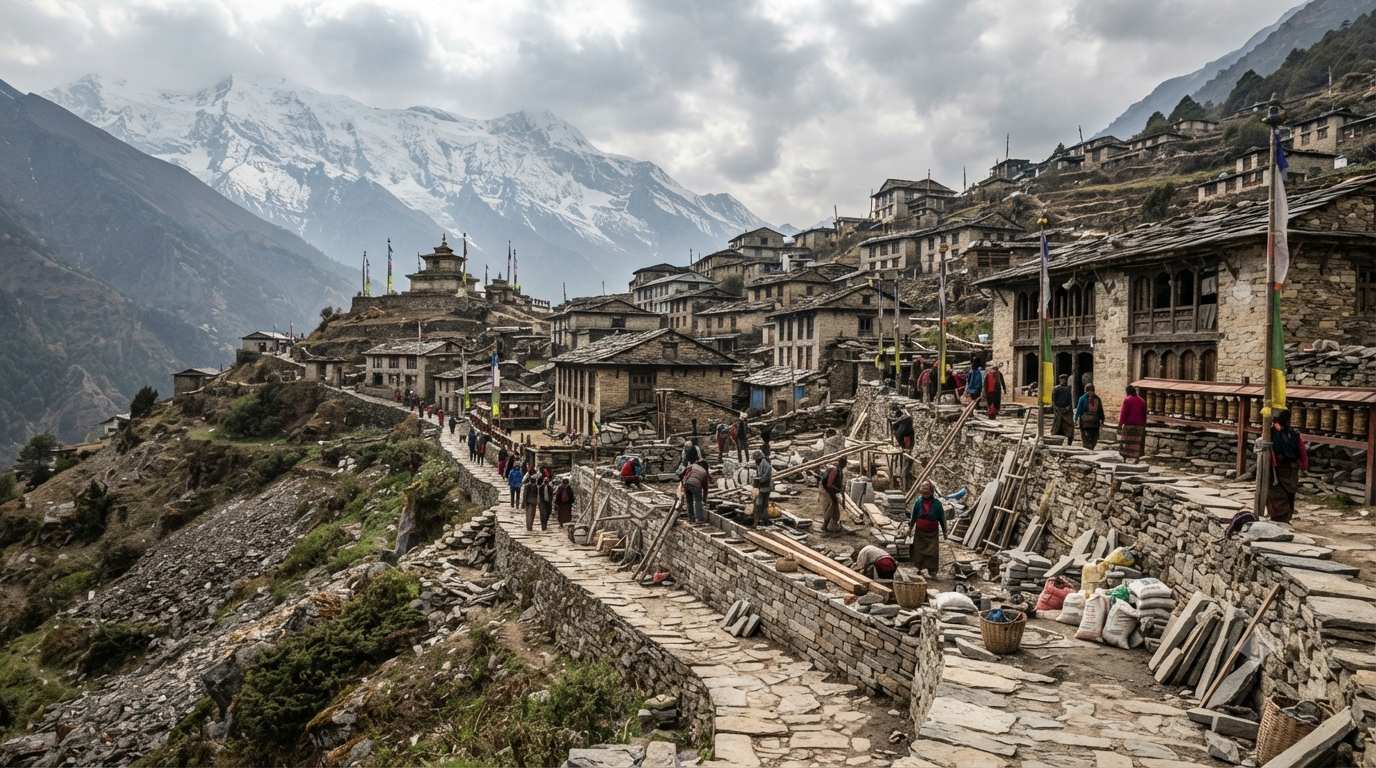
Kedarnath redevelopment has delivered important restoration work, but the wider rebuilding programme is not fully finished. That distinction matters if you are checking which facilities actually exist before visiting the Himalayan shrine. Government records for Kedarnath redevelopment confirm several completed projects, while officials still reviewed construction and utility connections during 2026.
Temples Map is an independent pilgrimage guide. We are not affiliated with the Uttarakhand government or Kedarnath temple authorities, and we accept no bookings, payments or donations. Use the official government websites linked here for travel arrangements and current information.
Kedarnath redevelopment: completion status at a glance
The short answer: The reconstructed Adi Shankaracharya Samadhi, important river protection works and sections of the pilgrim pathways are complete. Yet later phases cover more than these landmarks. Utility networks, some buildings, a historic trekking route and the proposed ropeway must be assessed separately.
| Work or project | Documented status | What that means |
|---|---|---|
| Adi Shankaracharya Samadhi | Completed and inaugurated in 2021 | An established restored landmark |
| Saraswati and Mandakini retaining walls, paths and ghats | Key works completed by 2021 | Part of the earlier flood-protection rebuild |
| PRASHAD integrated tourism project | Listed as completed by Ministry of Tourism | A specific scheme, not the entire master plan |
| Sewage treatment plant | Plant reported complete in 2026 | Full sewer connection coverage not established |
| Old Rambara–Garud Chatti trekking route | Partly rebuilt as reported in July 2026 | Do not assume the full route is open |
| Central Street buildings and other master-plan works | Further construction scheduled in 2026 | Completion of all blocks not verified |
| Sonprayag–Kedarnath ropeway | Government approval granted in 2025 | Not an operating transport option |
These labels summarise dated, project-specific evidence rather than live construction progress. In particular, a completed building does not prove its services or all connecting utilities are running.
1. Safer town planning and flood protection
What has Kedarnath redevelopment changed near the rivers?
The 2013 disaster devastated parts of Kedarpuri, so flood protection became a key Kedarnath redevelopment priority. In November 2021, the Prime Minister’s Office identified the Saraswati retaining wall, Aasthapath and ghats among completed projects. It also listed the Mandakini retaining wall and Aasthapath.
These are physical works, not simply items on a master-plan drawing. Their aim is to strengthen the setting around the temple and guide pedestrian movement. However, completed riverbank structures cannot remove every future flood, landslide or avalanche risk.
Why does the redevelopment still need hazard planning?
Kedarnath redevelopment takes place in steep mountain terrain, where weather can close routes even after construction ends. Therefore, flood control, slope safety, drainage maintenance and safe crowd movement need continuing attention. No development plan can guarantee that a high-altitude pilgrimage will be free of disruptions.
The official record confirms particular retaining walls; it does not justify claiming every nearby building has a certified disaster-proof design. Travellers should follow current district restrictions rather than judging safety by a wide paved path.
2. Restored landmarks and priest accommodation
The reconstructed Adi Shankaracharya Samadhi
One of the clearest results of Kedarnath redevelopment is the reconstructed Adi Shankaracharya Samadhi. The Prime Minister inaugurated it on 5 November 2021 and unveiled a statue at the site. The earlier samadhi had suffered destruction in the 2013 floods.
The restored samadhi is well documented, so there is no need to describe it as proposed. Visitors can recognise it as a completed heritage-restoration project. Still, the reconstruction of the samadhi does not mark completion of the whole town redevelopment.
What about Tirth Purohit housing?
The Prime Minister’s Office included Tirth Purohit houses among works completed by November 2021. Those houses formed part of an earlier construction package. Separate residential facilities and allocation work were still discussed in Uttarakhand’s October 2025 Governor’s report.
This distinction matters because several construction phases can share the same broad label. The Governor’s office described further priest accommodation as nearly complete in October 2025. Therefore, visitors should not infer that every planned residential building was handed over then.
3. Sanitation, sewage and waste management
Has Kedarnath redevelopment completed the sewage treatment plant?
According to a July 2026 report quoting Rudraprayag District Magistrate Vishal Mishra, the sewage treatment plant had been completed. This is a change from earlier reports that described it as under construction. The same update, however, placed sewer lines and water-supply lines among works still underway.
For Kedarnath redevelopment, plant construction, technical readiness and full network coverage are different claims. A finished sewage treatment plant cannot treat waste from a building that has no working connection. Accordingly, this guide does not claim the entire settlement has full sewer coverage.
Why does solid-waste management still matter?
High visitor numbers put pressure on Kedarnath redevelopment facilities, from toilets to collection points and water systems. During 2026, questions about wastewater coverage and waste disposal also featured in reporting on National Green Tribunal proceedings. These concerns show why reliable daily operations matter as much as new structures.
Use marked bins where available and carry back waste when collection points are full. Avoid assuming that every toilet, wastewater link or waste-processing system across the valley is operational. Check local notices if you need accessible or specific sanitation facilities.
4. Access routes and the proposed ropeway
Kedarnath redevelopment has not replaced the main trek
Despite Kedarnath redevelopment, the normal approach still involves travelling by road to Gaurikund and then uphill towards the shrine. Uttarakhand Tourism describes the trek as about 16 km. It is a demanding mountain route, so plan for changes in weather, fitness and official trail restrictions.
A July 2026 district-administration update also described work on the older Rambara–Garud Chatti route. It reported that work on a 5.35 km stretch had finished, while approximately 3 km remained under reconstruction. This does not establish public opening of the complete alternative route.
When will the Sonprayag–Kedarnath ropeway open?
The Union Cabinet approved a proposed 12.9 km Sonprayag–Kedarnath ropeway on 5 March 2025. The official approval gave a capital cost of ₹4,081.28 crore and a planned journey time of about 36 minutes. These are project specifications, not a current travel timetable.
The ropeway is not a confirmed operational service in the sources reviewed for this update. No opening date or public ticket-sales system has been verified here. Do not pay anyone offering a guaranteed ropeway ride based solely on the approval announcement.
5. Disaster readiness and crowd management
Which safety facilities are documented?
For Kedarnath redevelopment, the government announced further plans in 2021 for a command and control centre, first-aid facilities, a police station and rain shelters. A foundation-stone announcement shows intent, not that each facility opened that year. Later reporting identified a hospital building and police quarters as complete.
For that reason, this guide distinguishes a completed structure from a promise of staffing or service at every hour. The older article’s claims about smart poles, live surveillance coverage and a fully integrated evacuation system were not backed by adequate completion evidence.
Can Kedarnath redevelopment guarantee shorter queues?
No. Kedarnath redevelopment cannot control daily arrivals, darshan operations or weather merely by widening walkways. Even if officials improve circulation through the temple precinct, delays can occur at checkpoints or on the approach. Keep buffer time rather than relying on a guaranteed fast entry.
Follow instructions from temple staff, police and disaster-response teams when they divert a queue. In an emergency, use the designated local response channels. Never enter closed sections to save walking time.
6. Sustainability and the local economy
What environmental claims can be supported?
Kedarnath redevelopment has a clear need for river protection, cleaner waste handling and careful land use. However, the older post claimed IGBC Platinum certification, specific greywater reuse systems and frost-protected pipes without adequate proof. These claims should not appear as achieved milestones.
The environmental record of Kedarnath redevelopment depends on how infrastructure works after opening. For example, a treatment plant can exist while unconnected buildings still present a pollution risk. The practical test is maintenance, reliable waste collection and protection of the surrounding watercourses.
How may Kedarnath redevelopment affect residents?
Kedarnath redevelopment can improve pathways, local services and space for businesses. Yet temporary work areas can also change how residents and shopkeepers reach their premises. The exact effect depends on project handover, shop allocation and the seasonal flow of visitors.
In May 2026, the Governor encouraged pilgrims to support local products and self-help groups. Buying locally can benefit the regional economy without assuming the whole redevelopment is finished. There is also no basis to promise year-round access to the snowbound main shrine.
7. What pilgrims will actually notice
Completed landmarks versus facilities you must check
The reconstructed samadhi and established Aasthapath works offer visible evidence of the rebuilding programme. You may also encounter new-looking buildings or paved sections. However, their appearance alone cannot tell you whether every toilet, rest room, hospital service or digital display is available.
Treat Kedarnath redevelopment information as a guide to the site, not a guarantee of comfort. Weather, construction diversions, crowd levels and local access arrangements can vary from one visit to another. This is especially relevant during peak pilgrimage days.
How to plan a visit during Kedarnath redevelopment
- Check shrine opening dates and current registration rules on the Uttarakhand government Tourist Care portal before choosing travel dates.
- Confirm the current walking route, weather alerts and local access restrictions close to departure.
- Book any authorised travel service only through its officially designated channel, not through this article or an agent’s personal number.
- Carry warm layers, rain protection, water and any essential medication. Do not count on every proposed rest facility being available.
- Keep a spare day if road closures or bad weather would otherwise cause you to miss onward travel.
Altitude can strain the body. If you have heart or lung disease, ask a clinician before trekking.
The Temples Map guide to Uttarakhand shrines explains how Kedarnath fits into the Char Dham circuit. For the wider Shiva pilgrimage tradition, see the site’s Panch Kedar route guide.
8. Kedarnath redevelopment: what remains unfinished?
Which work was still pending in 2026?
Uttarakhand’s Governor inspected ongoing reconstruction on 9 May 2026. A July district update then identified continuing work on sewer and water lines, Shiv Udyan, accommodation and part of the old trekking route. These are dated progress reports, not proof that every item remains incomplete today.
A September 2026 review reported that the Chief Secretary wanted six Central Street buildings prioritised after the pilgrimage season. That is evidence that Kedarnath redevelopment had not reached a single, final completion point. No verified final completion certificate covering every redevelopment phase was found.
Why ‘project completed’ can be misleading
The Ministry of Tourism lists a specific ₹34.77 crore Integrated Development of Kedarnath project under its PRASHAD programme as completed. That is a legitimate completion record for that scheme. It does not mean every later master-plan work, utility connection or ropeway is finished.
When reading a Kedarnath redevelopment headline, ask which contract, phase or structure it names. This simple check prevents confusion between an inaugurated memorial, an operational sewage network and a future transport proposal. It also helps you avoid paying for facilities that have not opened.
Kedarnath redevelopment: the practical bottom line
Kedarpuri has gained substantial, documented reconstruction since the 2013 floods. The restored samadhi and major protective paths are real achievements. Meanwhile, the 2026 record still describes further work, so the wider programme should not carry a blanket ‘fully completed’ label.
Plan your journey around the route and services that officials currently confirm. For the latest destination details, use Uttarakhand Tourism’s Kedarnath guide. The approved ropeway should not enter your itinerary until the authorities announce actual operations.
Frequently asked questions
Is Kedarnath redevelopment fully completed?
No single verified announcement establishes that all Kedarnath redevelopment phases are complete. Several landmark projects are complete, but state officials continued reviewing construction during 2026. Check the specific project rather than treating the entire master plan as one finished work.
Which Kedarnath projects were completed first?
The Adi Shankaracharya Samadhi, major Saraswati and Mandakini retaining-wall works and associated paths were among projects completed by November 2021. The Garud Chatti bridge also featured in the official completion list.
Is the sewage treatment plant working?
District reporting in July 2026 described the plant as complete. Other utility connections were still under work, so complete treatment coverage across the valley cannot be assumed. Confirm current conditions locally if sanitation access is essential.
Can I take a ropeway to Kedarnath now?
Do not plan on it. The government approved the Sonprayag–Kedarnath ropeway in March 2025, but the sources used here do not verify an operating service or public opening date.
Has Kedarnath redevelopment made trekking unnecessary?
No. Uttarakhand Tourism still describes a roughly 16 km trek from Gaurikund as the normal walking approach. Always check official conditions, because local routes can close after severe weather.
Is the old Rambara–Garud Chatti route open?
Its full public opening was not established in the latest project reports reviewed. In July 2026, officials described one rebuilt stretch and another section under reconstruction. Do not enter it without clear local permission.
Are there guaranteed new hotels and rest rooms?
No such guarantee follows from the redevelopment plan. Some buildings form part of completed or ongoing works, but accommodation, staffing and individual facility access require separate confirmation. Never rely on unverified private booking contacts.
Can I visit Kedarnath throughout the year now?
No. The high-altitude shrine follows a seasonal opening and winter closure pattern. Urban redevelopment does not eliminate snow or make the main shrine a year-round destination.
Where can I track the latest official redevelopment updates?
Check the Uttarakhand Governor’s project inspection report, relevant Press Information Bureau project releases and Uttarakhand government travel notices. Dated official updates carry more weight than undated facility lists.