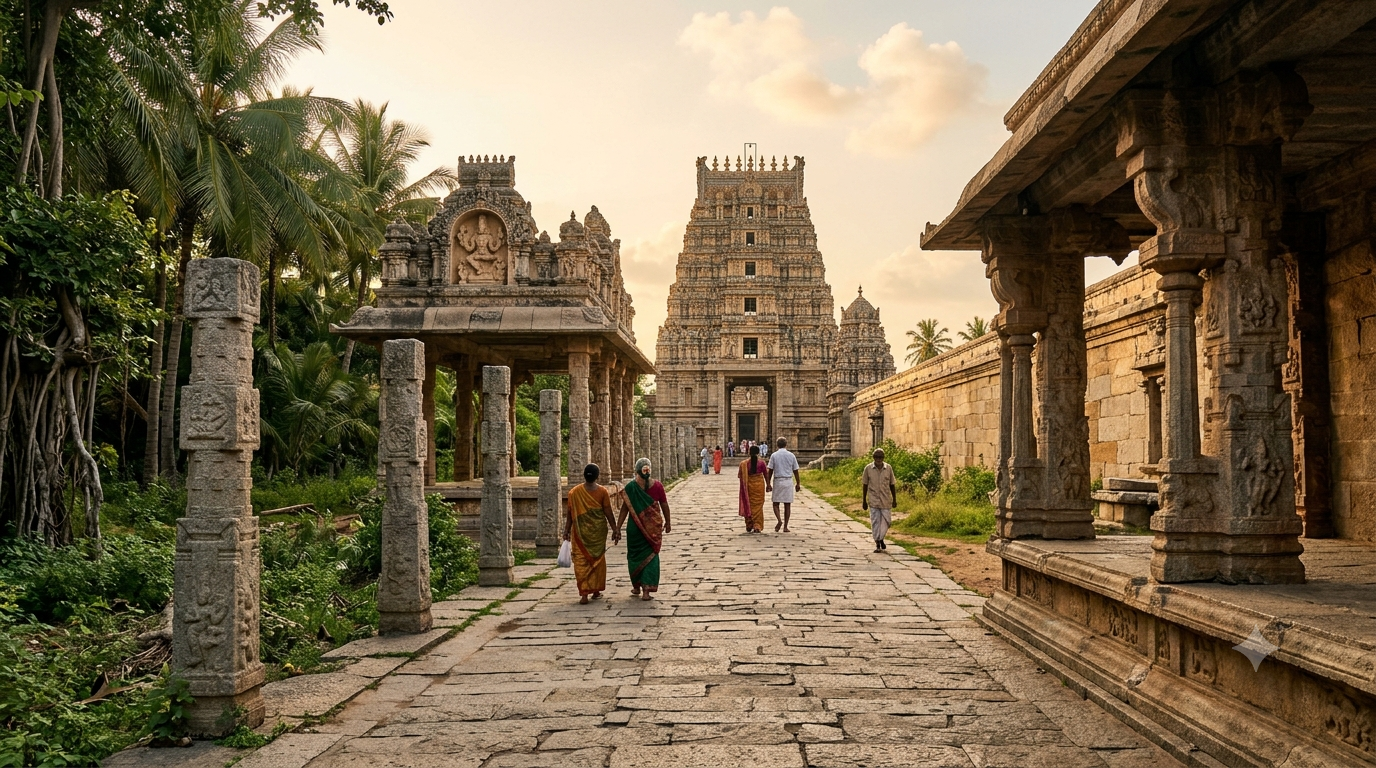
Temples in Andhra Pradesh offer very different journeys, from Tirumala’s crowded hill shrine to Lepakshi’s stone halls and Appikonda’s coastal Shiva temple. These five places reward a closer look, but they do not form a convenient weekend circuit. The sensible plan is to choose a region first and allow enough time for worship, history and travel.
Independent-guide note: Temples Map is not affiliated with any temple trust, Tirumala Tirupati Devasthanams (TTD), or the Andhra Pradesh Endowments Department. We do not accept darshan bookings, donations or payments. Check official temple channels for current services.
Five temples in Andhra Pradesh at a glance
This list keeps five contrasting temples in Andhra Pradesh from the original guide. They span southern, western and coastal Andhra Pradesh, so their nearest transport hubs matter as much as their architecture.
| Temple | Location and useful base | Main reason to visit |
|---|---|---|
| Sri Venkateswara Swamy Temple | Tirumala; base in Tirupati | Lord Venkateswara and the Seven Hills tradition |
| Veerabhadra Swamy Temple | Lepakshi, Sri Sathya Sai district; base in Hindupur | Vijayanagara carvings and hanging pillar |
| Sri Veera Venkata Satyanarayana Swamy Temple | Annavaram, Kakinada district; base near Annavaram or Tuni | Ratnagiri shrine, chariot form and Satyanarayana vratam |
| Talpagiri Ranganatha Swamy Temple | Nellore city; base in Nellore | Reclining Vishnu and historic riverfront gopuram |
| Someswara Swamy Temple | Appikonda; base in Visakhapatnam | Coastal Shiva shrine and medieval inscriptions |
Among these temples in Andhra Pradesh, the clearest pairing is Annavaram with a separate Visakhapatnam day for Appikonda. Tirumala needs its own schedule, while Lepakshi works better as a Hindupur-area heritage visit.
1. Tirumala Venkateswara Temple: devotion on the Seven Hills
Tirumala’s Sri Venkateswara Swamy Temple stands in the Seshachalam Hills above Tirupati. Devotees worship Lord Venkateswara here as a form of Vishnu. The Seven Hills and their link to Adisesha belong to the temple’s sacred tradition, rather than to a dated archaeological account.
The temple has developed over many centuries. According to TTD’s official temple history, successive patrons contributed to its entrances and complex. It is therefore more accurate to describe gradual development than to assign the whole monument one construction year.
Plan darshan before other sightseeing
Use the official TTD website to reach current temple information and authorised service links. Darshan entry and waiting time depend on the category, quota, crowd levels and temple operations. An early arrival alone cannot guarantee a short queue.
Give Tirumala a full day if darshan is your main purpose. Families who also want to see temples in Tirupati town may prefer an extra day. For more detail on official quota releases, read our TTD Special Entry Darshan guide.
Wear the clothing required for your chosen darshan category, and check the latest TTD guidance. Keep medicines, drinking water and rest breaks in mind when planning hill travel.
2. Lepakshi Veerabhadra Temple: Vijayanagara stonework
Among historic temples in Andhra Pradesh, Lepakshi’s Veerabhadra Swamy Temple stands in today’s Sri Sathya Sai district, not Anantapur district as older guides say. It remains closely associated with the Vijayanagara period. The district administration credits Virupanna with developing the shrine into its notable architectural form.
Its striking features include sculpted pillars, painted ceilings and a large monolithic Nandi nearby. One pillar has a visible gap beneath part of its base. That architectural feature deserves care and observation, not claims that the pillar breaks the laws of physics.
Make Hindupur your starting point
The Sri Sathya Sai district tourism page places Lepakshi around 15 km from Hindupur. It also identifies Bengaluru as a practical access city. This makes Lepakshi a strong day trip from the Hindupur or Bengaluru side.
Allow time to walk between the temple and Nandi sculpture. Stone paving can be uneven, so choose supportive footwear for the approach. Do not rub, push or slide objects under fragile historic features.
The site suits people who want to see craftsmanship as well as offer prayers. Our separate Lepakshi Veerabhadra Temple guide gives the monument its own detailed treatment.
At Annavaram in Kakinada district, devotees visit Sri Veera Venkata Satyanarayana Swamy on Ratnagiri Hill. The shrine’s distinctive symbolism unites forms of Brahma, Vishnu and Shiva in its traditional explanation. Families also come for Satyanarayana vratam, a devotional observance associated with prosperity and gratitude.
The main temple resembles a chariot on four wheels, as described in an Andhra Pradesh Tourism brochure. The Kakinada district tourism page also describes the shrine’s distinctive Trinity symbolism. Together, these details explain what makes the temple special without assigning it an uncertain construction date.
Annavaram has its own railway station on the coastal rail corridor. The hill shrine is reachable from the town, although uphill walking may be demanding. Check with the Devasthanam about current access, vratam procedures and arrangements for visitors with reduced mobility.
A vratam may take more time than a simple darshan visit. Therefore, do not schedule it between tightly timed road departures. If the service you need is unavailable, seek the next authorised slot through the temple’s official channel.
Devotional traditions describe spiritual benefits, but they are not medical treatment or a guarantee of material results. Visitors who fast should account for their own health needs.
4. Talpagiri Ranganatha Swamy Temple: Nellore’s river shrine
Talpagiri Ranganatha Swamy Temple stands beside the Penna, also called Pennar, in Nellore. Its principal deity is a reclining form of Lord Vishnu. The site offers a different experience from a large hill pilgrimage because its history is woven into the city itself.
The Nellore district government’s historical account associates the shrine with early Pallava patronage, Chola-period additions and later construction. It dates the prominent eastern Raja Gopuram to 1849. So the temple should not be described simply as a building completed in the 12th century.
See the gopuram, then the older temple layers
Look for the tall Gali Gopuram, the spacious temple setting and the reclining Vishnu iconography. The annual chariot festival is part of the local devotional calendar. Exact festival dates and entry arrangements change, so check locally before arranging a visit around them.
Stay in Nellore if you want an unhurried city visit. It is easier to give this temple a separate stop than to force it into a same-day Tirumala schedule. Avoid entering the river for bathing solely because a traditional account describes sacred benefits. Water and bank conditions need independent safety checks.
5. Appikonda Someswara Temple: Shiva worship by the coast
Appikonda is a coastal settlement near Visakhapatnam with a historic Shiva shrine. The Visakhapatnam district administration describes its large black-stone Nandi and local tradition linking the lingam to sage Kapila. The sage’s role is a belief recorded in local tradition, not an established construction date.
Another district account mentions 12th-century inscriptions connected with temple worship. That evidence is stronger than assigning the temple to a named king in exactly 1070 AD. Nor should guides automatically label the monument ASI-protected without a current official listing.
Pair Appikonda with a Visakhapatnam stay
District tourism places Appikonda about 18 km from Visakhapatnam. Treat that as a locality reference, not a guaranteed drive time from every part of the city. Port-area traffic and your accommodation location can change the journey.
Visit the shrine first, then decide whether coastal conditions permit a short walk. The beach is not a supervised swimming attraction simply because it sits near a pilgrimage place. Avoid entering rough water, especially during monsoon weather or strong surf.
How to plan temples in Andhra Pradesh by region
The quickest way to spoil a tour of temples in Andhra Pradesh is to count shrines without counting travel. These five places fall into separate clusters, so use one of the following plans instead of driving across the state for a photo at each entrance.
| Trip plan | Practical base | Suggested time |
|---|---|---|
| Tirumala pilgrimage | Tirupati | One full darshan day; add a day for town temples |
| Lepakshi heritage visit | Hindupur or Bengaluru | One day with transport arranged |
| Nellore temple visit | Nellore | Half day to one day, excluding intercity travel |
| Annavaram and Appikonda coastal trip | Annavaram/Tuni and Visakhapatnam | Two separate days plus transfer time |
Southern temples in Andhra Pradesh: Tirumala and Nellore
Start with your fixed Tirumala darshan arrangements because they determine everything else. If you also want Talpagiri, plan a separate Nellore stop while travelling along the southern corridor. Do not assume both temple visits fit between train departures on the same day.
Western Andhra: Lepakshi and Hindupur
Lepakshi belongs on a Hindupur-based itinerary, not as a quick detour after Tirupati. Travellers arriving from Bengaluru can also make it a focused heritage excursion. Since heritage viewing takes time, reserve daylight for the carvings and outdoor Nandi.
Visit Annavaram on one day and Appikonda from Visakhapatnam on another. The coastal railway and road corridor links the broader region, but local transfers still matter. For a broader statewide selection, see our Andhra Pradesh temple pilgrimage overview. If you have extra time near Kakinada, our Draksharamam travel guide covers another coastal temple option.
These routes between temples in Andhra Pradesh are planning patterns, not package tours or promises of transport availability. Confirm railway schedules through Indian Railways and road services through the relevant operators before departure.
Why visiting five temples in Andhra Pradesh takes time
Seeing all five temples in Andhra Pradesh is possible as a longer state trip. Yet it involves western, southern and northern coastal stops. Even a well-planned schedule needs multiple intercity journeys, breaks and flexible nights.
For travellers determined to cover all five, allow roughly a week or more as a planning allowance, not a guaranteed itinerary. Group visits into western, southern and coastal legs. Use trains for suitable long legs, and arrange local road transport only after checking the actual station and temple locations.
If time is limited to three days, choose one region. A three-day journey that spends most hours in transit will not deliver the experience these shrines deserve.
History of these temples in Andhra Pradesh
Temple history often blends inscriptions, later rebuilding and sacred narratives. These are valuable in different ways, but they should not be treated as identical forms of evidence.
- Tirumala: temple tradition explains the Seven Hills, while official historical material describes contributions across generations.
- Lepakshi: Vijayanagara-era art and Virupanna’s role have stronger support than sensational claims about its hanging pillar.
- Annavaram: government tourism sources describe its chariot-shaped structure and distinctive Trinity symbolism.
- Nellore: early patronage, Chola works and the 19th-century gopuram belong to different periods.
- Appikonda: 12th-century inscriptions support medieval significance, but not the previously stated exact construction year.
Read inscriptions and official district histories alongside the local stories. You can respect a tradition without treating every legend as a dated event.
Practical tips for temples in Andhra Pradesh
First, confirm your key temple visit and transport connection. Darshan access, ritual slots, dress requirements, photography restrictions and local transport can change independently. Never assume that a timing copied from a travel blog is the current temple schedule.
- Pick a regional base rather than starting with a statewide driving loop.
- Check official darshan and seva channels before finalising non-refundable travel.
- Verify train stops and last-mile transport, especially for Lepakshi and Appikonda.
- Allow for queues, afternoon pauses, festivals and road delays.
- Carry water and required medicines; assess steps and uneven paths if mobility is limited.
- Follow posted photography and footwear rules, and respect spaces reserved for worship.
October to February often offers more comfortable inland sightseeing than peak summer. However, coastal Andhra can also face heavy rain, cyclonic weather and rough seas. Check local forecasts, transport alerts and road conditions when your trip approaches.
When your first plan fails
Even at well-known temples in Andhra Pradesh, a desired darshan or ritual slot is never guaranteed until the relevant authority confirms it. Slots may fill, a festival may change access, or a road connection may be delayed. Start by checking the temple’s own notice or authorised portal.
If a Tirumala quota is unavailable, consider another officially offered date or category, subject to eligibility. If a smaller shrine closes before you arrive, stay nearby and return during confirmed hours. Never pay an agent who promises queue bypasses or guaranteed entry.
Before choosing temples in Andhra Pradesh
These five temples in Andhra Pradesh are worth visiting for different reasons. Tirumala centres on darshan, Lepakshi on art, Annavaram on devotional ritual, Nellore on layered history, and Appikonda on a coastal Shiva tradition. Choose a base that makes the travel reasonable, then give the temple visit room to breathe.
FAQs about temples in Andhra Pradesh
Can I visit all five temples in one weekend?
No. These temples in Andhra Pradesh are spread across western, southern and coastal regions. Choose a regional pair or single destination for a weekend, or allow a much longer trip for all five.
Which of these temples needs the most advance planning?
Tirumala usually deserves the earliest attention because darshan categories and quotas affect your whole schedule. Check TTD’s current official information before committing to transport or accommodation.
Is Lepakshi in Anantapur district?
Older references use Anantapur, but Lepakshi is in Sri Sathya Sai district under the current administrative arrangement. Hindupur remains a useful nearby travel hub.
Is the Lepakshi hanging pillar really floating?
No supernatural explanation is necessary. Part of the pillar’s base has a visible gap, making it a well-known architectural curiosity. View it respectfully and avoid attempts to test or disturb it.
Yes, as a coastal Andhra journey with separate temple days and travel time between them. Base one visit around Annavaram and the other around Visakhapatnam, rather than assuming a short local loop.
How old is the Talpagiri Ranganatha Swamy Temple?
The district’s history describes early Pallava connections and later Chola-period work. Its prominent eastern gopuram dates to 1849, so one construction year would hide its layered history.
Was Appikonda Someswara Temple built in 1070 AD?
That precise claim lacks sufficient support in the official district records reviewed here. The district instead documents 12th-century inscriptions, which establish a medieval historical connection.
Are temple timings, entry and rituals the same everywhere?
No. Each temple follows its own schedule and procedures, and festival arrangements may change them. Confirm with the relevant temple or government source shortly before travel.