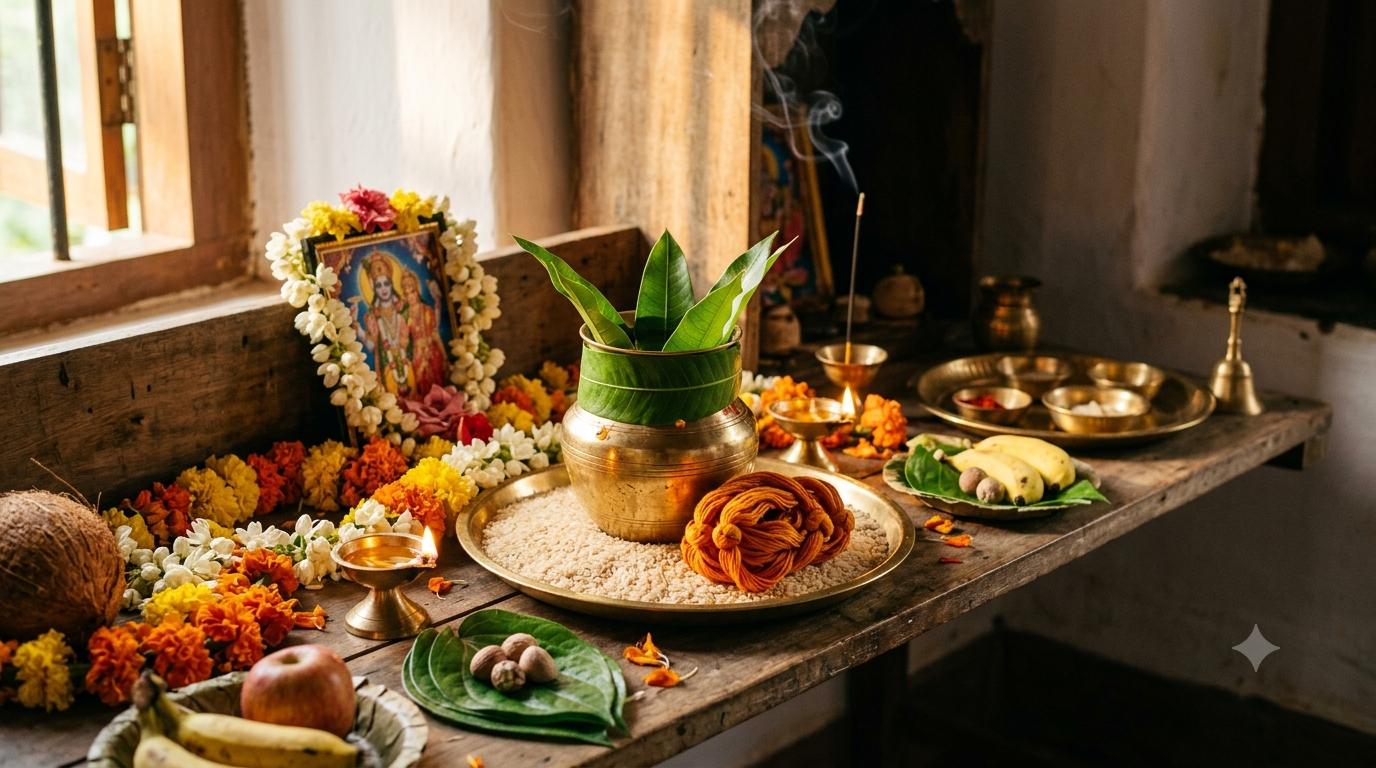
The Anantha Padmanabha Swamy Vratham in 2026 falls on Friday, 25 September, honouring Lord Vishnu in his eternal Ananta form on the serpent Adishesha. Millions of families across Andhra Pradesh, Telangana and South India keep this vow each year. Many confuse it with a Shiva ritual because of misleading images online, yet it worships Vishnu. This guide gives you the correct date, the full pooja vidhanam, the fourteen-knot thread ritual, and the vrata katha.
Temples Map is an independent devotional guide. We are not affiliated with, and are not the official website of, any temple or trust, and we do not accept bookings, poojas, or payments. For panchang timings and official temple information, use the sources linked at the end.
Anantha Padmanabha Swamy Vratham 2026 at a Glance
Here are the essential facts before the details. Devotees short on time can act on this summary alone.
- Date in 2026: Friday, 25 September (Bhadrapada Shukla Chaturdashi)
- Deity: Lord Vishnu as Ananta Padmanabha, worshipped with Yamuna and Shesha
- Sacred thread: the Ananta Sutra, a toram tied with fourteen knots
- Traditional duration: observed once a year for fourteen consecutive years
- Also known as: Ananta Chaturdashi, Anant Chaudas, Anantha Vratham
- Same day: Ganesh Visarjan, the final day of the Ganesh festival
When Is Anantha Padmanabha Swamy Vratham in 2026?
The Anantha Padmanabha Swamy Vratham in 2026 is observed on Friday, 25 September. It always falls on Chaturdashi, the fourteenth day of the bright fortnight in the month of Bhadrapada. Because this is a lunar date, it shifts every year, so a fixed calendar day never applies.
According to Drik Panchang, the Chaturdashi tithi in 2026 begins at 11:18 PM on 24 September and ends at 11:06 PM on 25 September for New Delhi. Since tithi windows depend on local sunrise, the exact start and end times vary by city. Telugu households in Vijayawada, Hyderabad or Visakhapatnam should therefore confirm the muhurtam on a regional panchangam before fixing the puja time.
This same day also marks Ganesh Visarjan, when the ten-day Ganesh festival concludes. In 2026, Ganesh Chaturthi begins on 14 September, so the tenth day lands on 25 September. Many families juggle both observances, although the two are separate.
The Meaning Behind Anantha Padmanabha Swamy Vratham
The word “Ananta” means endless or infinite. On this day, devotees worship Lord Vishnu resting in Ananta Shayana, his cosmic sleep on the coils of Adishesha, the thousand-hooded serpent. This reclining posture is a picture of perfect stillness, so the vratham teaches devotees to stay calm through both joy and sorrow.
The ritual honours three sacred presences together. First comes Yamuna, the holy river; then Shesha, the serpent who bears the Lord; and finally Ananta himself, meaning Vishnu. Because of this, the classical puja has three parts, which we cover in the vidhanam below.
The most famous shrine of this form is the Sree Padmanabhaswamy Temple in Thiruvananthapuram, where the eighteen-foot idol reclines in the very Anantha Shayanam posture the vratham celebrates. While the home vow does not require a temple visit, that temple is the great reference point for the deity.
Significance and Benefits of the Vratham
In tradition, the Anantha Vratham is believed to bring prosperity, marital harmony and relief from past karma. Married couples usually perform it together for household peace, so it is often called a vow for family well-being. These are matters of faith and Vedic custom rather than guaranteed outcomes.
The vrata traces back to the Mahabharata. During the Pandavas’ forest exile, Lord Krishna advised Yudhishthira to observe the Anantha Vratham to recover lost fortune and dignity. Because of that story, devotees associate the vow with restoration of wealth and stability. Scriptural mentions also appear in the Bhavishya Purana and in Hemadri’s treatise on tithis.
Anantha Padmanabha Swamy Vratham Pooja Vidhanam Step by Step
The full Anantha Padmanabha Swamy Vratham pooja vidhanam is a shodashopachara worship, meaning sixteen ceremonial offerings. You can perform it at home, either yourself or with a purohit. Below is the traditional sequence, followed by the samagri and the special rituals.
- Wake early, bathe, and wear clean clothes. Clean the puja area and draw a fresh muggu or rangoli.
- Take the sankalpam, the vow, stating your name, gotra and intention to perform the vratham.
- Set up the kalasham and the image of Ananta Padmanabha Swamy on a decorated plate of raw rice.
- Invoke Yamuna, then Shesha, then Ananta, and perform the sixteen upacharas for each.
- Tie the new Ananta Sutra after the puja, and read the vrata katha aloud.
- Offer the naivedyam, wave the deeparadhana, and distribute prasadam to conclude.
What You Need (Samagri)
Gather the materials a day ahead, since some items take time to source. Most are available at any puja store.
- A picture or small idol of Ananta Padmanabha Swamy, and a kalasham
- Fresh cotton thread and turmeric to prepare the toram
- Darbha grass to shape the serpent figure
- Fourteen types of flowers, fourteen leaves (patri) and fourteen fruits
- Raw rice, turmeric, kumkum, betel leaves, camphor and a ghee lamp
- Atirasalu or other sweet naivedyam for the offering
The Fourteen-Knot Ananta Sutra (Toram)
The heart of the vratham is the sacred thread, called the Ananta Sutra or toram. Made of cotton, it carries fourteen knots, each knot standing for one of the fourteen lokas and one year of the fourteen-year vow. Devotees dye it with turmeric and kumkum until it turns a deep saffron.
After the puja, men tie the thread on the right arm and women on the left, following common custom. Before wearing the new toram, you first remove the previous year’s thread with respect. Because the thread is sacred, you never throw it in the bin; you release it in flowing water or a clean spot instead.
The Three-Part Puja: Yamuna, Shesha and Ananta
Classical texts describe three linked worships on this day. The first is Yamuna Puja, where water in the kalasham represents the sacred river. The second is Shesha Puja, honouring the serpent, often shaped from darbha grass with seven hoods. The third is Ananta Puja for Vishnu himself, the presiding deity.
In many Telugu homes, two kalashams are set for Lakshmi and Vishnu, and fourteen lotuses are drawn before placing them. While practice varies by family, the spirit stays the same: you honour the Lord, his serpent seat, and the waters that sustain creation.
The Vrata Katha: Story of Sushila and Kaundinya
Every devotee reads or hears the vrata katha on this day. The best-known story is that of Sushila and her husband, the sage Kaundinya. Troubled by her stepmother, Sushila left home with Kaundinya, and on the way they rested by a river.
There Sushila saw women worshipping Bhagavan Ananta, so she learned the ritual and tied the sacred thread. Prosperity soon followed the couple, but their fortune vanished when Kaundinya later removed the thread in pride. Only after he sought Ananta again with humility did their wealth and peace return. Because of this lesson, devotees keep the vow with steady devotion, never casual pride.
Why the Number Fourteen Matters
Fourteen runs like a thread through the whole vratham, which is why the ritual repeats it so carefully. The table below shows where the number appears and what each represents.
| Element | Count | Meaning |
|---|---|---|
| Knots in the Ananta Sutra | 14 | The fourteen lokas and fourteen years of the vow |
| Years of observance | 14 | One vratham each year, then a concluding udyapana |
| Varieties of flowers | 14 | Offered to the deity for completeness |
| Varieties of leaves (patri) | 14 | Sacred leaves used in the archana |
| Fruits offered | 14 | Symbol of abundance and purity |
So the toram is not just decorative. Its fourteen knots quietly encode the entire structure of the vow.
What Devotees Often Get Wrong
A few practical mistakes trip up first-time observers, so keep these in mind.
- Wrong deity: this is a Vishnu vratham, not a Shiva one. Many online images show Shiva by error, which confuses newcomers.
- Skipping the katha: the story is not optional. Reading it is part of the vow, since it carries the whole moral of the ritual.
- Discarding the old toram carelessly: remove last year’s thread with respect and release it in water, never a dustbin.
- Fixing the time from a Delhi calendar: confirm the tithi on a local panchangam, because the window shifts by city.
- Starting without commitment: the vow traditionally runs fourteen years, so begin only when you can continue.
A Note on Fasting Safely
Most devotees keep a fast until the puja is complete, and then eat the prasadam and a simple meal. If you have diabetes, low blood pressure, or you are pregnant, elderly, or unwell, do not attempt a full waterless fast. A phalahar fast of fruit and milk is fully acceptable, and your health matters to the Lord too. When in doubt, consult your doctor before fasting.
Anantha Padmanabha Swamy Vratham in Telugu: Vidhanam and Katha
Many readers search for a Telugu PDF of the vidhanam and katha. The complete procedure and the story are laid out in full on this page, so you can follow the vratham without a separate download. If you prefer a printed Telugu booklet, most temple book stalls in Andhra Pradesh and Telangana stock the Anantha Vratha Kalpam during Bhadrapada.
For the mantras and slokas, a local purohit or a standard vratha kalpam will guide the recitation. Because pronunciation matters in these chants, hearing them from an experienced elder or priest is better than reading alone.
Before You Begin the Vratham
The Anantha Padmanabha Swamy Vratham is a gentle, home-centred vow that asks for sincerity more than grandeur. Fix the date for 25 September 2026, confirm the tithi locally, and gather your samagri a day ahead. Prepare the toram, worship Yamuna, Shesha and Ananta in order, read the katha, and tie the sacred thread. Above all, begin only if you intend to continue the vow with steady faith over the years.
Frequently Asked Questions
When is Anantha Padmanabha Swamy Vratham in 2026?
It falls on Friday, 25 September 2026, on Bhadrapada Shukla Chaturdashi. The tithi window varies slightly by city, so confirm the muhurtam on a local panchangam. This is also Ganesh Visarjan day.
Which god is worshipped in Anantha Padmanabha Swamy Vratham?
Lord Vishnu is worshipped in his Ananta Padmanabha form, reclining on the serpent Adishesha. It is not a Shiva ritual, despite misleading images online. Yamuna and Shesha are honoured alongside Vishnu.
Why does the sacred thread have fourteen knots?
The fourteen knots of the Ananta Sutra stand for the fourteen lokas and the fourteen years of the vow. Each knot is a reminder of the vratham’s structure. The thread is dyed saffron with turmeric and kumkum.
How long must the vratham be observed?
Tradition prescribes observing it once a year for fourteen consecutive years. After the fourteenth year, families perform an udyapana, a formal completion ceremony. Some continue the vow lifelong out of devotion.
Can I perform the vratham without a pandit?
Yes, many families perform it at home themselves. A picture of Ananta Padmanabha Swamy, a kalasham, the toram and the katha are enough for a sincere puja. A purohit helps mainly with the Sanskrit mantras.
Is Anantha Padmanabha Swamy Vratham the same as Ananta Chaturdashi?
Yes, they are the same observance. Ananta Chaturdashi is the tithi name, while Anantha Padmanabha Swamy Vratham describes the vow performed on it. Both fall on Bhadrapada Shukla Chaturdashi.
What prasadam is offered during the vratham?
Sweet offerings such as atirasalu, along with fourteen fruits, are commonly prepared. The naivedyam is offered to the Lord and then shared as prasadam. Sharing food with family and Brahmins is part of the tradition.
What should I do with last year’s toram?
Remove the previous year’s thread respectfully before tying the new one. Release the old toram in flowing water or a clean natural spot. It should never be thrown in a dustbin.
For the verified date and tithi, see the Drik Panchang Anant Chaturdashi 2026 page. For the deity in his Ananta Shayana form, refer to the official Sree Padmanabhaswamy Temple and the Government of Kerala temple page. You may also find our guides to Mahalaya Pitru Paksha 2026 and Navaratri Durga Pooja useful, since both follow soon after in the same season.