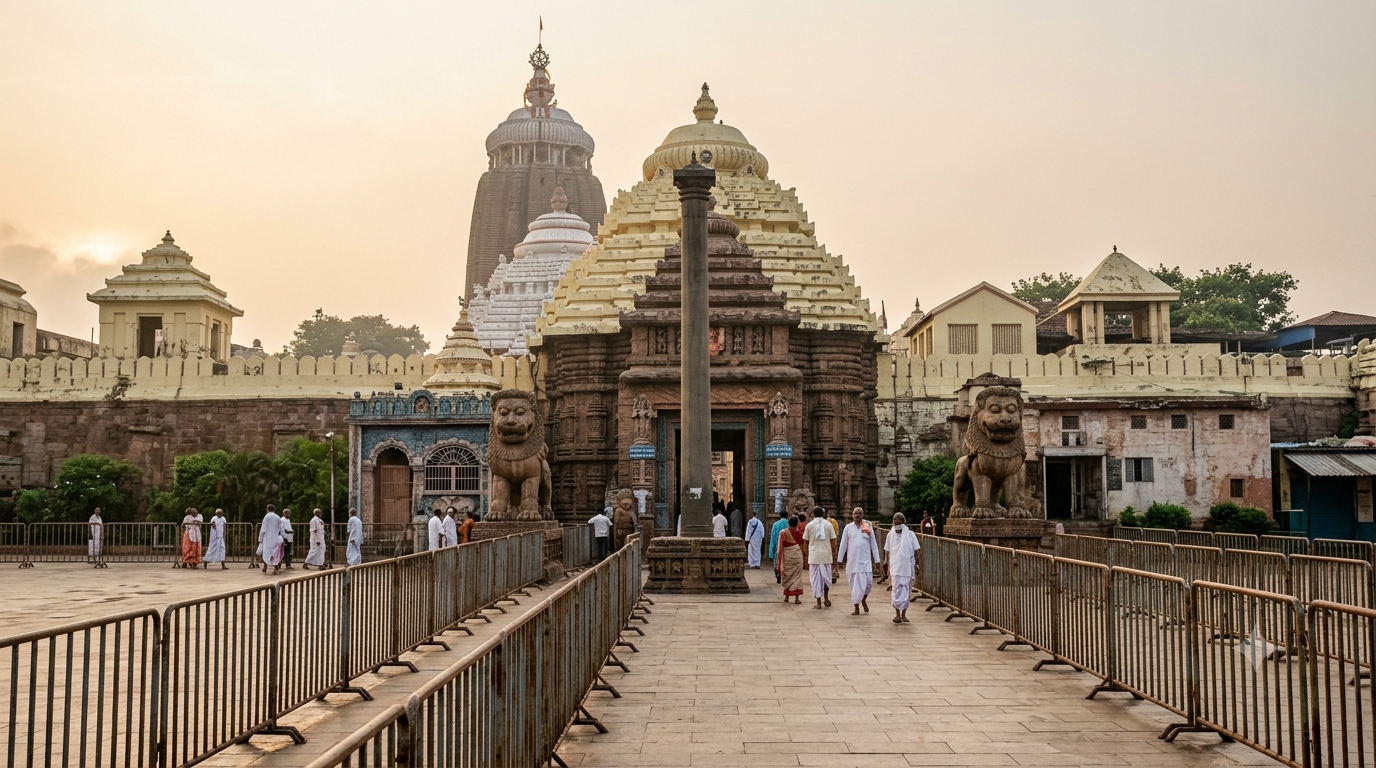
Every month, thousands of pilgrims hunt for a Jagannath Temple online darshan booking link that still does not exist. In fact, the Shree Jagannath Temple Administration (SJTA) in Puri runs no ticketing website, no slot system, and no paid queue for the main shrine. Entry is free, so every devotee joins the same line at Singhadwara.
That gap between what people search for and what actually exists is exactly where the Jagannath Temple online darshan scams live. In July 2026, the temple administration went to the police over one such fake portal. So before you hand money to any website, read what the authority itself has said.
Temples Map is an independent pilgrim guide. We are not affiliated with, endorsed by, or the official website of the Shree Jagannath Temple Administration. We also accept no bookings, donations, or payments of any kind. For official information, use the SJTA portal linked below.
Jagannath Temple Online Darshan Booking at a Glance
- Official booking site for darshan: none exists. SJTA has clearly confirmed this publicly.
- General darshan cost: free. The temple sells no entry ticket for ordinary darshan.
- Paid VIP darshan: SJTA stated in July 2026 that no such provision exists.
- Entry gate: Singhadwara (Lion’s Gate) only. The other three gates then serve as exits.
- Darshan start: around 5.30 AM, after Mangala Alati.
- What you can book online: SJTA guest house rooms, through the official stay portal.
- Entry restriction: non-Hindus are not permitted inside the temple.
Is There an Official Jagannath Temple Online Darshan System?
No. There is no official Jagannath Temple online darshan booking portal, app, or slot-reservation system for the Puri shrine. Darshan of Lord Jagannath, Lord Balabhadra, and Devi Subhadra is free and unticketed. Devotees simply join the public queue at the Lion’s Gate during open darshan hours.
This naturally surprises people who plan pilgrimages elsewhere. Tirumala, Vaishno Devi, and several other major shrines do run online systems, so pilgrims reasonably assume Puri works the same way. Still, it does not.
The distinction matters because search results overflow with pages promising exactly the opposite. For example, many aggregator sites publish step-by-step “booking” instructions, complete with invented fees. Those steps lead nowhere official, since the underlying facility was never created.
The single official source for temple information remains the SJTA website at shreejagannatha.in. If SJTA ever introduces a darshan booking facility, it will say so there first.
What SJTA Said About Fake Booking Portals in July 2026
On 20 July 2026, during the Rath Yatra period, SJTA issued a blunt clarification: there is no paid system or provision for “VIP Darshan” at the shrine. The administration also lodged a police complaint at Singhadwara police station against an entity operating as ‘eoOdisha’.
According to the complaint, that entity circulated social media advertisements promising smoother, privileged access to the temple in exchange for money from 1 August. Soon after, police and the SJTA security wing began tracing the people behind the website.
Central Range Inspector General Satyajit Naik put it plainly while warning the public about online scams, saying there are no rules or provision for VIP darshan. Similarly, senior servitors reinforced the same point. Chhatisa Nijoga chief Janardan Pattajoshi Mohapatra confirmed that no online ticketing exists for general or VIP entry.
Temple representatives added that every devotee must stand in the general queue, whether they travel from Maharashtra, Telangana, Uttar Pradesh, or anywhere else. SJTA specifically urged out-of-state pilgrims to stay alert, because they are the group most often targeted.
Separately, the SJTA website carries a standing notice that the administration never accepts donations or offerings from devotees for online puja. The notice also asks devotees to watch out for fraudulent sites offering such services.
How Darshan Actually Works Inside Shree Mandira
Because rituals continue all day, darshan runs in phases rather than one continuous stretch. The temple pauses public access while rituals and bhog offerings take place. Understanding these windows helps far more than any Jagannath Temple online darshan link, since your real constraint is timing.
Specifically, SJTA describes the daily pattern as follows. Treat the clock times as approximate, because rituals shift with the lunar calendar and festival load.
| Approximate window | Where you view from | Ends with |
|---|---|---|
| 5.30 AM to 7.30/8 AM | Jagamohan (Bhitar Kaatha) | Completion of Besha |
| 8 AM to 9.15 AM | No darshan | Gopal Ballav Puja |
| 9.15 AM to 11 AM | Natamandir (Bahaar Kaatha) | Sakala Dhoopa Puja |
| 11 AM to 1 PM | Jagamohan | Bhoga Mandap Puja |
| 2 PM to 5.30 PM | Near Bhitar Kaatha | Sandhya Aalati |
| 8 PM to 9 PM | Near Bhitar Kaatha | Chandan Laagi |
Note the long morning gap. Roughly one hour and fifteen minutes after Besha, darshan stops entirely for Gopal Ballav Puja. Pilgrims who arrive at 8.15 AM therefore wait without realising why.
There is also Sahana Mela, the open darshan when devotees may move close to the Ratnavedi. It also carries no charge at all.
Queue and Gate Movement
Because crowds surge, barricades channel devotees at the Lion’s Gate and at Kirtan Chakada in the inner courtyard. Singhadwara is the only entry point, while the remaining three gates handle exits. Officials, sevaks, and Puri residents may use any gate with valid ID proof.
What the Jagannath Temple Online Darshan Rumours Get Wrong
Meanwhile, competing pages repeat several claims that do not hold up. We checked each against SJTA material and current reporting, so you can stop paying for them.
- “VIP darshan costs ₹500 to ₹2,500.” SJTA says no VIP darshan provision exists. So any site quoting a tariff sells something the temple does not offer.
- “Book your slot on the SJTA website.” The official site offers no darshan slot booking at all.
- “Darshan tickets cost ₹10 on special days.” This figure circulates widely, including in older versions of this page, yet no official SJTA source supports it.
- “The temple opens at 4 AM.” SJTA puts the opening and darshan start at around 5.30 AM.
- “Darshan takes 30 to 45 minutes.” Waits swing from minutes to several hours, depending on the day and ritual phase.
A paid Parimanik darshan has existed at various points in the temple’s recent history, and reports about its status have gone back and forth. Because SJTA’s stated position in July 2026 is that no paid VIP access exists, treat any fee you see online as unverified. Confirm at the temple’s own counters instead.
How to Spot a Fake Jagannath Temple Online Darshan Website
Fake portals follow a recognisable pattern. Run any site you find through these five checks before entering a card number or an Aadhaar detail.
- Check what it is selling. If a page sells darshan entry, priority access, or a “VIP pass” for Puri, it is not legitimate.
- Check the domain. SJTA uses shreejagannatha.in for temple information and stayatpurijagannatha.in for guest houses. Any lookalike domain is therefore a warning sign.
- Check for pressure tactics. Countdown timers, “only 3 slots left”, and WhatsApp-only payment links are marketing devices, not temple practice.
- Check the contact route. Genuine temple services do not run through a private mobile number or a personal UPI ID.
- Check for online puja offers. SJTA has stated it never accepts donations or offerings for online puja, so any such offer is fraudulent.
If a site fails even one of these, walk away. Losing a booking fee is the smaller problem, because these portals also harvest identity documents and phone numbers.
What You Actually Can Book Online for a Puri Visit
Accommodation, however, is the genuine exception. Although no Jagannath Temple online darshan facility exists, SJTA does run several guest houses in Puri. You can reserve rooms through the official stay portal at stayatpurijagannatha.in. Moreover, part of the earnings goes back to the temple.
The administration lists properties including Shree Gundicha Bhakta Niwas near the Gundicha Temple on Grand Road, Neeladri Bhakta Niwas near the town police station, and Purushottam Bhakta Niwas near Old Jail. Neelachal Bhakta Niwas and Neelachal Yatri Niwas are also SJTA-managed.
Room categories run from non-AC to AC to VIP suites, and tariffs change during festival periods. SJTA publishes separate package rents for the Car Festival window, so check the portal for current rates rather than trusting a third-party figure.
One more verified detail worth knowing: a parking fee of ₹240 including 18% GST applies per four-wheeler for 24 hours at the Bhakta Niwas, effective from 18 January 2026.
Still, be careful here too. SJTA has publicly warned that miscreants created a fake website to cheat devotees booking rooms at Neelachal Bhakta Niwas and Neelachal Yatri Niwas. Reach the booking pages through the official site rather than through a search advertisement.
Entry Rules, Dress Code and Prohibited Items
The temple admits only Hindus. Visitors of other faiths may still view the shrine from the roof of the Raghunandan Library across the road, which is a long-standing practice at Puri.
Also, dress modestly. Temple custom expects traditional Indian clothing, so keep shoulders and knees covered.
Leather goods, including belts, wallets, and bags, are not allowed inside. You must also deposit mobile phones and cameras at the cloakroom near the Lion’s Gate, so carry as little as possible.
The temple prohibits photography inside. Keep valuables at your hotel, since cloakroom queues get long on festival days and slow your whole visit.
Cutting Queue Time Without Jagannath Temple Online Darshan
Since no Jagannath Temple online darshan booking can shorten your wait, timing and planning do the work instead. These tactics come from how the ritual schedule actually behaves.
- Arrive before 5.30 AM. The first window after Mangala Alati is usually the calmest of the day.
- Skip the 8 AM to 9.15 AM slot. Darshan stops then, so arriving at that hour only buys you a longer wait.
- Prefer weekdays. Crowds swell because weekends, public holidays, and the new year period draw the biggest turnout.
- Stay within walking distance. Grand Road accommodation lets you reach the gate early, so traffic never decides your day.
- Deposit belongings first. Clearing the cloakroom before the queue builds saves real time.
The Srimandir Parikrama Prakalpa, the heritage corridor around the temple completed in January 2024, has made movement noticeably more organised. Crowd management now uses a one-way system, with barricading extended well beyond the temple premises during peak days.
If you want the full ritual schedule in one place, our Puri Jagannath Temple timings and guide breaks down each seva window.
Health and Safety Notes for Puri Pilgrims
Queues at Puri stand in open heat for long stretches, and coastal humidity makes it harder. Carry drinking water and a cap, because the barricaded lines offer very little shade.
Elderly pilgrims, pregnant women, and anyone with a heart or blood pressure condition should plan an early-morning visit and keep medication accessible. If you are fasting before darshan, speak to your doctor first, particularly if you manage diabetes.
Ritual observances and traditional remedies also belong to faith and custom. They are not a substitute for medical treatment, so continue any prescribed care during your yatra.
During Rath Yatra the crowd density on Grand Road becomes extreme. Keep children close, agree a meeting point in advance, and follow police instructions without argument.
Days When Darshan Is Suspended or Altered
Public darshan does close occasionally for major rituals. In 2026, for example, SJTA suspended public darshan from 10.30 PM on 27 June until roughly 1 PM on 28 June, ahead of Snanajatra on 29 June.
After Snanajatra the deities enter Anasara, a seclusion period of about fifteen days when public darshan of the main deities is not available. Rath Yatra 2026 fell on 16 July, with Bahuda Yatra on 24 July.
Watching the chariot festival needs no ticket and no registration. Grand Road is open to everyone, including non-Hindus, although temple entry itself stays restricted.
Always check the SJTA site or credible Odisha news outlets a few days before travelling, since SJTA announces ritual closures at short notice.
Before You Book Your Trip
The practical takeaway, then, is short. There is no Jagannath Temple online darshan booking to arrange, no ticket to buy, and no legitimate way to skip the queue. So anyone selling one simply takes your money for nothing.
Spend that planning energy on the two things that genuinely matter: arriving inside the right darshan window, and staying close enough to reach the gate early. Book your room through the official SJTA stay portal, and confirm ritual timings shortly before you travel.
Planning the journey itself? Our route guides from Hyderabad to Puri and from Bangalore to Puri cover train, road, and air options in detail.
Jagannath Temple Online Darshan: Frequently Asked Questions
Can I book Jagannath Temple online darshan tickets in advance?
No. SJTA operates no advance booking system for darshan at the Puri temple. Servitors and temple officials confirmed in July 2026 that no online ticketing exists for general or VIP entry. Instead, every devotee joins the same public queue at Singhadwara.
Is darshan at Puri Jagannath Temple free?
Yes, general darshan is free. The temple sells no entry ticket for ordinary darshan, so any site charging you for Jagannath Temple online darshan is not connected to the administration.
Does the temple offer a paid VIP darshan?
SJTA stated in July 2026 that there is no paid system or provision for VIP darshan. Police also warned devotees against advertisements offering privileged access for money.
What time does darshan start at Puri?
Darshan generally begins around 5.30 AM, after Mangala Alati. Access then pauses and resumes through the day in phases, with a full closure of roughly an hour and a quarter after Besha.
Which gate do I use to enter the temple?
Singhadwara, the Lion’s Gate, is the only entry point for devotees. The other three gates are used for exit. Officials, sevaks, and Puri townspeople may enter through any gate with ID proof.
Can I book SJTA guest house rooms online?
Yes. You can reserve rooms at SJTA-managed guest houses through the official stay portal. Go there via shreejagannatha.in, because SJTA has warned about a fake room-booking website targeting its Neelachal properties.
Are non-Hindus allowed inside Puri Jagannath Temple?
No, the temple admits only Hindus. Visitors of other faiths commonly view the temple from the Raghunandan Library rooftop nearby, and everyone may attend the Rath Yatra procession on Grand Road.
What should I do if a website asks me to pay for darshan?
First, do not pay, and never share identity documents. Report it to the SJTA through the official site, since the administration has already filed a police complaint against one such portal.