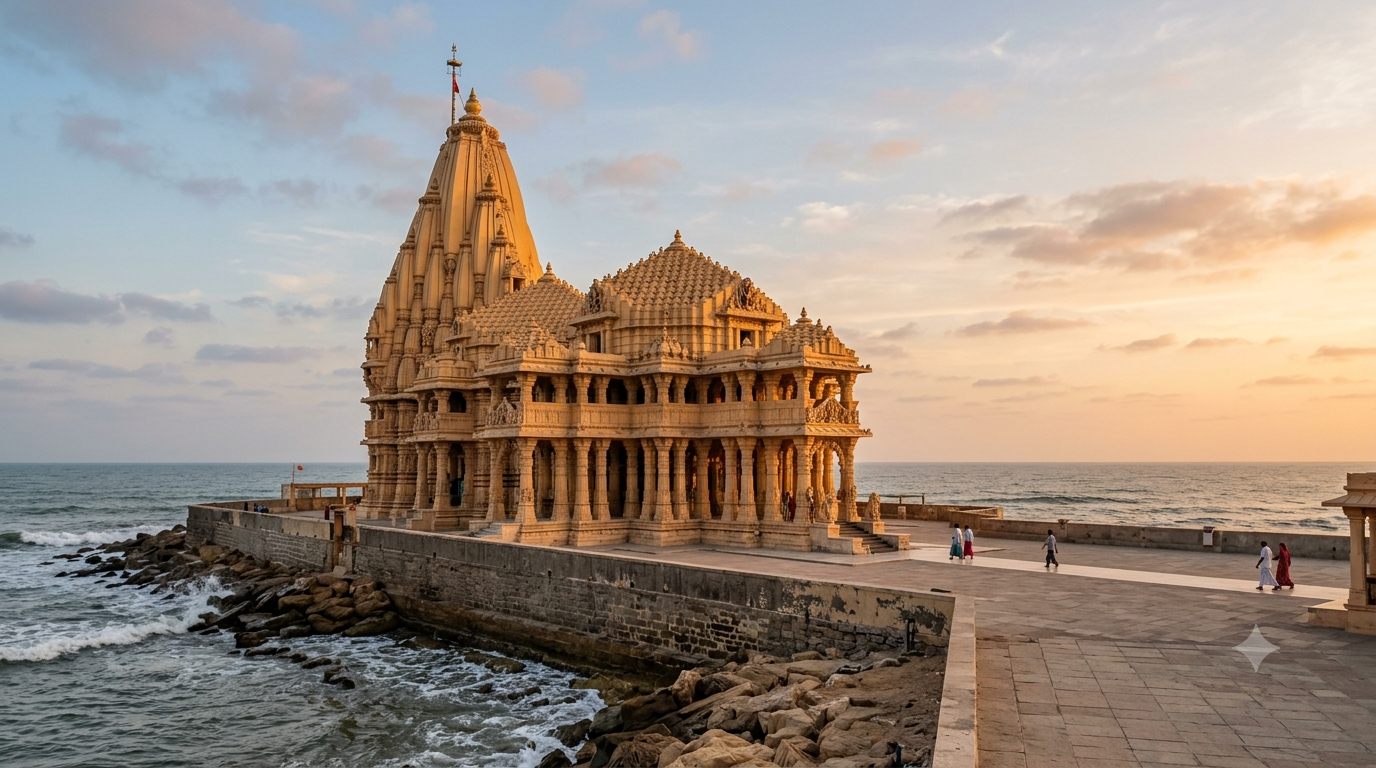
The famous temples in Gujarat span an enormous range. One is the first Jyotirlinga of Lord Shiva, right on the Arabian Sea. Another is a marble temple-city on a Jain hill. Each one rewards a little planning before you arrive.
Some open at dawn and close for a midday break. A few are protected monuments where no puja happens at all. This guide to the famous temples in Gujarat pulls verified timings, entry rules and honest travel notes into one place. So you spend less time guessing and more time in darshan.
Temples Map is an independent pilgrim guide. We are not affiliated with any temple trust or shrine board, and we take no bookings, donations or payments. Every reservation, seva or ticket goes through the official portal we link for each shrine.
Famous Temples in Gujarat at a Glance
Gujarat holds two of the twelve Jyotirlingas and a Char Dham shrine. It also has two major Shakti Peeths and the holiest hill in Jainism. So the famous temples in Gujarat suit almost every kind of pilgrim, from Shiva devotees to Jain yatris. Here is the quick shortlist before the details.
- Somnath — the first of the twelve Jyotirlingas, on the Veraval coast.
- Dwarkadhish (Jagat Mandir) — Krishna’s Char Dham temple at Dwarka.
- Nageshwar — a Jyotirlinga with an underground sanctum near Dwarka.
- Ambaji — a Shakti Peeth where a sacred Yantra, not an idol, is worshipped.
- Swaminarayan Akshardham, Gandhinagar — a vast BAPS cultural complex.
- Modhera Sun Temple — an 11th-century solar shrine, now a heritage site.
- Palitana (Shatrunjaya) — hundreds of Jain temples up a stepped hill.
- Pavagadh Mahakali — a hilltop Shakti shrine reached by ropeway.
The table below gives indicative hours only. Because temple trusts adjust timings for festivals, weather and rituals, always confirm on the official portal before you travel.
| Temple | Where | Deity / type | Typical darshan hours |
|---|---|---|---|
| Somnath | Prabhas Patan, Veraval | Shiva (Jyotirlinga) | 6:00 AM – 10:00 PM |
| Dwarkadhish | Dwarka | Krishna (Char Dham) | 6:30 AM – 1:00 PM, 5:00 PM – 9:30 PM |
| Nageshwar | Near Dwarka | Shiva (Jyotirlinga) | ~6:00 AM – 9:00 PM |
| Ambaji | Banaskantha | Maa Amba (Shakti Peeth) | 7:00–11:30 AM, 12:30–4:30 PM, 6:30–9:00 PM |
| Akshardham | Gandhinagar | Swaminarayan (BAPS) | ~9:30 AM – 7:30 PM, closed Monday |
| Modhera | Mehsana | Surya (heritage monument) | Roughly sunrise to sunset |
| Palitana | Bhavnagar | Adinath (Jain tirth) | Daytime only; hill clears by evening |
| Pavagadh | Panchmahal | Mahakali (Shakti Peeth) | Roughly 5:00 AM – 7:00 PM |
The Most Famous Temples in Gujarat, One by One
Somnath Temple: the first Jyotirlinga
Somnath is the first among the twelve Jyotirlingas of Lord Shiva. It sits right on the Arabian Sea at Prabhas Patan near Veraval. The Shree Somnath Trust lists darshan from 6:00 AM to 10:00 PM daily, so the window is generous.
Aarti runs at 7:00 AM, 12:00 noon and 7:00 PM. The “Jay Somnath” light-and-sound show plays from 8:00 PM to 9:00 PM, except in the monsoon.
General entry is free, and no ticket is needed for main darshan. The trust also runs its own guest houses, which you can book only through somnath.org. Since the shrine has been rebuilt many times across the centuries, devotees often call it the “Shrine Eternal”. Reach before 8:00 AM for the calmest queue.
Dwarkadhish Temple: Krishna’s Jagat Mandir
Dwarkadhish, also called the Jagat Mandir, honours Krishna as the king of Dwarka. It counts among both the Char Dham and the Sapta Puri, so it draws pilgrims all year. Darshan usually runs from 6:30 AM to 1:00 PM, then again from 5:00 PM to 9:30 PM. Meanwhile, the Mangla Aarti falls near 6:30 AM.
General darshan here is free, although special bhog and seva can be arranged at the temple. The five-storey shikhara and the tall flag, changed several times a day, are the landmarks people remember. Online booking scams are common for Dwarka. So treat any site promising paid “VIP tickets” with caution, and confirm arrangements at the temple counter.
Nageshwar Jyotirlinga: the underground shrine
Nageshwar is another of the twelve Jyotirlingas. It lies a short drive from Dwarka, on the way toward Bet Dwarka. The lingam rests in an underground sanctum, which is unusual.
As you approach, a 25-metre seated Shiva statue in the garden is visible from the highway. Devotees know it as Nagnath, the “Lord of Serpents”, believed to protect against all poison.
Most pilgrims pair Nageshwar with Bet Dwarka in a single half-day trip. Timings vary a little by source. The temple is generally open from about 6:00 AM to 9:00 PM, with an evening aarti around 7:00 PM. Confirm the exact slot locally, since some published hours differ.
Ambaji: a Shakti Peeth with no idol
Ambaji sits in the Aravalli hills of Banaskantha. It is one of the most revered Shakti Peeths, where the heart of Goddess Sati is believed to have fallen. The temple hides a surprise that first-time visitors rarely expect.
There is no idol in the sanctum at all. Instead, devotees worship a gold-plated Shree Yantra in a small chamber called the Gokh. It has never been photographed.
The temple opens in three sessions: 7:00–11:30 AM, 12:30–4:30 PM and 6:30–9:00 PM. Aarti falls at 6:00 AM, noon and 7:00 PM. Entry is also free for everyone. Mobiles and cameras are strictly banned inside, so plan to leave them behind.
Nearby Gabbar Hill, the original seat of the Goddess, needs a climb of 999 steps or a short ropeway. During Bhadarvi Poonam, the September full-moon fair, huge crowds arrive. So book stays early through ambajitemple.in.
Swaminarayan Akshardham, Gandhinagar
Akshardham in Gandhinagar is a sprawling BAPS Swaminarayan complex built from pink sandstone. It is a cultural landmark as much as a shrine.
First, a common mix-up: this is the Gujarat Akshardham, a different temple from the larger one in Delhi. It stays closed every Monday. Through the rest of the week, it opens roughly 9:30 AM to 7:30 PM.
Entry to the main mandir is free. The exhibitions, the Abhishek ritual and the Sat-Chit-Anand water show carry small ticket charges.
Also, phones and cameras are strictly prohibited, so you must deposit them in the lockers at the entrance. A modest dress code applies, and sarongs are available if needed. Check current show times on akshardham.com/gujarat before you go.
Modhera Sun Temple: heritage, not active worship
Modhera stands on the banks of the Pushpavati near Mehsana. Bhima I of the Solanki dynasty built this Sun temple around 1026–27 CE. Here is the correction most travel pages miss.
Modhera is a protected Archaeological Survey of India monument. So there are no priests and no daily rituals. You visit it for the architecture, not for darshan.
The complex has three parts: the stepped Surya Kund tank, the Sabha Mandapa hall and the Gudha Mandapa sanctum. Entry costs a small ASI fee: roughly ₹20–₹25 for Indian visitors and about ₹250–₹300 for foreigners. Children under 15 enter free.
Also, confirm the current amount at the ticket counter, since ASI rates change. The village nearby became India’s first round-the-clock solar-powered village in 2022, which suits a Sun temple rather nicely.
Palitana (Shatrunjaya): the Jain temple-city
Palitana sits on the Shatrunjaya hill near Bhavnagar. It is the holiest tirth of Svetambara Jainism, and unlike any other stop on this list. Around 863 marble temples cluster along the twin peaks.
So that density earns the town its nickname, the “City of Temples”. The chief shrine honours Adinath, the first Tirthankara, and the whole hill is a place of liberation.
By the rule of the hill, no one may stay overnight, not even the priests. So the temple-city clears by evening.
Reaching the top means climbing roughly 3,500 steps, which is a serious effort. Doli and palki chair-carry services help those who cannot manage the climb. There is no entry fee to climb, though the ascent itself is the demanding part.
Pavagadh Mahakali: the ropeway shrine
The Mahakali temple crowns Pavagadh hill in Panchmahal, and it is counted among the Shakti Peeths. It sits inside the Champaner-Pavagadh Archaeological Park, which UNESCO inscribed as a World Heritage Site in 2004. Since 1986, a passenger ropeway has carried pilgrims from Manchi to near the summit in about six minutes. After that, roughly 250 steps follow.
The shrine went through a major renovation. Workers restored its shikhara in 2022, after it stood incomplete for about five centuries. So the hilltop looks different from older photographs you may find online. Start early to beat both the heat and the crowd on the steps.
More shrines worth knowing
Beyond the headline names, Gujarat keeps plenty more. Girnar hill near Junagadh carries both Jain temples and Hindu shrines.
However, a modern ropeway now shortens the once-punishing climb of nearly 9,999 steps. Bahucharaji in Mehsana is another important Shakti temple, while Bhalka Tirth near Somnath marks Krishna’s final earthly leela. Add the Rukmini Devi temple outside Dwarka, and a single Saurashtra loop covers several of them.
Planning a Trip to the Famous Temples in Gujarat
Geography sorts the famous temples in Gujarat into neat circuits, which makes planning easier. The Saurashtra coast links Dwarka, Nageshwar, Bet Dwarka and Somnath. Most pilgrims cover this stretch by road over two or three days. The north-Gujarat group ties together Ambaji, Modhera and Akshardham, all reachable from Ahmedabad.
October to March is the best window, because the coastal heat eases and the hill climbs feel manageable. Also, weekday mornings are calmest at every shrine. Expect big crowds at Somnath during Mahashivratri and at Dwarka during Janmashtami. Ambaji fills up during Bhadarvi Poonam and Navratri.
Dress modestly at every temple, and carry a small bag for footwear and a water bottle. Since several shrines ban phones and cameras inside, keep a cloakroom token handy. Free drinking water and parking are usually available at the larger complexes.
Common Myths About the Famous Temples in Gujarat
Aggregator sites repeat a handful of errors about the famous temples in Gujarat. These slip-ups can genuinely trip up your visit.
The single biggest one concerns Modhera. Many pages call it a “UNESCO World Heritage Site”. Yet Modhera sits on UNESCO’s tentative list, not the inscribed list. Nearby Rani ki Vav in Patan is the one actually inscribed, back in 2014.
A second myth is that you can pre-book “VIP darshan” online at Dwarka or Somnath through third-party portals. General darshan at both is free. So treat paid-ticket sites with caution and use only the official trust website.
Finally, a third confusion mixes up Gandhinagar’s Akshardham with the Delhi complex. They are separate temples with different timings and rules.
People also assume Modhera holds daily aarti, though no worship happens there now. And many expect a traditional idol at Ambaji, when the sanctum actually holds a sacred Yantra. Knowing these facts in advance saves a wasted trip.
Health and Safety on the Hill Shrines
Several of the famous temples in Gujarat involve real physical effort, so a short safety note matters. Palitana’s roughly 3,500 steps, Pavagadh’s climb, and Ambaji’s Gabbar Hill all demand stamina. If you have heart, knee or breathing conditions, plan carefully. Start before the sun climbs, and rest often on the way up.
Carry water and any regular medication, and use the ropeway or doli services when a climb is too much. Elderly pilgrims, pregnant women and young children should be especially cautious on long stepped ascents. If you plan a fast or vratam around a visit, check with a doctor first. Faith practices are no substitute for medical advice.
Before You Go
The famous temples in Gujarat reward pilgrims who plan around real timings rather than guesswork. Cluster your visit by region, and travel in the cooler months. Confirm hours and any seva on the official trust portals we have linked. Keep free darshan free by ignoring paid-ticket touts, and respect the no-camera rule where it applies.
Want to compare states? Our guides to the famous temples in Maharashtra and famous temples in Telangana follow the same verified format. The Karnataka temple pilgrimage guide rounds out a wider south and west India circuit.
Frequently Asked Questions
Which are the most famous temples in Gujarat?
The most famous temples in Gujarat include Somnath, Dwarkadhish, Nageshwar and Ambaji. Others are Akshardham in Gandhinagar, the Modhera Sun Temple, the Palitana Jain temples and Pavagadh Mahakali. They span Shaiva, Vaishnava, Shakta and Jain traditions, so the choice depends on your faith and route.
Is entry to Somnath and Dwarkadhish temple free?
Yes, general darshan at both Somnath and Dwarkadhish is free. You pay only for optional sevas, special pujas or guest-house stays. The temple trusts handle these through their own official websites. Be wary of third-party sites selling paid darshan tickets.
Why is there no idol at Ambaji temple?
Ambaji worships a gold-plated Shree Yantra rather than a statue. This sacred geometric form sits in a small chamber called the Gokh, and by tradition it is never photographed. The priests decorate the opening so it looks like a deity from a distance.
Is the Modhera Sun Temple an active place of worship?
No. Modhera is a protected Archaeological Survey of India monument with no priests or daily rituals. Visitors come for its 11th-century Solanki architecture, the Surya Kund stepwell and the carvings, rather than for darshan.
How many steps are there at Palitana?
The climb up Shatrunjaya hill to the Palitana temples is roughly 3,500 steps. So it takes about two to three hours at a steady pace. Doli and palki chair services help those who cannot climb. No one may stay on the hill overnight.
Which temples in Gujarat are Jyotirlingas?
Gujarat has two of the twelve Jyotirlingas: Somnath near Veraval and Nageshwar near Dwarka. Naturally, both honour Lord Shiva. Pilgrims on a Jyotirlinga circuit usually visit them together with the Krishna and Shakti shrines nearby.
When is the best time to visit temples in Gujarat?
October to March offers the most comfortable weather for both coastal shrines and hill climbs. Weekday mornings are usually the calmest. Expect heavy crowds during Mahashivratri at Somnath, Janmashtami at Dwarka, and Bhadarvi Poonam and Navratri at Ambaji.