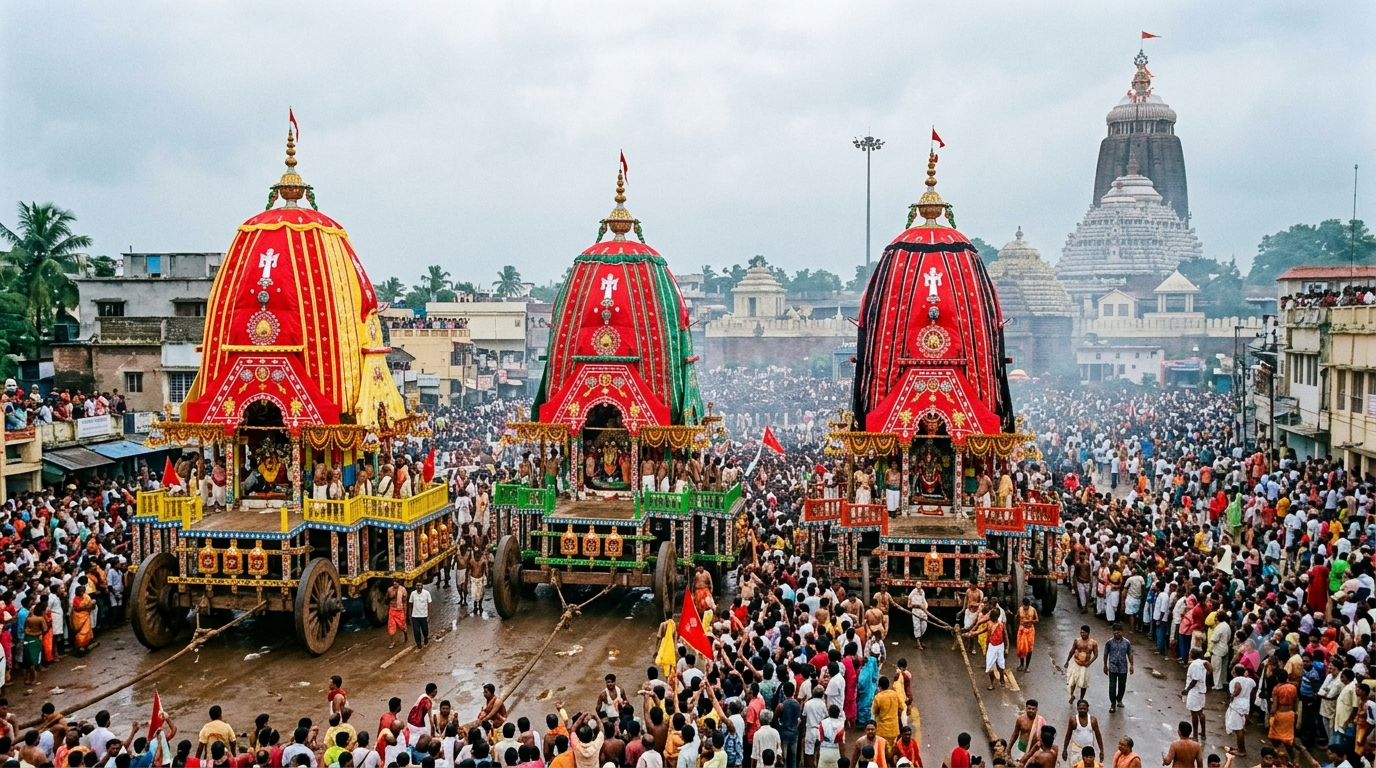
The Puri Jagannath Ratha Yatra is Puri’s grand chariot festival. On this day, Lord Jagannath, his brother Balabhadra, and sister Subhadra leave their sanctum and roll through the streets on three towering wooden chariots. The 2026 procession concluded on 16 July, so the next Puri Jagannath Ratha Yatra falls on Monday, 5 July 2027.
Millions of pilgrims gather on Puri’s Grand Road for this single sacred day. Knowing the exact date, the ritual order, and safe planning tips therefore matters a lot here. This guide covers the confirmed date, the three chariots, every key ritual, and how to attend without falling for a fake booking website.
Temples Map is an independent pilgrim guide. We are not affiliated with, endorsed by, or the official website of the Shree Jagannatha Temple Administration (SJTA). We take no bookings, donations, or payments — always use the official portal linked below for rooms, darshan, and offerings.
Puri Jagannath Ratha Yatra: Quick Facts
- Next date: Monday, 5 July 2027 (Ashadha Shukla Dwitiya).
- Where: Bada Danda (Grand Road), between Shree Jagannath Temple and Gundicha Temple, Puri, Odisha.
- Deities: Lord Jagannath, Lord Balabhadra, and Devi Subhadra.
- Chariots: Nandighosha, Taladhwaja, and Darpadalana — artisans build them fresh every year.
- Distance pulled: roughly 3 km from the main temple to Gundicha Temple.
- Official portals: shreejagannatha.in (temple) and stayatpurijagannatha.in (SJTA guest-house rooms).
Puri Jagannath Ratha Yatra 2027 Date and Time
The next Puri Jagannath Ratha Yatra takes place on Monday, 5 July 2027. The Hindu lunar calendar sets the date, so it always falls on Dwitiya Tithi in the Shukla Paksha of the Ashadha month. In 2027, that Dwitiya Tithi runs from 4:50 AM on 5 July to 1:12 AM on 6 July, according to Drik Panchang.
The 2026 festival already took place on Thursday, 16 July, with the return Bahuda Yatra on 24 July. Chariot pulling usually starts in the afternoon, though the temple priests announce the exact muhurta each year. Since the tithi and timings shift annually, confirm the current schedule on the official temple portal before you travel.
| Event | 2026 (past) | 2027 (upcoming) |
|---|---|---|
| Ratha Yatra start | 16 July, Thursday | 5 July, Monday |
| Hera Panchami | 20 July | 9 July (approx.) |
| Bahuda Yatra return | 24 July, Friday | 13 July (approx.) |
| Suna Besha | 25 July | 14 July (approx.) |
Treat the 2027 sub-event dates as approximate until the temple publishes its official festival calendar. The panchang fixes only the main date of 5 July 2027.
What Is the Puri Jagannath Ratha Yatra?
The Puri Jagannath Ratha Yatra, also called the Car Festival or Gundicha Yatra, marks the deities’ annual journey to the Gundicha Temple. This is the only time the three deities leave the sanctum. So devotees of every caste, faith, and background can pull the chariots and take darshan in the open. Tradition holds that pulling the ropes and seeing the Lord represents the soul’s journey toward salvation.
Puri is one of the four sacred Char Dham sites, alongside Dwarka, Badrinath, and Rameswaram. King Ananta Varman Chodaganga Deva built the main Shree Jagannath Temple in Kalinga style during the 12th century. The temple rises about 65 metres near the Puri seashore.
Legend links the festival to King Indradyumna and his queen Gundicha, in whose honour the deities visit the Gundicha Temple. While the story is old, the ritual has run without a break for centuries. That unbroken tradition is a big reason it draws pilgrims worldwide.
The Three Chariots of the Puri Jagannath Ratha Yatra
Each deity rides a separate chariot, and artisans build all three from scratch every year using seasoned wood and no nails. They assemble the raths to centuries-old specifications, then paint them in bright canopy colours that identify each deity. Here is how the three chariots compare.
| Chariot | Deity | Wheels | Height |
|---|---|---|---|
| Nandighosha | Lord Jagannath | 16 | ~45 feet |
| Taladhwaja | Lord Balabhadra | 14 | ~45 feet |
| Darpadalana | Devi Subhadra | 12 | ~44 feet |
Nandighosha, the chariot of Lord Jagannath, has 16 wheels and rises to about 45 feet. Subhadra’s chariot, Darpadalana, sometimes also goes by the name Devadalana. Because workers dismantle the raths after the festival, artisans source fresh timber each spring and begin construction on Akshaya Tritiya.
Rituals of the Puri Jagannath Ratha Yatra
The Puri Jagannath Ratha Yatra is not a single-day event but the peak of a longer ritual cycle. It begins weeks earlier and closes only when the deities return to the sanctum. Below are the key rituals in the order they unfold.
Snana Yatra and Anasara
On Deba Snana Purnima, priests bathe the deities with 108 pots of water. Tradition holds that the deities then fall ill, so they rest in seclusion for about fifteen days. Devotees call this period Anasara, when public darshan pauses.
Pahandi and Chhera Pahara
On festival morning, servitors carry the deities to their chariots in a swaying ceremonial procession known as Pahandi. Then the Gajapati King of Puri sweeps each chariot platform with a golden broom in a ritual called Chhera Pahara. This gesture signals that before the Lord, king and commoner stand equal.
Chariot Pulling to Gundicha Temple
After Chhera Pahara, thousands of devotees pull the chariots along Bada Danda toward the Gundicha Temple, about 3 km away. On the way, the chariots pause near the Mausi Maa Temple, where priests offer the Lord Poda Pitha, a traditional baked cake. The deities then stay at Gundicha Temple for about a week.
Hera Panchami, Bahuda, Suna Besha and Niladri Bije
On the fifth day, Goddess Lakshmi visits Gundicha Temple in the Hera Panchami ritual. The return journey, called Bahuda Yatra, brings the deities back toward the main temple. On the chariots, priests then dress them in dazzling gold ornaments during Suna Besha. Finally, Niladri Bije marks their re-entry into the sanctum, when the Lord offers rasagola to Lakshmi as a symbolic reconciliation.
How to Reach Puri for the Puri Jagannath Ratha Yatra
Puri connects well by air, rail, and road, though festival crowds make advance planning essential. The nearest airport is Biju Patnaik International Airport (BBI) in Bhubaneswar, about 60 km away. From there, taxis and buses run regularly to Puri.
Puri is a major railway junction with direct trains from Kolkata, Delhi, Chennai, and many other cities. By road, state and private buses connect Puri with Bhubaneswar and nearby towns. If you are mapping a route from your city, our Puri route guides break down the train, flight, and bus options.
Where to Stay
The SJTA runs official guest houses such as Neelachal Bhakta Niwas and Neelachal Yatri Niwas near the Grand Road. You can book these rooms during the Car Festival window only through the official portal, stayatpurijagannatha.in. Private hotels and lodges fill up months ahead, so reserve early if you plan to attend the Puri Jagannath Ratha Yatra.
Puri Jagannath Ratha Yatra: Darshan, Crowds and Safety
On Ratha Yatra day, the streets around Bada Danda become extremely dense, with lakhs of pilgrims in a small area. Odisha Police and the district administration set up barricades, crowd corridors, and medical camps. Even so, the sheer numbers demand personal caution. Reaching your viewing spot early is the single best way to avoid the crush.
Since the festival falls in the hot, humid monsoon season, carry water and wear light cotton clothing. Keep any regular medication with you, because reaching a pharmacy through the crowd is hard. Elderly pilgrims, pregnant women, and anyone with a heart or mobility condition should consult a doctor first. They are also far safer watching from a raised balcony or terrace than from the throng.
For general temple timings outside the festival, see our Puri Jagannath Temple timings and guide. The temple opens early and stays open late, though darshan queues swell sharply around every major festival. Odisha Tourism also lists festival amenities on its official website.
Beware of Fake Booking and Donation Websites
This is the warning most festival guides skip, and it is the one that protects your money. The Shree Jagannath Temple Administration has publicly confirmed that fraudulent websites impersonate the temple to cheat devotees. So verify every link before you pay a single rupee.
The SJTA states that it never accepts donations or offerings for “online puja.” It has also lodged a police complaint after miscreants built a fake site to take fraudulent room bookings for its Bhakta Niwas guest houses. Genuine room booking happens only on stayatpurijagannatha.in, while official temple information lives only on shreejagannatha.in. If a site demands an upfront “processing fee” or promises guaranteed VIP darshan, treat it as a red flag.
For giving to the temple, our Puri Jagannath Temple donation guide explains the official channels. Any spiritual benefit of a seva or offering is a matter of faith and tradition, never a guaranteed outcome. So donate only through verified official routes.
What Most Guides Won’t Tell You
A few practical lessons make a big difference on the ground. These tips reflect how experienced pilgrims actually handle the day.
- Arrive a day early. Trains and roads choke on festival morning, so reach Puri the evening before.
- Book a balcony view. Terraces and upper floors along Bada Danda offer safe, clear sightlines above the crowd.
- Travel light. Large bags slow you down and are hard to secure in a dense crowd.
- Fix a meeting point. Mobile networks jam when lakhs gather, so agree on a landmark with your group.
- Respect temple customs. Non-Hindus cannot enter the main sanctum, though everyone can view and pull the chariots outside.
Before You Go
The Puri Jagannath Ratha Yatra is one of India’s most powerful spiritual spectacles, and its next edition falls on 5 July 2027. Lock in your travel and accommodation early, and plan for heat and heavy crowds. Use only official portals for rooms and donations. If you go prepared, you can focus on what draws millions here — a rare, open darshan of the Lord on his chariot.
Frequently Asked Questions
When is the next Puri Jagannath Ratha Yatra?
The next Puri Jagannath Ratha Yatra falls on Monday, 5 July 2027. It follows Ashadha Shukla Dwitiya on the Hindu lunar calendar. The 2026 festival took place on 16 July 2026.
Why is the Ratha Yatra date different every year?
The Hindu lunar calendar decides the date, not the fixed Gregorian one. It always falls on Dwitiya Tithi in the Shukla Paksha of the Ashadha month, which usually lands in June or July. That is why the date shifts each year.
What are the names of the three chariots?
Lord Jagannath rides Nandighosha, Lord Balabhadra rides Taladhwaja, and Devi Subhadra rides Darpadalana. Artisans rebuild all three from fresh wood every year. Their wheel counts are 16, 14, and 12 respectively.
Can anyone pull the chariots during the Ratha Yatra?
Yes, devotees of every caste, religion, and gender may pull the chariot ropes along the Grand Road. This openness is a defining feature of the festival. It contrasts with the main temple sanctum, which only Hindus may enter.
How do I book rooms in Puri for the Ratha Yatra?
You can book official SJTA guest-house rooms only through stayatpurijagannatha.in. Book private hotels through their own channels well in advance. Avoid any third-party site claiming to offer official temple rooms, since the temple has warned about fake booking websites.
Is the Puri Jagannath Ratha Yatra safe for elderly pilgrims?
The crowds are enormous, so elderly pilgrims, young children, and pregnant women should take extra care. Watching from a booked balcony or terrace is far safer than joining the chariot-pulling crowd. Anyone with a medical condition should consult a doctor before travelling.
What is the Suna Besha of the deities?
Suna Besha is the ritual where priests dress the deities in gold ornaments on the chariots after their return journey. It usually falls a day after Bahuda Yatra. Lakhs of devotees gather to see this golden attire.
How far is the chariot procession route?
Devotees pull the chariots about 3 km from the Shree Jagannath Temple to the Gundicha Temple along Bada Danda. On the way, they pause near the Mausi Maa Temple. The deities stay at Gundicha Temple for roughly a week before returning.