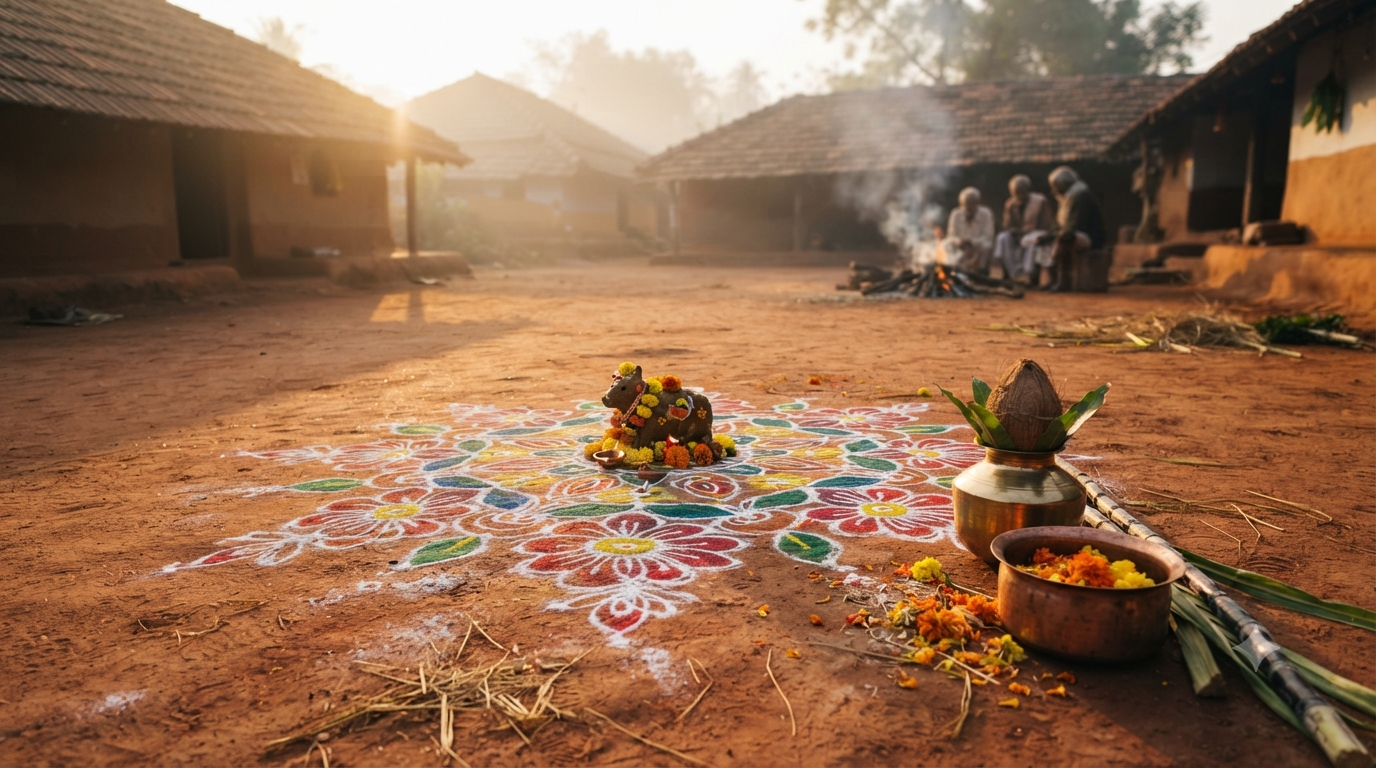
The Makara Sankranti date and time for 2027 falls on Friday, 15 January 2027, and the Sun crosses into Makara Rashi at roughly 2:45 AM IST that morning. Because that crossing happens well before sunrise, every ritual shifts to daybreak on the 15th. Most calendars still print 14 January out of habit, so this one small detail decides whether your puja lands inside the punya kalam or misses it completely.
Temples Map is an independent temple and festival guide. We are not affiliated with any temple, trust, or government body, we take no bookings or donations, and we issue no tickets. Always confirm timings with your family panchangam or the official temple portal.
Makara Sankranti Date and Time in 2027 at a Glance
Sankranti is a solar event, so it does not depend on a tithi. Instead it depends on the exact second the Sun enters Capricorn. Here is the complete Makara Sankranti date and time picture for 2027 in one place.
| Detail | 2027 Timing |
|---|---|
| Makara Sankranti day | Friday, 15 January 2027 |
| Sankranti moment (Sun enters Makara) | Around 2:45 AM IST, 15 January |
| Punya Kalam (40-ghati method) | Local sunrise to about 6:02 PM |
| Punya Kalam (16-ghati method) | Local sunrise to about 12:36 PM |
| Maha Punya Kalam | First 1 hour 45 minutes after sunrise |
| Bhogi | Thursday, 14 January 2027 |
| Kanuma | Saturday, 16 January 2027 |
| Mukkanuma | Sunday, 17 January 2027 |
Those punya kalam figures follow North Indian sunrise. In Vijayawada, Visakhapatnam, or Hyderabad the sun rises roughly 20 to 30 minutes earlier, so your window opens earlier too.
Why the Makara Sankranti Date and Time Shifts to 15 January in 2027
Almost every general article claims Sankranti is “always 14 January”. That is the single most repeated error on this topic, and 2027 proves it wrong. The festival tracks the Sun, not the calendar, so the date drifts.
Here is the rule that panchangam compilers actually apply. If the Sun enters Makara after sunset, the punya kalam cannot run at night, so observance moves to the next sunrise. In 2027 the crossing lands at about 2:45 AM on the 15th, which is after sunset on the 14th. Hence the 15th becomes the festival day.
There is a slower drift underneath this as well. The sidereal zodiac used by Indian panchangams shifts against the Gregorian calendar by about one day every 72 years, because of the precession of the equinoxes. Sankranti sat on 31 December around the year 1000 CE. Consequently it will creep toward 16 January over the coming centuries.
Punya Kalam and Maha Punya Kalam: Why Two Sites Give Two Timings
Punya kalam is the sacred window when the Sun appears to sit in both Dhanu and Makara. Charity, holy bathing, Surya puja, and shraddha rituals all belong inside it. Yet if you check three panchangam websites, you will often see three different end times.
The reason is not sloppiness. Two traditions calculate the window differently, and both are legitimate.
- The 40-ghati method counts about 16 hours from the Sankranti moment. Drik Panchang follows this, which is why it shows a long window ending near 6:02 PM.
- The 16-ghati method follows Muhurta Chintamani and counts about 6 hours 24 minutes. Prokerala and several Telugu almanacs follow this, so they close the window near 12:36 PM.
Maha punya kalam is narrower and both schools broadly agree on it. It runs for roughly the first 1 hour 45 minutes after sunrise, which lands near 7:10 AM to 9:00 AM in northern cities. If you can only spare one slot, use that one.
Practically speaking, morning is safe under either reckoning. So finish your bath, arghyam, and daanam before noon and you satisfy both traditions at once.
Bhogi, Sankranti, Kanuma, Mukkanuma: All Four Days in 2027
Sankranti is not a three-day festival in Andhra Pradesh and Telangana. It runs four days, and the fourth day has its own name. Older articles that stop at Kanuma simply drop Mukkanuma.
| Day | Telugu Name | Tamil Name | 2027 Date |
|---|---|---|---|
| Day 1 | Bhogi | Bhogi Pandigai | Thursday, 14 January |
| Day 2 | Pedda Panduga (Sankranti) | Thai Pongal | Friday, 15 January |
| Day 3 | Kanuma Panduga | Mattu Pongal | Saturday, 16 January |
| Day 4 | Mukkanuma | Kaanum Pongal | Sunday, 17 January |
Bhogi on 14 January 2027
Families light the Bhogi Mantalu bonfire before dawn and burn worn-out wooden items. Later in the morning, elders shower regi pallu, petals, sugarcane pieces, and coins over young children. This ritual is called Bhogi Pallu. Our Bhogi Pongal festival guide covers the Tamil observance in more detail.
Kanuma and Mukkanuma
Kanuma honours cattle, since bulls and oxen carried the ploughing season. Farmers wash, paint, and garland their animals before feeding them first. Mukkanuma then closes the festival with family visits, and many households that abstain during the first three days cook non-vegetarian meals on this day.
How the Makara Sankranti Date and Time Is Calculated
Nearly every Hindu festival follows the luni-solar calendar, so its Gregorian date swings by weeks each year. Sankranti behaves differently because it is purely solar. As a result, it stays locked to 14 or 15 January.
Panchangam compilers work from the sidereal position of the Sun. When the Sun’s longitude reaches 270 degrees in the sidereal zodiac, Makara Sankranti occurs. That instant is identical everywhere on Earth, although the clock time you see depends on your time zone.
Sunrise is the second variable, and it is the one readers forget. Since punya kalam usually begins at local sunrise, a devotee in Visakhapatnam starts earlier than one in Mumbai. Therefore a single “national” timing published by any website is an approximation for your town.
What to Do During the Makara Sankranti Date and Time Window
The rituals are simple, and you do not need a priest for most of them. Work through this order on the morning of 15 January 2027.
- Bathe before sunrise, ideally in a river or with a little sesame added to the water.
- Offer arghyam to Surya at sunrise while facing east, using water in a copper vessel.
- Place the naivedyam, usually chakkara pongali or ariselu, and light the deepam.
- Give daanam before noon, because charity carries the greatest weight during punya kalam.
- Draw the muggu with gobbemma at the centre, then finish family visits through the day.
Sesame and jaggery matter here for a practical reason as well as a ritual one. Both are warming foods, and the festival lands in the coldest fortnight of the South Indian year.
Sankranti at Tirumala, Sabarimala, and Other Temples
Bhogi carries special weight at Tirumala because Goda Kalyanam, the celestial wedding of Andal and Lord Venkateswara, is celebrated that day. Vaishnava temples across Andhra Pradesh mark it too, since Bhogi closes Dhanurmasam. Check the Tirumala Tirupati Devasthanams portal for the current year’s schedule before you travel.
Sabarimala observes Makaravilakku on the same evening, and crowds there are among the heaviest of the year. Meanwhile, Prayagraj and Ganga Sagar draw enormous holy-dip gatherings in the north. Temple queues everywhere run long on the 15th, so arrive early or plan a quieter darshan on the 16th.
Common Mistakes People Make with the Makara Sankranti Date and Time
Every January the same handful of errors circulates in forwarded messages and comment threads. Each one distorts the Makara Sankranti date and time in a slightly different way.
- Assuming 14 January always. In 2027 that is wrong, and following it would place your puja a full day early.
- Copying last year’s timings. The sunrise and the crossing both move, so old punya kalam figures do not carry forward.
- Using a North Indian timing in the South. Sunrise differs, therefore the window differs.
- Treating Sankranti as a lunar festival. There is no tithi involved, so tithi-based calculators will mislead you.
- Calling it a three-day festival. Telugu states observe four days, ending with Mukkanuma.
When two sources genuinely disagree, prefer your family or regional panchangam. The Telugu Gantala Panchangam remains the reference most Andhra households actually follow.
What If You Miss the Makara Sankranti Date and Time Window?
Nothing about punya kalam is guaranteed to suit your schedule. It is a fixed astronomical window, so work shifts, travel, and a late start can all push you past it. Fortunately the tradition is more forgiving than most articles suggest.
Rank your fallbacks in this order if the Makara Sankranti date and time slips away from you.
- Missed maha punya kalam but still before noon? Proceed normally, because the wider punya kalam is still open under both calculation methods.
- Missed the morning entirely? Complete your snanam, arghyam, and daanam any time before sunset on the 15th. The 40-ghati school still counts this window.
- Away from home on the 15th? Perform a simple arghyam wherever you are. Sankranti has no mandatory temple visit, so a sunrise offering with water and sesame is sufficient.
- Missed the day completely? Daanam carries merit through the whole solar month of Makara, which runs until mid-February.
One thing genuinely cannot be shifted. The Sankranti moment itself is astronomical and happens once, so no priest can move it for you. Everything else is flexible.
Safety Notes for the Festival Days
Two Sankranti traditions send people to hospital every January, so a little care goes a long way.
Glass-coated and synthetic manja used for kite flying causes serious neck and hand injuries, and it kills birds. Several Indian states restrict it for exactly this reason. Use plain cotton thread instead, and keep children off terraces without a railing.
Cold-water holy dips are the second risk. If you are elderly, pregnant, or managing a heart condition, bathe at home with warm water and a symbolic sprinkle of river water. Fasting through Bhogi and Sankranti is also unwise for anyone on diabetes or blood-pressure medication, so speak to your doctor first. These observances are matters of faith and tradition, and no ritual substitutes for medical treatment.
Before You Plan Your 2027 Sankranti
The short version is straightforward. The Makara Sankranti date and time for 2027 is Friday, 15 January, with the Sun crossing at about 2:45 AM, so your rituals belong between sunrise and noon that day. Bhogi comes the day before on Thursday the 14th, while Kanuma and Mukkanuma follow on the 16th and 17th.
Note the shift from last year, since it catches people out. Sankranti fell on 14 January in 2026, yet it moves to the 15th in 2027. Never assume the date carries forward.
Book travel early if you are heading home, because the 15th to 17th falls on a Friday-to-Sunday stretch in 2027. That long weekend will strain buses and trains across the Telugu states. For related festival planning, our Karthika Masam guide covers the preceding devotional season.
Frequently Asked Questions
What is the Makara Sankranti date and time in 2027?
Makara Sankranti falls on Friday, 15 January 2027. The Sankranti moment, when the Sun enters Makara Rashi, occurs at approximately 2:45 AM IST. Because this happens before sunrise, punya kalam rituals begin at local sunrise on the 15th and are best completed before noon.
Why is Sankranti on 15 January in 2027 and not 14 January?
The Sun crosses into Capricorn at about 2:45 AM on 15 January 2027, which is after sunset on the 14th. Panchangam rules move all punya kalam activity to the following sunrise whenever the crossing happens at night. So the 15th becomes the observed festival day.
What is punya kalam and how long does it last?
Punya kalam is the auspicious window when the Sun sits between two rashis. Its length depends on tradition. The 40-ghati method gives roughly 16 hours, while the 16-ghati method gives about 6 hours 24 minutes. Morning rituals satisfy both calculations.
What are the Bhogi, Kanuma, and Mukkanuma dates in 2027?
Bhogi falls on Thursday, 14 January 2027. Kanuma follows on Saturday, 16 January, and Mukkanuma closes the festival on Sunday, 17 January. Together with Sankranti on the 15th, these make up the four-day Pedda Panduga observed in Andhra Pradesh and Telangana.
Is Pongal on the same day as Makara Sankranti in 2027?
Yes. Thai Pongal in Tamil Nadu falls on Friday, 15 January 2027, the same day as Makara Sankranti. Bhogi Pandigai precedes it on the 14th, then Mattu Pongal and Kaanum Pongal follow on the 16th and 17th respectively.
Does Makara Sankranti ever fall on 13 January?
Not in the current era. The festival has been fixed to 14 or 15 January for well over a century. Because of precession, the date drifts later rather than earlier, so it will eventually move toward 16 January over several centuries.
Can I perform the puja after the Makara Sankranti date and time window closes?
Yes, within limits. Rituals completed later on 15 January still fall inside the 40-ghati punya kalam. If you miss the day altogether, daanam and charity continue to carry merit through the solar month of Makara, which lasts until roughly mid-February.
Why do different websites show different Sankranti timings?
Two factors explain it. Panchangams use either the 40-ghati or the 16-ghati rule for punya kalam, which changes the end time. Additionally, punya kalam starts at local sunrise, so a timing calculated for Delhi will not match Hyderabad.
Which timing should I follow for my city?
Use a panchangam set to your own location rather than a national figure. Drik Panchang lets you select your city, and most Telugu Gantala Panchangams print regional sunrise tables. Your family purohit’s almanac remains the final authority.
Is Sankranti a public holiday in Andhra Pradesh and Telangana?
Both states normally declare holidays across the Sankranti days, though the exact list changes annually. The General Administration Department publishes the official holiday notification, so check ap.gov.in or the Telangana equivalent once the 2027 list is released.