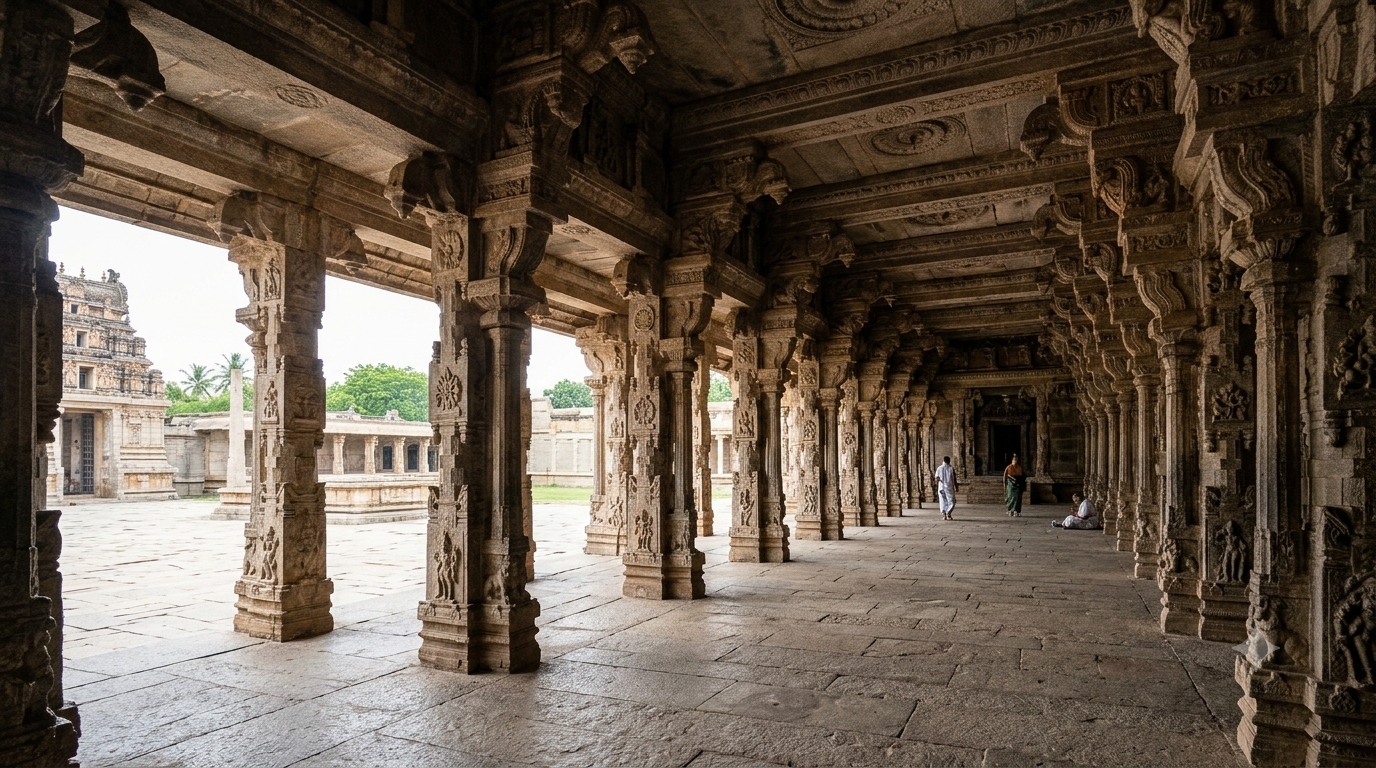
The temple mandapa meaning is simple: a mandapa is a pillared hall or pavilion within a temple setting. Yet that one word can describe several spaces, from an entrance porch to a large hall for worship, gatherings or ceremonies. The name of a particular mandapa often offers a clue, but its layout and documented use tell the fuller story.
Independent heritage guide: TemplesMap is not affiliated with any temple authority, the Government of Karnataka or UNESCO. We do not take bookings, donations or payments. Check the relevant temple administration for current access and event rules.
Temple mandapa meaning: the basic definition
A mandapa, also written mandapam or mantapa, is a roofed hall or pavilion supported by pillars. It may stand beside a shrine, connect to its entrance or occupy another part of a temple complex. Some mandapas have enclosing walls, while others remain open or partly open on their sides.
The glossary in the Government of Karnataka’s Sacred Ensembles of the Hoysalas nomination dossier, hosted by the UNESCO World Heritage Centre, makes that last point explicit. It describes open, closed and partly open halls rather than one standard shape.
That distinction is central to temple mandapa meaning: a mandapa is not always a public prayer hall. A row of carved columns does not, by itself, reveal the hall’s formal name or ritual role. You need its place in the building and, ideally, a reliable site plan.
Temple mandapa meaning at a glance
- Main idea: a pillared temple hall, rather than the sanctum or a gateway tower.
- Common forms: open, enclosed and partly open halls.
- Possible settings: in front of a shrine, beside a court or within a larger complex.
- Common uses: gathering, prayer, ritual activity, performance and processional preparation.
- Names: ardhamandapa, mahamandapa, sabhamandapa and others describe specific forms or roles.
- Key caution: every temple does not contain every hall type or use the same sequence of names.
For the broader setting, see our guide to Indian temple architecture. It explains how regional traditions affect plans, roofs and sacred spaces.
Common types of mandapas and their uses
There is no single list that applies neatly to every temple. However, the Karnataka heritage glossary gives useful terms for reading plans and descriptions. The table below reflects those definitions without treating them as fixed national rules.
| Term | What the heritage glossary indicates | Useful clue |
|---|---|---|
| Ardhamandapa | Smaller hall adjoining or extending from the shrine | Close to the sacred core |
| Mukhamandapa | Entrance or front hall | At an approach to another space |
| Mahamandapa | Large hall, sometimes linked with other hall terms | Greater gathering space |
| Gudhamandapa | Enclosed hall | Walls surround the hall |
| Sabhamandapa | Audience or pilgrims’ hall | Gathering and assembly |
| Rangamandapa | Semi-open hall associated with performance | Performance-related use |
| Navaranga | Square columned hall with nine internal divisions | Plan divided into nine bays |
| Nandi or vahana mandapa | Pavilion for the deity’s mount | Location and associated image |
| Kalyana mandapa | Hall associated with marriage | Check the temple’s ritual context |
Temple mandapa meaning concerns architecture; the hall name never guarantees public access or ceremonies. A heritage label may describe a historic use even when today’s temple follows different practices.
Ardhamandapa and mukhamandapa: smaller halls near an approach
An ardhamandapa is a smaller hall close to the shrine in the Karnataka glossary. Meanwhile, a mukhamandapa is an entry or front hall. Both names can appear in plans that show several spaces between the public approach and the sanctum.
Do not turn those terms into a universal route. The Tamil Nadu Department of Archaeology’s study of the Kampaharesvara Temple at Tribhuvanam names both halls in a site-specific plan. Other temple layouts may arrange them differently or use another term.
Mahamandapa and gudhamandapa: size and enclosure
Maha points towards a larger hall, while gudhamandapa identifies an enclosed one in the heritage glossary. The glossary also notes some overlap among mahamandapa, gudhamandapa and rangamandapa. Therefore, those words are not always separate rooms in a fixed sequence.
When a report calls a space a mahamandapa, inspect its plan before guessing its purpose. A large hall may support several activities, while a smaller chamber can have a more defined ritual role.
Temple mandapa meaning in assembly and performance halls
A sabhamandapa serves as an audience or pilgrims’ hall in the Hoysala glossary. A rangamandapa has an association with theatrical performance. Both entries describe semi-open columned halls, but the labels emphasise different uses.
Music, dance and storytelling formed part of temple cultural life in several traditions. Still, an old performance-related name does not prove that public performances take place there today. Temple management and local custom decide present use.
Navaranga is particularly useful because its name describes an internal arrangement. The Karnataka glossary calls it a square columned hall with nine divisions. In a floor plan, pillars and wall lines can help you recognise that structure.
It would be wrong, however, to call every square hall a navaranga. You need the actual internal divisions and preferably a source that identifies the space. This avoids turning an architectural clue into a guess.
Nandi mandapa and vahana mandapa: spaces for a sacred mount
A Nandi mandapa shelters the bull associated with Shiva, according to the glossary. A vahana mandapa concerns a deity’s mount or vehicle. These terms show how some hall names follow what occupies the space, not its size.
The relationship to the shrine can help you read the plan. Yet a mandapa need not contain a Nandi image, and the word vahana does not mean every temple displays the same animal or object.
Kalyana mandapa: what does the name really mean?
The glossary identifies a kalyana mandapa as a hall for marriage. In temple settings, this can refer to sacred wedding ceremonies or associated ritual traditions. It does not automatically mean the temple rents the space for private weddings.
For example, UNESCO’s Group of Monuments at Hampi account names a kalyana mandapa among the Vitthala Temple complex’s buildings. That is an architectural and historical description. It is not an event-booking notice, so visitors should never infer availability or permission from the name alone.
Why temple mandapa meaning varies by function
A mandapa can serve more than one purpose because its architecture and its activities are different kinds of information. Pillars, walls and roof form the space. A temple’s ritual practice determines how people use it. Uses can also change as a complex grows or daily needs evolve.
Temple mandapa meaning becomes clearer when you picture a large covered hall. It may host gathering before worship or support special ceremonies. That does not make either activity universal. Therefore, separate the physical description from evidence about the local practice.
Another point is scale. A hall with richly carved pillars may have a modest functional role, while a plain-looking pavilion could be important in a festival route. Ornament and function do not always match.
Temple mandapa meaning in two heritage examples
Real monuments show why the temple mandapa meaning needs site context. One region may favour enclosed, carefully divided halls. Another complex may spread open pavilions around courts and processional streets. The same broad word can cover both without making them architecturally identical.
Temple mandapa meaning in Hoysala temples
The Karnataka nomination dossier records varied mandapa types across the Hoysala heritage sites. Its glossary distinguishes open and closed forms as well as the nine-part navaranga. These labels help when reading descriptions of temples at Belur, Halebidu and Somanathapura.
Look beyond the pillars’ carved surfaces. Here, temple mandapa meaning becomes clearer when you study the hall’s openings, shape and link to the shrine. A closed space with an organised interior is not the same type of pavilion as an open gathering platform.
Hampi: halls inside and outside temple enclosures
UNESCO describes the Vitthala Temple complex at Hampi with a kalyana mandapa and an utsava mandapa. It also describes pillared pavilions beside chariot streets and a ceremonial pavilion in the temple tank. This is a good warning against thinking every mandapa stands directly before a sanctum.
At Hampi, temple mandapa meaning extends beyond halls beside a shrine. Halls can connect sacred buildings, festivals, movement and the public spaces around a temple. However, that historical account does not establish present access, visitor routes or permission for events.
Reading temple mandapa meaning on a floor plan
First locate the main shrine, then examine every roofed hall or pavilion around it. A mandapa may share the shrine’s axis, stand to one side or sit in a courtyard. Use the hall’s shape and any published labels before assigning a specific name.
- Locate the garbhagriha. This is the inner sanctum, not the hall where people gather.
- Mark the halls. Look for a roof and supporting columns, then note the enclosing walls.
- Find the approach. An entrance or front hall may carry the name mukhamandapa.
- Check its plan. Nine internal divisions may support a navaranga identification when the heritage source agrees.
- Read the label and use together. A kalyana, Nandi or sabha name offers a functional clue, not a public-use guarantee.
- Compare building phases. Later halls can stand beside older shrines, so the complex may not follow one original plan.
Photographs help, but a single camera angle can hide entrances and enclosure walls. Therefore, a labelled heritage plan offers stronger evidence than a cropped picture.
Mandapa, gopuram, prakaram and sanctum: the difference
A mandapa is a hall, while the garbhagriha is the inner shrine. A gopuram marks an entrance with a tower, and a prakaram refers to an enclosure wall or precinct. These features can appear together, but none is simply another word for mandapa.
Our temple gopuram guide explains gateway towers. The separate prakaram guide explains enclosure walls, corridors and walking routes. This distinction matters when a photograph shows pillars near a temple entrance.
A pillared corridor can be part of a larger enclosure. Yet the line of pillars alone cannot tell you whether you are seeing a mandapa, a roofed passage or both. Read the building in context.
Temple mandapa meaning: common mistakes to avoid
The first mistake is expecting a fixed number of halls. Some temples have a small porch, while large complexes contain several named pavilions. Regional practice, time and later building work all affect the result.
The second is treating every mandapa as an open public assembly space. An enclosed hall might have restricted ritual use. Access may also differ during worship, conservation work and crowded festival days.
Third, a kalyana mandapa is not proof of wedding rentals. Likewise, a rangamandapa does not guarantee a public dance programme. Historic function and current administration are separate questions.
Finally, do not identify a so-called thousand-pillar hall by counting from a photograph. Such names may reflect local tradition or a specific architectural description. Consult the site’s own records before repeating a numerical claim.
Temple mandapa meaning: the essential point
The temple mandapa meaning begins with a pillared hall, not a prescribed floor plan. Names such as sabhamandapa, navaranga and kalyana mandapa add clues about form or use. Yet a temple’s history and present rules determine what those names mean in practice.
Start with the Government of Karnataka heritage glossary, then compare it with the monument’s own plan. This method helps you enjoy the architecture without turning one regional example into a rule for every temple.
Frequently asked questions
What does mandapa mean in a Hindu temple?
Mandapa means a pillared hall or pavilion in a temple context. It can be open, enclosed or partly open, and its exact role varies by site.
Is mandapa the same as mandapam or mantapa?
These words commonly refer to the same broad architectural idea, with spellings shaped by regional languages and transliteration. The specific hall name still matters when reading a heritage plan.
What is the difference between mandapa and garbhagriha?
A mandapa is a hall or pavilion, while the garbhagriha is the inner sanctum. A hall may lead towards the sanctum, but the two spaces have different architectural roles.
What is an ardhamandapa?
An ardhamandapa is a smaller hall associated with the approach to a shrine. Its exact position and connection to other rooms depend on the temple and the terminology used by its heritage source.
What is the difference between sabhamandapa and rangamandapa?
A sabhamandapa emphasises assembly or audience use, while a rangamandapa has a performance association. The Karnataka heritage glossary describes both as semi-open columned halls, so their functions can overlap.
Does every Hindu temple have a kalyana mandapa?
No. Temple complexes vary widely, and a kalyana mandapa is not a universal requirement. Even where one exists, its name does not establish that private wedding bookings are available.
A navaranga is a square columned hall that the Hoysala glossary describes with nine internal divisions. Identify it from a reliable plan rather than assuming any square pillared room has that name.
Are all mandapas open to visitors?
No. Heritage terminology does not decide today’s access rules. Check the relevant temple or monument authority and follow signs, barriers and instructions when visiting.