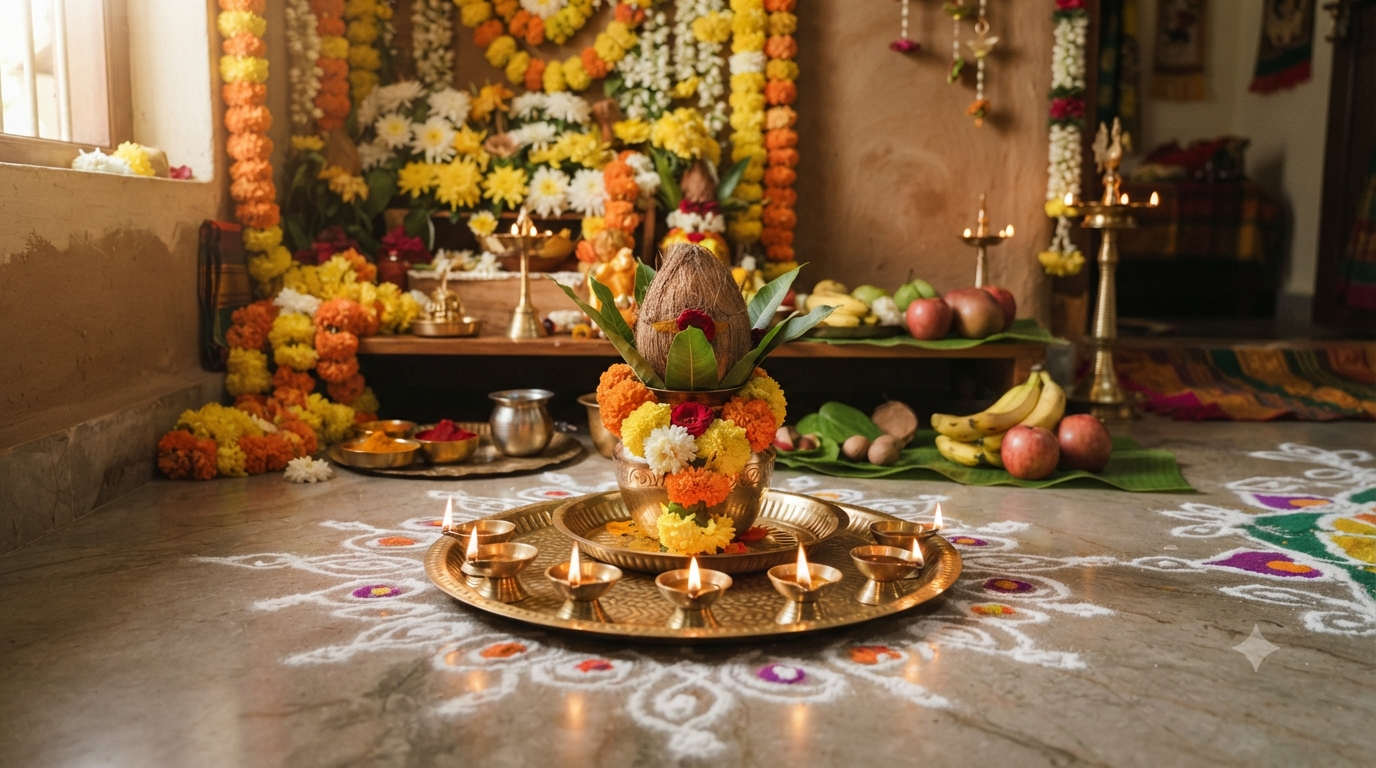
Navaratri Ammavari Alankaralu follow the traditional nine forms of Goddess Durga, beginning with Shailaputri and ending with Siddhidatri. For 2026, Sharad Navaratri begins on Sunday, 11 October, while Vijayadashami falls on Tuesday, 20 October for Andhra Pradesh and Telangana calendars. This refreshed guide gives the nine names in Telugu, the correct 2026 date framework, and the key difference between home Navadurga worship and temple-specific alankaram schedules.
Temples Map is an independent temple and festival guide. We are not affiliated with any temple, devasthanam, trust, or endowments department. We do not accept bookings, donations, or payments; always use the relevant official temple portal for temple services and official schedules.
The nine-day Navadurga order is stable even when festival dates change each year. However, local panchang calculations can place Ashtami, Navami, Saraswati Puja, or Vijayadashami differently by location and tradition. Therefore, use the list below for the traditional nine forms, then use the separate 2026 calendar section for Andhra Pradesh and Telangana.
- Traditional order: Shailaputri to Siddhidatri across nine devotional days.
- 2026 start: Sunday, 11 October.
- 2026 Vijayadashami in the Telugu calendar: Tuesday, 20 October.
- Important 2026 quirk: Saptami extends across two sunrise days in Telugu panchang data.
- Temple caution: a specific temple may use a different alankaram sequence from the Navadurga list.
The traditional Navaratri Ammavari Alankaralu are the nine forms known collectively as Navadurga. This sequence appears widely in Navaratri worship across India. Telugu families may recite the names in Sanskrit, Telugu, or both, because the devotional form remains the same.
| Day | Durga form | Telugu name | Simple meaning |
|---|---|---|---|
| Day 1 | Shailaputri | శైలపుత్రి | Daughter of the mountain. |
| Day 2 | Brahmacharini | బ్రహ్మచారిణి | Form of discipline and devotion. |
| Day 3 | Chandraghanta | చంద్రఘంట | Warrior form with the crescent bell symbol. |
| Day 4 | Kushmanda | కూష్మాండ | Creative and radiant form of Devi. |
| Day 5 | Skandamata | స్కందమాత | Mother of Skanda. |
| Day 6 | Katyayani | కాత్యాయనీ | Powerful warrior form of Durga. |
| Day 7 | Kalaratri | కాలరాత్రి | Fierce form associated with protection. |
| Day 8 | Mahagauri | మహాగౌరి | Serene and pure form of Devi. |
| Day 9 | Siddhidatri | సిద్ధిదాత్రి | Bestower of spiritual accomplishments. |
Days 1 to 3: Shailaputri, Brahmacharini and Chandraghanta
Shailaputri begins the sequence, so many households keep the first day simple and focused on kalasha sthapana. Brahmacharini follows on the second day and represents tapas, or disciplined spiritual effort. Chandraghanta comes third, and devotees traditionally associate this form with courage and readiness to face difficulty.
These meanings belong to devotional tradition rather than a promise of a specific outcome. Therefore, a family can keep the worship simple with a lamp, flowers, kumkuma, fruit, and its usual prayer routine. An expensive decoration is not required for the observance.
Days 4 to 6: Kushmanda, Skandamata and Katyayani
Kushmanda is worshipped on the fourth devotional day, followed by Skandamata on the fifth and Katyayani on the sixth. The middle days often become more elaborate at community pandals and temples, while home worship usually continues with the same daily puja pattern. Families may change flowers, saree colours, or naivedyam according to custom.
However, those household choices are not one universal rule. A fixed chart copied from another region can easily confuse Telugu readers, especially when it mixes Gujarat-style daily colours, Bengal Durga Puja customs, and Andhra temple alankarams into one list.
Days 7 to 9: Kalaratri, Mahagauri and Siddhidatri
Kalaratri, Mahagauri, and Siddhidatri complete the traditional Navadurga sequence. These final days overlap with major observances such as Durgashtami, Maha Navami, Saraswati worship, and Ayudha Puja in different regional calendars. Therefore, the devotional day number and the sunrise tithi do not always move in a neat one-to-one pattern.
This distinction matters in 2026 because Saptami continues across two sunrise days in the Telugu calendar. If your family follows a local priest or a specific panchangam, keep that tradition rather than forcing a generic internet chart onto the household schedule.
For Andhra Pradesh and Telangana, established panchang sources place the start of Sharad Navaratri on 11 October 2026. Prokerala’s Telugu calendar shows Ashwayujam beginning that Sunday, while Drik Panchang’s Tirumala calendar also lists Navratri Day 1 on 11 October. Both sources place Vijayadashami on 20 October for the regional calendar.
| Date | Sunrise tithi / observance | Planning note |
|---|---|---|
| 11 Oct, Sunday | Ashwayuja Shukla Padyami | Navaratri begins; Ghatasthapana day. |
| 12 Oct, Monday | Vidiya / Dwitiya | Second devotional day. |
| 13 Oct, Tuesday | Tadiya / Tritiya | Third devotional day. |
| 14 Oct, Wednesday | Chavithi / Chaturthi | Fourth devotional day. |
| 15 Oct, Thursday | Panchami | Lalita Panchami in many calendars. |
| 16 Oct, Friday | Shashti | Saraswati Avahan begins in some traditions. |
| 17 Oct, Saturday | Saptami | Moola nakshatra and Saraswati worship are important in Telugu practice. |
| 18 Oct, Sunday | Saptami continues at sunrise | Durgashtami or Bathukamma-related observances may be marked by local tradition. |
| 19 Oct, Monday | Ashtami at sunrise; Navami begins later | Durga Ashtami and Maha Navami observances overlap. |
| 20 Oct, Tuesday | Navami at sunrise; Dashami begins later | Vijayadashami in the Telugu regional calendar. |
Use the Drik Panchang calendar for Tirumala and the Prokerala Telugu calendar for Andhra Pradesh and Telangana to cross-check the date pattern. Exact muhurta times vary by city, so change the location before using a precise time.
The disagreement comes from how tithis cross sunrise, not from nine different forms of Durga. In 2026, Saptami lasts into 18 October, while Ashtami and Navami then compress near the end of the festival. As a result, one website may label a civil date by the devotional day count while another labels it by the sunrise tithi.
That is why this page does not pretend that every Navadurga form has one universally fixed civil date in every locality. The nine-form order remains useful, but tithi-based puja timing should follow the panchangam used by your family or temple.
A common mistake is to treat the nine Navadurga names as the official alankaram schedule of every Durga temple. They are not the same thing. Sri Durga Malleswara Swamy Varla Devasthanam at Vijayawada follows its own Dasara Sharannavaratri alankaram sequence, which includes forms such as Swarna Kavachalankruta Durga Devi, Bala Tripura Sundari Devi, Saraswati Devi, Mahishasura Mardini Devi, and Raja Rajeswari Devi.
So use this article when you want the general nine-form Navadurga order in Telugu. If you are travelling to Indrakeeladri for a specific temple alankaram, use our separate Vijayawada Navaratri alankaram schedule. Keeping these two intents separate prevents the most common planning error.
Many readers search for one saree colour for each Navaratri day. For readers using the Navaratri Ammavari Alankaralu list, the commonly circulated 2026 colour sequence is orange, white, red, royal blue, yellow, green, grey, purple, and peacock green. Drik Panchang and Prokerala both publish a similar weekday-based colour system for the festival.
Still, treat those colours as a popular observance rather than a compulsory rule for every Telugu household or temple. Specific temples may dress the deity in colours tied to their own alankaram, while families may follow inherited customs. Therefore, do not assume a social-media colour card is the same as a devasthanam’s official saree schedule.
What Naivedyam Goes With the Nine Durga Forms?
There is no single official Telugu naivedyam chart that every household must follow. Common offerings include fruit, coconut, pulihora, payasam, chakkera pongali, daddojanam, garelu, sundal, and jaggery-based sweets. Families often choose one sattvic dish each day, because consistency and cleanliness matter more than an elaborate menu.
If your family already follows a day-wise prasadam tradition, keep it. However, avoid copying a temple prasadam table and presenting it as a universal Navadurga rule. Temple kitchens follow their own customs, quantities, and festival instructions.
The Navaratri Ammavari Alankaralu list can guide a simple home observance without requiring nine separate idols or expensive decorations. A framed Durga image, a clean altar, a lamp, flowers, turmeric, kumkuma, and a small naivedyam are enough for many families. The form of the day can be remembered through its name, dhyanam, or a short prayer.
- Clean the puja space and light the lamp at your regular prayer time.
- On the first day, perform kalasha sthapana if that belongs to your family tradition.
- Remember the Navadurga form for the devotional day and offer flowers or kumkuma.
- Offer a simple vegetarian naivedyam, then perform harati.
- Keep the same basic sequence daily, because a calm routine is easier than rebuilding the altar each morning.
- On Vijayadashami, complete the observance according to your family practice and local panchangam.
For a fuller home procedure, see the site’s refreshed Durga Pooja Vidhanam in Telugu. It covers the daily sequence, samagri, Ghatasthapana, and practical home-puja notes without turning this alankaram page into a duplicate procedure article.
Navaratri in Andhra Pradesh and Telangana is not limited to the Navaratri Ammavari Alankaralu or the nine Navadurga names. Telangana families also observe Bathukamma during the same season, while many households mark Saraswati Puja, Ayudha Pooja, and Vijayadashami with books, tools, vehicles, or instruments. These customs overlap, but they do not replace the Navadurga sequence.
Saraswati worship is especially important around Moola nakshatra in Telugu tradition. Since panchang timing changes yearly, use the dedicated Navratri Saraswati Puja date and procedure page if that is the main purpose of your observance.
Most confusion comes from combining three different lists: the nine Navadurga forms, a temple’s own alankaram sequence, and the yearly Navratri colour chart. They can all be valid in their own context, yet they are not interchangeable. Check which list you are reading before you plan a temple visit or home decoration.
- Do not reuse a 2022 or 2025 festival date table for 2026.
- Do not assume Vijayawada’s ten festival alankarams equal the nine Navadurga forms.
- Do not treat a popular daily colour as an official temple dress-code instruction.
- Do not present a past temple prasadam list as a fixed household naivedyam rule.
- Do not rely on one national calendar for exact local muhurta times; set the correct city first.
If a family custom differs from an internet list, there is no need to create a conflict. Follow the panchangam, priest, or inherited practice your household normally trusts, especially for tithi-sensitive observances.
The most useful way to read this page is to separate the permanent tradition from the yearly calendar. The nine Navadurga names stay in the same order, while dates, tithi boundaries, and local temple alankarams can change. For 2026, plan the festival from 11 October and keep 20 October for Vijayadashami in the Telugu regional calendar.
Then confirm any precise muhurta with a location-specific panchangam. If you are visiting a temple for one special alankaram, check that temple’s official announcement rather than assuming the general Navaratri Ammavari Alankaralu list is its schedule.
Frequently Asked Questions
The nine traditional forms are Shailaputri, Brahmacharini, Chandraghanta, Kushmanda, Skandamata, Katyayani, Kalaratri, Mahagauri, and Siddhidatri. This Navadurga order is used for the nine devotional days of Sharad Navaratri. Temple-specific alankarams may use different names.
Sharad Navaratri begins on Sunday, 11 October 2026 in the Andhra Pradesh and Telangana calendar framework checked for this refresh. Both Drik Panchang’s Tirumala calendar and Prokerala’s Telugu calendar show the festival starting on that date.
When is Vijayadashami in 2026?
Vijayadashami falls on Tuesday, 20 October 2026 in the Telugu regional calendar used for Andhra Pradesh and Telangana. Since Dashami begins later in the day in some panchang calculations, local muhurta labels can differ. Use a city-specific panchangam for ritual timing.
Why does the 2026 list show Saptami on two dates?
Saptami spans two sunrise days in the 2026 Telugu calendar, appearing on both 17 and 18 October at sunrise. That pushes Ashtami and Navami observances close together afterward. Therefore, do not force the nine Navadurga names into a strict tithi-per-day formula.
No. Navadurga refers to the traditional nine forms from Shailaputri to Siddhidatri. Vijayawada’s Sri Durga Malleswara Swamy Varla Devasthanam follows a separate temple festival sequence, so travellers should check the temple-specific schedule before choosing a darshan date.
No universal Telugu household chart applies everywhere. Families commonly offer fruit, pulihora, payasam, pongali, daddojanam, sundal, or sweets according to their custom. A temple prasadam list should not be treated as a compulsory home-puja rule.
Do I need nine different idols for the nine days?
No. Many households use one Durga image, idol, or kalasham through the entire festival and remember a different Navadurga form each day. The method depends on family tradition, so elaborate daily idol changes are optional rather than mandatory.
No. The daily colour sequence is a popular observance, but it is not a universal rule for every Telugu household or temple. Wear the suggested colour if your family enjoys the tradition, yet do not treat it as a required ritual condition.
Can I follow this list for a temple visit?
Use this page for the general Navadurga order, not as an official temple timetable. Specific temples often publish their own Dasara alankaram schedule. Therefore, check the temple’s official portal or notice before travelling for a particular form of the Goddess.