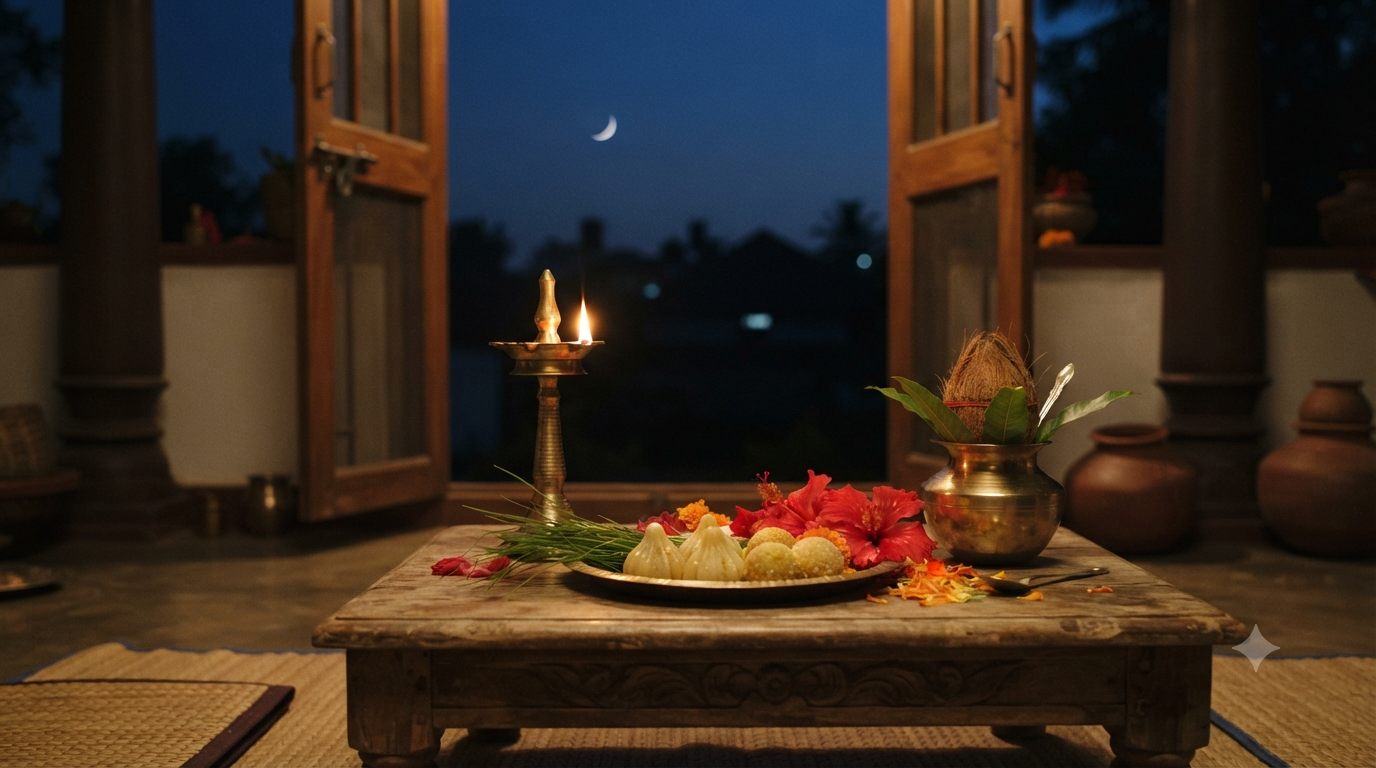
The Sankashti Chaturthi dates for 2026 run to thirteen fasting days, not the usual twelve. The next one falls on Monday, 31 August 2026, when the moon rises over Hyderabad at roughly 8:35 PM. An extra lunar month sits in the middle of this year, so last year’s calendar simply will not work.
This page carries the full set of Sankashti Chaturthi dates along with the moonrise timings that decide when you break the fast. It also flags the one September date that several widely-copied calendars still get wrong.
Temples Map is an independent temple and festival guide. We are not affiliated with any temple trust, endowments department or panchangam publisher, and we take no bookings, poojas, donations or payments. Because moonrise shifts from city to city, always confirm your own local timing on a panchang before you break the vrat.
Sankashti Chaturthi 2026 at a Glance
- Thirteen Sankashti Chaturthi dates in 2026, since an extra lunar month falls mid-year
- Three Angaraki Chaturthis: 6 January, 5 May and 29 September 2026
- Next observance: Monday, 31 August 2026 (Heramba Sankashti)
- The fast ends only after moonrise, not at sunset
- Moonrise across 2026 lands between about 8:00 PM and 10:00 PM
- Each month carries a different name of Ganesha and its own vrat katha
Complete Sankashti Chaturthi Dates for 2026
The Sankashti Chaturthi dates below cover every observance of the year, with the traditional name and the Hyderabad moonrise time. Devotees in other cities should shift the timing by roughly fifteen to thirty minutes. Sankatahara Chaturthi is the name used across Telugu and Tamil households, while Maharashtra simply says Sankashti.
| Date and day | Traditional name | Moonrise (Hyderabad) |
|---|---|---|
| 6 January 2026, Tuesday | Lambodara Sankashti (Angaraki, Sakat Chauth) | 9:06 PM |
| 5 February 2026, Thursday | Dwijapriya Sankashti | 9:30 PM |
| 6 March 2026, Friday | Bhalachandra Sankashti | 9:00 PM |
| 5 April 2026, Sunday | Vikata Sankashti | 9:27 PM |
| 5 May 2026, Tuesday | Ekadanta Sankashti (Angaraki) | 9:59 PM |
| 3 June 2026, Wednesday | Vibhuvana Sankashti (extra month) | 9:32 PM |
| 3 July 2026, Friday | Krishnapingala Sankashti | 9:33 PM |
| 2 August 2026, Sunday | Gajanana Sankashti | 9:20 PM |
| 31 August 2026, Monday | Heramba Sankashti (Bahula Chaturthi) | 8:35 PM |
| 29 September 2026, Tuesday | Vighnaraja Sankashti (Angaraki) | 8:00 PM |
| 29 October 2026, Thursday | Vakratunda Sankashti (Karwa Chauth) | 8:41 PM |
| 27 November 2026, Friday | Ganadhipa Sankashti | 8:39 PM |
| 26 December 2026, Saturday | Akhuratha Sankashti | 8:32 PM |
Three of these Sankashti Chaturthi dates deserve a mark in red ink. Angaraki Chaturthi arrives on 6 January, 5 May and 29 September 2026, because each falls on a Tuesday. The year’s earliest moonrise is 8:00 PM on 29 September, while the latest is 9:59 PM on 5 May.
The September Date Most Calendars Get Wrong
Several popular festival lists still print 30 September 2026 for the September observance. That single slip costs devotees the most auspicious fast of the entire year, so it is worth understanding.
Chaturthi tithi in September begins at about 5:09 PM on 29 September and ends at roughly 2:55 PM on 30 September. Sankashti is fixed by which day carries a moonrise while Chaturthi is still running. On 29 September the moon rises around 8:00 PM, comfortably inside the tithi. By the time the moon rises on 30 September, Chaturthi has already ended and Panchami has begun.
The correct day is therefore Tuesday, 29 September 2026, which also makes it Angaraki. Drik Panchang, the Gochar panchang engine and Ishvaram’s ephemeris calculations all agree on this. Lists that publish 30 September appear to have taken the tithi end date rather than applying the moonrise rule.
Why 2026 Has Thirteen Sankashti Chaturthi Dates
A normal Hindu year holds twelve Krishna Paksha Chaturthis, so twelve Sankashti vrats. Every two or three years, though, an extra lunar month called adhik maas is inserted to keep the lunar and solar calendars aligned. That extra month brings an extra Chaturthi with it.
In 2026 this shows up between May and July. Because of it, the Sankashti Chaturthi dates fall on both 3 June and again on 3 July, and the annual total reaches thirteen. Panchangams differ slightly on how they label the extra month, so you may see 3 June described as Vibhuvana Sankashti, Adhik Maas Sankashti, or simply the second Jyeshtha Chaturthi.
This is exactly why last year’s list cannot be copied forward. After an adhik maas, every festival that follows shifts by close to a lunar month. Anyone who offsets a whole calendar from a single anchor date ends up wrong for the rest of the year.
Angaraki Chaturthi in 2026: Three Tuesdays That Matter
When Sankashti Chaturthi lands on a Tuesday, tradition calls it Angaraki Chaturthi. Angarak is a name of Mangal, and Tuesday is Mangal’s own weekday, so the combination is treated as especially powerful. Devotees in Maharashtra and coastal Karnataka fill Ganesha temples on these days.
Three of the Sankashti Chaturthi dates land on a Tuesday in 2026, which is more than most years offer. The first two, on 6 January and 5 May, have already passed. The remaining one falls on Tuesday, 29 September 2026, with moonrise near 8:00 PM in Hyderabad. Tradition holds that a single Angaraki fast carries the merit of a full year of monthly vrats, although this is a matter of faith rather than a verified outcome.
How Sankashti Chaturthi Dates Are Decided
Every lunar month contains two Chaturthi tithis. The one that follows Purnima, during the waning fortnight or Krishna Paksha, is Sankashti Chaturthi. The one that follows Amavasya, during Shukla Paksha, is Vinayaka Chaturthi. The old confusion between the two is common, yet the rule is simple: Sankashti always comes after the full moon.
The tithi alone does not settle the Sankashti Chaturthi dates, though. Because the vrat ends with moon sighting, panchangams apply the tithi-at-moonrise rule. The chosen day is the one on which the moon rises while Chaturthi is still active. Occasionally that pushes the fast onto the preceding day, when Tritiya is technically running at sunrise.
Why Your City Can Change the Date
Moonrise is a local event, so two cities in the same state can differ. Kolkata sees the moon earlier than Mumbai by a noticeable margin, since it sits further east. When moonrise happens to fall right at the edge of the tithi, that gap is enough to move the observance by a full day.
This is why national one-size lists of Sankashti Chaturthi dates sometimes clash with your family panchangam. Follow the panchangam your household has always used, or check a location-based calendar such as Drik Panchang, which generates city-specific dates. Maharashtra households often rely on the Kalnirnay moonrise listings instead.
How to Keep the Vrat Through the Day
The observance is straightforward, although the long stretch without food catches beginners out. Here is the sequence most families follow.
- Bathe before sunrise and take a sankalp, a quiet resolve to keep the fast for Lord Ganesha.
- Set up the idol or picture, light a ghee lamp, and offer durva grass in blades of three or five.
- Add red flowers, sindoor and modak or laddoo, since durva and modak are considered essential to Ganesha worship.
- Chant “Om Gan Ganapataye Namah” through the day and read the vrat katha for that month.
- Take only permitted phalahar food if you are not fasting completely: fruit, milk, sabudana, potato and groundnut.
- Wait for moonrise, offer arghya of water to the moon, complete the aarti, and only then eat.
Students traditionally keep this vrat for concentration and success in exams, while others observe it for relief from debt or stalled work. Many devotees also visit a Ganesha shrine on the day, such as the well-known temple covered in our guide to the Kanipakam Ganapathi Homam.
What If Clouds Hide the Moon?
Monsoon Sankashti days create a genuine problem, because the moon can stay hidden for hours. The vrat is not guaranteed to end on schedule, so plan for it.
Tradition offers a practical answer. Once the panchang moonrise time for your city has passed, most families offer arghya facing the direction of moonrise and break the fast, even without a clear sighting. Some households wait a further fifteen to twenty minutes before doing so. A few strict lineages insist on actual darshan and will wait through a break in the cloud.
If your family has no settled practice, the safest route is to follow the panchang time and offer arghya to the covered moon. Ask an elder or your family priest rather than guessing, since this varies by tradition. What you should not do is break the fast at sunset simply because the moon has not appeared.
Fasting Safely on Sankashti Chaturthi
A Sankashti fast can run fourteen hours or longer, because moonrise on some months comes close to 10:00 PM. That is a long stretch, so treat the physical side seriously.
Anyone living with diabetes, low blood pressure, kidney trouble or an ulcer should speak to a doctor before attempting a full-day fast. The same applies to pregnant women, nursing mothers, elderly devotees and anyone on regular medication. A phalahar fast with fruit, milk and water is widely accepted where a nirjala fast is unsafe. Ritual observance is a matter of faith and never a substitute for medical treatment.
What Devotees Most Often Get Wrong
- Confusing the two Chaturthis. Vinayaka Chaturthi comes after Amavasya, while Sankashti always follows Purnima.
- Copying last year’s dates. After an adhik maas the whole sequence moves, so each year needs fresh verification.
- Breaking the fast at sunset. The vrat closes at moonrise, which can be three or four hours later.
- Using a Delhi moonrise time in Chennai. The gap is small but real, and it matters when the tithi is ending.
- Skipping durva grass. Many treat flowers as enough, yet durva is the offering most closely tied to Ganesha.
- Trusting a single website. When two calendars disagree, check the tithi timings rather than picking the first result.
Before You Mark Your Calendar
Four Sankashti Chaturthi dates remain in 2026 after August: 29 September, 29 October, 27 November and 26 December. The September date is the one to protect in your calendar, since it is both Angaraki and the day most lists print incorrectly. Save the moonrise time for your own city rather than the Hyderabad figure, because that single number decides your evening.
If you follow the Telugu festival calendar closely, the same care applies to other monthly vratams. Our guides to the Karthika Masam festival list and to Skanda Shasti Vratam dates follow the same tithi rules. For temple-specific observances, check the temple’s own trust website, such as the Shree Siddhivinayak Ganapati Mandir Trust calendar in Mumbai.
Sankashti Chaturthi Dates: Common Questions
When is the next Sankashti Chaturthi?
The next observance is Monday, 31 August 2026, known as Heramba Sankashti and also as Bahula Chaturthi. Moonrise in Hyderabad is around 8:35 PM. After that the vrat falls on Tuesday, 29 September 2026, which is an Angaraki Chaturthi.
How many Sankashti Chaturthi dates are there in 2026?
There are thirteen Sankashti Chaturthi dates, because an extra lunar month known as adhik maas falls during the year. A normal year carries twelve. The extra observance appears in the June to July stretch of the calendar.
Is Sankashti Chaturthi on 29 or 30 September 2026?
It is Tuesday, 29 September 2026. Chaturthi tithi runs from about 5:09 PM on 29 September to roughly 2:55 PM on 30 September. Since the moon rises on 29 September while the tithi is still active, that is the correct fasting day.
What is Angaraki Chaturthi?
Angaraki Chaturthi is a Sankashti Chaturthi that falls on a Tuesday. Angarak is a name of Mangal, whose weekday is Tuesday, so the day is treated as particularly auspicious. In 2026 it occurs three times: 6 January, 5 May and 29 September.
Can I break the fast without seeing the moon?
Most families offer arghya once the panchang moonrise time has passed, even when clouds hide the moon. Some lineages insist on an actual sighting and wait longer. Follow your family practice, or ask your family priest if there is no settled custom.
What is the difference between Sankashti and Vinayaka Chaturthi?
Sankashti Chaturthi falls in Krishna Paksha, the waning fortnight after the full moon. Vinayaka Chaturthi falls in Shukla Paksha, the waxing fortnight after the new moon. Both honour Lord Ganesha, but only Sankashti carries the moonrise fasting rule.
What food is allowed during the Sankashti vrat?
Traditional phalahar food includes fruit, milk, sabudana khichdi, potato, groundnut and root vegetables. Grains, onion and garlic are avoided. Devotees who cannot fast completely often take one such meal during the day.
Why do two calendars show different Sankashti Chaturthi dates?
Because the date depends on local moonrise, not on a fixed calendar day. When moonrise falls near the edge of the Chaturthi tithi, a difference of twenty minutes between cities can move the observance to the previous day. Use a location-based panchang for your own city.