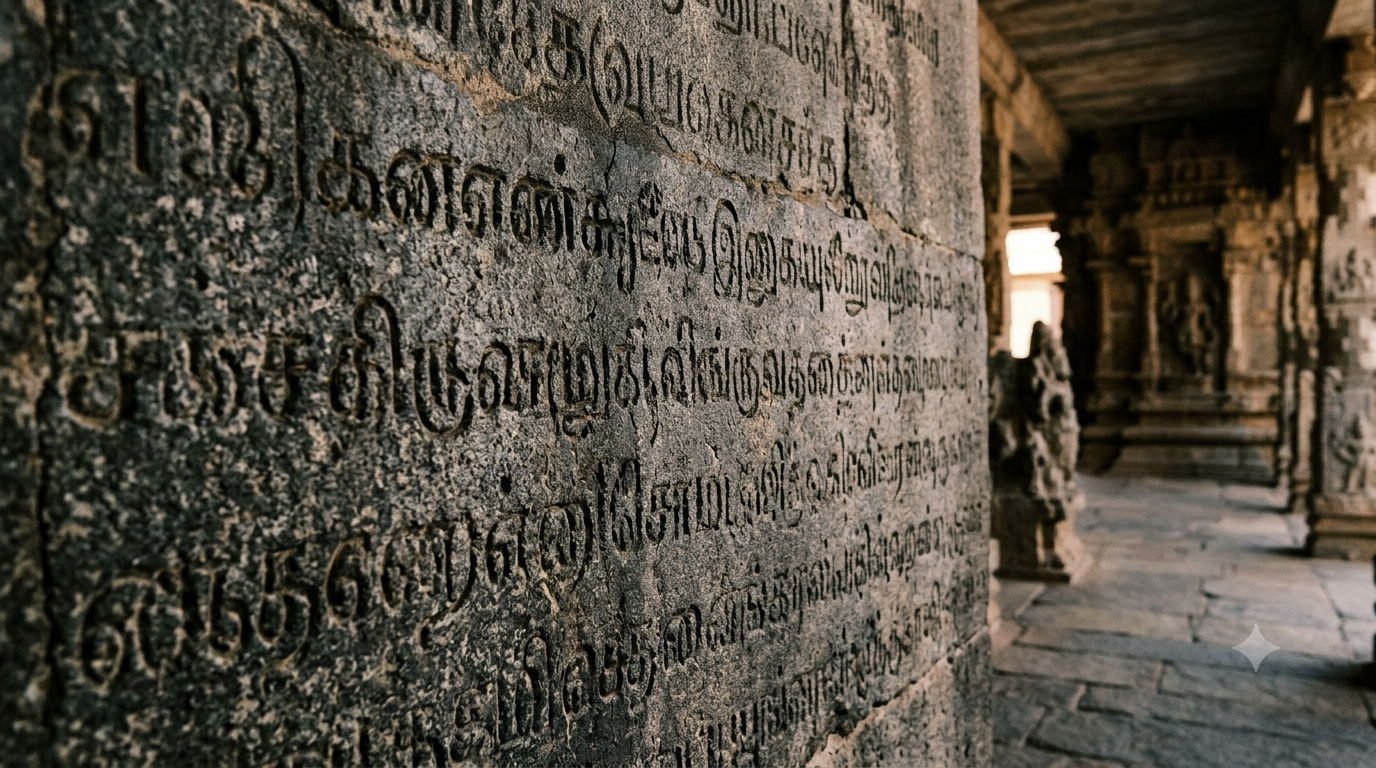
Temple inscriptions of India record how people funded shrines, managed land, honoured deities and remembered rulers. A few lines on a wall can reveal more than a royal name: they may identify a donor, record a field boundary or explain how a lamp received its daily supply of oil. Reading those lines requires care because not every ancient Indian inscription belongs to a temple.
Independent heritage guide: Temples Map is not affiliated with the Archaeological Survey of India or any temple authority. We do not arrange visits, bookings or payments. Please use official sources for site access and research permissions.
Temple inscriptions of India at a glance
- What they are: Texts carved on temple walls, pillars, steps, images and nearby stone slabs.
- What they record: Donations, land grants, worship arrangements, official orders and local people.
- Key distinction: Ashoka’s third-century BCE edicts are early Indian inscriptions, not temple donation records.
- Main challenge: The language, script and date must each be identified separately.
- Research starting point: The Archaeological Survey of India’s Epigraphy Branch and BharatSHRI repository.
What are temple inscriptions?
Temple inscriptions are written records placed on or around sacred buildings, usually by carving letters into stone. For example, some document a gift to a deity or shrine. Others set out administrative decisions, repairs, rituals or the names of people involved in temple life.
The temple inscriptions of India were not merely decorative. A stone record could preserve the terms of an endowment when future administrators needed to know its purpose. Yet an inscription does not tell us everything about the society around it. Instead, it gives the viewpoint of those who commissioned or recorded the text.
The Archaeological Survey of India (ASI) Epigraphy Branch distinguishes temple-wall records from copper-plate charters and Ashokan edicts. That distinction matters because their dates, settings and purposes differ.
A short chronology: edicts, caves and temple walls
The temple inscriptions of India belong to a longer history of writing, which did not begin with medieval shrines. Earlier evidence comes from several settings, including rock surfaces, pillars, caves and metal objects. These categories should not be combined into one claim about the oldest temple inscription.
| Broad period | Inscriptional setting | Why it matters |
|---|---|---|
| Indus civilisation | Signs on seals and objects | The writing remains undeciphered; it is not a set of readable temple records. |
| Third century BCE | Ashokan rocks and pillars | Edicts describe royal policies and dhamma, not medieval temple endowments. |
| Early historic South India | Tamil-Brahmi cave records | Some name donors and gifts associated with ascetic communities. |
| Early medieval period onward | Temple walls, pillars and slabs | Many records explain worship, gifts, grants and temple administration. |
| Chola and later kingdoms | Extensive temple and copper-plate records | Detailed entries help historians reconstruct institutional and local history. |
Why Ashoka’s edicts are not the oldest temple inscriptions
Ashoka’s edicts date to the third century BCE and form a major body of early decipherable Indian inscriptions. The ASI explains that they appear in several languages and scripts across the Mauryan world. Their central purpose differs from the grants and ritual records that later temples preserved.
The Indus signs are older, but scholars have not securely deciphered them. Meanwhile, Tamil-Brahmi cave inscriptions belong to another important strand of epigraphy. A claim that one of these groups is the first temple inscription confuses the type of record with the age of writing.
Is there one agreed oldest temple inscription in India?
There is no reliable single answer without defining the structure, religious tradition and kind of inscription involved. An early cave record is not automatically a temple-wall record. Likewise, the date of an inscription need not be the date when a shrine was first built.
Some summaries name Udayagiri and Pallava records as the oldest temple examples without identifying a specific inscription. That is not enough evidence for a reliable ranking. For a particular inscription, consult its published edition and archaeological context before assigning a date or a superlative.
How scholars decode temple inscriptions of India
Epigraphy helps scholars read the temple inscriptions of India through careful study and interpretation. Reading a record involves more than recognising a few letters because scripts changed over time. The reader must also understand the language, the original wording and the historical setting.
- Record the location. Note the monument, wall or pillar and nearby features. Context then helps connect the text to a building phase.
- Document the surface. Specialists use careful photography and, when authorised, an estampage or paper impression to capture letter shapes.
- Identify the script. Compare letter forms with dated examples. A script name does not, by itself, identify the language.
- Transcribe the text. Copy each visible sign and mark gaps. Damaged letters should not become certain words through guesswork.
- Translate and date. Examine names, titles, regnal years and any calendar information. Then test the reading against other evidence.
- Publish the evidence. A usable edition should distinguish the original reading from translation and commentary.
The ASI describes survey, photography, estampage preparation, transcription and digital archiving in its inscription documentation overview. Visitors should never make their own rubbings, apply chalk or touch fragile lettering. Such actions can damage a surface.
Scripts and languages are not the same thing
To interpret the temple inscriptions of India, first separate their languages from their scripts. A script is the set of letter forms used for writing. A language is the system of words and grammar expressed through those letters. Confusing them can lead to false claims about the people who made a record.
Tamil-Brahmi, Tamil and Grantha
Tamil-Brahmi appears in early South Indian inscriptions, including cave records. Later South Indian epigraphy includes Tamil, Vatteluttu and Grantha letter forms. Grantha was especially useful for writing Sanskrit, while Tamil records used Tamil scripts in changing historical forms.
Some inscriptions use more than one script or language. Therefore, a Sanskrit passage need not be written in modern Devanagari. The Tamil Nadu Department of Archaeology provides a regional introduction to epigraphic research.
Kannada, Telugu and the changing northern scripts
Early Kannada and Telugu epigraphy developed through related South Indian script traditions before their familiar modern shapes emerged. Their history also predates the Vijayanagara period. As a result, attributing these writing traditions only to Vijayanagara would be misleading.
North India used Brahmi-derived scripts that developed into regional forms. Nagari, Sharada and eastern varieties belonged to different places and periods. Devanagari is important today, but it was not the single script of every ancient northern temple.
What temple inscriptions of India reveal about daily life
The temple inscriptions of India show that shrines could also be centres of work and resource management. Inscriptions help explain these roles with named people and recorded obligations. They also reveal how rulers and local communities wished their actions to be remembered. Since patrons chose what to record, silence can be as revealing as praise.
| Topic | Typical record | What historians can ask |
|---|---|---|
| Endowments | Land, money, grain or livestock donated | Who supported worship, and under what terms? |
| Rituals | Oil for lamps, offerings and festival duties | Which practices had ongoing support? |
| Administration | Boundaries, taxes and local officers | How were resources recorded and managed? |
| People | Rulers, women donors and specialists | Whose names appear in the surviving record? |
| Language | Titles, place names and changing spellings | How did local vocabulary and script evolve? |
The limits matter too. A grant may report an intended arrangement rather than prove that payments continued for centuries. Praise of a king is not neutral political history. Historians therefore compare inscriptions with other records and with the archaeology of the site.
Examples: Chola temples, Khajuraho and Hampi
Thanjavur: inscriptions and Chola administration
Among the temple inscriptions of India, the Chola-period records at Brihadisvara Temple in Thanjavur stand out. They help historians understand royal patronage and the organisation of a major shrine. UNESCO identifies Rajaraja I as its royal patron and places consecration in his 25th regnal year, around 1009–1010 CE.
Such records can illuminate gifts, service and the arrangements supporting temple worship. Still, avoid treating every inscription as a modern payroll or a complete list of workers. Read the individual record before making that claim. See UNESCO’s Great Living Chola Temples account for the monument’s wider context.
North and central India: different temple traditions
Khajuraho preserves remarkable Chandella-period temples of Hindu and Jain traditions. UNESCO dates the principal building phase to the tenth and eleventh centuries. However, architecture alone does not prove that a particular inscription names its sculptor or records a project’s full construction cost.
Hampi, by contrast, belongs chiefly to the Vijayanagara capital’s surviving sacred and urban landscape. Its temples and public spaces need study alongside the empire’s records. The UNESCO Hampi description explains the site’s wider historical setting.
What do the names of artisans tell us?
When an inscription names a builder, craftsperson or donor, it offers rare personal evidence. Yet many surviving records celebrate patrons more prominently than the hands that made the art. That imbalance should shape how we tell the story.
For background on the skills behind sacred buildings and objects, read our guide to temple artisans of India. It gives useful context, although it cannot replace an inscription’s original wording.
Digital preservation: what is actually documented?
The temple inscriptions of India have entered a new stage of documentation. The ASI operates BharatSHRI, the Bharat Shared Repository of Inscriptions, to preserve and provide digital access to records. Its official description identifies the digitisation of estampages held by the Directorate of Epigraphy in Mysuru. It also describes work to re-copy damaged or missing impressions.
BharatSHRI documents a specific kind of preservation work: copying and digitising inscription impressions. That does not establish any particular AI reconstruction project or a wider LiDAR programme. Claims about those technologies need separate project reports before readers can treat them as verified.
Digital images make collections easier to study, but they do not automatically reconstruct missing words. Even so, researchers still need original context, expert readings and a clear record of uncertain letters. For related technology themes, our article on modern innovations in Indian temples offers broader background.
How to study temple inscriptions of India as a visitor
Visitors can sometimes see inscriptions on exposed pillars, walls or slabs. Visibility varies with the site, ongoing worship, conservation work and access rules. So check access before travelling. Do not assume that a monument has a dedicated inscription gallery or that every inscribed surface is open to the public.
- Read the official monument information before travelling, since permitted areas and opening arrangements may change.
- Look for existing interpretation boards, but do not count on a translation beside every inscription.
- Use photos only where site rules permit them. Avoid flash, contact or tracing on fragile stone.
- Compare a published transcription with the visible letters, rather than trying to guess damaged words.
- If access is restricted, study official photographs or published epigraphic editions instead.
For the wider practical context of temple travel, see our Andhra Pradesh temple tourism overview. It is background reading, not a current statement of inscription access or visitor facilities.
Where can you find reliable inscription records?
Begin with the institution that documents the object. The BharatSHRI project page explains what the ASI is digitising. The Epigraphy Branch’s historical overview also explains broad periods, scripts and record types.
State archaeology departments publish regional material, while specialist editions give the original text and scholarly notes. Also look for the exact findspot, language, script and edition reference. A photograph without these details may be interesting, but it is weak evidence for a precise historical claim. Therefore, consult the original record when possible.
Always distinguish the inscription’s own words from a modern editor’s translation. If the stone is damaged, compare readings rather than choosing the most dramatic reconstruction. That habit makes both heritage writing and visitor interpretation more reliable.
Why these records deserve careful protection
The temple inscriptions of India can preserve names and local details absent from other sources, even when the stone has weathered. Damage through scraping, paint or careless repair can therefore erase evidence permanently. The ASI specifically warns about losses through displacement, whitewashing and misuse.
Preservation also requires intellectual care. A royal boast needs context, and a damaged date needs an honest question mark. Instead, the most useful heritage guide does not turn uncertainty into an invented story. It helps people see why the surviving words matter.
Frequently asked questions
What is the difference between epigraphy and archaeology?
Epigraphy focuses on inscriptions, their scripts and their meaning. Archaeology studies material remains more broadly, including buildings, objects and the layers in which they appear. Together, these approaches can produce a stronger account of a site.
Are Ashoka’s edicts temple inscriptions?
No. Ashoka’s third-century BCE edicts are royal inscriptions on rocks and pillars, not the same category as later temple grants. They remain essential to Indian epigraphy because they preserve early decipherable texts.
Which is the oldest temple inscription in India?
There is no dependable single answer without a clear definition and a cited inscription. Early cave records, Ashokan edicts and inscriptions on temple buildings have different histories. A published archaeological edition is the best starting point for a specific claim.
Were all ancient temple inscriptions written in Sanskrit?
No. Temple and related records appear in Tamil, Kannada, Telugu, Sanskrit and other languages. Scripts also differ across regions and centuries, so script and language must be checked separately.
What is a copper-plate inscription?
It is a text engraved on a metal plate, often as part of a legal or royal charter. Some copper-plate sets record land grants, while temple walls often preserve other kinds of gifts and local orders. The two forms overlap in subject but differ in material.
Can visitors see inscriptions at Thanjavur, Hampi or Konark?
Some inscribed surfaces may be visible, but public access and interpretation vary. There is no basis for promising dedicated inscription panels at all three sites. Check the managing authority’s current visitor information before a trip.
Does artificial intelligence automatically restore unreadable inscriptions?
No. Digital tools can help document and compare images, but a proposed reading still needs expert review. A claimed restoration project needs a named primary source and published methods before readers can treat its results as fact.
Where can I find authentic translations of temple inscriptions?
Start with ASI publications, state archaeology material and scholarly editions that identify the original record. BharatSHRI provides a route into digitised inscription evidence, although coverage and supporting material may vary. Prefer a documented transcription over an unattributed translation online.