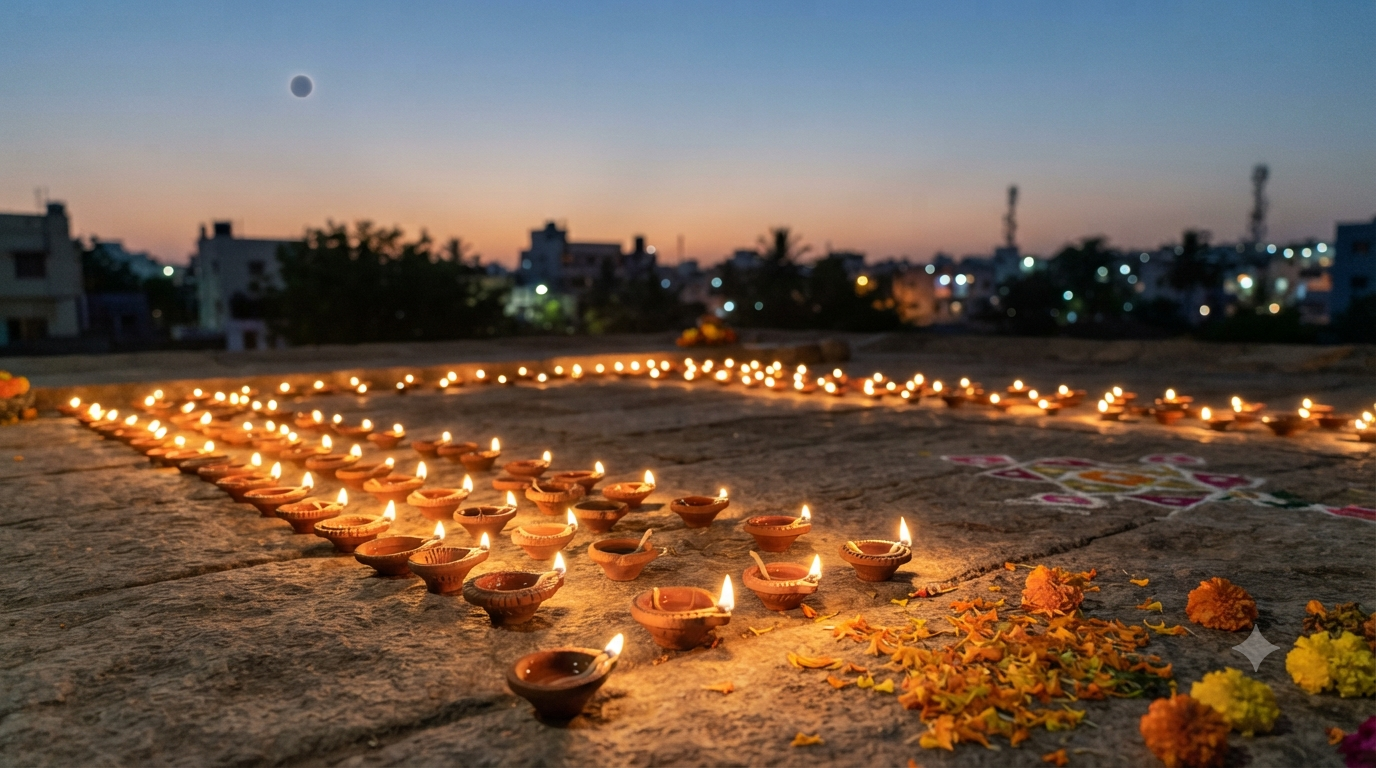
Surya Grahan 2026 India is not a Deepavali-day event: India will not see either solar eclipse of 2026, while Deepavali falls on Sunday, 8 November 2026. The confusion comes from 2022, when a partial solar eclipse followed Deepavali by one day and was visible from much of India.
Temples Map is an independent festival and temple guide. We are not affiliated with any temple, trust, government body, or panchang publisher, and we do not accept bookings, pooja reservations, donations, or payments.
Surya Grahan 2026 India: Quick Answer
The short answer is simple: there is no solar eclipse on Deepavali in 2026, and neither of the year’s two solar eclipses is visible from India. Deepavali falls on 8 November 2026. The solar eclipses occur much earlier, on 17 February and 12 August.
- Deepavali 2026: Sunday, 8 November 2026.
- First solar eclipse: 17 February 2026, annular, not visible from India.
- Second solar eclipse: 12 August 2026, total, not visible from India.
- Diwali eclipse: None in 2026.
- Sutak in India: Under the common Hindu practice tied to local eclipse visibility, no Sutak applies for these 2026 solar eclipses in India.
NASA lists two solar eclipses in 2026, while the Government of India holiday calendar and the Rashtriya Panchang place Deepavali on 8 November. Those dates are months apart, so the old 2022 eclipse situation does not repeat this year.
Deepavali 2026 Date and the Eclipse Question
Deepavali 2026 falls on Sunday, 8 November in India. The Government of India calendar for Central Government offices in Delhi lists Diwali on that date. The Rashtriya Panchang published through the India Meteorological Department also marks Dipavali and Lakshmi Puja on 8 November.
The Amavasya phase starts late in the morning on 8 November and continues into 9 November. Drik Panchang gives the interval at roughly 11:27 AM on 8 November to 12:31 PM on 9 November, with tiny rounding differences possible between almanacs.
| Event | Date | What it means |
|---|---|---|
| Deepavali / Lakshmi Puja | 8 Nov 2026 | Main festival evening in India |
| Annular solar eclipse | 17 Feb 2026 | Not visible from India |
| Total solar eclipse | 12 Aug 2026 | Not visible from India |
South Indian families may place more emphasis on Naraka Chaturdashi and the pre-dawn oil bath. In 2026, that observance and the evening Deepavali worship fall on the same civil date in many South Indian calendars.
Surya Grahan 2026 India Dates and Visibility
For anyone checking Surya Grahan 2026 India, the key point is visibility. NASA records an annular solar eclipse on 17 February and a total solar eclipse on 12 August. Neither eclipse path crosses India.
| Date | Eclipse type | Visible from India? | Main visibility |
|---|---|---|---|
| 17 Feb 2026 | Annular solar eclipse | No | Antarctica; partial phases across parts of southern South America, southern Africa and surrounding regions |
| 12 Aug 2026 | Total solar eclipse | No | Greenland, Iceland, northern Russia, Spain and a small part of Portugal; partial phases across other northern regions |
The NASA eclipse catalogue for 2026 confirms both dates. NASA’s 12 August eclipse page maps totality across Greenland, Iceland, northern Russia and Spain. Timeanddate’s India eclipse page also states that the 12 August event cannot be seen from India.
This distinction matters because global eclipse times are sometimes copied into Indian articles. A worldwide eclipse can be underway while the Sun is below the horizon or the shadow misses India entirely. Global timings are therefore not Indian viewing timings.
Why Visibility Matters for Surya Grahan 2026 India
Surya Grahan 2026 India should always be checked against an India visibility map, not only a worldwide eclipse calendar. The date alone does not tell you what can be seen from your city. Location decides that.
The February eclipse stays far south of India. The August shadow also misses the country. Therefore, neither event creates a local solar-eclipse viewing period in India.
This makes Surya Grahan 2026 India different from 2022. In that year, the 25 October partial eclipse crossed the Indian evening sky. In 2026, the correct planning advice is much simpler. Keep Deepavali and eclipse planning separate.
Does Surya Grahan 2026 India Affect Deepavali?
No. Surya Grahan 2026 India does not affect Deepavali 2026 because the nearest solar eclipse is on 12 August, almost three months before the festival. Deepavali arrives on 8 November, with no solar eclipse that day or the following day.
That also means there is no eclipse-based reason to shift Lakshmi Puja, close a home shrine, delay the evening lamps, or move Deepavali worship in India. Follow the normal local panchang for the festival instead.
Some families use stricter inherited rules around eclipses and Sutak. If your household follows a specific sampradaya, follow that family practice. The astronomical fact remains unchanged: no 2026 solar eclipse is visible from India, and none coincides with Deepavali.
Deepavali 2026 Lakshmi Puja Date and Timings
Lakshmi Puja is observed on the evening of Sunday, 8 November 2026, while Amavasya is in force. The preferred muhurat changes by city because local sunset and the fixed-lagna window change with longitude and latitude.
The table below uses city-specific timings published by Drik Panchang. Use it as a planning reference, then confirm your city before fixing a family ceremony.
| City | Lakshmi Puja Muhurat | Date |
|---|---|---|
| New Delhi | 5:54 PM to 7:50 PM | 8 Nov |
| Mumbai | 6:27 PM to 8:27 PM | 8 Nov |
| Hyderabad | 6:07 PM to 8:08 PM | 8 Nov |
| Chennai | 6:07 PM to 8:09 PM | 8 Nov |
| Bengaluru | 6:17 PM to 8:20 PM | 8 Nov |
| Kolkata | 5:20 PM to 7:18 PM | 8 Nov |
Why does the puja time change by city?
Pradosh Kaal begins after local sunset, so the clock time shifts across India. A single all-India muhurat copied from Delhi or Mumbai can therefore be wrong for another city.
If your family follows a temple calendar or inherited Telugu, Tamil, Kannada, Marathi, Gujarati, or North Indian panchang, use that tradition first. Regional practice can differ even when the civil date is the same.
Simple Lakshmi-Ganesha Puja Vidhi at Home
There is no single household puja sequence followed across India. Still, many families use a simple Lakshmi-Ganesha worship order during the Deepavali evening. Treat the steps below as a general devotional outline rather than a substitute for your family tradition.
- Prepare the puja area. Clean the space before sunset, place a fresh cloth, and arrange lamps safely away from curtains or loose decorations.
- Set the deities or images. Place Lakshmi and Ganesha images or murtis according to your household custom. Add a kalash only if it is part of your normal practice.
- Light the lamp. Use a stable diya or lamp, then begin with Ganesha prayer before Lakshmi worship if that is your family sequence.
- Offer simple items. Flowers, fruit, sweets, kumkum, turmeric and akshata are common offerings. Keep the list simple when you do not have a prescribed vrata procedure.
- Recite prayers. Chant the stotras, names or mantras your family already uses. Devotional benefit claims belong to faith and tradition, not measurable guarantees.
- Complete with arati. After the prayers, perform arati and share the offered food as prasadam.
If you observe a Telugu household nomu, see our Deepavali Nomulu 2026 guide. For the early-morning observance, our Naraka Chaturdashi 2026 timings explain the Telugu muhurtham separately.
What the Old 2022 Article Got Wrong
The original version of this page contained two important factual errors. It said the 2022 solar eclipse fell on 24 October, and it also said India would not be able to see it. Both statements need correction.
The partial solar eclipse occurred on 25 October 2022. It was visible from many parts of India, including Delhi, Gujarat, Maharashtra, Karnataka, Telangana, Tamil Nadu and parts of Andhra Pradesh. Timeanddate’s archived India map places the country’s partial phase between about 4:12 PM and 6:23 PM IST, depending on location.
Deepavali itself was observed on 24 October 2022, so the eclipse came the next day. That historical coincidence is probably why old search results still connect “Deepavali” and “Surya Grahan.” The 2026 calendar does not repeat it.
Surya Grahan 2026 India Sutak Kaal: What Should Families Follow?
Under a widely followed Hindu rule, Sutak is observed only when an eclipse is visible at the observer’s location. Since neither 2026 solar eclipse is visible from India, many panchangs list no solar-eclipse Sutak for Indian cities this year.
Sutak is a religious observance, not an astronomy safety rule. Family customs can differ, so a household that follows a specific guru, temple calendar, or regional panchang may choose a different practice.
For Surya Grahan 2026 India, do not use a foreign city’s Sutak clock as an Indian one. An eclipse may be visible in Spain or Iceland while remaining completely unobservable from India.
Surya Grahan 2026 India: Solar Eclipse Eye Safety
India cannot see the 2026 solar eclipses, but travellers may encounter the 12 August eclipse abroad. Never look directly at a partial or annular Sun with ordinary sunglasses. NASA says safe solar viewers should comply with the ISO 12312-2 international standard.
Cameras, binoculars and telescopes need special solar filters mounted on the front of the optics. Eclipse glasses alone do not make magnified viewing safe. NASA also recommends indirect methods, such as a pinhole projector, when proper solar viewers are unavailable.
Read NASA’s eclipse viewing safety guidance before observing any solar eclipse. Eye safety is separate from religious practice and applies regardless of whether someone observes Sutak.
Planning the Days Around Deepavali 2026
The 2026 festival calendar has an unusual gap after Deepavali because Amavasya continues into 9 November. Some regional calendars therefore place Govardhan Puja on 9 November, while others place it on 10 November based on the local Pratipada rule. Check your own panchang instead of assuming a five-day graphic applies everywhere.
For Telugu readers, Karthika Masam begins after the Deepavali Amavasya clears. Our Karthika Masam 2026 dates for Andhra Pradesh explain why the month begins on 10 November and list the four Karthika Somavarams.
This is also why a single “Diwali week” chart can be misleading. Dhanteras, Naraka Chaturdashi, Lakshmi Puja, Govardhan Puja and Bhai Dooj follow tithi rules, so some observances can share a date or leave a gap.
Surya Grahan 2026 India: Final Planning Notes
For Surya Grahan 2026 India, remember three facts. India will not see either solar eclipse in 2026, Deepavali falls on Sunday, 8 November, and no solar eclipse coincides with the festival.
Use a city-specific panchang for Lakshmi Puja because the evening muhurat changes by location. If you are travelling abroad to watch an eclipse, use proper solar eye protection and follow the local visibility map.
Most importantly, do not reuse the 2022 eclipse story for 2026. The dates, visibility and Sutak situation are completely different.
Frequently Asked Questions
Is there a Surya Grahan on Diwali 2026?
No. Deepavali falls on 8 November 2026, while the year’s solar eclipses occur on 17 February and 12 August. There is no solar eclipse on Deepavali or the following day.
Will any solar eclipse be visible in India in 2026?
No. NASA lists two solar eclipses in 2026, but neither is visible from India. The 17 February eclipse is annular, while the 12 August eclipse is total along a path through parts of the North Atlantic and Europe.
What is the Deepavali 2026 date in India?
Deepavali falls on Sunday, 8 November 2026 in India. The Government of India holiday calendar and the Rashtriya Panchang both place Diwali on that date.
What time is Lakshmi Puja on Deepavali 2026?
The exact time depends on your city. For example, Drik Panchang lists 6:07 PM to 8:08 PM for Hyderabad and 5:54 PM to 7:50 PM for New Delhi. Always confirm your own location before fixing the ceremony.
Does Sutak apply in India for the 12 August 2026 solar eclipse?
Under the common visibility-based Hindu practice, Sutak does not apply when the eclipse is not visible locally. Since the 12 August eclipse cannot be seen from India, many Indian panchangs do not apply Sutak for it. Family traditions can still differ.
Why do old pages connect Deepavali and Surya Grahan?
The connection mainly comes from 2022. Deepavali fell on 24 October that year, and a partial solar eclipse followed on 25 October. Unlike 2026, that eclipse was visible from many parts of India.
Can I use normal sunglasses to watch a solar eclipse?
No. Ordinary sunglasses are not safe for direct solar viewing. NASA recommends compliant eclipse glasses or handheld solar viewers for partial phases, while cameras and telescopes require properly fitted solar filters.