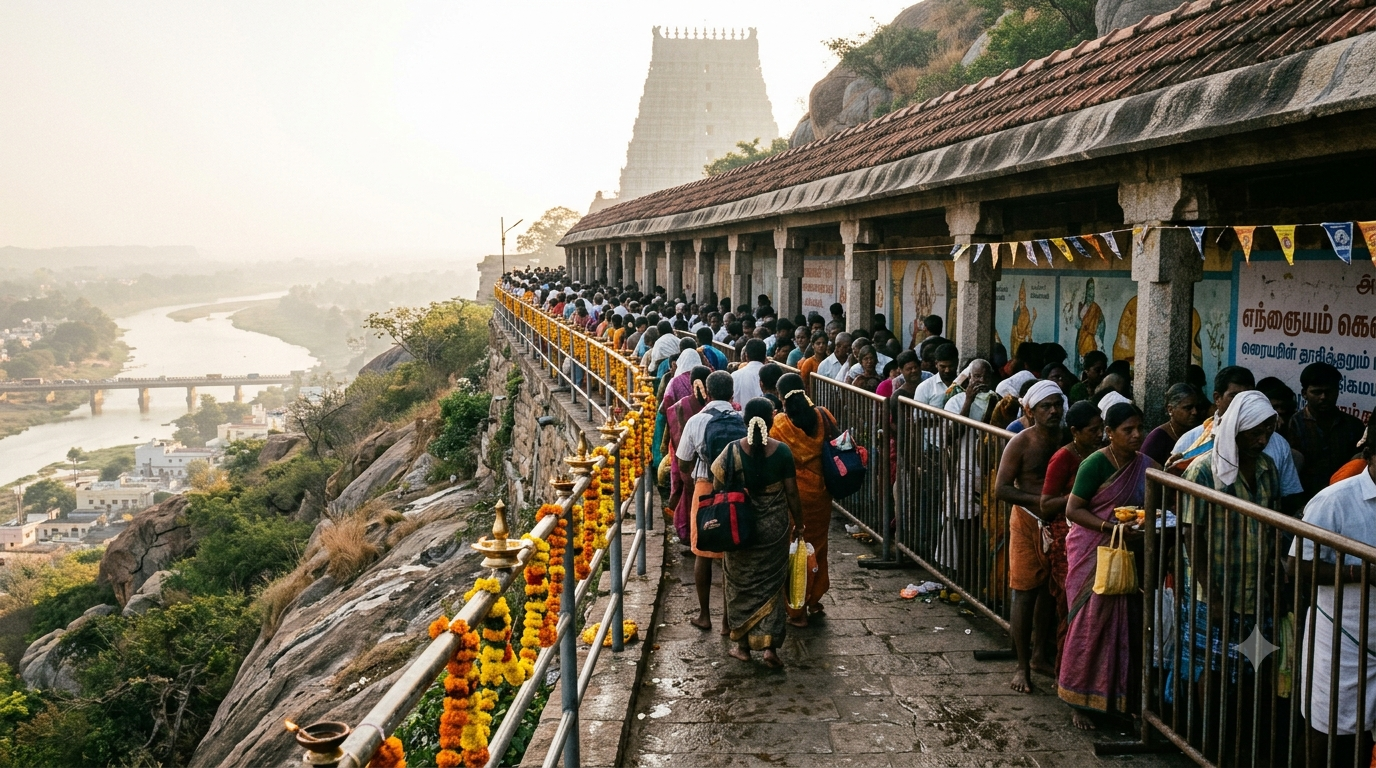
Kanaka Durga Temple Navaratri falls almost three weeks later than usual this year, and that one shift is already wrecking travel plans. Sharannavaratri at Indrakeeladri begins on Sunday, 11 October 2026. Vijayadashami lands on Tuesday, 20 October 2026. Several popular pages still show 22 September to 2 October, because they copied the 2025 calendar forward without recomputing the tithis.
Temples Map is an independent guide. We are not affiliated with, endorsed by, or the official website of Sri Durga Malleswara Swamy Varla Devasthanam. We do not accept bookings, donations or payments of any kind. For tickets, sevas and confirmed timings, use the official temple portal linked further down this page.
- Festival window: 11 October to 21 October 2026, since the temple runs an eleven-day Sarannavaratri Mahotsavam.
- Day 1, Kalasa Sthapana: Sunday, 11 October 2026, on Ashwayuja Shuddha Padyami.
- Moola Nakshatram window: from 16 October morning until 17 October morning.
- Vijayadashami: Tuesday, 20 October 2026.
- Hamsa Vahana Theppotsavam: on Vijayadashami evening, on the Krishna river.
- Temple: Sri Durga Malleswara Swamy Varla Devasthanam, Indrakeeladri, Vijayawada 520001.
- Official portal: kanakadurgamma.org.
Kanaka Durga Temple Navaratri 2026 begins on Sunday, 11 October and ends with Vijayadashami on Tuesday, 20 October 2026. The devasthanam observes an eleven-day Sarannavaratri Mahotsavam, so temple listings run the calendar through 21 October. Ashwayuja Shuddha Padyami, the tithi that opens the festival, stays active on the morning of 11 October.
| Event | Day | Date in 2026 |
|---|---|---|
| Mahalaya Amavasya, the day before | Saturday | 10 October. |
| Festival opening on Padyami | Sunday | 11 October. |
| Moola Nakshatram begins | Friday | 16 October. |
| Moola Nakshatram ends mid-morning | Saturday | 17 October. |
| Durgashtami in North Indian reckoning | Sunday | 18 October. |
| Ashtami and Mahanavami together | Monday | 19 October. |
| Vijayadashami | Tuesday | 20 October. |
Because the tithis behave oddly this year, two days in the middle share one label. Saptami stretches across both 17 and 18 October, since it covers two consecutive sunrises. Ashtami then ends around mid-morning on 19 October, so Navami starts the same day.
Devotees ask this every year, and almost no page answers it properly. Dasara follows the lunar month of Ashwayuja rather than the Gregorian calendar. Its date therefore drifts backwards by roughly eleven days each year. When that drift grows too large, the Hindu calendar inserts an extra lunar month to realign the two systems.
That correction is exactly what pushed Kanaka Durga Temple Navaratri so late this year. In 2025 the temple celebrated Dasara from 22 September to 2 October. In 2026 the same tithis land on 11 to 20 October. The jump runs to nearly three weeks instead of the usual small slide.
The Wrong Dates Still Circulating Online
Several widely shared guides currently list “Dasara Navaratri 2026: September 22 to October 2” for Indrakeeladri. Those are last year’s dates with the year swapped. If you plan around them, you will reach Vijayawada nineteen days before the festival even opens.
The check takes a minute, so do it before you book anything. Cross-reference any Dasara date against two independent panchangams, such as Drik Panchang and your family almanac. A page that cannot name the tithi beside the English date has probably copied it from elsewhere.
The day-wise schedule of Kanaka Durga Temple Navaratri 2026 follows the tithis below. Each morning opens with abhishekam and alankaram before the queues start moving. The goddess then appears in a different form every day until Vijayadashami. Treat the tithi column as the fixed anchor, because English dates can slip by a day in some almanacs.
| Date | Tithi | What happens |
|---|---|---|
| 11 October | Shuddha Padyami | Kalasa Sthapana, and the festival opens. |
| 12 October | Vidiya | Second-day alankaram. |
| 13 October | Thadiya | Third-day alankaram, a calm weekday. |
| 14 October | Chaviti | Fourth-day alankaram, also quieter. |
| 15 October | Panchami | Fifth-day alankaram. |
| 16 October | Shashti | Moola Nakshatram begins in the morning. |
| 17 October | Saptami | Saraswati alankaram day, when Moola ends. |
| 18 October | Saptami continues | Durgashtami in the North Indian reckoning. |
| 19 October | Ashtami into Navami | Mahanavami, the heaviest single-day rush. |
| 20 October | Dashami | Vijayadashami and the Theppotsavam. |
How the Alankaram List Actually Works
Here is the detail that most reprinted schedules get wrong. The alankaram order at Indrakeeladri is not a fixed calendar that repeats identically every year. The devasthanam publishes a fresh day-wise list a few weeks before the festival, and it arranges the sequence around the tithis and Moola Nakshatram.
Compare two recent years and the point becomes obvious. In some years Swarna Kavachalankruta Durga Devi opens the festival, while in others Bala Tripura Sundari takes the first day. Rare alankarams such as Sri Katyayani Devi and Sri Maha Chandi Devi appear only when the tithis allow it.
The Forms Devotees Can Expect
Although the running order changes, the core roster stays stable. Across the eleven days the goddess usually appears as Bala Tripura Sundari, Gayatri Devi, Annapurna Devi, Mahalakshmi and Saraswati. Lalitha Tripura Sundari, Durga Devi, Mahishasura Mardini and Raja Rajeswari Devi complete the sequence. Swarna Kavachalankruta Durga Devi, the golden-armour form, falls on one of the opening days.
Prasadam changes with the alankaram too, so the offering gives you a clue on the day. Counters distribute pulihora, chakra pongali and laddu right through the festival. Do not treat any prasadam list you find online as final, since the devasthanam revises it annually.
Moola Nakshatram draws the biggest single crowd of the festival. Families bring children for aksharabhyasam, while students come for Saraswati’s blessings. In 2026 the Moola window runs from roughly 6:47 AM on 16 October until roughly 9:47 AM on 17 October. Both dates therefore hold a legitimate claim.
This is where panchangams split. Traditions that fix a nakshatra by sunrise place Moola on 17 October, and reports point to that date for the Saraswati alankaram at Vijayawada. Other calendars, including Sringeri’s, put the Saraswati Avahana on 16 October instead.
So confirm the temple’s own announcement before you travel for this one day. The devasthanam posts the alankaram date on its official portal a few weeks ahead. If you cannot manage both days, choose 17 October and keep 16 October as your fallback.
Hamsa Vahana Theppotsavam on Vijayadashami
The festival closes on 20 October 2026 with the Theppotsavam. Priests carry the utsava idols onto the Krishna river on an illuminated swan-shaped float. Devotees line the Punnami ghat and the Prakasam Barrage road to watch. Arrive early in the afternoon if you want a usable view, since the riverbank fills long before dusk.
Vijayadashami itself brings the Raja Rajeswari alankaram at the hill temple. Many families combine the morning darshan with Ayudha Puja at home. Police also restrict traffic across the barrage that evening, so plan the return leg before you set out.
On ordinary days the temple opens around 4:00 AM and closes around 10:00 PM, with an afternoon break. During Dasara the temple extends those hours and reorganises the queue system entirely. It also restricts or suspends special darshan quotas on peak days, so the usual ticket tiers may not apply.
Ticket categories commonly listed for regular days run from about ₹100 to ₹500 per person. Free Dharma darshan stays available throughout. Treat those figures as indicative only. Confirm current rates, released quota and darshan windows on the official devasthanam portal or the Andhra Pradesh temple management system at tms.ap.gov.in.
What to Do If Slots Are Sold Out
Festival darshan is never guaranteed, and the Mahanavami quota usually clears within hours of release. If online slots have gone, you still have workable options. Free Dharma darshan queues run all festival, although the wait can stretch past four hours on peak days.
- Shift your visit to 12, 13 or 14 October, when crowds thin out sharply.
- Join the free queue very early, before the first heavy wave arrives after sunrise.
- Use the late evening session, which empties after the main alankaram viewing.
- Consider Paroksha Seva on the official portal if you cannot reach Vijayawada at all.
Beware of any site that promises confirmed festival darshan for a fee. The devasthanam and the state portal are the only genuine booking channels. A private page collecting your money or your ID details is a scam.
Vijayawada Junction sits about 4 km from the hill, while Vijayawada International Airport lies roughly 20 km away. Both fill up sharply during Dasara week, so reserve travel well before October. City buses and autos run to the base of Indrakeeladri throughout the festival.
There are two ways up the hill itself. The flight of steps from the Durga Ghat side is the traditional climb. The ghat road carries vehicles and shuttle services instead. Traffic police frequently stop private vehicles on peak days, so check the local advisory before driving up.
Reports commonly cite around one lakh devotees a day at Indrakeeladri during Dasara, and Mahanavami runs heavier still. Long standing queues in October heat are the real physical challenge here, not the climb itself. Carry water, wear cotton, and keep a small snack if you are queuing with children.
If you are elderly, pregnant, or managing a heart or joint condition, use the ghat road rather than the steps. Keep your regular medication in a pocket, because entry points often restrict bags. Anyone observing a full nine-day fast with a medical condition should speak to a doctor first. Navaratri vratam is a matter of faith and tradition, never a substitute for treatment.
Secure phones and valuables in the compression points near the sanctum. Agree on a meeting spot before you enter, as mobile networks struggle under festival load. The temple also offers wheelchair assistance and priority queues for senior citizens and differently-abled devotees.
What Most Dasara Guides Miss
Three practical things rarely make it into the schedule posts. First, the middle weekdays stay genuinely calm, so 13 and 14 October give you a far better darshan than the weekend. Second, the river dip at Durga Ghat peaks between 5 AM and 7 AM.
Third, the evening session shows the alankaram better than the morning rush. Lighting inside the sanctum favours the later hours, and the queue moves at a steadier pace. For everyday visiting hours outside Kanaka Durga Temple Navaratri, see our guide to Kanaka Durga Temple timings.
Devotees performing puja at home can follow the traditional method in our Navaratri Durga pooja vidhanam guide. If you are building a longer itinerary, our places to visit in Vijayawada list pairs well with a Dasara trip. The Ministry of Tourism also lists the festival on its Utsav portal.
Before You Go
The one thing to lock in is October, not September. Kanaka Durga Temple Navaratri opens on 11 October 2026 and closes with Vijayadashami on 20 October 2026. Every travel decision should hang off those two dates. Confirm the alankaram list and the darshan quota on the official portal roughly two weeks ahead, since the temple releases both late.
If you want the calmest experience, aim for 13 or 14 October. If you want the most auspicious, aim for Moola Nakshatram and accept the crowd. Either way, verify the day-wise schedule with the devasthanam rather than with a reprinted list.
Frequently Asked Questions
Kanaka Durga Temple Navaratri 2026 runs from Sunday, 11 October to Tuesday, 20 October. Temple listings extend the eleven-day festival calendar through 21 October. Vijayadashami falls on 20 October 2026. Any page showing September dates for 2026 has simply copied the 2025 calendar.
Why is Dasara so late in 2026?
Dasara follows the lunar month of Ashwayuja rather than the English calendar. The lunar year is shorter, so festivals drift earlier until the calendar inserts an extra month to correct the gap. That correction pushed the 2026 festival from late September into mid-October.
Which day is Moola Nakshatram at Vijayawada in 2026?
The Moola window runs from about 6:47 AM on 16 October to about 9:47 AM on 17 October 2026. Sunrise-based reckoning places the day on 17 October, and reports point to that date for the Saraswati alankaram. Confirm the temple’s own announcement, because panchangams differ here.
Can I book darshan tickets online for Dasara?
Yes, through the official devasthanam portal at kanakadurgamma.org or the Andhra Pradesh temple management system. Festival quotas run out fast and open only a few weeks ahead. Free Dharma darshan needs no booking at all, although the queue is long on peak days.
The temple observes an eleven-day Sarannavaratri Mahotsavam rather than a strict nine days. The extra days come from repeated tithis and the closing Theppotsavam. In 2025 the same festival ran from 22 September to 2 October.
What is the Hamsa Vahana Theppotsavam?
It is the closing float festival on Vijayadashami. Priests carry the processional idols onto the Krishna river on a lit swan-shaped raft. In 2026 it falls on 20 October. Crowds gather along the Punnami ghat from late afternoon.
Is the alankaram order the same every year?
No, and this is the most repeated error online. The devasthanam issues a fresh day-wise alankaram list each year, arranged around the tithis and Moola Nakshatram. Lists from 2022 or 2024 do not map onto the 2026 dates.
For a calm darshan, choose 13 or 14 October, because midweek days draw the smallest crowds. For the most auspicious day, choose Moola Nakshatram around 16 and 17 October. Avoid Mahanavami on 19 October unless you can handle a very long wait.
What should I carry for a Dasara darshan?
Carry water, a light snack, your identity proof and any regular medication. Wear traditional cotton clothing, since the queue is long and October afternoons stay warm. Leave large bags behind, because storage runs short during the festival.